
What are the Layers of Data Lakehouse Architecture
Five layers stand between a lakehouse that scales cleanly and one that quietly turns into an expensive mess.

TL;DR
A data lakehouse combines a data lake's cheap, flexible storage with a data warehouse's schema enforcement and governance, structured across five layers: ingestion, storage, metadata and governance, query, and consumption.
It sits between a warehouse, which governs well but scales expensively, and a lake, which scales cheaply but governs poorly. Skip the layers, and you rebuild the lake's problems on costlier infrastructure.
.png)
Data warehouses gave enterprises structure and query performance, but cost scaled badly with volume, and rigidity made new use cases slow to ship. Data lakes promised a fix: one infinitely scalable store for everything, raw or refined. Instead, governance weakened, quality drifted, and discovery turned into archaeology. The lake stopped being a system of insight and became storage with good intentions.
The data lakehouse emerged from that failure. It layers ACID transactions, schema enforcement, and query performance on top of low-cost object storage, without duplicate pipelines or a forced choice between flexibility and reliability.
[data-expert]
What is a Data Lakehouse
💡The data lakehouse emerged directly from that failure. It layers ACID transactions, schema enforcement, and query performance on top of low-cost, flexible object storage in a single unified system, without duplicate pipelines or having to choose between flexibility and reliability.
[related-1]
What separates a lakehouse that delivers from one that replicates the same governance problems of the lake it replaced isn't the platform you pick. It's how deliberately you design each layer, and each layer has its own failure modes.
Understanding what those layers are and, more importantly, what decisions you make within each is increasingly foundational to any serious enterprise data architecture strategy.
Why Data Lakehouse Architecture Is Defined by Its Layers
A lakehouse is not a single technology but a set of interconnected layers, each responsible for a different aspect of how data is collected, stored, governed, accessed, and consumed.
- Ingestion layer: determines the quality and reliability of data entering the lakehouse, making it the foundation for every downstream workload.
- Storage layer: provides a scalable, shared foundation where all data types can coexist without creating separate systems.
- Metadata and governance layer: gives data meaning, trust, and discoverability, turning stored information into usable enterprise assets.
- API and query layer: separates compute from storage, allowing multiple analytics, ML, and AI workloads to operate on the same data simultaneously.
- Consumption layer: determines how effectively data is delivered as reusable products rather than isolated datasets.
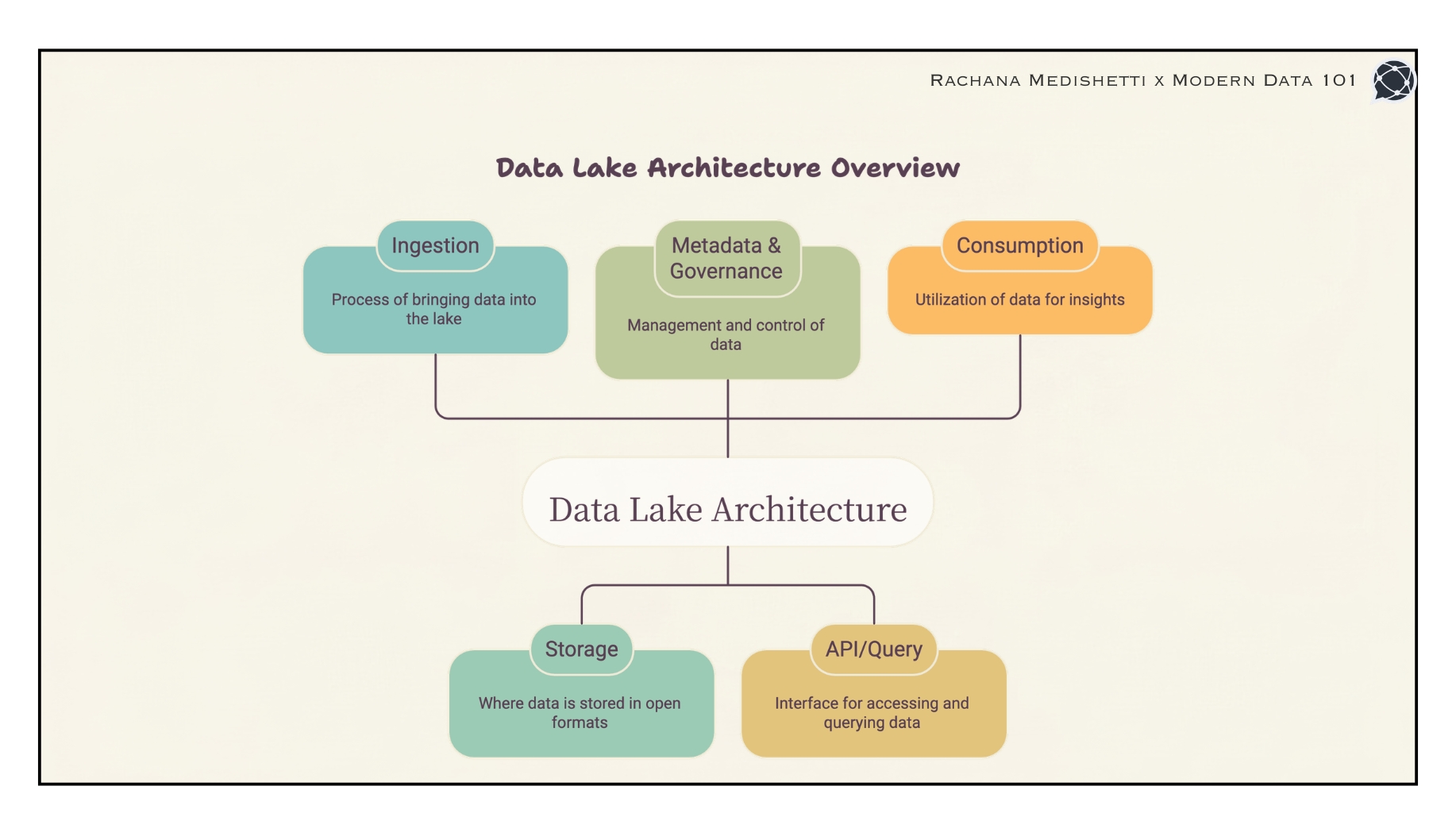
The Five Layers of Data Lakehouse Architecture
1. Ingestion Layer
The ingestion layer is where data enters the system, pulling from structured sources (relational databases, ERP systems), semi-structured sources (APIs, event logs, JSON feeds), and unstructured sources (documents, sensor telemetry, media files). It handles both batch loads and real-time streaming.
What’s underappreciated here is how much downstream quality the ingestion layer determines. Schema inconsistencies, duplicate records, and misaligned timestamps all enter at this stage, and if you’re building pipelines expected to serve production AI applications, they become structurally embedded and expensive to fix later.
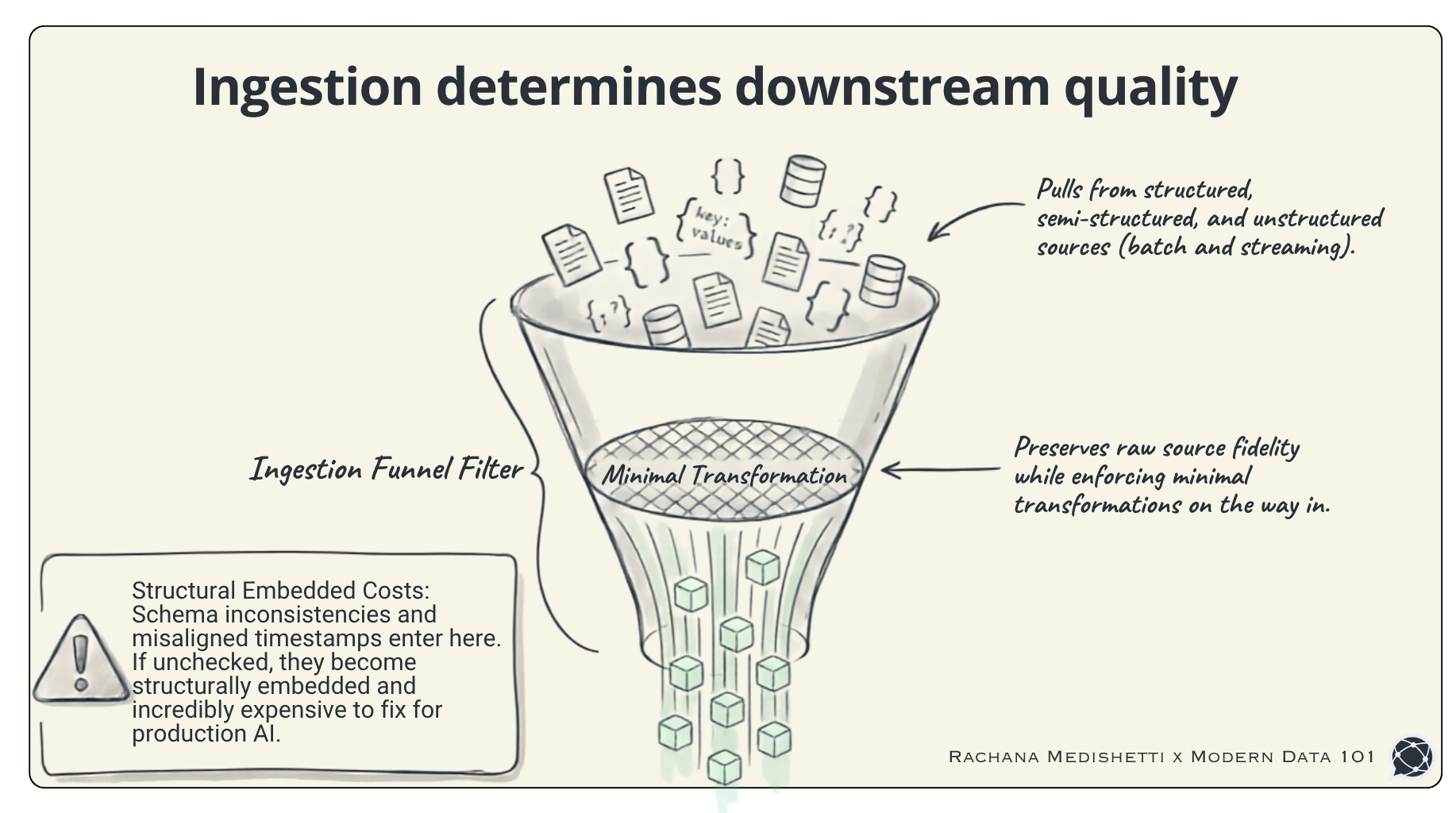
A well-designed ingestion layer preserves raw source fidelity, enforces minimal transformations on the way in, and routes data into appropriately partitioned storage paths.
2. Storage Layer
Cloud object storage (AWS S3, Azure Data Lake Storage Gen2, Google Cloud Storage) forms the physical base of any lakehouse. It’s cheap, durable, and infinitely scalable. But storage alone doesn’t make a lakehouse; what matters is the open table format layered on top of it. Additionally, Delta Lake, Apache Iceberg, and Apache Hudi are what transform a raw object store into something queryable with warehouse semantics.
This is also where the medallion architecture pattern typically lives. The Bronze/Silver/Gold tiering model organises data by quality and describes the data state: raw ingest, cleaned and conformed, and finally curated and domain-aligned.
.png)
[related-2]
Supported file formats at this layer: Parquet (columnar, compression-optimised), ORC, Avro, JSON, and Delta/Iceberg files that bundle both data and metadata.
3. Metadata and Governance Layer
This is the layer that converts storage into an enterprise asset, and historically, the one most organisations underinvest in. The metadata layer manages:
- Schema definitions and versioning: what each table contains, how it’s structured, and how it has changed over time
- Data lineage: where data came from, what transformed it, and where it goes downstream
- Access control policies: column-level, row-level, and tag-based permissions
- Data quality rules: profiling statistics, freshness thresholds, and completeness checks
- Cataloguing and discovery: making assets findable and interpretable by humans and systems alike
.jpg)
As AI adoption grows, this layer becomes increasingly important because AI agents and retrieval-augmented systems need context as well as data. Semantic tags, ownership metadata, and lineage information help make data understandable, trustworthy, and usable by both humans and machines.
[state-of-data-products]
4. API and Query Layer
The query layer is where compute meets storage. Because storage and compute are decoupled in a lakehouse, multiple processing engines can query the same underlying data without moving it: SQL engines, notebooks via PySpark or DataFrames, and REST APIs exposing data to external applications.
.jpg)
This decoupling matters operationally: a BI team querying aggregated Gold-layer data and a data science team running feature engineering jobs on Silver-layer data can operate off the same storage with independent compute clusters, scaled and billed separately.
The open data lakehouse architecture specifically prioritises this interoperability, mixing storage technologies and query engines without being locked into a single vendor’s execution environment.
5. Consumption Layer
The consumption layer is where the lakehouse earns its keep; the interface between the architecture and the people and systems that depend on it.
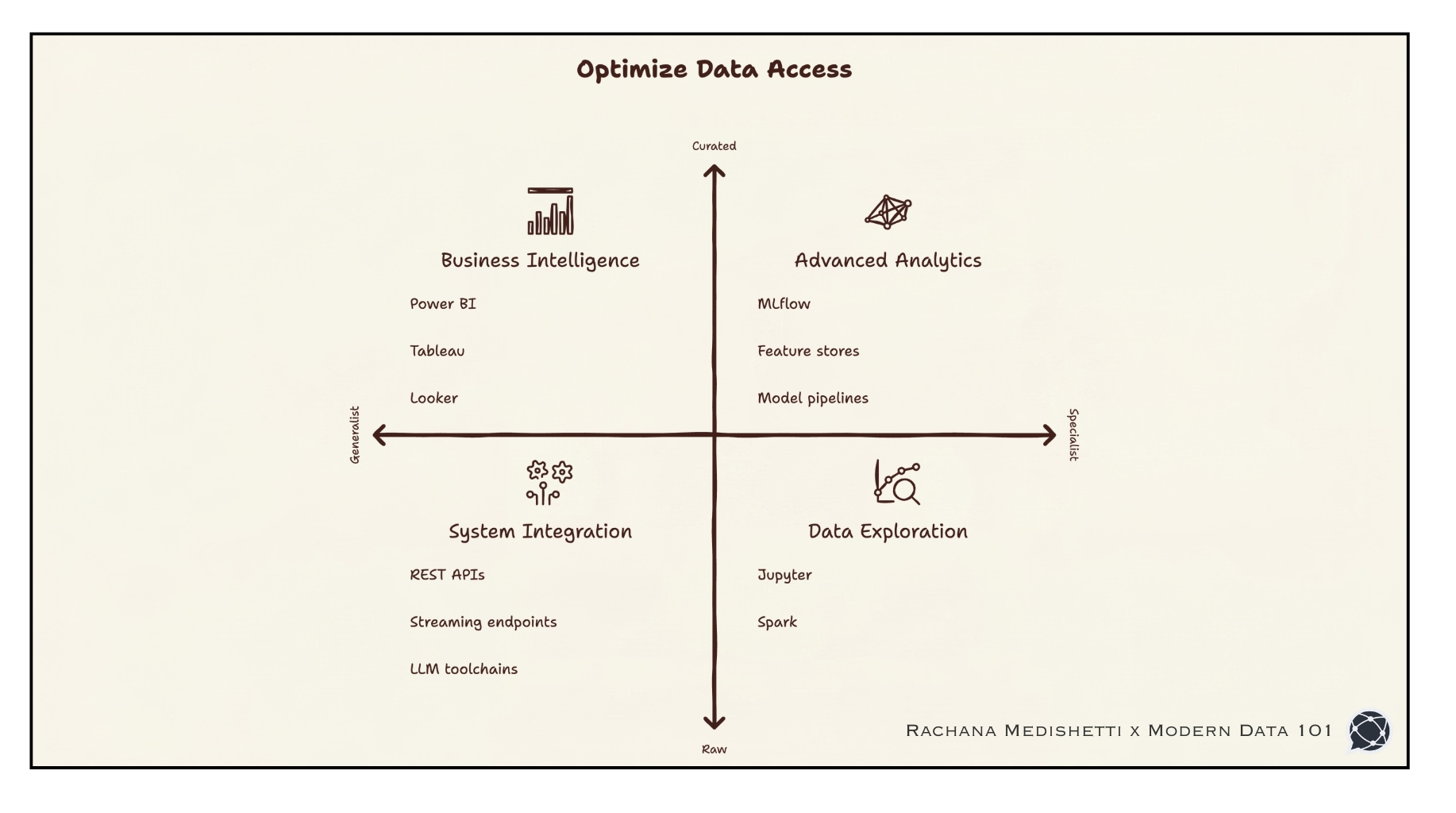
This is where the distinction between a data platform and a data product platform becomes most visible. A well-structured lakehouse surfaces data as governed, semantically rich assets, with defined owners, SLAs, quality contracts, and documented interfaces.
Teams that have invested in product thinking at this layer report dramatically reduced time-to-insight and lower maintenance overhead per use case.
What Makes a Lakehouse Architecture Actually Work
The layers of a data lakehouse architecture aren’t difficult to understand. What’s harder is recognising that the technology is only half the problem. Who owns each layer, who is accountable for quality at each tier, and how data moves from raw ingest to something a downstream team can trust: that’s the organisational half.
Teams that apply data product thinking, treating each layer’s outputs as governed, reusable assets with defined consumers, consistently get more value from the same infrastructure. The architecture gives you the foundation. The product mindset gives you the discipline to build on it.
.jpg)
A lakehouse gives you five layers. A data product turns them into something a downstream team can actually trust and reuse. See what that shift looks like in practice: Read our complete guide to data products.
FAQs
What is the difference between a data lake and a data lakehouse?
A data lake stores raw data cheaply but with little built-in structure or governance, which risks turning into an unusable "data swamp." A data lakehouse adds ACID transactions and schema enforcement on top of that same low-cost storage, so it stays queryable, governed, and reliable at scale.
How does a data lakehouse differ from a data warehouse?
A data warehouse enforces schema and governance well but scales expensively and struggles with unstructured data. A data lakehouse handles structured, semi-structured, and unstructured data on cheaper object storage, while still enforcing the schema and quality guarantees a warehouse provides.
What are the biggest challenges with data lakes?
The biggest challenges are weak governance, inconsistent formats, and difficulty managing unstructured data, which can turn a lake into a "data swamp." Without a metadata and governance layer on top, discovery and trust degrade as the lake grows.
What is the "Medallion Architecture"?
Medallion architecture organises lakehouse data into Bronze (raw), Silver (cleaned), and Gold (business-ready) tiers. It gives every downstream consumer a clear signal of how trustworthy and processed a dataset is, without needing separate systems for each stage.
Why are lakehouses becoming popular for AI?
Lakehouses give AI systems real-time access to both raw and processed data in a single governed location, rather than stitching together a BI warehouse and an ML lake. That single source removes a common failure point: models trained on one copy of the truth, served on another.
Connect with a community data expert
A no-cost session with a practitioner who's been where you are.
About Modern Data 101
Modern Data 101 is a movement redefining how the world thinks about data. A community built by the same team behind the world’s first data operating system, Modern Data 101 sits at the intersection of data, product thinking, and AI. Spread across 150+ countries, the community brings together a global network of practitioners, architects, and leaders who are actively building the next generation of data systems.
At its core, Modern Data 101 exists to simplify the journey from raw data to tangible and observable impact. It advocates high-potential data systems and next-gen architectures to unify and activate insights and automation across analytics, applications, and operational workflows at the edge.
In a world shifting from data stacks to AI ecosystems, Modern Data 101 helps teams not just navigate the change but lead it.


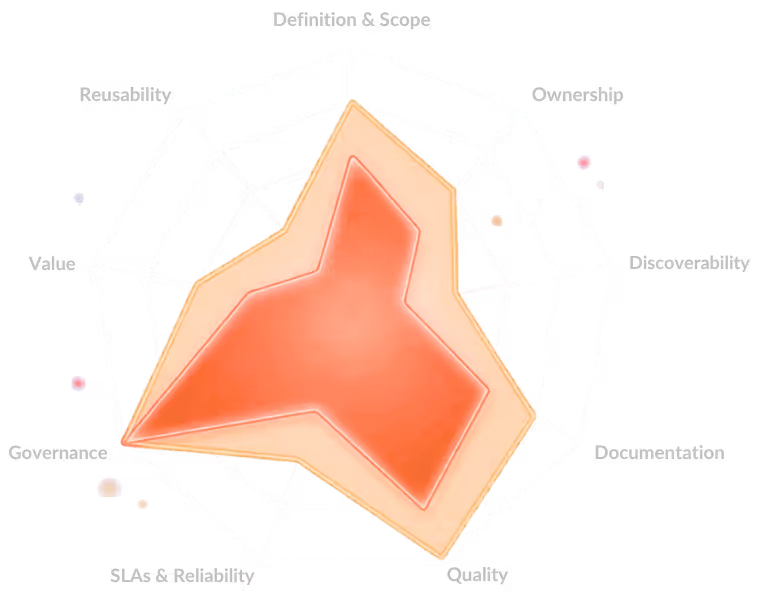
Where does your org stand on data product maturity?
A 9-dimension self-assessment used by 100+ data teams to benchmark strategy, ownership, and platform readiness.


Rachana Medishetti
Rachana is a data engineer with 5+ years of experience with a deep passion for how businesses leverage data, focusing on building end-to-end data systems, from ingestion and pipelines to analytics. She is skilled in PySpark, SQL, Python, and Snowflake, focused on turning data into reliable, real-world business value.
Read the ideas here. Build them with The Modern Data Company.
Modern Data 101 is where the data community thinks out loud. When you're ready to move from articles to architecture, data products, governed AI pipelines, or a full Data Operating System; the team behind this community can help you build it.
Continue reading


.jpg)
