How AI is Impacting Data Analytics in 2026
From static BI reports to conversational insights, how AI-driven data analytics platforms are accelerating enterprise decision-making.

TL;DR
- Modern organisations generate massive volumes of data, but human teams lack the capacity to manually query it all. Over 48% of enterprises are increasing AI investments to bridge this gap.
- AI enhances every analytics stage, from raw data ingestion and automated preparation to real-time predictive forecasting and plain-language dashboarding.
- Generative AI for data analytics functions as a natural-language query interface, allowing business leaders to ask plain-English questions and receive instant contextual answers.
- Models are only as good as the underlying data platform. Activating data through governed, self-describing “data products” (via platforms like DataOS) ensures accuracy, lineage, and security across all AI applications.
Every business now sits on more data than it can manually interpret. That gap is exactly why AI and data analytics have become inseparable in modern strategy conversations. Instead of analysts spending days building static reports, AI for data analytics now automates preparation, spots patterns in real time, and answers plain-language questions the moment they’re asked.
Deloitte’s 2026 State of AI in the Enterprise survey of 3,235 global leaders found 84% of organisations increasing AI investment, with a quarter already reporting a transformative business effect.
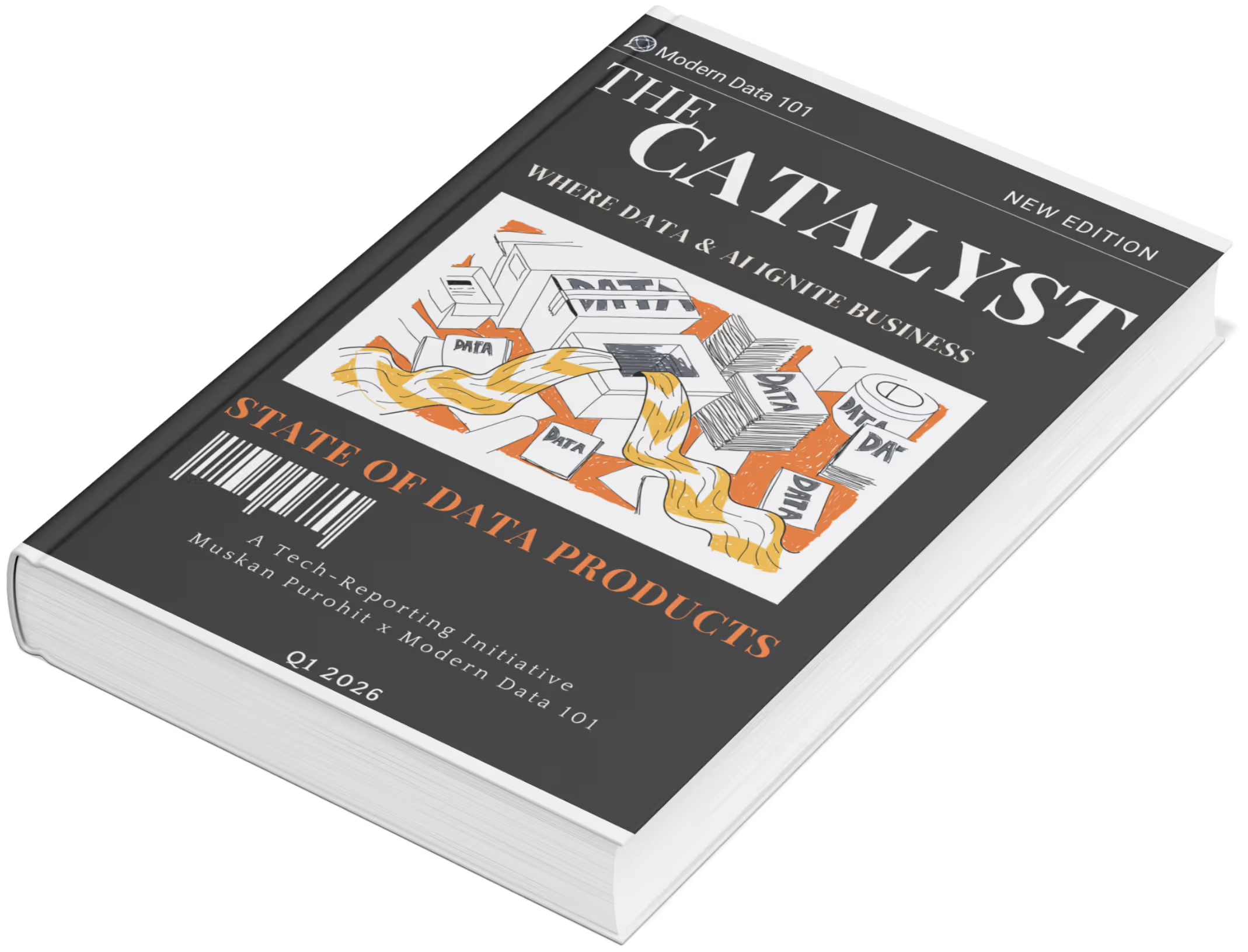
[state-of-data-products]
What Is AI for Data Analytics
AI for data analytics refers to the use of artificial intelligence, machine learning, natural language processing, and automation to collect, prepare, analyse, and interpret data. It can automate repetitive analytical tasks while helping teams identify patterns, anomalies, trends, and predictions.
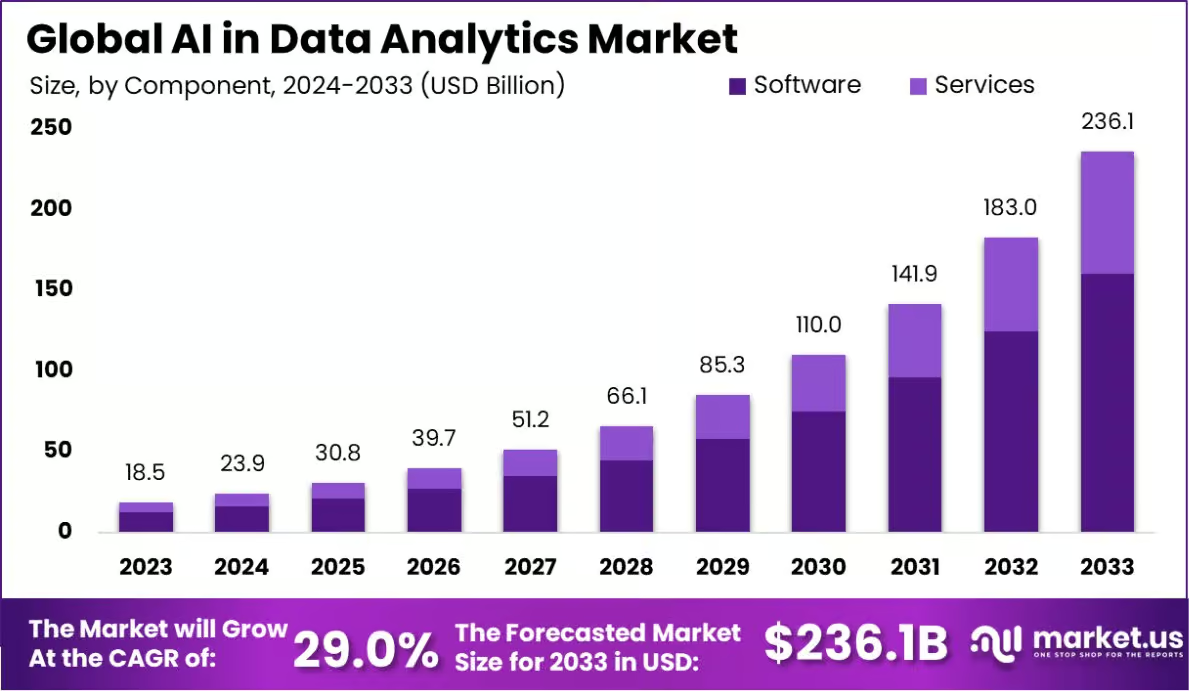
Why Is AI Important for Data Analytics
AI is important for data analytics because it allows organisations to analyse larger volumes of data faster, automate repetitive work, identify patterns continuously, and make analytical insights accessible through natural-language interfaces.
Data volume alone doesn’t create value; interpretation does, and human teams can no longer keep pace with what’s being generated across apps, sensors, and transactions. Data leaders across countries found that most organisations aren’t short on tools; they’re short on activated data, information that’s findable, documented, and trusted enough to act on. AI closes that gap by doing the repetitive interpretation work at a speed no analyst team can match on its own.
[related-1]
How Does AI Improve the Data Analytics Workflow
AI improves every stage across the pipeline:
- Collection: Pulls structured and unstructured data from apps, APIs, and sensors without custom pipelines for each source.
- Preparation: Flags missing values, inconsistencies, and duplicates far faster than manual review.
- Analysis: Detects patterns and runs continuously, enabling real-time forecasting instead of waiting on scheduled reports
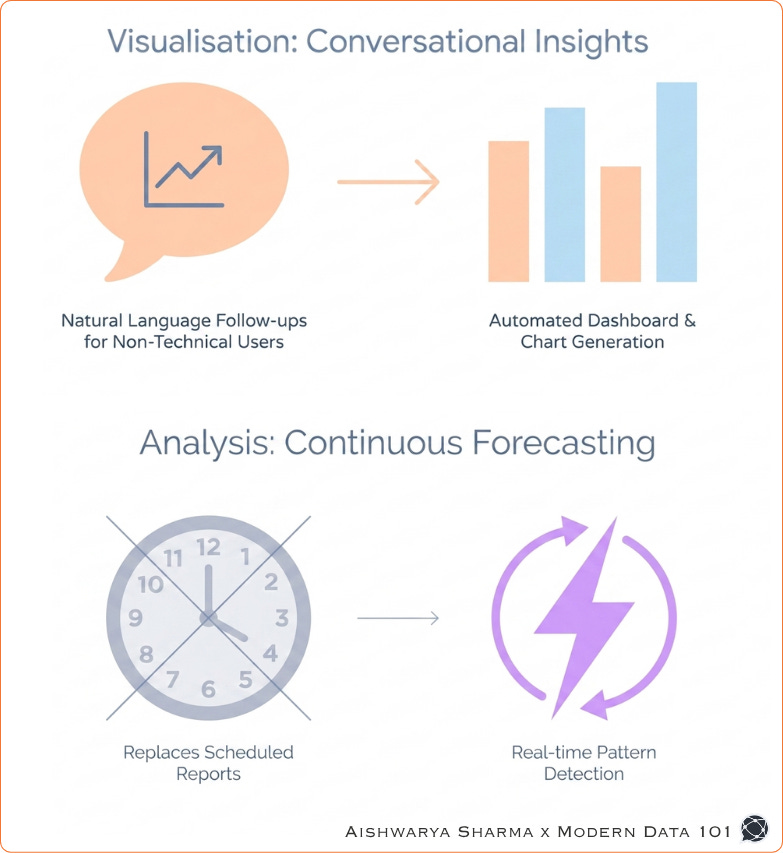
- Visualisation: Builds charts and dashboards automatically, while natural language interfaces let non-technical users ask follow-up questions.
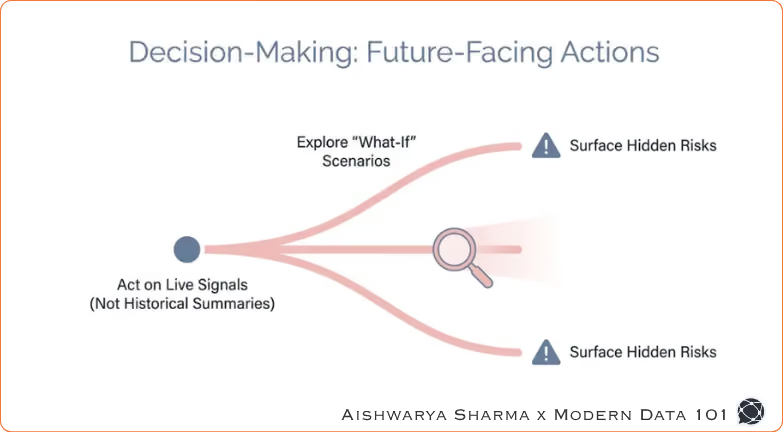
- Decision-making: Surfaces risks and “what-if” scenarios so leaders act on live signals rather than historical summaries alone.
What Are the Benefits of AI-Powered Data Analytics?
AI-powered data analytics platforms consistently deliver:
- Faster processing, where insights are in minutes rather than hours of manual prep
- Fewer errors with statistical consistency, reducing the human-error margin
- Deeper personalisation, which means customer segments and recommendations built from behavioural patterns
- Broader access that means natural language querying lets non-technical teams self-serve
- Stronger forecasting where demand, churn, and risk models that improve as new data arrives
Treat your data as a product and assess its maturity here.
What Is Generative AI Data Analytics?
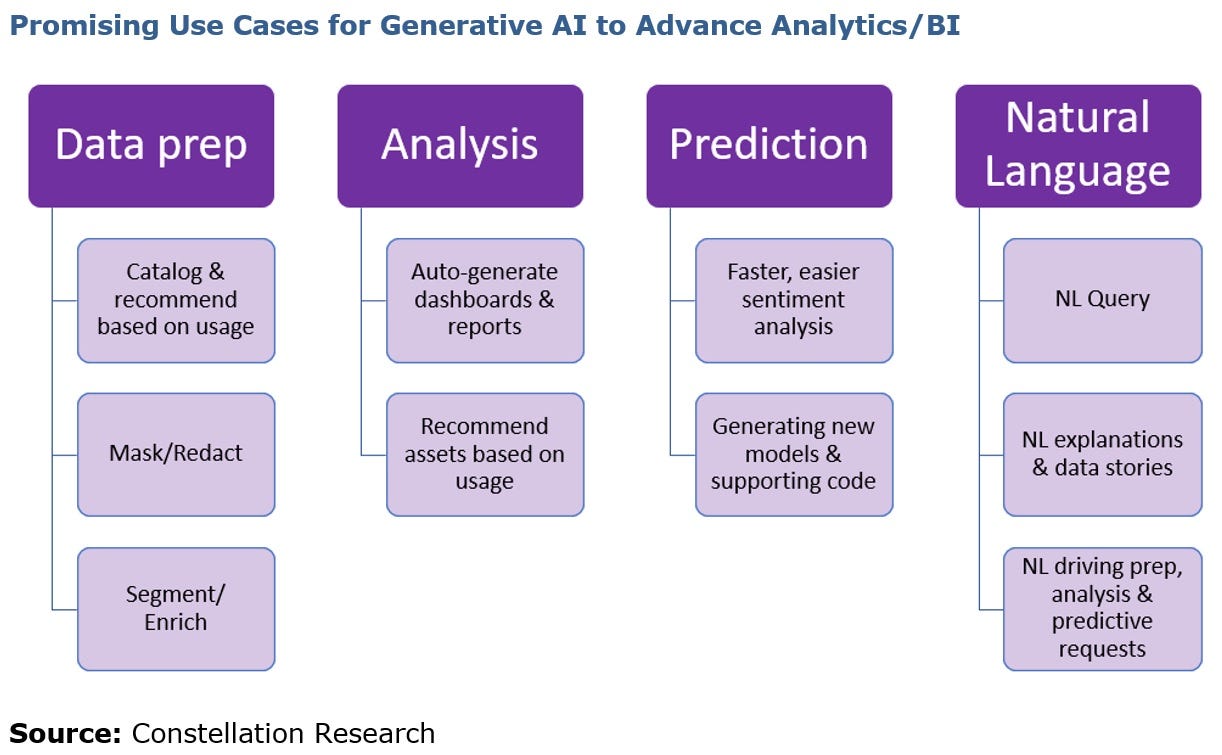
Generative AI data analytics uses specific generative AI models to let users interact with data through natural-language questions, generate analytical summaries, explain trends, and accelerate the creation of insights. Instead of navigating predefined dashboards, users can ask questions about their data and receive contextual responses.
Instead of navigating a dashboard, someone can ask, “Which region had the sharpest drop in retention last quarter?” and get a written answer instantly. Generative models summarise datasets and translate technical output into business language, removing the repetitive first draft so analysts can focus on interpretation and context that automation still can’t fully replicate.
What Are Data Analytics Platforms and How Do They Enable AI?
The model gets the attention, but data platforms decide whether that model can be trusted with real business decisions.
Traditional data analytics platforms
Traditional data analytics platforms help organisations collect, process, query, visualise, and report on business data. They typically power dashboards, scheduled reports, ad hoc analysis, and business intelligence workflows, giving teams a structured view of what has already happened and what is happening now. These platforms remain the foundation for many enterprise analytics environments, but often rely on predefined queries, dashboards, and human-led analysis.
[related-2]
AI-powered data analytics platforms
AI-powered data analytics platforms add machine learning and automation to traditional analytics workflows. They can automate data preparation, detect anomalies and patterns, generate forecasts, and surface insights without requiring analysts to manually perform every step. Natural-language interfaces can also let business users ask questions about data without writing SQL or navigating complex dashboards.
Generative AI analytics platforms
Generative AI analytics platforms use large language models to make data analysis more conversational. Users can ask questions in natural language, generate summaries, explore follow-up questions, and translate analytical results into business language. For example, instead of navigating multiple dashboards, a user could ask, “Which region saw the largest decline in customer retention last quarter, and what factors contributed to it?” The platform can then generate an answer based on the available data and context.
Data platforms for AI
Data platforms for AI focus on the underlying data infrastructure that makes AI-powered analytics reliable. While analytics platforms focus on analyzing data, AI-ready data platforms address whether that data is discoverable, accessible, governed, and sufficiently contextualised for AI systems to use.
This layer brings together data from warehouses, lakes, applications, APIs, and other enterprise sources while adding data quality, lineage, metadata, semantic definitions, access controls, and governance. These capabilities matter most when AI systems or agents are making analytical decisions, a technically accessible dataset isn’t necessarily a trustworthy or correctly understood one.
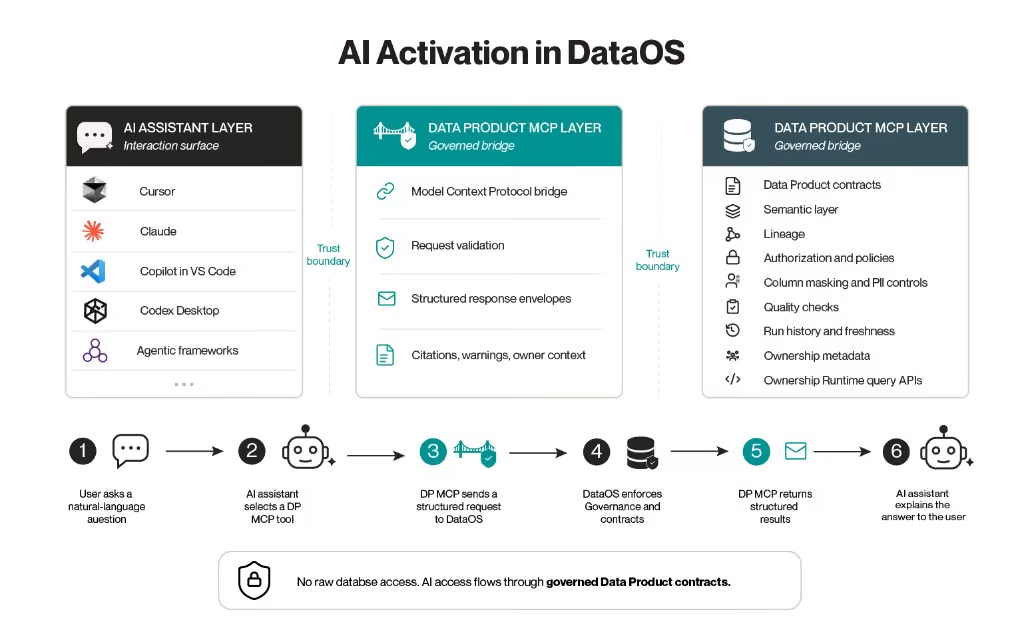
Platforms like DataOS, built by The Modern Data Company, show where this category is heading. Rather than functioning as another warehouse or BI tool, DataOS operates as a data activation layer: it wraps raw datasets into governed “data products” that carry their own lineage, semantic definitions, quality checks, and access policies, then exposes them consistently to BI tools, applications, and AI agents alike.
.avif)
An AI agent querying a dataset needs the same trustworthy context a human analyst would demand, without it, “AI-ready” is just a marketing label.
DataOS layers into existing warehouses and lakes without a rip-and-replace migration, which is a large part of why deployments reportedly reach production 80–90% faster than traditional pipeline-first approaches. For teams evaluating options, this comparison of leading data platforms for 2026 and the open Data Developer Platform specification are both useful for benchmarking what “AI-ready” should actually mean before committing to a vendor.
How to Use AI for Data Analysis: An 8-Step Framework
Getting value from AI in analytics is much more than a single tool purchase (it is infact an entire process). Each step has a distinct failure mode if skipped.
1. Define objectives. Name the specific decision or metric you’re trying to move, such as “reduce churn by X%,” instead of “get better insights.” Vague objectives are the single most common reason AI pilots stall: without a target metric, there’s no way to tell a working model from a plausible-looking one.
2.Collect and prepare data. Connect the relevant sources like CRM, warehouse, event streams, third-party feeds, and run automated checks for missing values, duplicates, and schema drift before any model sees the data. AI can accelerate this step, but it can’t compensate for data nobody bothered to validate first.
[related-3]
3. Engineer features and train models. Translate raw fields into variables that actually carry signal (recency, frequency, rate-of-change), then train against a holdout set so performance numbers reflect real generalisation rather than memorised noise.
4. Run AI-assisted analysis. Let pattern-detection models and natural language query tools surface correlations, anomalies, and segments at a scale manual review can’t match, but treat the output as a set of hypotheses to check, and not much of a finished conclusion.
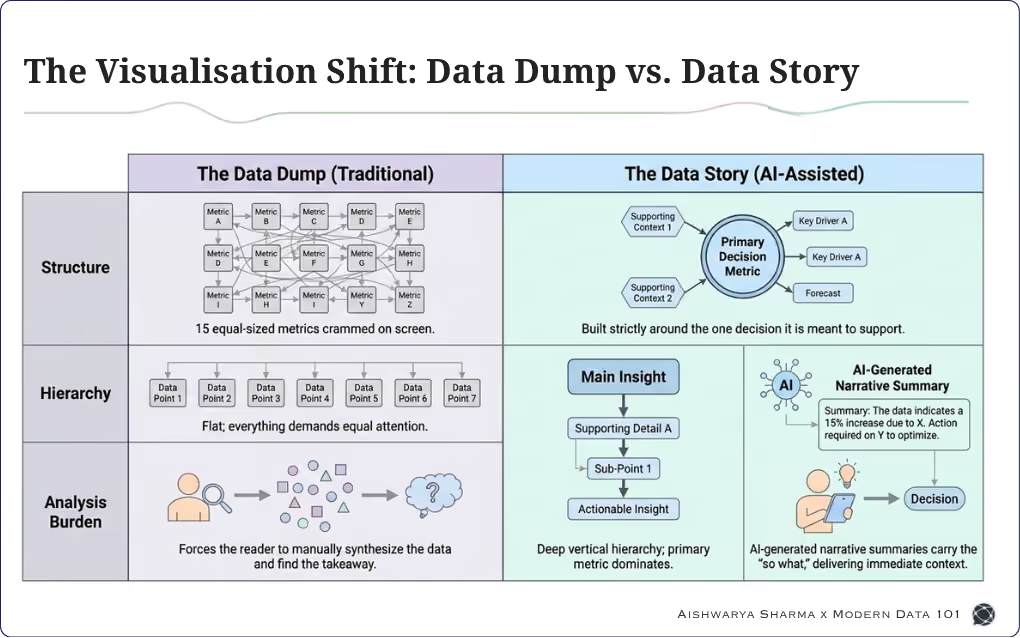
5. Visualise results as a data story instead of data dump. A dashboard that shows fifteen metrics with no hierarchy forces the reader to do the analysis themselves. Structure the visualisation around the one decision it’s meant to support, and let AI-generated narrative summaries carry the “so what.”
6. Forecast with predictive analytics. Move from describing what happened to modelling what’s likely next, such as demand, churn, risk exposure, using time-series or regression approaches suited to how far ahead you actually need to see.
7. Monitor and maintain the models. Model performance decays as customer behaviour, markets, and upstream data schemas shift. Set a review cadence and concrete drift thresholds now, before accuracy quietly erodes and nobody notices until a decision goes wrong.
8. Act on the decision. An insight that doesn’t reach the person who can act on it has no value. Route the output into the actual workflow, a pricing system, a staffing tool, an alert, rather than leaving it in a dashboard no one opens.
AI and Data Analytics Use Cases Across Industries
- Retail: Demand forecasting and dynamic pricing based on real-time purchase behaviour
- Finance: Fraud detection and algorithmic risk scoring across millions of transactions
- Healthcare: Predictive models supporting diagnosis, staffing, and readmission-risk monitoring
- Manufacturing: Predictive maintenance that flags equipment failure before it happens
Challenges and Risks of AI-Powered Analytics
AI doesn’t remove the fundamentals of good data management; it raises the stakes on them. Poor-quality inputs still produce misleading outputs, and many models remain interpretability black boxes. Bias in training data, skills gaps, integration complexity with legacy systems, and regulatory compliance (GDPR, HIPAA) all remain live risks; academic research on algorithmic bias continues to show that biased inputs produce biased predictions regardless of model sophistication. Governance, human review, and audit trails aren’t optional add-ons; they’re the precondition for analytics anyone can actually rely on.
How AI Is Changing the Data Analyst’s Role
AI is shifting analysts away from manual cleaning and repetitive querying toward judgment-heavy work: validating model outputs, deciding which insights matter, and monitoring for bias. This lines up with Modern Data 101’s broader research on emerging data roles, which finds that as AI agents become active consumers of enterprise data, human analysts increasingly shift from executing queries to governing and orchestrating what the AI touches. AI accelerates the process, but it doesn’t replace the contextual judgment and accountability analysts bring to a decision.
Skills You Need to Get Started with AI in Analytics
The foundational skills are: basic data literacy (understanding what “clean” data actually means), comfort validating AI-generated outputs rather than accepting them blindly, and enough prompt and query fluency to ask AI tools the right question the first time. Most teams build this by piloting one narrow, high-value use case, a single forecast or a single automated report, rather than trying to overhaul the entire analytics stack at once. A solid grounding in what a data platform actually is makes that first pilot considerably easier to scope.
The Future of AI in Data Analytics
Data analytics platforms have the potential to keep converging automation, prediction, and natural-language access into one experience, with AI agents increasingly acting as autonomous consumers of enterprise data products rather than passive report generators. Organisations treating their data platform as the foundation instead of being an afterthought, are the ones seeing measurable gains rather than stalled pilots.
FAQs
Q1. When should enterprises use AI for data analytics?
Enterprises should consider AI for data analytics when analysts spend significant time on repetitive preparation and reporting, business users need faster access to insights, teams need continuous anomaly detection, or forecasting influences operational decisions. AI analytics is less effective when business objectives are unclear or the underlying data cannot be trusted.
Q2. Is AI replacing data analysts?
No. AI automates repetitive prep and querying, but it can’t replace the business context, judgment, and accountability analysts bring to a decision.
Q3. What’s the difference between AI analytics and traditional BI?
Traditional BI depends on predefined dashboards and scheduled reports. AI-powered analytics adds real-time pattern detection, forecasting, and natural language querying on top of that foundation.
Q4. Do I need a new data platform to use AI in analytics?
Not necessarily. Platforms like DataOS are designed to layer into existing warehouses and lakes rather than requiring a full migration, which is often the faster path to AI-ready data. As both Deloitte’s research and Modern Data 101’s independent survey suggest, the gap between AI ambition and AI results is rarely the algorithm. It’s whether the data underneath is actually ready to be trusted.
Connect with a community data expert
A no-cost session with a practitioner who's been where you are.
About Modern Data 101
Modern Data 101 is a movement redefining how the world thinks about data. A community built by the same team behind the world’s first data operating system, Modern Data 101 sits at the intersection of data, product thinking, and AI. Spread across 150+ countries, the community brings together a global network of practitioners, architects, and leaders who are actively building the next generation of data systems.
At its core, Modern Data 101 exists to simplify the journey from raw data to tangible and observable impact. It advocates high-potential data systems and next-gen architectures to unify and activate insights and automation across analytics, applications, and operational workflows at the edge.
In a world shifting from data stacks to AI ecosystems, Modern Data 101 helps teams not just navigate the change but lead it.


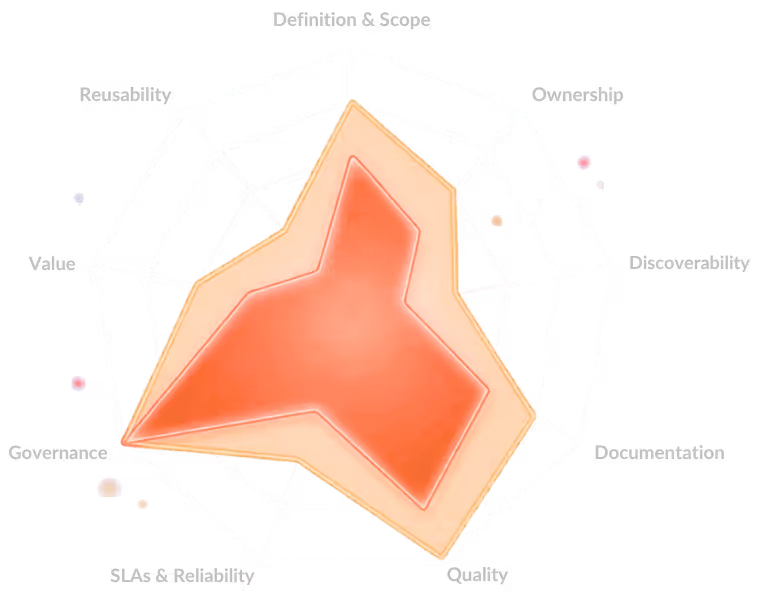
Where does your org stand on data product maturity?
A 9-dimension self-assessment used by 100+ data teams to benchmark strategy, ownership, and platform readiness.


Aishwarya Sharma
Aishwarya is a Senior Analytics Engineer at The Modern Data Company, focused on building end-to-end data solutions that bridge engineering and analytics. He works across data pipelines, modelling, and visualisation to deliver reliable, business-ready insights, combining strong technical expertise with a practical, problem-solving approach to modern data systems.
Read the ideas here. Build them with The Modern Data Company.
Modern Data 101 is where the data community thinks out loud. When you're ready to move from articles to architecture, data products, governed AI pipelines, or a full Data Operating System; the team behind this community can help you build it.
Continue reading
.jpg)

.png)
.png)