5 Ways To Measure AI Governance Success in the Era of Agentic AI
Navigating how traditional governance models fall short for autonomous agents, creating the scope for policy enforcement, data quality, breach detection, agent drift, and business value to ensure safe, scalable and responsible AI.

Only 21% of organisations report a mature governance model for autonomous agents. At the same time, nearly 3 in 4 organisations expect to use agentic AI at least moderately within the next two years. Pressure is building, but accountability still isn’t keeping pace.
AI governance policies are common across organisations, but proving whether they actually work is far less common.
The issue at the core is with the intent behind how traditional governance is built. It is ideal for systems that stay put: fixed models, bounded pipelines, human reviewers in the loop. However, agentic AI behaves differently. It initiates actions, persists across sessions, interacts directly with sensitive data, and moves faster than any dashboard-based review cycle can track. As AI agents and data products become increasingly intertwined in cross-domain enterprise decision-making, measuring governance success means rethinking both what you track and what counts as evidence that it is working.
[report-2025]
Here are 5 most important KPIs for tracking AI governance in agentic systems.
The Five AI Governance KPIs Every Agentic Deployment Should Be Tracking
Use this as a diagnostic starting point. Any row where the failure column describes your current state is a gap worth addressing before scaling:
.avif)
1. Policy Enforcement for AI Goverance
Policy enforcement is the first real measure of whether AI governance works in practice.
In agentic AI environments, that means policies must be machine-enforceable. Agents cannot read employee handbooks or rely on human interpretation. If governance controls cannot be applied automatically, agents are effectively operating without governance.
Here, the ideal concern is regarding policies being encoded rather than just the documentation of it. Can your platform translate a rule, say, "no PII in test environments", into a constraint an agent cannot bypass? Can it block a query, mask a column, or kill a job automatically when a boundary is crossed? Building a governance framework that spans people, process, and technology is the prerequisite; measurement only becomes meaningful on top of that foundation.
.avif)
Useful metrics here include the percentage of policies that are version-controlled and enforceable via API, mean time to block (MTTB) a policy violation after detection, and what proportion of data assets have a documented human owner. The last one matters more than it sounds: when an agent makes a consequential error, ambiguity about who is accountable compounds the damage.
[state-of-data-products]
2. Making Data Quality Scalable in AI-First Enteprises
Agentic systems amplify the underlying quality of the data they consume. A well-governed data environment becomes exponentially more efficient under autonomous operation. A poorly governed one becomes exponentially more risky.
A data quality index tracking accuracy, completeness, consistency, and timeliness is not new. What is new is the need to measure it in real time, across the assets agents consume, along with the ones that governance teams traditionally audit. Understanding what makes data truly AI-ready, including the infrastructure and friction points that determine whether an AI system can operate reliably, is foundational to building quality metrics that reflect actual agent behaviour rather than theoretical pipeline health.
.avif)
Additionally, for high-risk AI systems, the EU AI Act (Article 10) makes data quality and provenance governance a primary legal obligation, rather than just being a best practice.
The most operationally useful signals to track are:
- Drift metrics: detecting when a data source shifts statistically in ways the agent was not designed to handle, which can silently corrupt downstream outputs before any alert fires.
- Lineage completeness rates: what proportion of AI-consumed data has a documented provenance trail?
- Real-time quality indexing: continuous scoring across accuracy, completeness, and consistency. This doesn’t include periodic audits that miss what agents consumed between cycles.
Organisations that structure their data around well-defined data products with embedded quality contracts find it easier to enforce, because quality becomes a product-level commitment rather than a pipeline-level afterthought.
[related-1]
3. Quick Detection of AI Agent Policy Breaches
Detection speed is one of the most underused governance metrics. Most frameworks invest heavily in prevention; very few build systematic measures around response time.
For agentic systems, that gap is acute. Agents do not wait for quarterly reviews.
By the time an anomaly surfaces through a retrospective review, it has often already cascaded through every downstream process that touched the affected data. Governance built for quarterly or even weekly review cycles simply has no mechanism for systems acting on a sub-second timescale.
Mean time to detect (MTTD) and mean time to block (MTTB), the interval between identifying a boundary breach and stopping the agent, are the operational metrics that separate governance in practice from governance on paper. And crucially, how data moves through pipelines in real time determines how quickly breaches can even be surfaced; legacy ingestion architectures create detection blind spots that no governance dashboard can compensate for.
[related-2]
4. Monitoring Agent Drift
Agent failures are rarely sudden. More often, performance declines gradually over time. Intent drift, consistency score decline, and emergent behaviour patterns are signals that a model is changing in ways its original governance assumptions no longer cover.
Point-in-time evaluation misses this. The more reliable approach is baseline tracking over 30 to 60-day windows, looking for sustained deviation rather than individual incidents. An agent that maintains high task accuracy in week one but shows rising escalation frequency and policy boundary violations by week six is a governance problem, even if no single output looks obviously wrong.
.avif)
Tracking autonomous resolution rates alongside escalation frequency tells data leaders whether a system is maturing or quietly degrading. If intervention rates are rising rather than declining over time, the governance guardrails are failing regardless of what the uptime metrics show.
[related-3]
5. Measuring Business Value in Data Governance
An agent with perfect uptime that routinely escalates, violates policy boundaries, or produces inconsistent outputs is not reliable. It is operational overhead disguised as automation and governance programmes that cannot surface this distinction that tend to get defunded.
The measurement problem is structural: governance costs money, creates friction, and its benefits are invisible until something goes wrong. The antidote is pairing outcome metrics with trust signals from the start. Cost per successful task, time saved, and value generated per agent must be tracked alongside policy compliance rates and behavioural drift indicators. Neither set of metrics tells the full story without the other.
The broader question: whether AI and data investment are translating into actual business strategy or remaining a set of disconnected experiments, is precisely what governance metrics should help answer. When a governance programme can show that structured oversight reduced costly rollbacks, shortened regulatory audit cycles, or accelerated compliant deployment, it earns organisational credibility. ROI without trust metrics is an incomplete picture, and one that tends to mislead at exactly the wrong moment.
.avif)
Also Read: The 20-Year Failure: How AI Closes the Gap between Data Strategy and Business Strategy
How To Build an AI Governance Measurement Programme in the Era of Agentic AI
The five areas above are not a complete framework; they are the signals most often missing from governance programmes that look mature on paper but fail under agentic load. Governance teams that connect each metric to a concrete business risk, regulatory obligation, or accountable human owner will find them far more useful than ones that simply accumulate scores.
As autonomous systems become embedded across enterprise data stacks, the organisations investing now in enforcement infrastructure, real-time observability, and drift detection will be better positioned to scale safely and to demonstrate that they have done so when the question is eventually asked.
FAQs
Q1. What is an AI governance framework?
It is a combination of technical controls and organisational policies that define how AI systems are built, monitored, and supervised over their entire lifecycle.
Q2. What are the core dimensions of data quality?
Data quality is generally evaluated by accuracy, completeness, consistency, timeliness, validity, and uniqueness.
Q3. What is the difference between Generative AI and Agentic AI?
Generative AI outputs text, images, or code based on prompts, while Agentic AI uses this intelligence to make decisions and take autonomous actions across systems without constant human intervention.
Q4. What happens when AI governance fails?
Failures usually result from unchecked "Shadow AI" or blanket data access grants, which can lead to leaking Personally Identifiable Information (PII), intellectual property violations, or reputational damage.
Connect with a community data expert
A no-cost session with a practitioner who's been where you are.
About Modern Data 101
Modern Data 101 is a movement redefining how the world thinks about data. A community built by the same team behind the world’s first data operating system, Modern Data 101 sits at the intersection of data, product thinking, and AI. Spread across 150+ countries, the community brings together a global network of practitioners, architects, and leaders who are actively building the next generation of data systems.
At its core, Modern Data 101 exists to simplify the journey from raw data to tangible and observable impact. It advocates high-potential data systems and next-gen architectures to unify and activate insights and automation across analytics, applications, and operational workflows at the edge.
In a world shifting from data stacks to AI ecosystems, Modern Data 101 helps teams not just navigate the change but lead it.


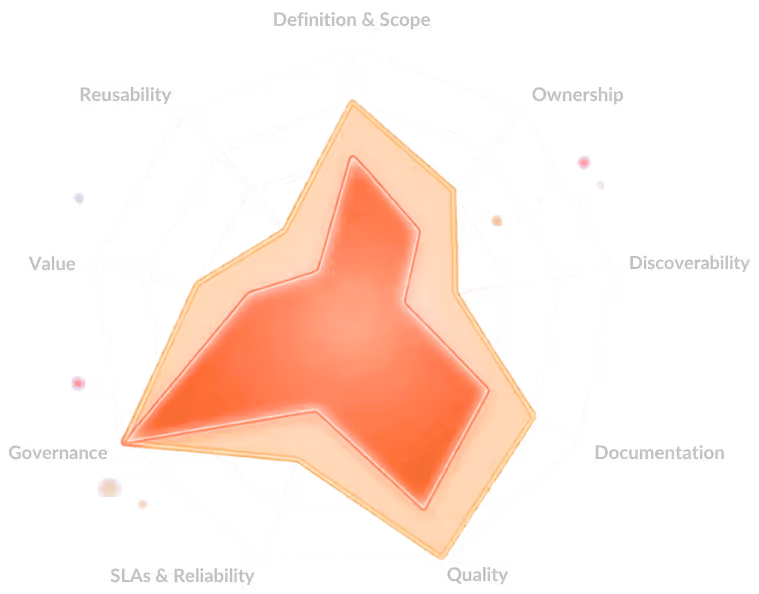
Where does your org stand on data product maturity?
A 9-dimension self-assessment used by 100+ data teams to benchmark strategy, ownership, and platform readiness.


Abhishek Gupta K
Abhishek Gupta builds and deploys production-grade AI systems, working across data pipelines, machine learning models, and agentic AI workflows. During his time at The Modern Data Company, his work focused on applying advanced ML techniques to real-world business problems such as forecasting, churn prediction, and supply chain optimisation, while exploring emerging paradigms in multi-agent systems, retrieval-augmented generation, and large language models.
Read the ideas here. Build them with The Modern Data Company.
Modern Data 101 is where the data community thinks out loud. When you're ready to move from articles to architecture, data products, governed AI pipelines, or a full Data Operating System; the team behind this community can help you build it.
.png)

.png)

.png)