The Governance Framework: Passing Through the Trifecta of People, Process, and Tech
What makes bad data, focus areas in the Governance Framework, and a detailed guide on how to navigate the nuances of People, Process, and Technology in large organizations

This piece is a community contribution from Jose Almeida, Data Strategy & Governance Leader with 25+ years of experience driving business value across EMEA, and specialising in Master Data Management and Data Quality processes and technologies. Jose is also an Advisor, Speaker, and founder of the ‘Data Foundation’ Newsletter. We’re thrilled to feature his unique insights on Modern Data 101!
We actively collaborate with data experts to bring the best resources to a 15,000+ strong community of data leaders and practitioners. If you have something to share, reach out!
🫴🏻 Share your ideas and work: community@moderndata101.com
*Note: Opinions expressed in contributions are not our own and are only curated by us for broader access and discussion. All submissions are vetted for quality & relevance. We keep it information-first and do not support any promotions, paid or otherwise!
TOC
What Makes “Bad Data”
- Miscalculated impact of dirty data
- Bad data is extremely pervasive
- Bad Data Quality will cost more than anticipated
- How to clean up the debt caused by bad data
The Governance Framework Passing Through the Trifecta of People, Process, and Tech
- People’s Corner: Making Data Quality Everyone’s Job
- Process Corner: Have Direct KPI Attribution Lines with Governance
- Tech Corner: The Choice of Platform and the Culture Around it Makes all the Difference
What makes “Bad Data”
Dirty data is information that’s incomplete, inaccurate, outdated, or duplicated, and can wreak havoc in organizations. It’s a costly issue that breeds mistrust, wastes resources, and undermines decision-making. Despite its importance, data quality is frequently overlooked, leading to significant business disruptions and lost opportunities.
The Miscalculated Impact of Dirty Data
The consequences of dirty data are significant and far-reaching. According to research, poor data quality costs businesses millions annually. Sales teams waste time and money chasing bad leads, finance departments make errors in reporting, and marketing campaigns are less effective because they’re targeting the wrong audience.
Even more alarming, decisions made based on flawed data can steer an entire company off course, leading to missed opportunities, misallocated resources, and strategic blunders.
Take, for example, a healthcare provider with inaccurate patient records. An incorrect diagnosis due to outdated or mismatched data could have devastating consequences, both in terms of patient care and legal liability. In industries like finance, where data-driven risk assessments guide billions in investments, the margin for error is even smaller.
Bad Data is Extremely Pervasive
Despite the clear risks, dirty data is a problem that persists in nearly every organization, and the root cause is often poor data governance practices, siloed systems, and a lack of ownership.
Too many companies treat data as a byproduct of business operations, rather than an asset that requires care, attention, and maintenance.
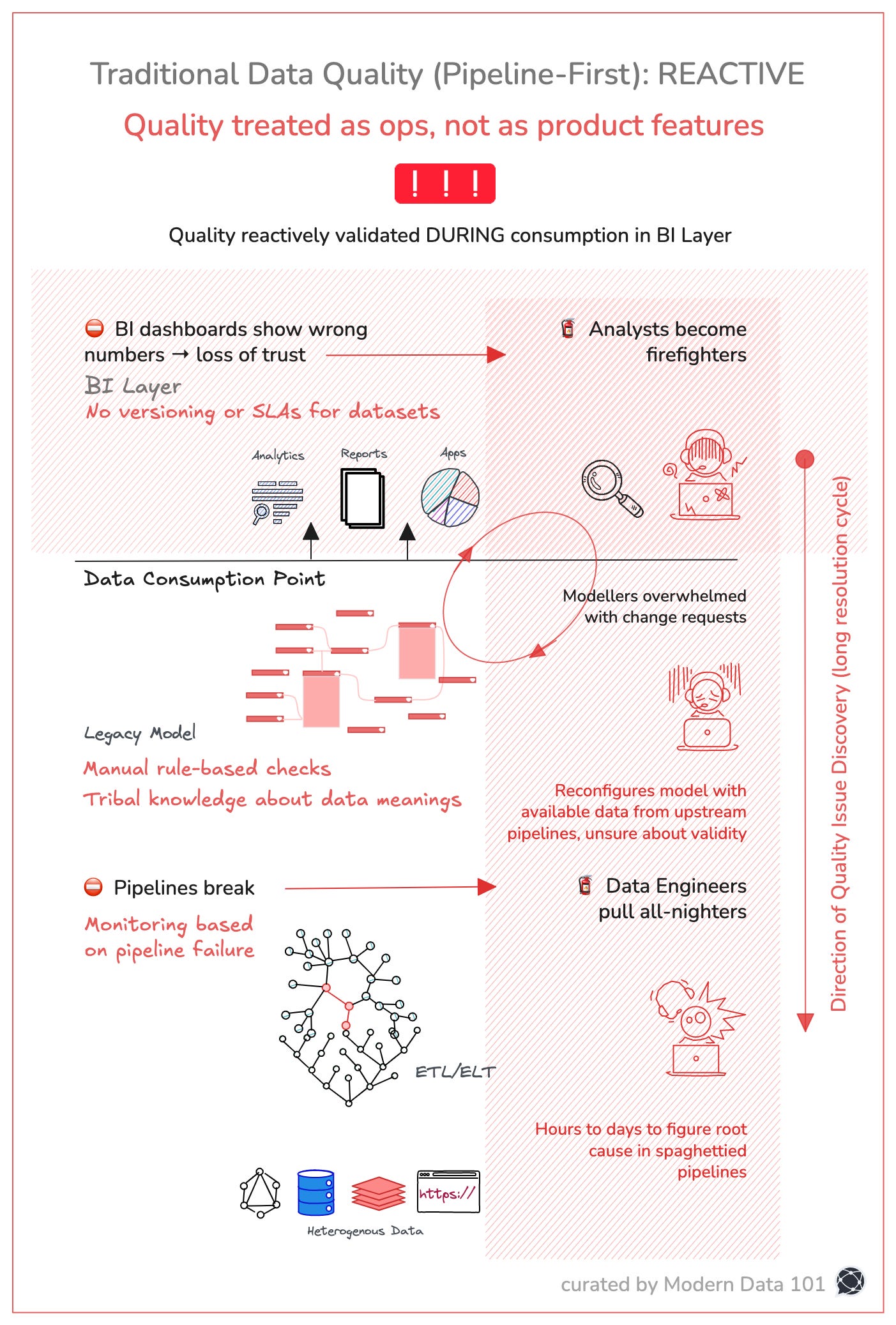
The rush to adopt new technologies and AI without addressing data quality at the source only compounds the issue.
In many organizations, no one “owns” the data. Teams are responsible for entering, maintaining, and reporting on data without a coordinated effort to ensure its accuracy. Worse still, data quality initiatives are often seen as an IT problem, disconnected from the business units that depend on that data for critical decisions.
Bad Data Quality Will Cost More Than Anticipated
Bad data quality is a ticking time bomb for your business. Many organizations overlook the hidden costs of poor data, but these costs can quickly spiral out of control, leading to far more than just a few incorrect reports.
When your data isn’t reliable, trust in the numbers erodes across the organization. Decision-makers begin to second-guess reports, and soon enough, departments start taking matters into their own hands.
This is where shadow data teams come into play: unofficial, decentralized groups that build their own reports and metrics, often based on the data they trust more than the official sources. These teams operate outside the standard data governance structures, creating their own processes, definitions, and metrics.
This decentralized approach might seem harmless at first, but it often leads to conflicting versions of the truth. When every department is working off a different set of numbers, consistency in decision-making vanishes.
Suddenly, your sales team, marketing department, and finance office are all making strategic decisions based on data that doesn’t align. This not only hampers collaboration but also creates inefficiencies that ripple throughout the organization.
Shadow data teams can also lead to significant compliance risks. Without proper oversight and governance, data is more likely to be mishandled or misinterpreted, leading to potential legal or regulatory repercussions.
The financial cost of poor data quality is substantial. According to studies, bad data can cost organizations millions each year in lost productivity, operational inefficiencies, and missed opportunities. But beyond the dollars and cents, the impact on your organization’s culture is even more troubling. Poor data quality fosters a culture of mistrust, where employees are more focused on justifying their own numbers than working together towards common goals.
So, what’s the solution? It starts with investing in data quality initiatives. Implementing strong data governance practices, ensuring regular data audits, and fostering a culture of transparency around data use are crucial steps. By prioritizing data quality, you not only ensure accurate reporting but also align your organization around a single, trusted source of truth.
Don’t let bad data quality drive your organization into debt. The costs are too high, and the consequences too severe. Invest in data quality now, and you’ll not only save money, you’ll build a stronger, but more cohesive organization also ready to tackle the challenges of tomorrow.
How to clean up the debt caused by bad data
To tackle dirty data, organizations need to shift their mindset. The solution starts with strong data governance, where clear policies, standards, and accountability are established across the business. Every employee, from the C-suite to the front lines, should understand that they have a role to play in maintaining data integrity.
- Adopt a data governance framework: Establish rules for how data is collected, stored, and updated. A governance framework provides the structure to ensure data quality at every stage of its lifecycle, across People, Process, Tech!
- Invest in data cleaning tools: Technologies that can automatically detect, clean, and flag dirty data help maintain high-quality datasets and reduce manual work.
- Make data quality everyone’s responsibility: Cross-functional collaboration is key. Data isn’t just an IT issue. Marketing, sales, operations, and finance all need clean data to succeed.
- Start small, measure, and scale: Begin by cleaning up high-priority areas. Focus on quick wins where the impact of clean data can be clearly measured, then expand the effort across the organization.
The Governance Framework Passing Through the Trifecta of People, Process, and Tech
People’s Corner: Making Data Quality Everyone’s Job
Data is no longer the sole responsibility of IT or data team, but the foundation of every modern business decision. Yet, too often, data quality is treated as someone else’s problem, an issue to be fixed downstream rather than prevented at the source. If businesses are serious about competing in a data-driven world, they need to make data quality a universal job requirement for all knowledge workers.
The Problem: Passive Approach to Data Quality
Most organizations recognize that poor data leads to poor outcomes: flawed reports, misguided strategies, regulatory risks, and lost revenue. Yet, the responsibility for fixing bad data is often pushed to data teams, creating an endless cycle of cleaning up after business users rather than preventing errors in the first place.
The root cause? Data is still perceived as a technical asset rather than a shared business responsibility. Marketing, finance, operations, every department relies on data, but few take ownership of ensuring its accuracy, completeness, and consistency. This gap between data usage and accountability is what needs to change.
The Solution: Embedding Data Quality in Every Role
To make data quality a universal job requirement, organizations must shift from a reactive mindset to a proactive culture where every knowledge worker understands their role in maintaining high-quality data. Here’s how to drive that transformation:
1. Tie data quality to performance metrics
If data is essential to business success, then data quality should be reflected in performance evaluations. Just as employees are held accountable for financial targets or customer satisfaction, they should also be responsible for the integrity of the data they enter, manage, or consume.
2. Make data literacy a core skill
Most knowledge workers aren’t trained to think critically about data quality. Organizations should invest in data literacy programs that teach employees how to assess, validate, and improve the data they interact with daily.
3. Shift from data ownership to data accountability
Assigning “data owners” isn’t enough. Everyone who touches data should be accountable for its accuracy, just as they are for their own work. This requires clear policies, user-friendly data governance frameworks, and tools that make quality checks seamless.
4. Embed data quality into workflows
Expecting employees to manually validate data won’t work. Processes need to be designed with built-in quality controls. This means implementing automated validation, real-time feedback, and intuitive interfaces that guide users toward better data practices without disrupting productivity.
5. Foster a data-driven culture
A culture where data quality matters must be led from the top. Leaders need to champion data as a strategic asset, celebrate teams that prioritize quality, and ensure that discussions about data integrity are as routine as financial reviews.
The Payoff: A Competitive Edge through Better Data
Organizations that successfully embed data quality into every role will see direct benefits: faster decision-making, reduced risks, and improved customer trust. More importantly, they will break free from the costly cycle of poor data leading to bad decisions, rework, and missed opportunities.
Data is no longer a back-office function; it’s the lifeblood of modern business. The sooner organizations treat data quality as a universal responsibility, the sooner they can fully unlock the value of their information assets.
The question is no longer who owns the data? but rather who is accountable for making it better? The answer must be “everyone”.
Process Corner: Have Direct KPI Attribution Lines with Governance
Data governance is the foundation of effective data management, yet for it to truly thrive, it must evolve into a self-sustainable function.
This evolution ensures that every investment in data governance yields tangible returns and that the function can adapt to changing business landscapes and technological advancements without undue reliance on external support.
Moreover, self-sustainability fosters a culture of ownership and accountability for data quality throughout the organization while promoting efficiency through streamlined processes and optimized resource utilization.
To achieve self-sustainability in data governance, several key steps must be taken.
Aligning Metrics with Business Goals
First and foremost, organizations need to establish specific, measurable goals aligned with their overarching business objectives. These goals should be accompanied by key performance indicators (KPIs) to track progress and demonstrate the value of data governance initiatives. Additionally, fostering collaboration and communication across departments is crucial to gaining buy-in and support for these initiatives.
Associating business KPIs with data governance performance is crucial. This allows organizations to demonstrate the direct impact of data governance initiatives on the bottom line, showing tangible results such as revenue increases, cost reductions, and operational efficiency gains.
Define Ownership and Domain Boundaries
Empowering individuals within the organization to act as data stewards is another essential component of self-sustainability. These data stewards take on the responsibility of ensuring data quality and governance within their respective domains. Leveraging technology and automation tools can further streamline data governance processes, reducing manual effort and enhancing efficiency.
Consistent Evaluation and Redefining Shifting Business Goals
Continuous assessment and refinement of data governance practices are also essential for maintaining self-sustainability. Organizations must regularly evaluate their processes, solicit feedback, and adapt to evolving business needs and industry standards.
To illustrate the concept of associating business KPIs with data governance performance, here are some concrete examples:
1. Customer satisfaction (CSAT) improvement: One of the primary objectives of data governance is to ensure the accuracy and reliability of customer data. By tracking CSAT scores before and after implementing data governance initiatives, organizations can measure improvements in customer satisfaction resulting from better-targeted marketing campaigns, personalized customer experiences, and more accurate billing and support services.
2. Operational efficiency metrics: Data governance aims to streamline data processes, reduce redundancy, and optimize resource utilization. KPIs such as cycle time reduction in data processing, time-to-market for new products or services, and the number of data errors or redundancies identified and resolved can directly reflect the impact of data governance on operational efficiency.
3. Revenue growth: Improved data quality and accessibility can lead to better-informed decision-making and more effective sales and marketing strategies. By tracking metrics such as customer acquisition rates, average transaction value, and customer lifetime value, organizations can quantify the impact of data governance on revenue growth.
4. Cost reductions: Data governance helps identify and eliminate inefficiencies in data management processes, leading to cost savings. KPIs such as reduced data storage costs, decreased data processing times, and lower compliance-related fines or penalties can directly measure the financial benefits of data governance initiatives.
5. Risk mitigation: Data governance plays a crucial role in ensuring data security, compliance with regulations, and mitigating risks associated with data breaches or privacy violations. KPIs such as the number of security incidents or breaches, compliance audit results, and regulatory fines or sanctions avoided can quantify the effectiveness of data governance in risk management.
6. Decision-making effectiveness: Enhanced data quality and accessibility empower decision-makers with accurate, timely, and actionable insights. KPIs such as the percentage of decisions supported by data, the time taken to access relevant data for decision-making, and the accuracy of forecasts or projections can measure the impact of data governance on decision-making effectiveness.
Aligning data governance initiatives with these business KPIs and tracking their performance over time, allows organizations to demonstrate the direct value of data governance in driving business outcomes and achieving strategic objectives.
Tech Corner: The Choice of Platform and the Culture Around it Makes all the Difference
Why your data platform won’t deliver ROI until you clean the mess
Over time, I’ve met leadership teams excited about a shiny new data platform. The promise? “This tool will finally fix our data problems.”
Except it never does. New technology stack won’t solve:
- Undefined data ownership.
- Conflicting KPIs.
- Business teams working in silos.
In fact, tech usually amplifies what already exists.
If your processes are broken, your governance unclear, and your culture resistant, the best platform in the world will only make the mess bigger and more expensive.
The trap of “technology-first” thinking
Why do companies fall into this trap? Because tools are tangible. They’re easy to buy, demo, and showcase to the board.
But data strategy isn’t about what you buy. It’s about how you work.
A platform can organize metadata, but it can’t resolve conflicting definitions of “customer.” An AI model can crunch numbers, but it won’t align sales and finance around the same KPIs. A cloud warehouse can centralize data, but it won’t convince business teams to share it. Technology accelerates, it doesn’t transform.
What a Real Data Platform Strategy Looks Like
Even a platform strategy, starts with your people”
- Define the business problem you’re solving: Is it revenue leakage? Customer churn? Regulatory risk? Start with outcomes, not tools.
- Assign ownership that sticks: Someone in the business must be accountable for critical data. Ownership can’t be optional.
- Establish the minimum rules needed to deliver value: Data governance isn’t about bureaucracy. It’s about creating just enough structure to enable trust.
- Then (and only then) bring in technology to scale: Tools should amplify working processes, not replace them.
Until you fix the way your organization manages, owns, and uses data, no platform will save you.
When should I buy a tool/platform to help govern my data?
Investing in data governance technology is a strategic decision that can significantly enhance an organization’s ability to manage and govern its data effectively. However, determining the right time to make this investment requires careful consideration of various factors.
Here’s how to decide when to purchase data governance tools for your organization:
1. Complexity of data environment
Evaluate the complexity of your organization’s data landscape. If you’re dealing with diverse data sources, large volumes of data, and complex data relationships, investing in data governance tools may streamline data management processes and ensure compliance with regulations.
2. Data governance maturity
Assess the maturity level of your organization’s data governance practices. If you’ve already established foundational data governance processes and frameworks but lack adequate tools to support them, it may be time to invest in dedicated data governance software to scale your efforts and drive efficiency.
3. Regulatory compliance requirements
Consider the regulatory environment in which your organization operates. If you’re subject to stringent data privacy regulations, investing in data governance tools with built-in compliance features can help ensure regulatory adherence and mitigate risks associated with non-compliance.
4. Data quality issues
Identify any existing data quality issues within your organization. If you’re experiencing challenges related to data accuracy, consistency, or completeness, investing in data governance tools with data quality management capabilities can help improve data integrity and reliability.
5. Business growth and expansion
Anticipate future growth and expansion of your organization. If you’re planning to scale your operations, enter new markets, or launch additional products or services, investing in data governance tools early on can facilitate seamless data management and governance across diverse business units and geographies.
6. Executive buy-in and support
Assess the level of executive buy-in and support for data governance initiatives. If senior leadership recognizes the strategic importance of data governance and is willing to allocate resources for technology investments, it may be an opportune time to procure data governance tools and demonstrate ROI to key stakeholders.
7. Cost-benefit analysis
Conduct a cost-benefit analysis to determine the potential return on investment (ROI) of implementing data governance tools. Evaluate factors such as upfront costs, ongoing maintenance expenses, anticipated productivity gains, risk reduction, and compliance savings to justify the investment.
The decision to invest in data governance tools should be guided by an organization’s specific needs, regulatory requirements, data governance maturity, and strategic objectives.
Only when carefully assessing these factors and evaluating the potential benefits, organizations can make informed decisions about when to purchase data governance tools to support their data management and governance initiatives.
Thanks for reading Modern Data 101! Subscribe for free to receive new posts and support our work.
MD101 Support ☎️
If you have any queries about the piece, feel free to connect with the author(s). Or feel free to connect with the MD101 team directly at community@moderndata101.com 🧡
Author Connect

Find me on LinkedIn 🙌🏻
Connect with a community data expert
A no-cost session with a practitioner who's been where you are.
About Modern Data 101
Modern Data 101 is a movement redefining how the world thinks about data. A community built by the same team behind the world’s first data operating system, Modern Data 101 sits at the intersection of data, product thinking, and AI. Spread across 150+ countries, the community brings together a global network of practitioners, architects, and leaders who are actively building the next generation of data systems.
At its core, Modern Data 101 exists to simplify the journey from raw data to tangible and observable impact. It advocates high-potential data systems and next-gen architectures to unify and activate insights and automation across analytics, applications, and operational workflows at the edge.
In a world shifting from data stacks to AI ecosystems, Modern Data 101 helps teams not just navigate the change but lead it.


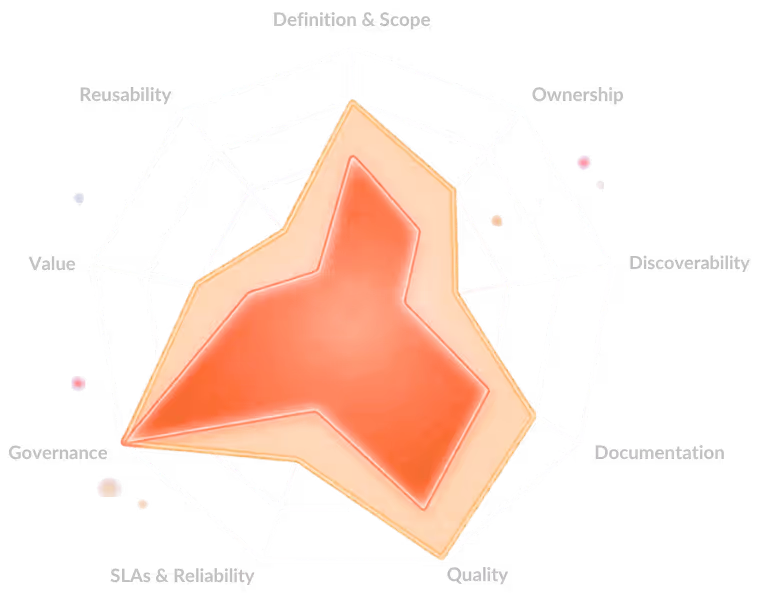
Where does your org stand on data product maturity?
A 9-dimension self-assessment used by 100+ data teams to benchmark strategy, ownership, and platform readiness.


Jose Almeida
Jose Almeida is a Data Strategy & Governance Leader with 25+ years of experience driving business value across EMEA, and specialising in Master Data Management and Data Quality processes and technologies. Jose is also an Advisor, Speaker, and founder of the ‘Data Foundation’ Newsletter.
Read the ideas here. Build them with The Modern Data Company.
Modern Data 101 is where the data community thinks out loud. When you're ready to move from articles to architecture, data products, governed AI pipelines, or a full Data Operating System; the team behind this community can help you build it.
.png)

.png)

.png)