The Complete Guide to Data Products
A Practical, End-to-End Guide to Architecture, Ownership, Metrics, and Business Impact of Productised Data Management

Last Updated: August 25th, 2026
In this fast-paced world, every modern data product ecosystem wants faster decisions at lower prices and with greater revenue. But this requires businesses and technologies to keep up and make changes in the ways they handle their data.
And speaking of data, there’s one term that has gained significant traction, i.e. “data product”. But does its popularity also align with its correct interpretations? Considering that it is a new concept, are organisations that want to utilise it able to understand it and see it beyond the lens of rebranding existing assets and just dashboards or machine learning models?
This article is about breaking down the understanding of a data product at a structural level, while opening up about questions like who owns the data, who is accountable for it, and how it is defined.
Imagine being an employee in an organisation who wears multiple hats, serves different clients, manages conflicts, and doesn't require constant monitoring. That's the expectation from most professionals in the AI age, where the new skills go beyond individual contributions. The role of people managers is disappearing.
The expectations from data today are also not too different. Consider how convenient it would be if businesses could rely on data repeatedly, without reinterpretation? This is where the concept of a data product enters the conversation, not as just another dataset, but as data intentionally designed to be accountable, trustworthy, reusable, and dependable at scale.
What is a Data Product
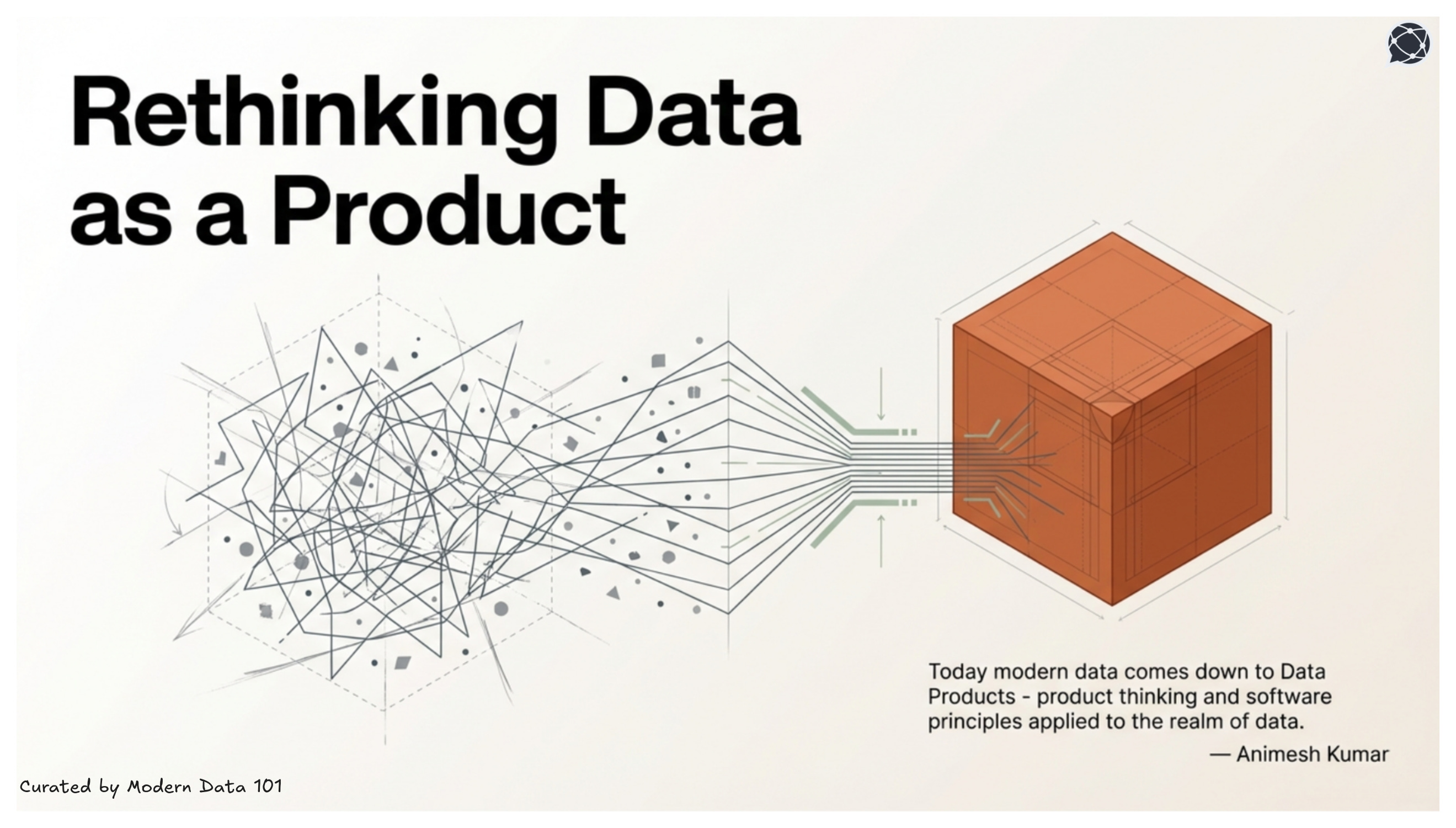
A data product is a curated, reliable, and reusable purpose-bound data asset built for ongoing use, intentionally designed to support decisions over time rather than serve as a one-off dataset or dashboard. It operates within a defined domain boundary, with a stable data model, embedded validation logic, and clearly defined access mechanisms. It is documented, discoverable, and continuously monitored for quality.
A data product is self-contained, governed, and reusable unit of data designed to deliver specific business value.
In our framework, a data product is a "vertical slice" of the data architecture that includes the data itself, its metadata, transformation code, SLAs, and the necessary infrastructure to make it consumable. This enables a move away from "fragile pipelines" toward a "Lego-like" system where these modular data products can be snapped together to build complex applications quickly.
This perspective reinforces the idea that data is not merely stored and governed, but intentionally engineered, packaged, and delivered for repeatable consumption, much like any well-designed product.
“For greater responsiveness and a higher benefits realisation ratio, ‘product-mode’ is a more effective way of working than projects.” - Martin Fowler.
Martin Fowler, one of the greatest minds shaping systems design, argues that real responsiveness comes from structuring teams around enduring outcomes rather than temporary projects. He suggests that value increases when stable teams stay accountable for solving problems over time, continuously validating and improving results. In this view, effectiveness is measured by sustained business impact, not by delivering predefined scope.
Additionally,
IBM Think defines that
...a data product is a reusable, self-contained combination of data, metadata, semantics, and implementation logic designed to deliver consistent value across use cases, much like a commercial product serves customers in a market.
To understand this better, it’s important to recognise that a data product is intentionally designed to solve users’ problems and is developed with the same discipline and structure as any other product, which means prioritising high-value features, managing iterations based on feedback, and presenting clear ownership and accountability.
The Gartner Chief Data and Analytics Officer (CDAO) Agenda Survey for 2024 shows that,
...1 in 2 organisations studied have already deployed data products, defined by Gartner as a curated and self-contained combination of data, metadata, semantics and templates.
Another industry pioneer in the data product space, Thoughtworks, cites the following:
While the term “data product” has been employed with different definitions, in the context of DaaP, data products, just like traditional products, are valuable and functional on their own, addressing specific business needs or goals. They encompass all the essential components needed for their utilisation: not just data, but also relevant metadata, the code required to transform and present the data, governance policies, quality processes, and the infrastructure required to publish and operate it.
[related-1]
Why Does Consumer Intent Define a True Data Product
Because the whole point of productisation begins with purpose: design as per the need to create a decision-centric data product. Interfaces are designed deliberately, quality thresholds reflect real usage expectations, and evolution becomes intentional rather than reactive.
This shift marks a change from passive storage to purposeful design. Additionally, defining a clear consumer, whether for operational decisions, analytics, reporting, or integration, helps to introduce direction and accountability.
Why Data as a Product Has Become a Business Imperative
Modern data environments are expanding every day, more so with AI interactions. It is important to accommodate a feasible and useful interaction with data and its growing use. These days, organisations involving self-serve analytics, cloud-native systems, and domain-oriented ways of working require stability, which is presented by treating data as a product.
And since data product has features like clear ownership and structural discipline, it prevents definitions from drifting by aligning with the drifts themselves in data consumption patterns, infrastructure, and code. Ironilcally, being "duplicated", or forked in case of data products, increases trust instead. Data product brings structural discipline to an environment that would generally be fragmented under scale or consumption-heavy in nature.
In addition to this discussion, it has been acknowledged by Thoughtworks that applying product thinking to data starts a journey of focused management of data to adhere to consumer needs instead of letting infrastructure or process dictate usage.
What Changes When You Treat Data as a Product
Changing the way we reframe data presents an opportunity to build assets that ensure customer-centricity, instead of just delivering outputs based on new tooling. Because now, we are focusing on the design intent.
Through this methodology, it becomes possible to align data products from their raw data form into structured, accessible, and valuable assets. IBM also supports such an approach by highlighting how proactive decision-making and alignment with business goals can be achieved seamlessly.
So, in environments where reusability, composability and trust are the core aspects, this shift becomes a foundation rather than just an option.
Why Is the Term “Data Product” So Often Misused
The term "data product" is often misused because as soon as any form of data initiative or structured artefact starts to expand, it gets labelled as a “product”. However, what we fail to identify is that in order to qualify as a product, we have to observe the capabilities instead of the in-the-moment outputs presented. Like ownership, accountability, and intentional design for long-term consumption.
But if these elements are missing, the label that was expected to present clarity, reflects confusion. This also leads to misuse once structure gets misunderstood as data stewardship, further preventing the purpose of a label.
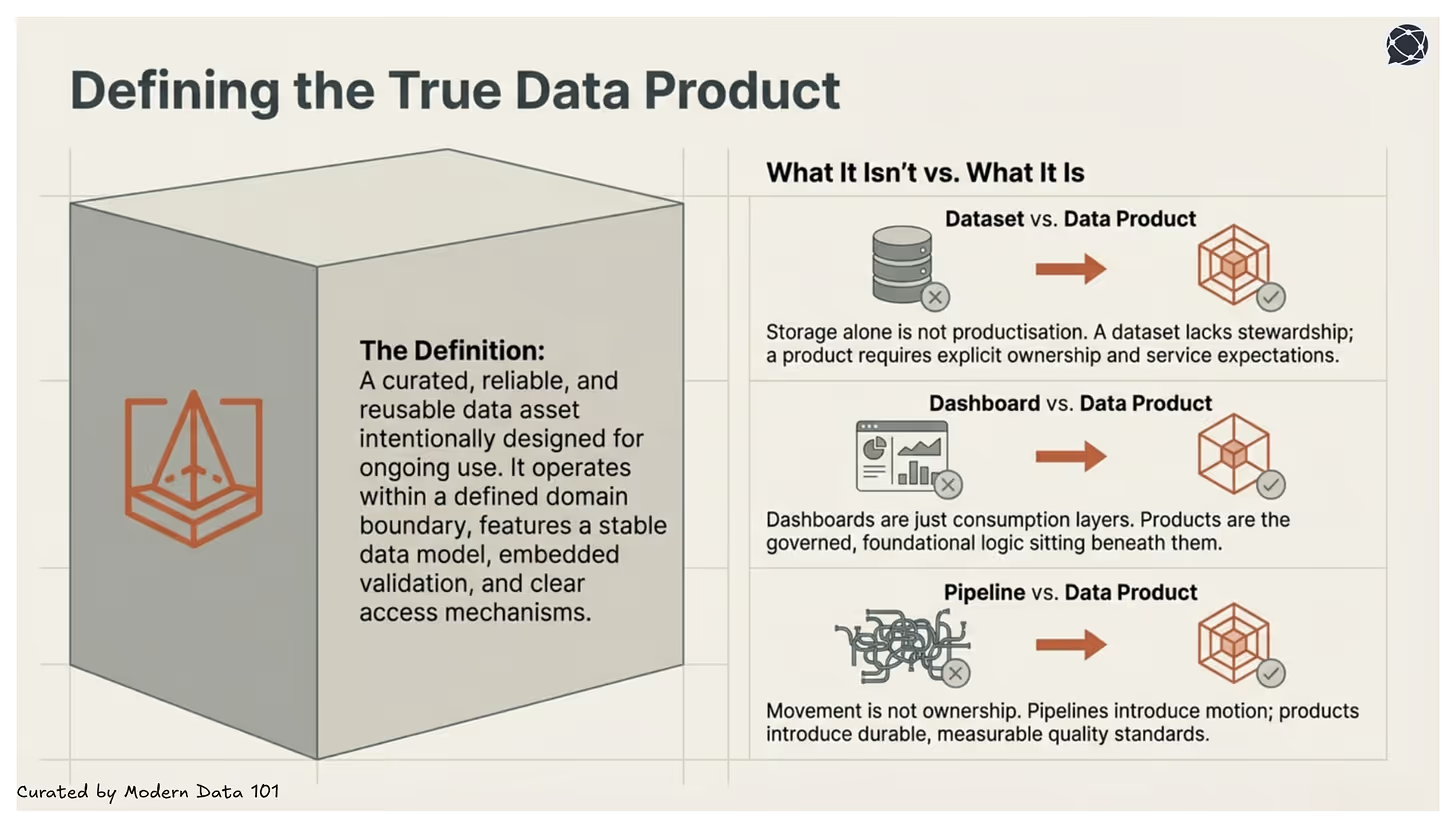
Datasets vs. Data Products
A dataset is a stored and structured collection of data. It may be well-modelled and queryable, but storage alone does not constitute productisation.
A dataset refers to an asset which is valuable in nature but not engineered for durable consumption or direct enablement of business goals. It also often lacks attributes such as being FAIR (findable, accessible, interoperable, reusable) in nature and having consistent governance.
However, a data product requires explicit ownership, defined service expectations, embedded quality controls, and long-term accountability. It simply can’t function without stewardship and consistently active business or consumer orientation.
Dashboards and Reports vs. Data Products
Dashboards and reports serve as consumption layers as they do not define or govern the underlying logic but only interpret and visualise data to support decisions.
What we are looking at when speaking about data products is a foundational product which is inclusive of stable definitions, data’s governed access, and consistent metrics that dashboards depend on.
This exists and thrives beneath these interfaces of dashboards and reports, and also prevents duplication and inconsistency while guaranteeing integrity.
Data Pipelines vs. Data Products
Pipelines move and transform data. They streamline and direct the flow across systems. But movement is not ownership.
A pipeline is capable of delivering a table, but a data product presents reliable consumption while maintaining measurable quality standards and accountability.
A pipeline can also NOT ensure semantic consistency and long-term quality. But a data product is streamlined in its procedure and productisation by being durable, while pipelines only introduce motion.
It takes the convergence of three forces: stable semantics, embedded governance, and a clearly defined consumer purpose to create a data product. At that point, data ceases to be a by-product of systems and becomes decision infrastructure. Additionally, it shifts the focus from delivering outputs to maintaining dependable infrastructure that others can rely on repeatedly.
[related-2]
What Problem Do Data Products Solve in Modern Enterprises
The concept of a data product emerged to address the failures of traditional data delivery and create an efficient response towards structural inefficiencies of data maintenance or dataOps
As data ecosystems scale, these inefficiencies compound, resulting in fragmentation, inconsistency, and declining trust. To prevent this, productisation becomes necessary.
Why Traditional Data Delivery Fails
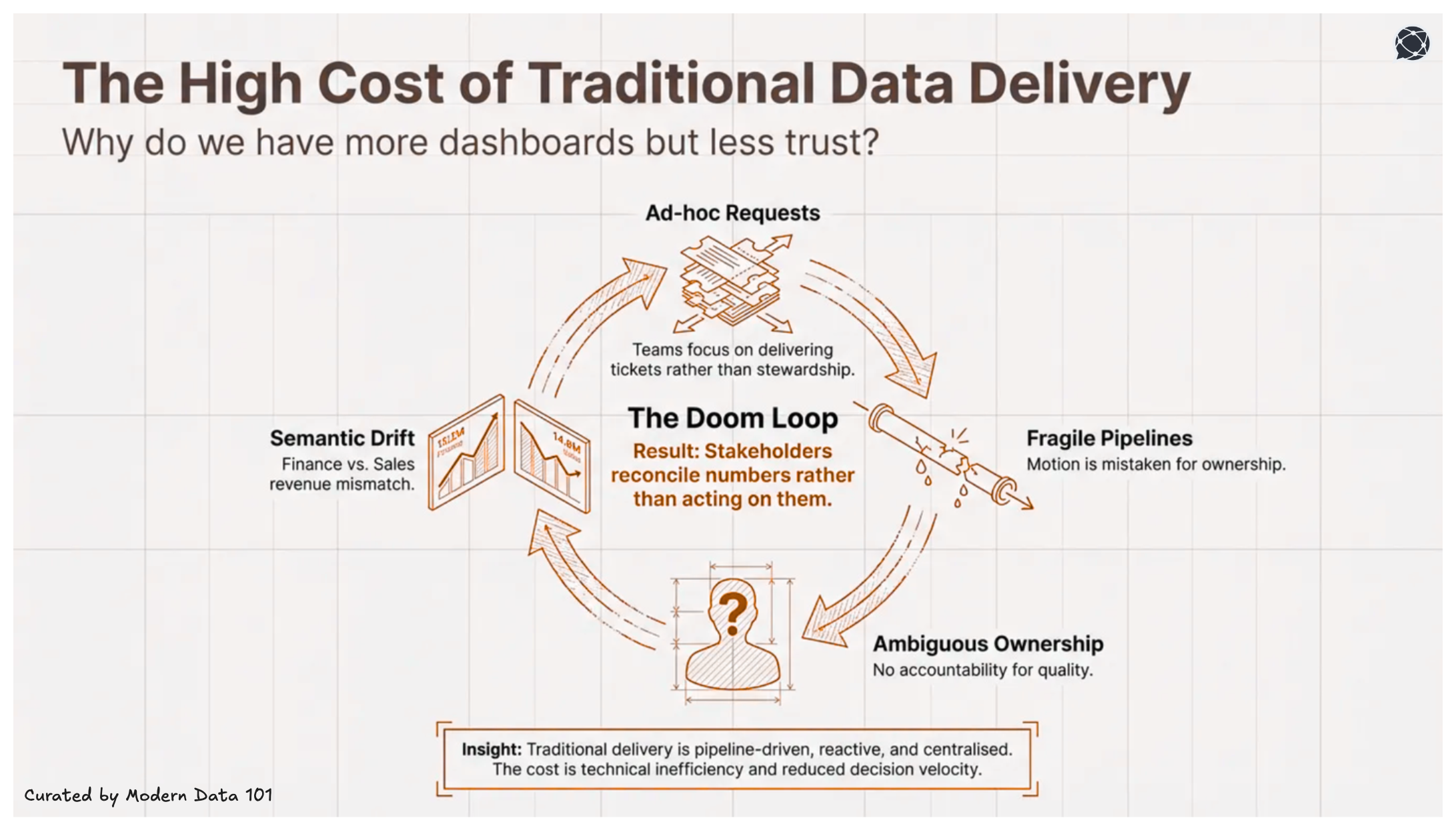
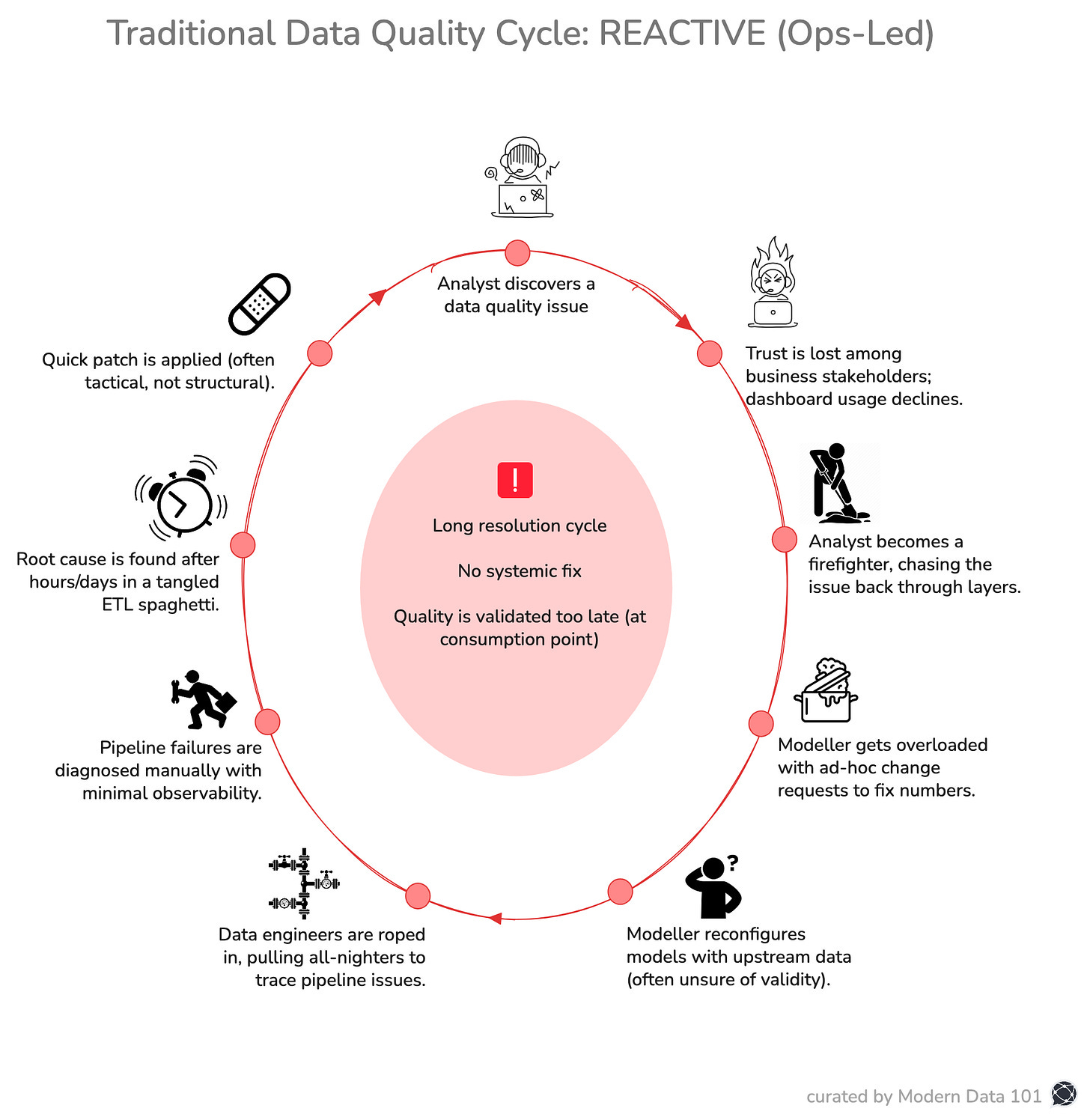
Teams are focused on moving on to the next ticket rather than building long-term usability. The traditional data delivery method revolves around being pipeline-driven, reactive, and centralised.
Another major flaw in the system is served when ownership remains ambiguous, and once delivered, assets are rarely governed with explicit accountability for quality, definition, stability, or service expectations.
This overall model is a structural weakness with ad-hoc analysis, reporting and pipelines accumulating over time, no specific request being converted into a reusable foundation, and centralised teams becoming bottlenecks as demand scales.
What Is the Business Cost of Not Treating Data as a Product
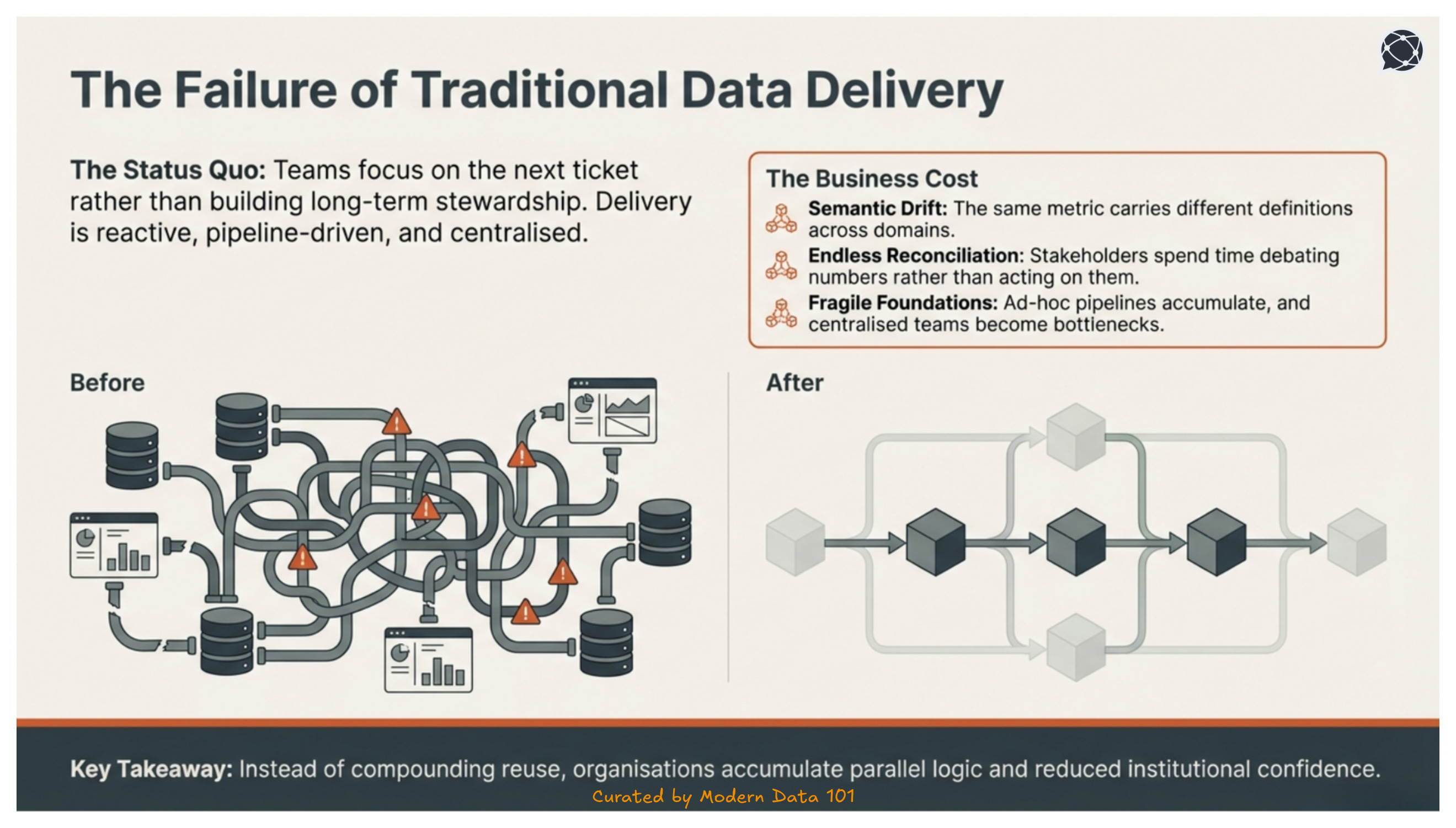
Multiple disadvantages starting from systematic duplication, similar transformations for different use cases and finally, a semantic drift, and it is the same metric carrying different definitions across reports and domains.
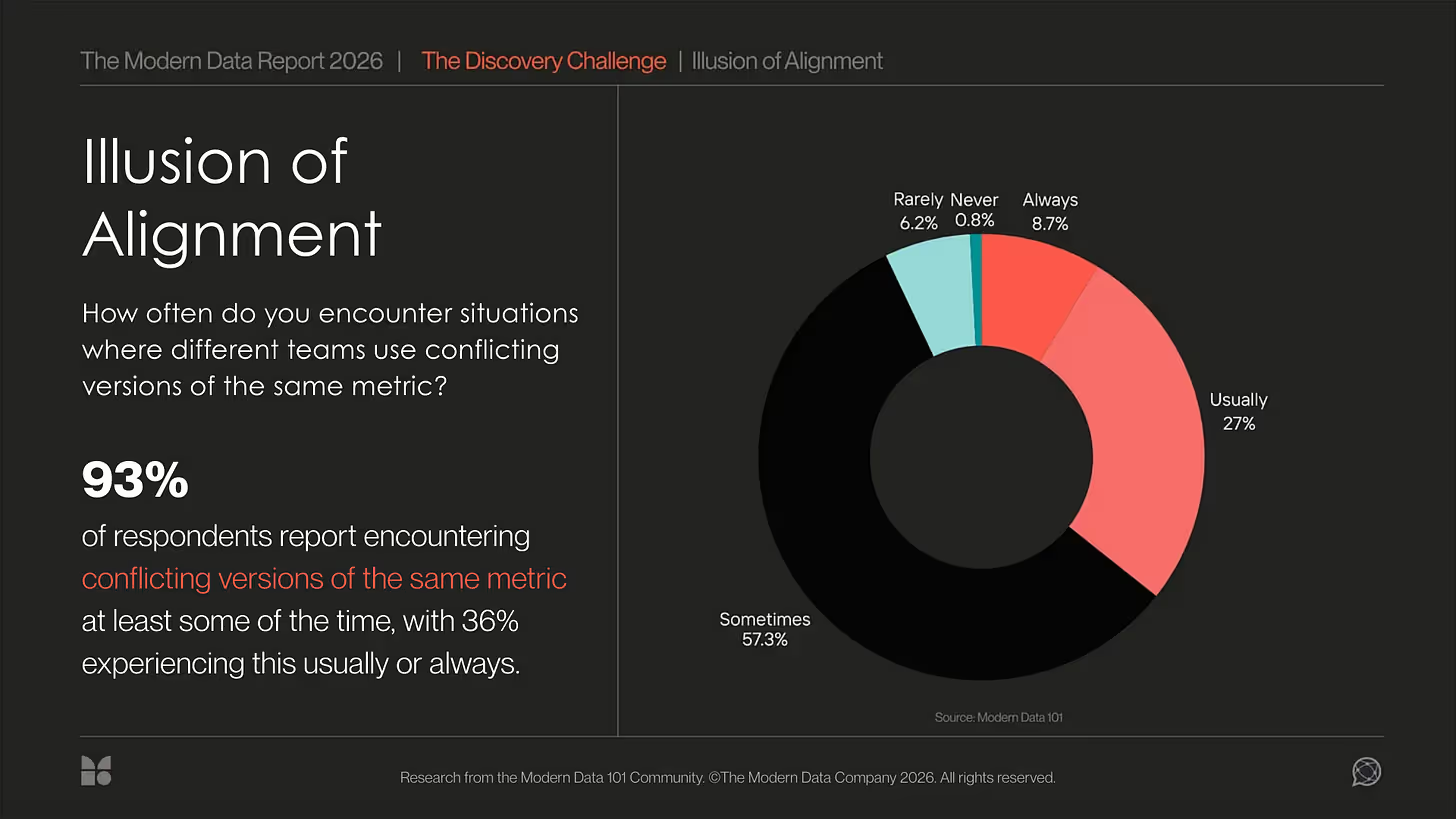
All this also leads to:
- Stakeholders reconciling numbers rather than acting on them.
- Rework cycles increasing due to inconsistencies in the decision process.
- Instead of compounding reusability, organisations accumulate parallel logic, inconsistent definitions, and fragile pipelines.
The cost is not only technical inefficiency but reduced decision velocity and institutional confidence.
Where Do Data Products Fit in the Data Architecture
A data stack includes tools for ingestion, transformation, storage, and visualisation in a modular and scalable manner. However, a data product still needs other components than this for operation to result in a governed, consumer-oriented asset that leverages the stack but is not defined by it.
In this sense, data products sit at the intersection of architecture and accountability, leading to the conversion of technical capability into durable, reusable decisions.
Also, a data product is a consumable outcome built on top of a data developer platform. The platform provides primitives; the product provides structured value: this is a platform thinking perspective that enables capabilities, storage, compute, access control, and observability.
Related read: Death to Data Pipelines: The Banana Peel Problem.
What is the Anatomy of a Data Product
To ensure that a data product has matured, it is important to understand that it does so through design. But when we strip down the idea even further, it opens up the gate towards first principles like a table, a transformation or an interface. But it takes a coordinated system along with responsibility and guarantee to create results with reliable outcomes.
For a data product, it is the integration that differentiates it from a well-modelled dataset. This is where each component has a role, and that role reflects durability. If you look at it, it is all interconnected: one gets removed, and others begin to lose context and purpose.
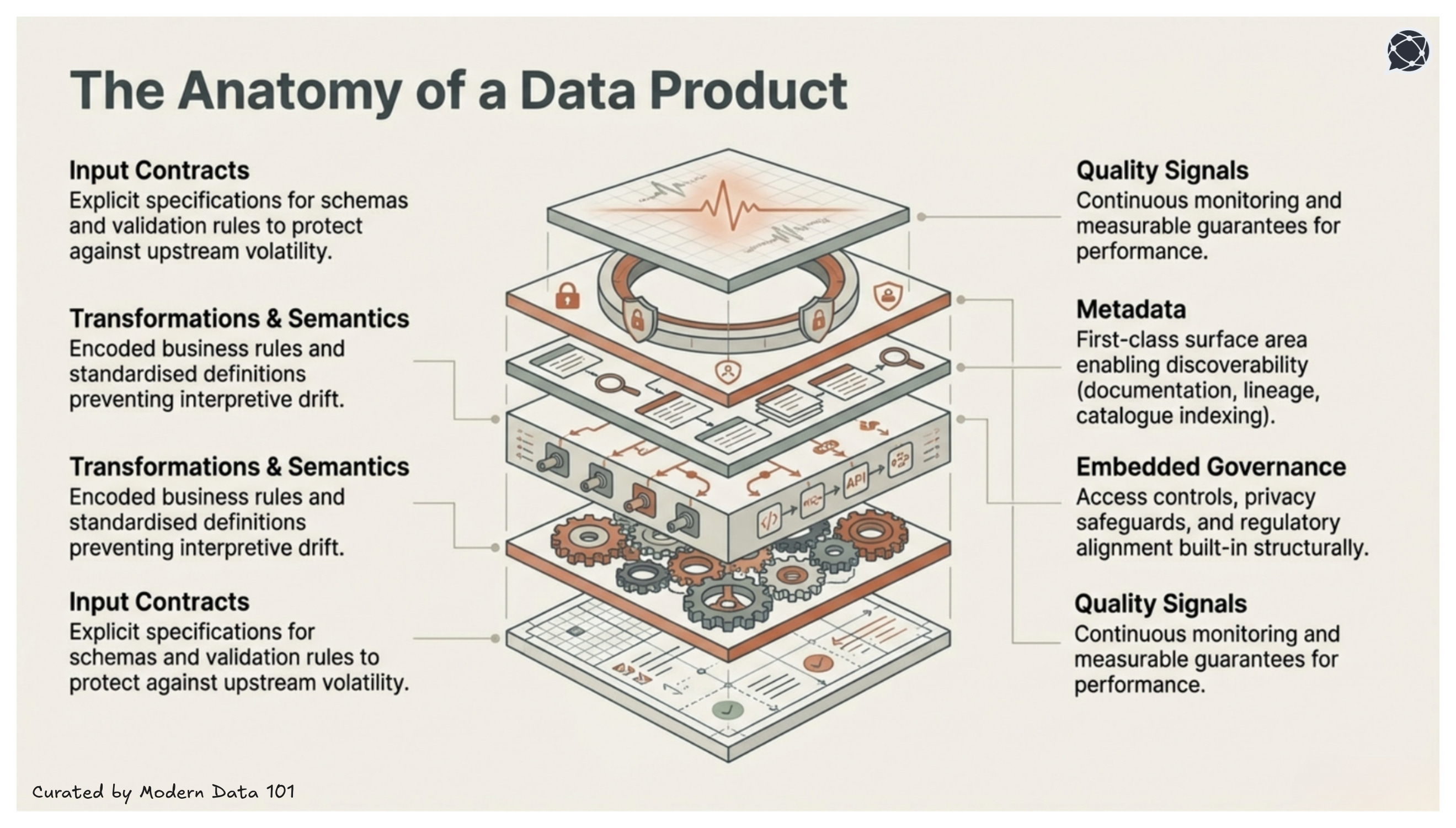
A mature data product is therefore not defined by a single artefact, but by a set of integrated elements that ensure PURPOSE, attribution, independence, stability, reusability, and governance at scale.
Input Contracts
Data products define structured input expectations. Source systems are integrated through explicit data contracts that specify schema, data types, validation rules, and change management processes. This reduces upstream volatility and protects downstream consumers from unexpected structural shifts.
Transformations and Semantics
Transformation logic is not merely technical manipulation. It encodes business rules, metric definitions, and domain logic. Semantics are documented and standardised to prevent interpretive drift. This layer ensures that derived metrics remain consistent across consumption contexts.
Output Interfaces
A data product exposes deliberate access mechanisms, such as SQL endpoints, APIs, governed data shares, or derived views. These interfaces are stable, versioned when necessary, and designed for predictable consumption patterns.
Metadata as First-Class Surface Area
Documentation, data lineage, ownership details, data classifications, and usage guidance are treated as part of the product itself. Metadata is not an afterthought; it is a primary interface that enables discoverability and trust.
DataCamp notes that metadata and documentation are core to making data products user-friendly, discoverable, and reusable as key factors that distinguish them from unmanaged data artefacts.
Embedded Governance
Access controls, policy enforcement, regulatory alignment, and data protection mechanisms are integrated into the product’s design. Governance is implemented structurally rather than retrofitted through manual review processes.
Quality Signals and Guarantees
A data product defines measurable quality thresholds, such as freshness, completeness, accuracy, and reliability. Monitoring systems track these indicators continuously. Where appropriate, service-level guarantees formalise expectations for availability and performance.
[related-3]
Consumption Patterns
Usage is anticipated and observed. Whether supporting analytical queries, operational systems, machine learning workflows, or reporting tools, the product is shaped around repeatable consumption scenarios. Over time, usage insights and data usage analytics inform iteration and prioritisation.
What are the Core Features of a Data Product
It is not that organisations don’t have data or lack the commitment to it. The problem lies in stability in reusability.
To understand this, one should know that a data product is not defined by the volume it holds but by the standards that uphold it. It’s not the table but the guarantee around it, the ownership behind the definitions and its predictable behaviour under scale.
That’s the key to having a data product: it can be utilised without teams having to revalidate every assumption. And most importantly, there's an assurance across the data value chain that the direct impact and value of the data product can be tracked, evaluated, measured, and attributed, enabling an ability like never before to activate or deactivate data efforts and data resources strategically.
Following are the data product features than make this feasible at scale:
Purpose-Driven and Valuable
A data product without an intent or a purpose doesn’t serve any demonstrable value and is as valuable as an other asset.
Ranging from analytical insights to operational decisions and even downstream automation, a data product aligns its structure and freshness to align itself with serving a guarantee of a defined business outcome. Right-to-left engineering enables this by reverse engineering from the desired business outcome itself.
So, every aspect of the data product bundle, including its code, metadata, infrastructure resources, and data assets, and success of data contracts is directly aligned to a purpose.
Discoverable and Natively Accessible
A data product that is not easily accessible is as good as a data asset that doesn’t even exist.
To ensure discoverability and native accessibility, a data product must always be indexed in a searchable catalogue along with clear ownership, metadata, definitions and appropriate guidance on usage. And this is enabled through seamlessly through the depot construct (an infrastructure resource) that assigns unique universal address, allowing product calls or sub-asset calls from across the data ecosystem (internal or external sub-systems).
These depots are also policy-controlled at the granular level, automated through contract-triggers, and self-governed at scale. A data product should be consumable across environments, through stable interfaces, APIs, or query endpoints, without manual and unnecessary mediation.
Trustworthy with Explicit SLAs
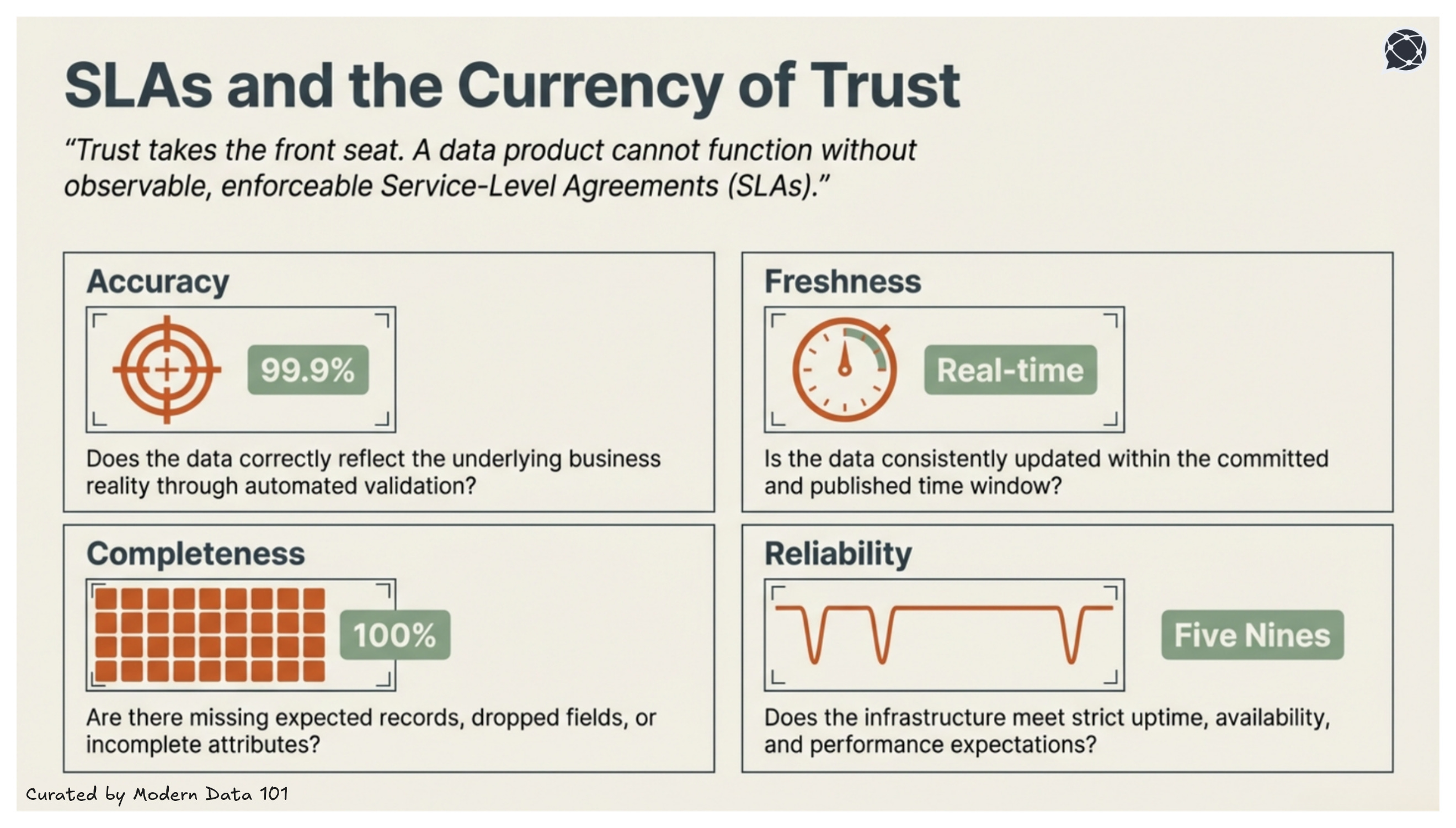
A data product must be observable through mechanisms that can guarantee its transparent quality signals and enforceable service expectations.
Just like with any business, trust takes the front seat, and a commitment to measurable outcomes is a basic expectation. A data product won’t pass data quality criteria involved in a service-level agreement (SLA), which is usually based on:
- Accuracy
- Freshness
- Completeness
- Availability
- Performance
Governance, Security, and Policy Enforcement (Built-In)
Embedded governance is a fundamental expectation of the current data stack. It is a mechanism that sustains governance and quality expectations at every interface of the data product.
Governance also consists of several factors like security controls, privacy safeguards and implementing policies. Meaning it is not a separate concern, but instead, something that contributes to access management and value-enablement.
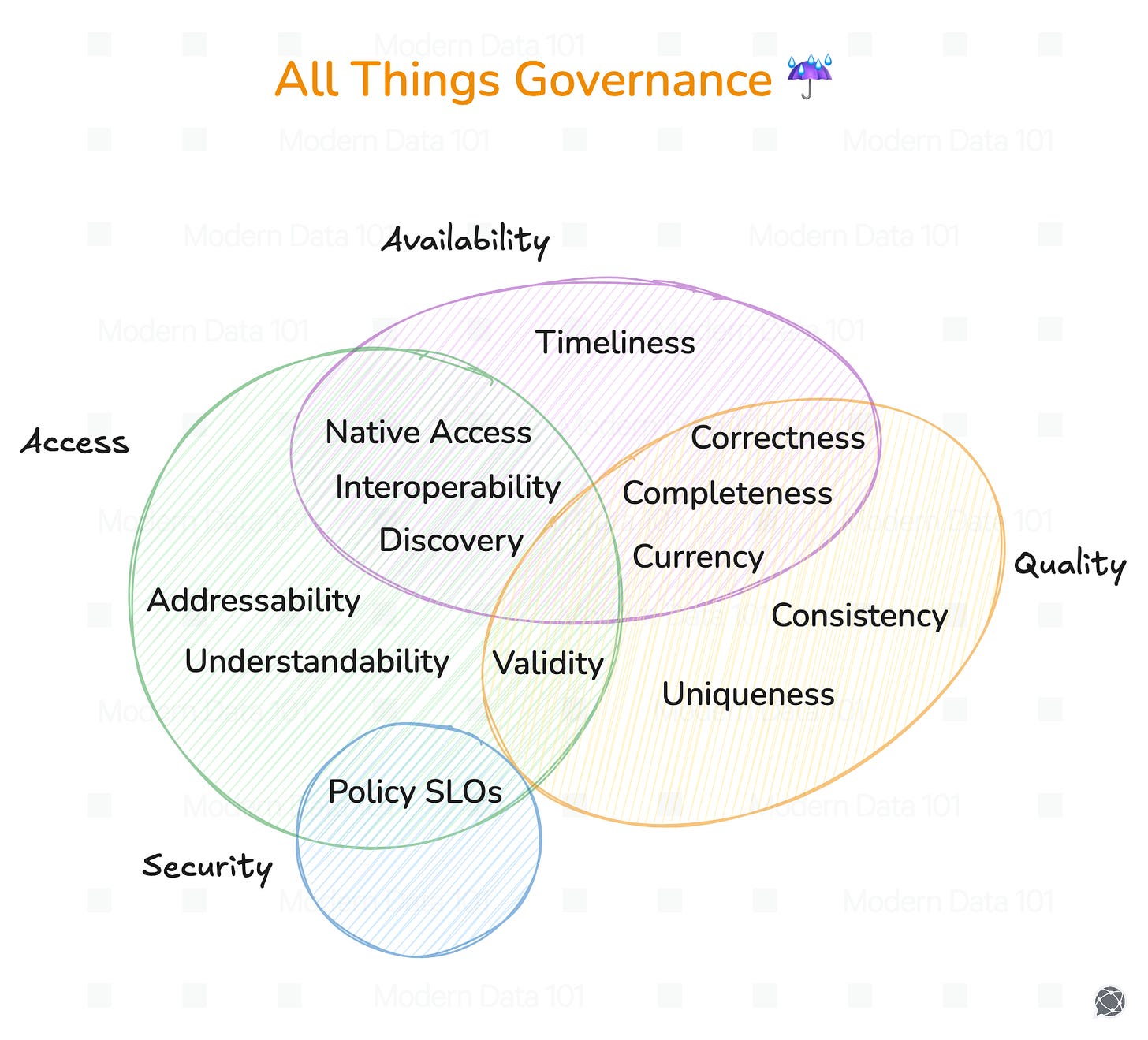
This makes a data product systematic, traceable, and aligned with regulatory and organisational constraints.
Reusable and Interoperable by Design
What majorly differentiates a dataset from a data product is its capability to be reused like a concrete product due to its stable definitions and consistent semantics. This allows consumers to use it widely without having to constantly worry about rebuilding transformations. Consider the value in reusing not just the data product, bust aspects of it as well including forking transformations, policy granules, and contract essentials (SLAs).
Additionally, this ensures compatibility across other data products along with other tools and domains. But it’s the reusability factor of a data product that prevents fragmentation and enables scale.
[related-9]
Versioned and Sustainably Operated
To prevent downstream consumers from unexpected shifts, change is required to be controlled to a certain degree while being transparent in nature. This is where structural and semantic updates come into the picture to put the user-first perspective in focus.
This leads to performance expectations being monitored, while cost implications are visible to ensure sustainable operation. Ideally, a product must remain stable, performant, and economically viable as adoption grows.
What Are the Key Types of Data Products in Modern Enterprises
What are the different types of data products?
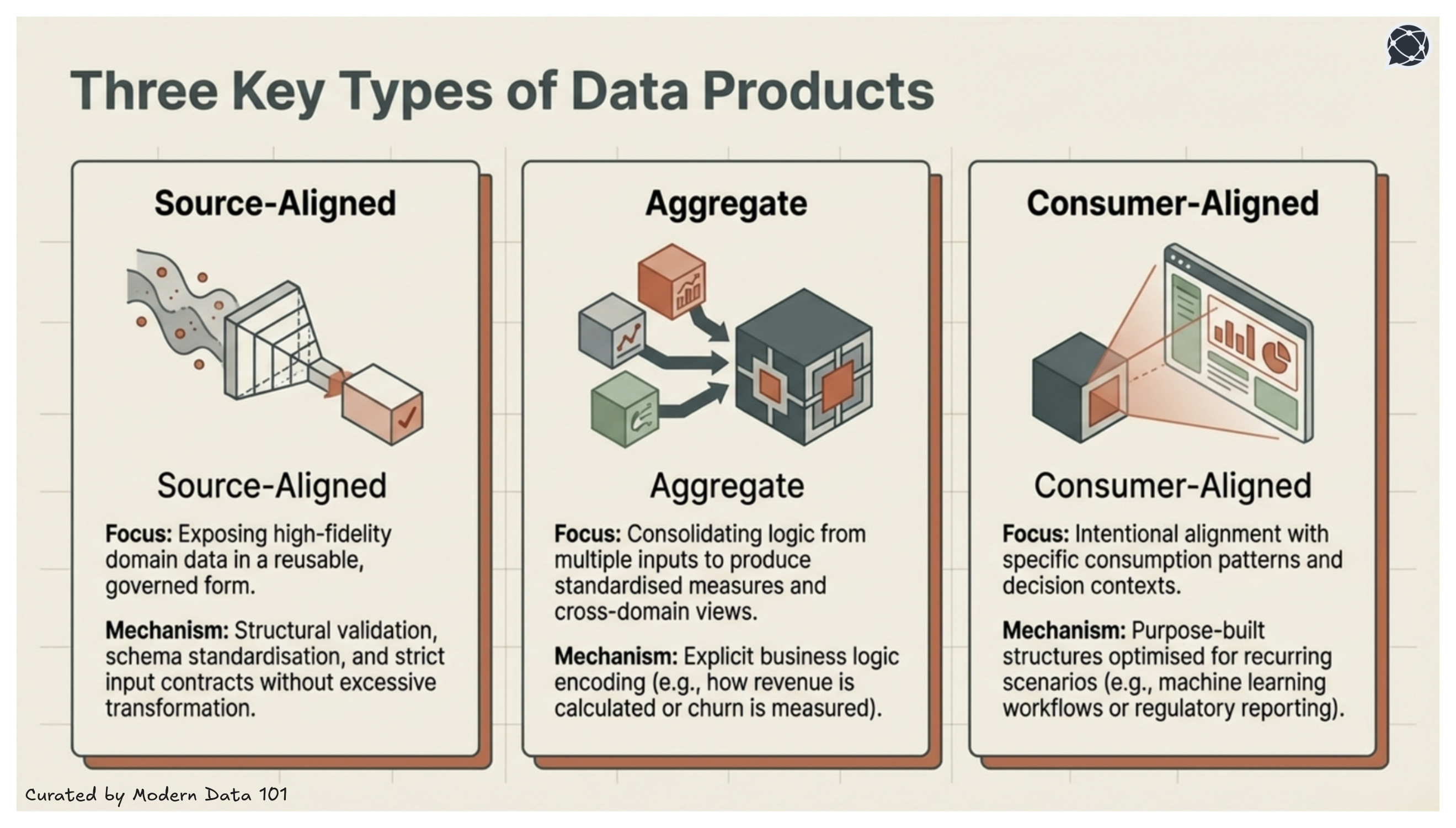
The three core types are source-aligned data products (raw domain data, minimally transformed), aggregate data products (combining multiple sources into standardised metrics), and consumer-aligned data products (built around a specific business use case or decision).
Since all data products are not created to serve the same purpose, utilising them interchangeably can lead to poor design decisions. So, a data product’s structure and scope are determined by the role it serves in the broader data value chain.
And this is why it is important to identify these distinctions to enable leaders and architects to design products that complement one another. This also ensures preventing competition, duplicated logic, and fragmentation.
Source-Aligned Data Products
Source-aligned data products serve the primary purpose of exposing domain data in a reusable form that is also governed and structured, without any excessive transformation. It is the one that is closely aligned to operational systems.
Rather than deriving the value from aggregation or interpretation, these data products thrive on stability and reusability. This is achieved through preserving high-fidelity representations of business entities and applying structural validation, schema standardisation, and input contracts.
Aggregate Data Products
Aggregate data products consolidate logic from multiple inputs, which requires strong semantic discipline and clear quality thresholds. These data products not only operate at the insight layer but also combine multiple domain-aligned sources to produce standardised measures, derived entities, and cross-domain analytics views.
These data products encode business logic explicitly, defining how revenue is calculated, how churn is measured, or how performance indicators roll up across segments.
Due to their core characteristics, aggregate products’ reliability directly influences organisational trust in metrics. And these are often foundational to reporting, performance tracking, and strategic planning.
Consumer-Aligned Data Products
Consumer-aligned data products are designed around specific business use cases or decision contexts. Their defining characteristic is intentional alignment with defined consumption patterns, including latency expectations, access interfaces, and service guarantees.
These may support regulatory reporting, machine learning workflows, embedded analytics, or operational decision engines. Rather than reflecting a single source or domain boundary, they shape data into purpose-built structures optimised for recurring data consumption and usage scenarios.
While closer to business outcomes, they still rely on stable upstream source-aligned and aggregate products to maintain consistency.
[related-4]
What are the Stages in the Data Product Lifecycle
What is the Data Product Lifecycle?
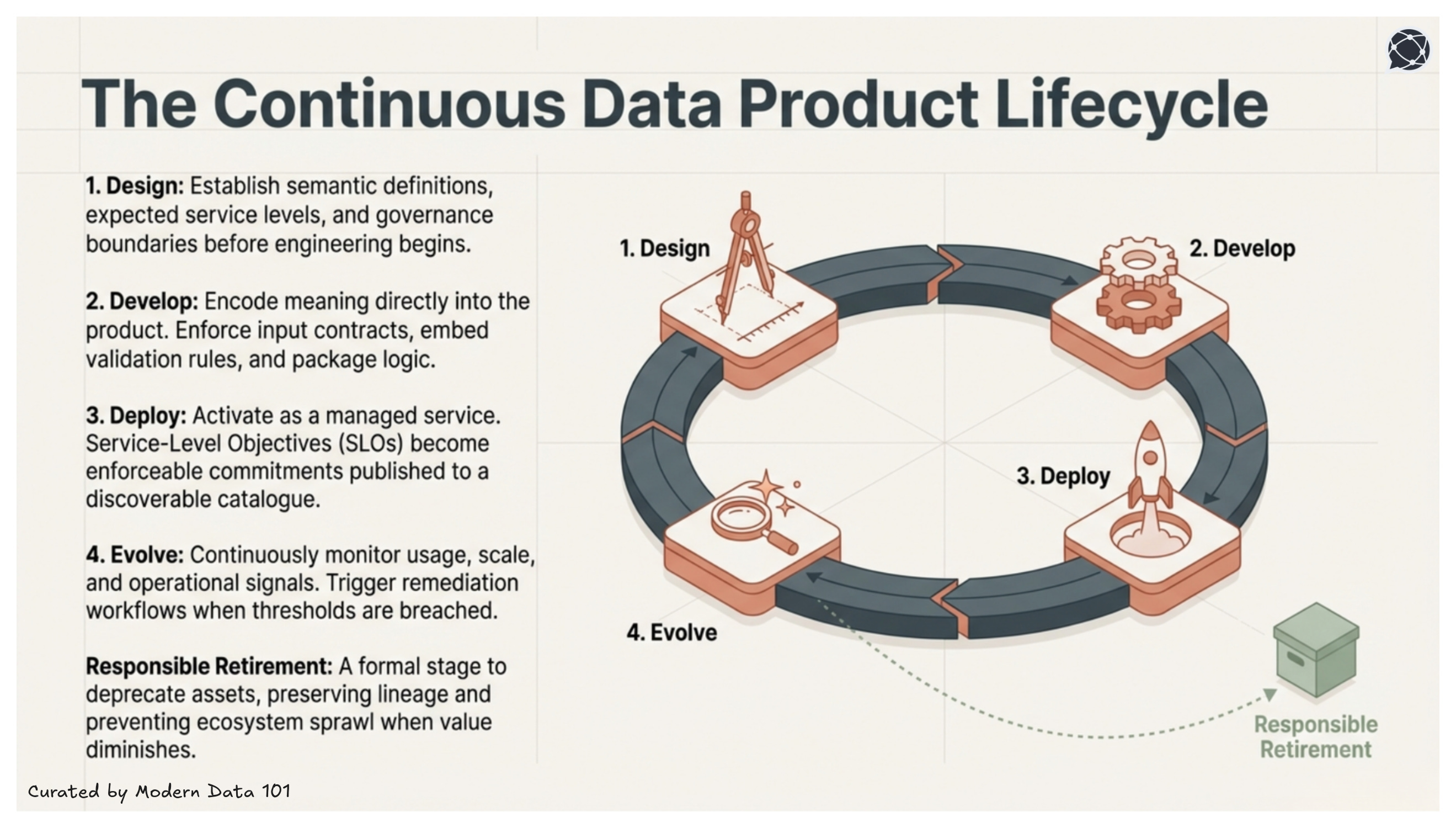
The Data Product Lifecycle is the continuous process of capturing raw reality, shaping it into consumable forms for specific consumers (humans or machines), activating it in production, and evolving it based on how that consumption resolves uncertainty. In other words, the data product lifecycle preserves and shapes reality for different consumers over time.
The data product lifecycle has four stages, starting from design stage that sets the intent, develop stage that implements the data product specifications, and deploy stage that delivers the expectations to downstream consumers. In addition to this, it is the evolve stage that tests the above against real use cases, gathers feedback and incorporates it in the next design decision.
1. Designing a Data Product for Business Impact
How do you design a data product?
The design stage is the initial and most critical phase of the data product lifecycle, where the primary objective is to work backwards from a problem to identify consumers and their specific needs before any development begins.This stage is comprised of several key components:
- Focus on Problem-Solving: This stage prioritises working backwards from a problem by identifying consumers and their specific needs before development begins.
- Market Research & User Journeys: Teams validate data value in the market, identify personas, and map user journeys to surface specific pain points.
- Metric Identification: Efforts are tied to high-level business metrics (e.g., ROI, P&L) to ensure data initiatives drive actual business value.
- Semantic Engineering: This involves defining ownership through a RACI matrix and creating semantic data models that are decoupled from physical data to define business entities and relationships.
- Validation: Before development, models are tested using "Mock Data as a Service" to simulate impacts on KPIs and reduce rework
[related-5]
2. Developing a Reliable Data Product
What does data product development involve?
Data product development is the stage where engineers turn the design's requirements into a working product, wiring up pipelines, governance policies, and quality checks through a single interface, so that what ships matches exactly what was specified.
The develop stage (Stage 2) of the data product lifecycle is the phase where data developers build the actual product based on the requirements and metrics established during the design stage. During this phase, business users primarily act as observers while developers integrate the technical stacks, data pipelines, and governance policies required to create a functional data product.
Key aspects of the development stage include:
- Unified Developer Experience: Developers access all necessary technical stacks and resources (depots, policies, workflows) through a single, common interface.
- Consolidated Codebase: All code for the data product, including transformations, quality jobs, and policies, is managed in one repository for better version control and release management.
- Programming Flexibility: Platforms support various paradigms (Python, Spark, Flink) and provide SDKs so developers can work in familiar environments.
- Dynamic Configurations: Workflows use config-based transformations, allowing developers to change input/output parameters without needing to redeploy entire images.
- Reusability: Existing data products and workflows are discoverable in a catalog, allowing teams to duplicate and adapt proven resources for new use cases
The output of this is treated as a single entity to serve the purpose of product traceability, reproducibility, and consistent deployment across environments.
[related-6]
3. Deploying Data Products with Service Guarantees
The deploy stage (Stage 3) is considered the "crux" of the data product lifecycle, primarily focused on providing an optimum developer experience. It shifts the focus from building individual components to launching a unified, functional data product through a self-serve platform that abstracts underlying infrastructure complexities.
Key components and processes of the deployment stage include:
- Declarative "Bundles": Resources are deployed as a Bundle, which orchestrates code, infrastructure, and metadata as a single, standardised unit.
- Single-Command Operations: The Apply, Get, and Delete commands allow developers to experiment, validate, and launch resources in test and production environments iteratively.
- Scaffolding: Pre-built templates (scaffolds) provide the foundational structure for ports and SLOs, enabling developers to focus on custom logic.
- Resource Isolation: Data products are assigned isolated namespaces or "Workspaces" for compute and storage to prevent interference between different products.
- Automated Cataloging: Upon deployment, metadata (lineage, schema, quality conditions) is instantly populated into an open catalog for discovery
[related-7]
4. Evolving Data Products Over Time
The evolve stage (Stage 4) is the final, continuous phase of the data product lifecycle that acts as a bridge back to the initial design stage. Rather than being a linear endpoint, it is an iterative process focused on the "fitness" and optimisation of the data product to ensure long-term business value.
Key components and capabilities of the evolve stage include:
- Continuous Fitness Monitoring: This phase uses "fitness functions" to measure how well an architecture achieves its aims, focusing on quality, security, and scalability.
- Feedback Loops: It establishes a bridge between consumers and developers, allowing users to request new features or report issues directly through a catalog interface.
- Metric Tree & SLOs: Teams use a metric tree to monitor all touchpoints; this knowledge is used to optimise and evolve SLOs based on real-world usage.
- Resource Optimisation: Usage metrics at the bundle and pod levels allow teams to de-provision or scale resources to maintain cost-effectiveness.
- Automated Maintenance: Through Dynamic Configuration Management, developers can reflect changes across all dependent environments by updating a single specification file.
- Advanced RCA: Enhanced observability and lineage tracking allow developers to quickly perform Root Cause Analysis (RCA) when incidents occur.
[related-8]
How to Measure Data Products
Value measurement is the key USP of data products, given how it enables a clear path to measure multiple aspects tied to one business goal in one bounded bundle.
Measurement matters more than portfolio size. Inventorying data products, classifying them by domain or business, and knowing their counts and distribution is a great start to managing a portfolio of data products, but measuring data products isn't just about tracking metrics. It's about driving and understanding value. A well-labelled shelf of unused products is still a losing strategy. Measurement closes the gap between existence and impact.
Many organisations struggle to measure effectiveness systematically. Countless dashboards and curated datasets exist in varying stages of maturity, use, and age. This is a direct consequence of treating data solutions as projects rather than products: projects optimise deadlines while products optimise ongoing outcomes.
Products optimise ongoing outcomes, which are measured by adoption, quality, and business impact. It starts with understanding why the data exists and who it serves, then defines quality, usability, and success metrics upfront. Without this shift in orientation, no measurement framework will hold. You'll always be measuring outputs, never outcomes. See DORA metrics for a comparable product-health orientation from the software engineering world.
Data Quality & Health: Is the Product Trusted?
A data product adheres to rigorous quality assurance processes and data governance principles. It ensures that data is accurate, reliable, and transparently sourced, instilling trust and confidence in the insights or outputs it provides.
Trust is the precondition for all downstream measurement: adoption, ROI, and business impact metrics are meaningless if the data itself is suspect.
Quantitative measures:
- Composite Quality Score: Quality checks across Accuracy, Completeness, Freshness, Schema, Uniqueness, and Validity give a structured pass/fail view. Trend charts show the percentage of SLO compliance over time, with 100% indicating full compliance. Track this as a time series, not a point-in-time snapshot: degradation trends matter more than any single reading. The Soda Stack in the data operating system operationalises exactly this kind of SLO-linked quality monitoring.
- SLO Adherence Rate: SLOs guide architecture, operations, and observability decisions across performance, scalability, reliability, data quality (completeness, freshness, accuracy), and governance (compliance with regulations like GDPR, HIPAA). SLOs without adherence tracking are just aspirations. Define breach thresholds and automated alerts before launch, not after. Compare with Google's SRE approach to SLOs for operational rigour.
- Metadata Compliance Rate: Percentage adherence to metadata standards like business glossary terms, data lineage documentation, and ownership fields. Stack-integrated catalogs like Metis offer detailed insights into the input, output, and SLOs for every data product, along with governance policies, associated code, and infrastructure resources used for creating it. Users can track the entire lifecycle of data product creation. Poor metadata compliance directly suppresses discoverability and is the silent killer of cross-team adoption.
Qualitative measures:
- Subject Matter Expert Attestations; Periodic sign-offs from domain experts confirming the product still reflects current business reality. These catch semantic drift that automated checks miss entirely, especially critical for aggregate and consumer products.
- Documentation Completeness: Evaluate supporting materials, data dictionaries, and usage guides. Data products are delivered with the context business teams need, like clear definitions, business logic, lineage, and usage guidance. That means fewer misunderstandings and smoother conversations across teams. Poor documentation is where good products go to die quietly. The FAIR data principles (Findable, Accessible, Interoperable, Reusable) are a useful external benchmark for documentation standards.
Adoption & Usage: Is Anyone Actually Using the Data Product?
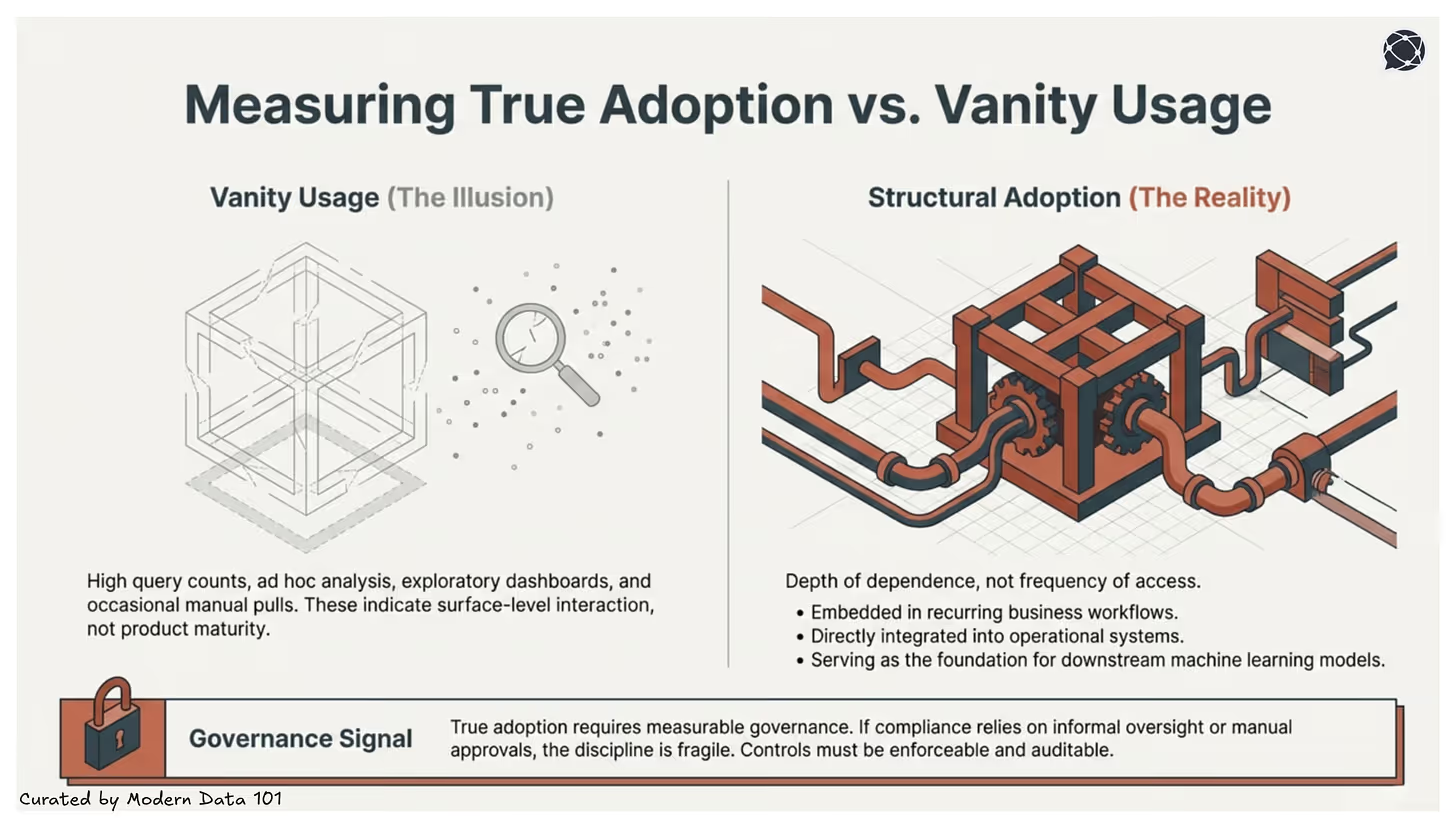
By dedicatedly focusing on broader user adoption as the primary North Star of platform engineering teams, platforms evolve into being more user-friendly, with more intuitive features that deliver embedded experiences.
The same logic applies at the product level: adoption isn't a vanity metric, it's the primary signal that a product is solving a real problem.
Quantitative measures:
- Active User Count by Segment: Track unique consumers (users, applications, AI agents) broken down by domain, role, and team. A product used by 15 teams is categorically different from one used by 15 people on the same team. A Data Product Hub provides lineage, quality metrics, usage patterns, governance details, semantic definitions, and documentation, giving a central layer for generating APIs and connecting to BI/analytics tools and AI/ML tools.
- Usage Frequency & Pattern Analysis: An internal data product can impact either revenue/cash flow or cost savings. When a team has a task that takes 15 hours a month, like preparing an investor's report, and an internal product reduces this time by ten hours, that's measurable time saved linked directly to usage. Irregular or bursty usage patterns often signal that the product serves reports rather than live decisions; a meaningful distinction for prioritisation.
- Reuse Rate Across Domains: When a single product serves multiple use cases without requiring duplication or rework, it creates a compounding return. Think of a customer profile data product reused across marketing campaigns, customer support analytics, and personalisation engines. That's when the value of a data product really starts to scale. Cross-domain reuse is your highest-ROI adoption signal; track it explicitly, not just total query counts.
Qualitative measures:
- Use Case Coverage Documentation: Maintain a live log of which business processes and workflows the product actively supports. A product serving three clearly documented use cases is dramatically more defensible in a portfolio review than one with high query volumes and no documented purpose.
- User Feedback Loops: Drive adoption with usage insights. Analyse product usage, prioritise improvements, and track performance to ensure relevance and value. Structured sessions with active consumers are the primary mechanism for detecting relevance decay before it shows up in usage drop-off. See Teresa Torres's continuous discovery framework for a structured approach to product-level user research.
Performance & Reliability: Is the Data Product Doing What it Promised?
Teams iterate and monitor over time, treating data products as dynamic entities with owners, service level objectives (SLOs), and feedback loops. This mindset introduces ownership, governance, and continuous improvement, ensuring data becomes a durable, evolving business entity rather than a one-time deliverable.
Quantitative measures:
- System Performance (Availability + Latency): Organisations using a data operating system report up to 90% faster time to insight, 70% faster reporting through standardised metrics, and up to 50% savings on total data costs. These are the outcome benchmarks: the leading indicators are availability rate and query response time per SLO tier. Benchmark against your own product contracts, not generic industry norms. A batch product and a real-time feature store have fundamentally different thresholds.
- Change Failure Rate & Mean Time to Recovery (MTTR): Mean Time to Recovery is particularly relevant in the data context. Things break without you even touching them, just because something upstream changed. This metric measures the time between incident reporting and restoration in production. If you can measure it, use the first incident appearance as the start time, since that also gives feedback on how quickly problems are recognised. Pair with DORA metrics for a complete engineering health picture.
- Control Port Metrics: Control Ports are used for monitoring, logging, and managing the Data Product. They facilitate performance tracking and operational metrics through monitoring and logging, and offer access to metadata such as ownership, organisational unit, licensing, and versioning. These are your real-time telemetry feeds. If Control Ports aren't instrumented, you're flying blind on operational health.
Qualitative measures:
- Consumer Satisfaction (CSAT/NPS): Run these at the product level, not just the platform level. A high platform NPS can mask a specific product that frustrates its primary users daily.
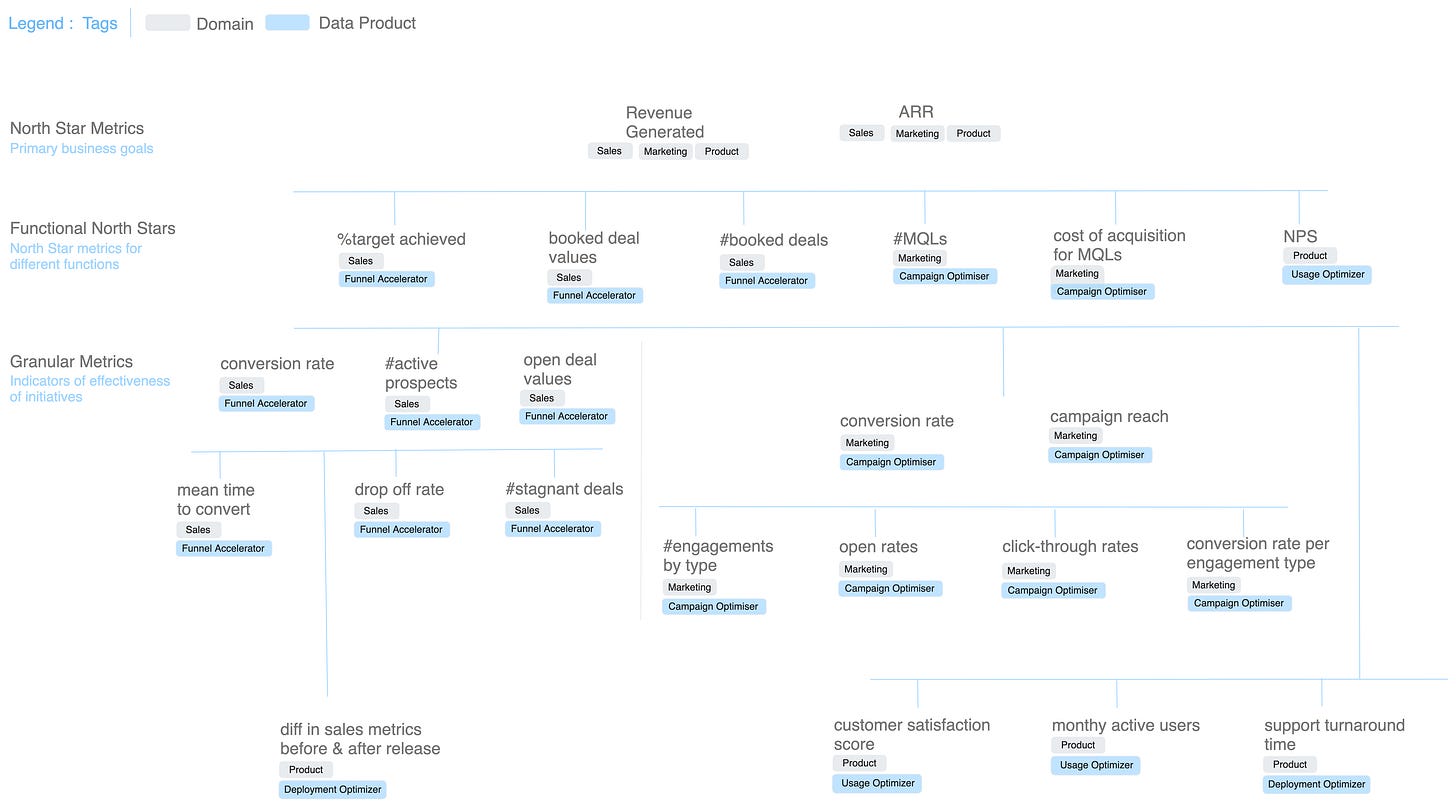
- Business Impact Attribution: Implementing the right strategy for building data products involves identifying primary business objectives or the North Star goals. Metrics like ARR and Revenue are prime North Star goals for any business. Every function strives to pump these goals by enhancing their distinct north stars: %Target Achieved for Sales, #MQLs for Marketing, or NPS for Product. These qualitative conversations with domain owners are how you establish the causal link before you can measure it quantitatively.
Becoming Metrics-First: Are Your Data Product Metrics Actually Connected to Business?
A Metric Tree is a hierarchy of numbers which expresses how a business creates value. It starts with a North Star metric and decomposes it into its components and controllable levers. This structure turns business performance into a navigable system.
Analysts stop chasing disconnected KPIs and start reasoning through dependencies. Metric Trees expose causality: where an improvement will actually matter and how interventions cascade through the business.
- Build a Metric Dependency Tree First: Every domain is looking to work with data for better decision-making. To make a data product strategy truly successful, pin down the key business goals of different functions, the question domains that need to be answered, and the dependencies between metrics: North Star metrics, granular metrics, and associations between them. Without a tree, you end up with 80 metrics and no clear line to a single business objective. This transparent metric tree approach illustrates how this gives CMOs and CDOs direct visibility into which tracks are fuelling or pulling down primary KPIs.
- Semantic Layer as the Measurement Interface: If Metric Trees describe how value flows, the Semantic Model defines how it is measured. It is the layer where metrics gain formal definitions, lineage, and governance: a source of truth that sits between raw data and every analytical tool. Without a semantic layer, the same metric defined three different ways by three different teams means the Metric Tree is a theoretical construct, not a measurement instrument. DataOS's Lens creates and manages semantic models directly within the data product.
- Filter Through a Prioritisation Framework: The metric model needs to pass through a prioritisation filter (a concrete product strategy) that enables you to substantiate the model with its true value proposition and prioritise efforts behind metrics resourcefully. Substack The BCG growth-share matrix applied to metric prioritisation (Stars, Cash Cows, Question Marks, Pets) is a practical tool for deciding which metric tracks to invest in versus retire. See the Speed-to-Value Funnel for the full prioritisation walkthrough.
ROI Measurement: Is this Data Product Investment Worth it?
A great ROI measurement framework should account for both tangible and intangible value. Data products are never responsible for creating direct revenue. What they do is enable operational efficiency, reduce risks, and increase the trust quotient of gathered insights, contributing to business value in the long run. Treating data product ROI as a direct revenue attribution exercise will always disappoint.
Three measurement models:
- Input-Output Efficiency Matrix: Evaluate inputs (compute resources, engineering hours, platform spend) against outputs (adoption, usage, time savings, delivered impact). Use this to quickly surface high-effort, low-impact products for redesign and low-effort, high-impact ones for scaling. The ratio between efficiency and value is what gets optimised. Compare with lean manufacturing's value-to-waste analysis as the foundational analogue.
- Data Product Value Stream Mapping: This lean method tracks every step from initial ideation to user adoption, highlighting delays, inefficiencies, and handoffs. It uncovers hidden costs and value, making delivery optimisation and impact scaling more tractable. Map the entire flow before instrumenting individual metrics: invisible handoffs are where time-to-value bleeds out silently.
- Total Cost of Ownership + Value Realisation: TCO factors in all cost components: development, deployment, maintenance, and governance. Combined with value-based metrics like process automation, risk reduction, and time-to-insight, the formula becomes: ROI = (Business Value - TCO) / TCO. A data operating system embeds governance directly into every data product through attribute-based access controls, data contracts, SLO monitoring, and a comprehensive governance framework, enforced automatically rather than applied manually, so compliance scales with usage without creating bottlenecks. Automating governance reduces a significant hidden TCO component that most teams fail to account for.
Outcome-driven KPIs that move the needle:
- Reduced Manual Reporting: Quantify hours reclaimed from previously manual, repetitive reporting tasks. Link this explicitly to analyst capacity freed for higher-value work. This is the most legible ROI narrative for non-technical stakeholders.
- Decision-to-Implementation Speed: Discovers how insights derived from a data product are applied to business actions in real-time, showing how tightly a product is embedded in operational workflows and how it drives execution.
- Self-Serve Rate: Empowering users to explore and extract value from data products without dependency on central data teams reduces turnaround time, lowers operational burden, and unlocks insights at scale, shifting data teams from service providers to product enablers. A rising self-serve rate is one of the clearest signals of a maturing data product. Track this via a Data Product Hub, which bridges IT-managed infrastructure and business teams directly.
Portfolio-Level Measurement: Is the Whole Greater than the Sum of its Parts?
- Multi-Level Scorecard: Roll individual product scorecards up to domain-level and enterprise-level views. Data products enable the possibility of a transparent metric tree: a web of associated metrics cutting across the entire vertical of data's journey. This gives decision-makers the ability to detect tracks fuelling primary business metrics/KPIs, detect tracks pulling down primary KPIs, and make informed calls on empowering or shutting down tracks without needing to be technically savvy.
- SLO Evolution as a Lifecycle Signal: SLO Evolution generates insights to build better SLOs or metrics that serve and measure the business better, by discovering better connectivity and detecting points of potential. Use Case Expansion follows: the more use cases a data product can serve, the higher its value. Post-deployment analysis of active state and consumption patterns brings to light new opportunities for more diverse and effective use cases. A data product whose SLOs have never been updated is likely a data product that's been forgotten, not matured.
- Portfolio Rationalisation Reviews: Conduct quarterly reviews using usage pattern analysis and value attestations. Data products built without alignment to a business outcome often see low adoption or unclear value. When a product supports a specific goal, like speeding up forecasts or improving customer actions, the impact is easier to measure. This clarity also helps teams decide what to invest in, what to scale, and what to retire.
Retirement criteria matter as much as launch criteria; without them, you get data product sprawl. See resources on data product governance for enterprise-scale portfolio management patterns.
How a Single Data Product Supports Multiple Business Use Cases
A well-designed data product supports multiple business use cases without losing integrity because it is built around a semantic model and a metric dependency tree, not around any single consumer's needs.
Business logic is defined once and reused everywhere: dashboards, notebooks, and applications all speak the same analytical language without redefining logic downstream. One definition of "Revenue," instead of three. This is what makes cross-domain reuse structurally safe rather than structurally fragile.
A data product is able to furnish multiple output ports based on the user's requirements: Experience Ports that serve a wide band of demands without any additional processing or transformation effort, ejecting the same data through different channels: HTTP, GraphQL, Postgres, Data APIs, LLM interfaces, and more.
Each new consumer draws from the same governed core; they just access it through a different door. Beneath that, data contracts instil trust in the underlying data product and encourage a "build once, use many times" model: codified SLOs governing quality, semantics, and schema across every exchange point, so a change caught at the contract level doesn't silently cascade into every downstream pipeline.
And because reusability is built in before modelling even begins through lineage graphs, metadata graphs, and a marketplace scan for existing templates that can be forked and customised, the product starts composable and stays that way, accumulating use cases as a feature rather than absorbing them as an unplanned liability.
The Canonical Core of a Data Product
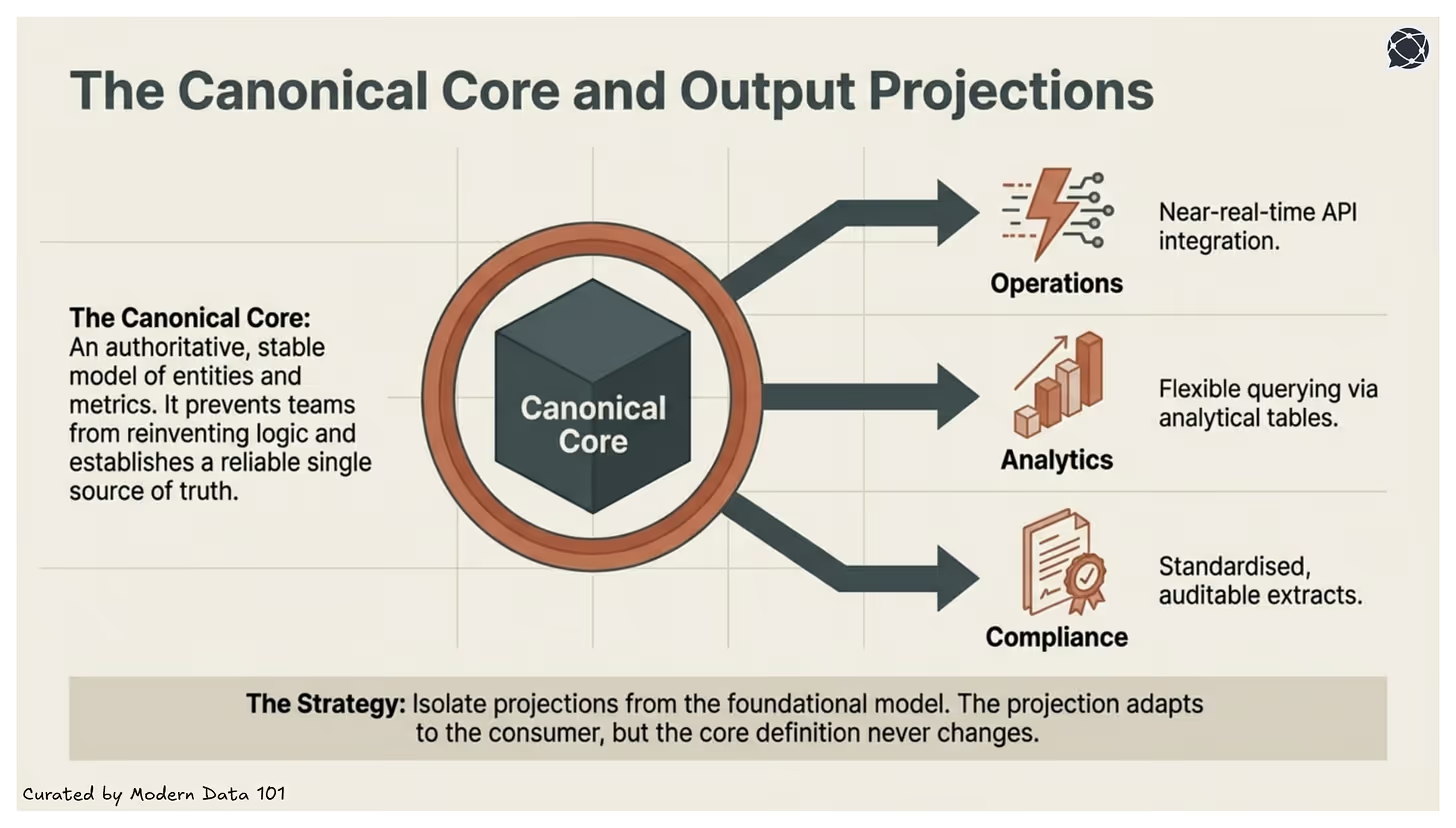
An authoritative and stable model is the centre of a well-designed data product, which consists of entities, metrics, and relationships and governs them deliberately.
This presents controlled changes and not reactive ones, which are also not distorted from a use-case-specific sense but instead are semantically consistent, versioned, and protected in nature. This also leads to deriving all downstream views. This is the core that creates structural reuse and also prevents teams from reinventing logic by reducing the semantic drift and establishing a reliable single source of truth.
Data Product Output Interfaces
Well-built and well-defined output ports become fundamental when we are enquiring about a data product’s maturity because different teams consume data differently:
- Operational systems require structured product integration.
- Analysts require flexible querying.
- Reporting environments require optimised views.
But a mature data product has a smarter way to deal with this. It exposes multiple output ports such as SQL views, APIs, data shares, streaming endpoints, or derived analytical tables, while keeping the foundational logic centralised.
This architectural separation allows one product to serve many contexts without sacrificing consistency. Here, only the projection changes, but the definition does not.
Multi-Use Data Products Across Operations, Analytics, and Compliance
The infrastructure and the core of a data product make a huge difference because, when built cautiously, they can lead to serving multiple decision layers simultaneously. It’s the alignment that is capable of replacing reconciliation and the trust that substitutes debate.
Check out: The Data Product Marketplace: A Single Interface for Business
For example:
- Operational workflows may require near-real-time access.
- Analytical use cases may require aggregated or historical views.
- Regulatory reporting may require standardised, auditable extracts.
By deriving each of these from the same canonical core, the organisation ensures that every decision context relies on identical foundational definitions.
Preventing Use-Case Drift in a Data Product
As adoption grows, pressure follows. New teams request customisations, edge cases multiply, and without discipline, the canonical core begins to bend toward individual demands. Over time, this results in duplicated transformations and semantic drift. A mature data product prevents this by isolating projections from the foundational model, keeping use-case logic modular while the core remains stable and governed.
Protecting the core is not rigidity. It is what makes durable reuse, composability, and long-term trust possible.
How to Practically Implement Data Products
Knowing what a data product is and knowing how to actually build and deploy one are two different organisational capabilities, and the gap between them is where most implementations break down.
Companies haven't figured out the right delivery operating model. Their waterfall process doesn't fit business needs, and shouting agile without implementing it properly doesn't work. Moreover, most traditional data stacks lack the foundational elements required to construct data products on top.
Practical implementation, then, isn't primarily a technology question. They are operational questions:
- who owns the product,
- what does the lifecycle look like,
- who is the user,
- and what business outcome is the product accountable for, before a single line of code is written.
The Most Important Stage of the Data Product Implementation
The Data Product 101 module frames this as a sequential journey through Design, Develop, Deploy, and Evolve, and the key insight is that the design stage carries the most weight. Organisations that skip it tend to build technically functional products that nobody adopts, because the product was designed around data availability rather than user need.
What separates implementations that compound in value from ones that decay is the discipline of working backwards from the business problem before touching the data. A product approach means identifying the consumer and their problems before kickstarting any effort: mapping all data efforts to specific business goals, metrics, and challenges.
The first and most critical stage is thorough market research: finding out the validity of your data in your consumer market, surfacing the users and personas the data product can optimally serve, and then mapping out their pain points across the user journey. From that foundation, a metric model is drafted (a stable map from granular sub-metrics up to North Star business goals) before the semantic model and physical data mapping begin.
This sequencing is what determines whether a data product accumulates use cases as an asset or accumulates technical debt as a liability. Research on product-led organisations from Harvard Business School consistently shows that organisations anchoring products to measurable user outcomes before building, sustain higher adoption and longer product lifespans, and data products are no exception.
Below are a few implementation examples that should illustrate the journey from a 10k feet view:
Customer 360 Data Product Implementation
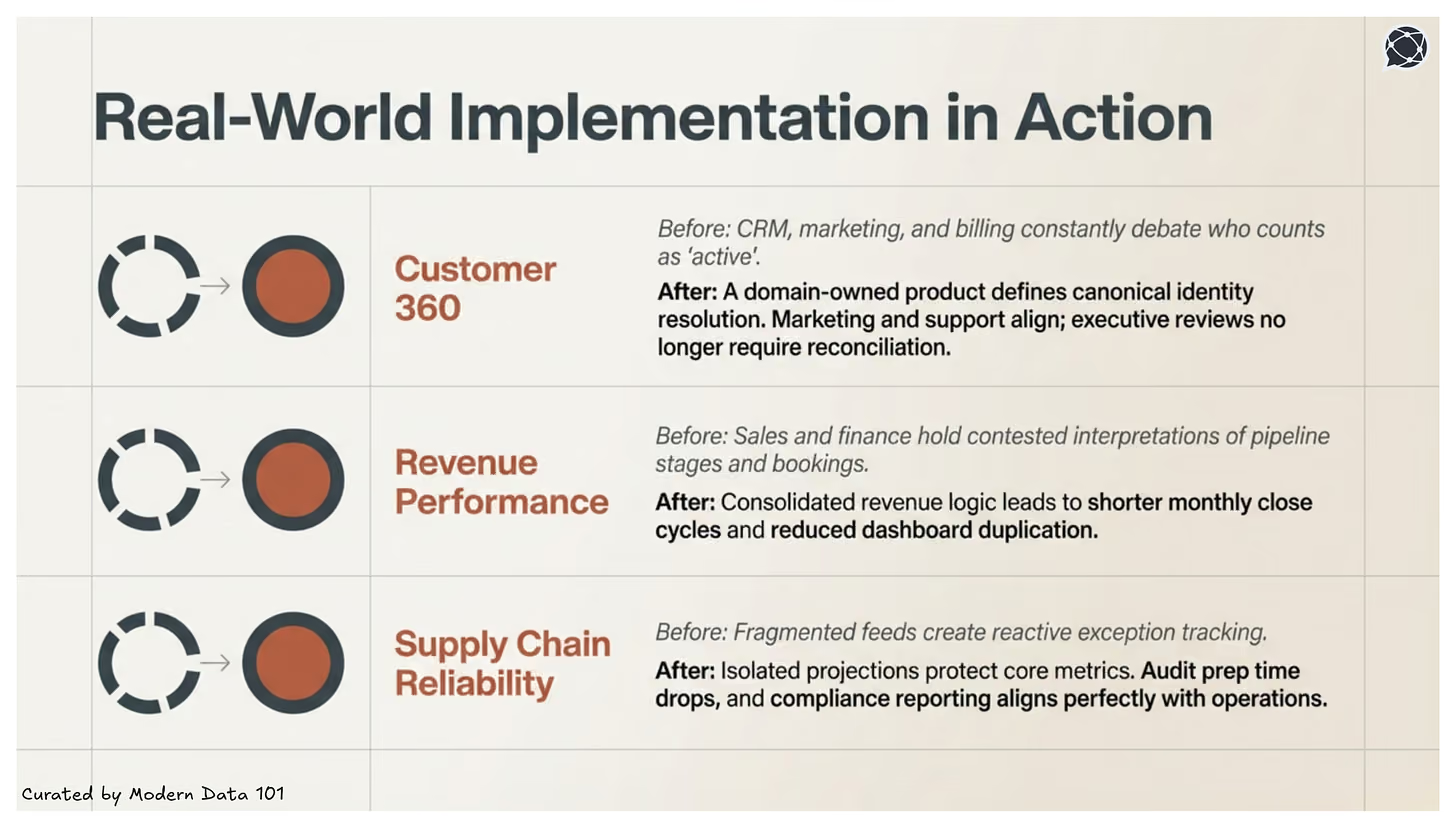
The core implementation challenge for a Customer 360 Data Product isn't getting the data, but it's resolving definitional conflicts across the domains that own it. Before any source is connected, align on what the product must answer: what counts as an "active customer," how "lifetime value" is calculated, and which system holds the authoritative customer ID.
Step 1: Design the semantic model first
- Map every domain that touches customer data: CRM, support, billing, product usage
- Define logical tables with dimensions like customer demographics and product details, measures like purchase frequency and total spending, and relationships that link customer purchases to products.
- Standardise metric definitions across departments: finance, sales, and marketing must operate from the same definition of "revenue" and "active customer" before a single source is mapped.
Step 2: Build source-aligned products as foundations
- Multiple consumer-aligned data products can share the same set of source-aligned data products: Customer, Product, and Sales data can support marketing campaigns, cross-sell opportunities, and Customer 360 use cases, all from shared underlying sources.
- This is what allows a single well-built Customer 360 to serve marketing segmentation, sales qualification, customer success health scoring, and AI personalisation simultaneously, without diverging into four separate pipelines
Step 3: Enable reuse through templatisation
- If a customer upselling model is being developed, an existing Customer 360 template can be partially forked to avoid recreating the basic structure of the new model from scratch: these templates are ideally available in a data product marketplace where standard industry-specific designs are published as successful models are deployed.
- Publish the semantic model to a Data Product Hub so downstream teams can discover, activate, and consume it via consistent APIs without engineering handoffs.
Step 4: Enforce governance at the product layer, not the consumer layer
- Apply attribute-based access controls at the data product level so different teams get role-based views from one governed product instead of separate copies with separate policies
- Academic research on customer data integration consistently identifies unified customer profiles as the highest-leverage foundation for personalisation, churn reduction, and cross-sell, making this the most strategically rewarding and structurally demanding implementation to get right
Revenue Optimisation Data Product Implementation
The core implementation challenge for a Revenue Optimisation Data Product is connecting operational metrics to financial outcomes in a way that every function, including Sales, Marketing, and Finance, trusts and can act on from the same source.
Step 1: Define the North Star before defining the data
- Metrics like ARR and Revenue are prime North Star goals and therefore the primary definition from which all others may or may not form around. Every function strives to pump these by enhancing their own north stars: %Target Achieved for Sales, #MQLs for Marketing, NPS for Product.
- Map the full metric dependency tree, where each leaf node becomes a metric that the product must emit. Each relationship between nodes becomes a join or calculation that the semantic model must encode.
- Dependencies between metrics don't need to be exhaustive to get started. The goal is to discover and add new, more business-aligned metrics through the data product over time.
Step 2: Build the logical model around business entities, not source tables
- Follow the model-first approach: weave standard CRM entities like Contacts and Customers with domain-specific dimensions into a logical model that analytics engineers then map to physical sources
- Keep the logical model independent of physical source limitations so it can absorb schema changes downstream without breaking consumer products upstream
Step 3: Enable cross-functional reuse from a single semantic layer
- The Sales team's deal velocity metrics, Marketing's pipeline contribution analysis, and Finance's forecast accuracy view should all draw from the same governed semantic layer, not three separately maintained data marts.
- Once the product is live for one use case, extracting the data product template and feeding in new parameters (like different sources, updated SLOs, different transformation steps) produces a ready-to-go pipeline for the next context, replicating the entire underlying tech stack in a new instance.
Step 4: Bridge existing tooling into the data product construct
- For teams already invested in dbt, combining dbt transformations with a Data Developer Platform provides the practical bridge: dbt handles declarative transformations, the platform layer enforces governance, versioning, and interoperability.
- MIT Sloan's research on data-driven decision-making identifies the inability to connect operational metrics to financial outcomes as the primary barrier to enterprise data maturity, exactly the gap this type of data product closes.
Supply Chain Reliability Data Product Implementation
The core implementation challenge for a supply chain management data product is that data arrives from dozens of source systems (ERP, WMS, supplier portals, logistics APIs) with strict freshness requirements, where latency directly translates to cost.
Step 1: Build source-aligned products per entity before building anything consumer-facing
- A source-aligned data product unlocks the true value of raw supply chain data by cleaning, transforming, and governing it, then making it accessible through a self-service experience, producing trusted, high-quality data that is ready for exploration, analysis, and downstream consumption.
- Create dedicated source products for each critical entity: Orders, Inventory, Suppliers, Shipments: one per domain, governed independently.
- Domain-aligned source products are the essential prerequisite for any consumer product to be trustworthy at scale. Supply chain is the domain where this is most consequential.
Step 2: Set SLOs that reflect operational reality, not engineering convention
- SLOs guide architecture, operations, and observability decisions across performance, scalability, reliability, data quality dimensions (completeness, freshness, accuracy) and governance requirements.
- Freshness SLOs for inventory data: 15-minute refresh intervals. Supplier lead-time accuracy: daily validation. Shipment status: near-real-time reconciliation. Define these before deployment, not after the first incident.
Step 3: Automate quality enforcement across all dimensions
- Use DataOS's Soda Stack to implement SodaCL-based quality checks: YAML-defined rules for completeness, accuracy, uniqueness, and freshness, running on schedule with trend charts tracking SLO compliance over time and automatic alerts on breach.
- This case of a national distributor shows how starting with domain-aligned source products and building governed consumer products around specific use cases (cross-channel sales visibility, campaign optimisation) collapsed the distance between raw operational data and confident business decisions.
Step 4: Feed operational metrics back into product evolution
- Track Mean Time to Recovery when a source goes stale, SLA adherence on delivery ETAs, and anomaly detection rates on inventory discrepancies: all as product health metrics instead of infrastructure tickets.
- SLO evolution generates insights to build better SLOs and metrics that serve the business better, discovering better connectivity and detecting points of potential. Use case expansion follows: post-deployment analysis of active state and consumption patterns brings to light new opportunities for more diverse and effective use cases.
- Research from the MIT Center for Transportation and Logistics consistently identifies data visibility across supply chain tiers as the primary differentiator of supply chain resilience. The data product architecture is the mechanism that makes that visibility governed, trustworthy, and reusable rather than fragile and bespoke
Key Roles and Responsibilities for Data Product Management
A data product lifecycle doesn't sustain itself through tooling or architecture alone. To execute the data product lifecycle effectively, it needs dedicated teams and, crucially, very clear roles with well-defined responsibilities.
When roles blur, accountability collapses: projects miss their mark, definitions drift, and what looked promising on a roadmap fails in production. The roles below constitute the full operating model for any organisation serious about data products as long-term business assets.
Data Product Manager (DPM)
The Data Product Manager is the strategic brain and ultimate champion of the data product's vision: the CEO of their specific data product domain, charting the course for its success in the vast ocean of business needs. Their orientation is always outward and forward: market fit, business alignment, and long-term relevance.
Core responsibilities:
- User Research: Continuously engages internal business teams and external stakeholders to surface pain points and translate vague requests into clear, valuable problem statements.
- Product Vision, Strategy & Roadmap: Crafts the overarching direction for the data product, where it's going, what insights it must serve, and how it aligns with company strategy. Then converts that vision into an actionable roadmap.
- Business Case & ROI: Builds the justification for investment by outlining how the product drives revenue, reduces costs, or unlocks new business opportunities
- Stakeholder Management: Engages executives, CDOs, CISOs, cloud infra teams, and peer DPMs (for cross-domain data product interoperability) to keep everyone aligned on value
- Viability Analysis: Monitors emerging technologies and competitive landscape to ensure the product remains relevant and technically current
- Communicating Value: Serves as the product's chief evangelist across the organisation, ensuring impact is understood well beyond the data team
Data Product Owner (DPO)
If the DPM is the visionary architect mapping out the grand design, the Data Product Owner is the chief builder on the construction site. Their core mission is crystal clear: to bring the set strategic vision to life as tangible, working data products. Their orientation is inward and immediate: the sprint, the backlog, the build.
Core responsibilities:
- Translating Vision into Actionable Items: Takes DPM-defined user stories and decomposes them into concrete, tactical tasks that populate the team's sprint backlog and are executable by engineers
- Backlog Management & Prioritisation: Maintains and sequences the development backlog, ensuring the highest-value features are always at the top, and no sprint is wasted on low-priority work
- Daily Liaison with Development Teams: Embedded with data and analytics engineers day-to-day, clarifying requirements, unblocking questions, and ensuring nothing stalls at the specification level
- Ensuring Technical Feasibility & Delivery Quality: Validates that what's being built is technically sound, scalable, and meets the quality standards expected of a governed data product
- Accepting Completed Work: Reviews and formally accepts delivered pipelines and features against original requirements before they move to production
- Removing Impediments: Proactively identifies and resolves dependencies, missing approvals, or blocked information that would otherwise stall development momentum
How do a Data Product Manager and a Data Product Owner Work Together
Neither role can truly succeed in isolation. Their collaboration is the heartbeat of successful data product development, each leading at different moments, but always moving toward a shared destination: a data product that delivers undeniable value and delights its users.
- Vision to execution: DPM defines the "what" and "why" rooted in business needs; DPO converts that into "how" and "when" through sprint-level delivery. It's a continuous loop, not a handoff.
- Strategic vs. tactical prioritisation: DPM navigates the long-term roadmap; DPO manages the daily backlog. Regular syncs ensure immediate sprints contribute directly to long-term goals.
- Feedback loops: DPM surfaces stakeholder and consumer insights about unmet needs; DPO relays engineering feedback on feasibility and technical constraints back upstream. Together, they create a continuous improvement cycle.
- Shared accountability: When a data product solves a business problem while delivering reliable insights, both roles share the win, and both own different aspects of the performance, value, and ROI of the outcome.
Learn more on how these two roles collaborate in this detailed guide here ↗️
Analytics Engineers & Data Engineers
These two roles form the core execution layer beneath the DPO, where business intent gets translated into a stable, production-grade data infrastructure.
- Analytics Engineers translate business metric definitions into reusable, version-controlled semantic models, preventing interpretive drift as the product scales across consumers and use cases. Their work is the reason "revenue" means the same thing to Finance, Sales, and Marketing simultaneously
- Data Engineers own the ingestion, transformation logic, and performance characteristics that keep the product dependable across environments. As scale and complexity increase, they ensure the product's reliability guarantees don't erode
Platform Engineers
Platform engineers provide the standardised automation, access controls, and observability infrastructure that domain teams rely on to operate autonomously. Their contribution is most leveraged when the organisation runs on a Data Developer Platform: a standard that abstracts infrastructure complexity so data product teams can focus on outcomes rather than plumbing. Scalability, security, and compliance are designed into the foundation, not bolted on after the first incident.
Data Scientists & ML Engineers
Data scientists and ML engineers are primary consumers of data products through stable, governed interfaces. Their role in the operating model is to extend products responsibly (building models, features, and downstream applications on top of governed foundations)without destabilising the core product that other consumers depend on. The stability guarantee from the DPO and engineering layer is what makes this extension safe at scale.
Governance & Risk Teams
Governance and risk functions ensure that regulatory obligations, traceability, and auditability are structurally embedded into the product rather than manually policed after the fact. In practice, this means data contracts, attribute-based access controls, and lineage documentation are requirements the product must satisfy before deployment.
Business & Domain Leads
Business and domain leads validate that the definitions encoded in the semantic model reflect how the business actually operates, not how data engineers assume it does. Their involvement at the design stage, and their ongoing attestation of metric accuracy, is what prevents the most common form of data product failure: a technically correct product that answers questions nobody is actually asking.
Executive Sponsors
Executive sponsors provide the organisational mandate, funding continuity, and strategic air cover that allow data products to be treated as long-term infrastructure rather than expiring projects.
Getting the distinction between data product roles right isn't just about drawing organisational charts or arguing over titles: it's vital for building truly useful, impactful data products that genuinely move the needle for the business, and for fostering smoother, more efficient, and ultimately happier data teams.
Without executive sponsorship, reinforcing that framing, even well-designed products get deprioritised the moment a quarterly target shifts.
About Modern Data 101
Modern Data 101 is a movement redefining how the world thinks about data. A community built by the same team behind the world’s first data operating system, Modern Data 101 sits at the intersection of data, product thinking, and AI. Spread across 150+ countries, the community brings together a global network of practitioners, architects, and leaders who are actively building the next generation of data systems.
At its core, Modern Data 101 exists to simplify the journey from raw data to tangible and observable impact. It advocates high-potential data systems and next-gen architectures to unify and activate insights and automation across analytics, applications, and operational workflows at the edge.
In a world shifting from data stacks to AI ecosystems, Modern Data 101 helps teams not just navigate the change but lead it.
Connect with a community data expert
A no-cost session with a practitioner who's been where you are.
About Modern Data 101
Modern Data 101 is a movement redefining how the world thinks about data. A community built by the same team behind the world’s first data operating system, Modern Data 101 sits at the intersection of data, product thinking, and AI. Spread across 150+ countries, the community brings together a global network of practitioners, architects, and leaders who are actively building the next generation of data systems.
At its core, Modern Data 101 exists to simplify the journey from raw data to tangible and observable impact. It advocates high-potential data systems and next-gen architectures to unify and activate insights and automation across analytics, applications, and operational workflows at the edge.
In a world shifting from data stacks to AI ecosystems, Modern Data 101 helps teams not just navigate the change but lead it.


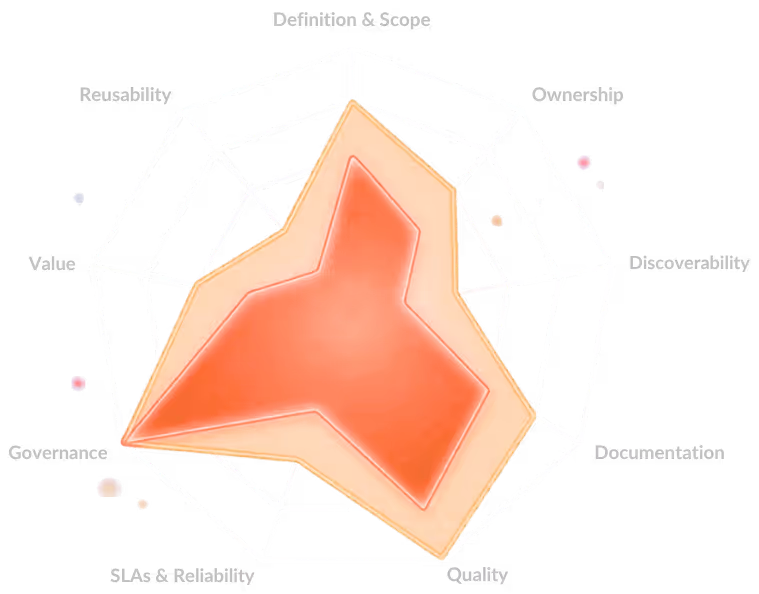
A 9-dimension self-assessment used by 100+ data teams to benchmark strategy, ownership, and platform readiness.


Animesh Kumar
Animesh Kumar is the Co-Founder and Chief Technology Officer at The Modern Data Company, where he leads the design and development of DataOS, the company’s flagship data operating system. With over two decades in data engineering and platform development, he is also the founding curator of Modern Data 101, an independent community for data leaders and practitioners, and a contributor to the Data Developer Platform (DDP) specification, shaping how the industry approaches data products and platforms.

Travis Thompson
Travis is the Chief Architect of DataOS, building full-stack Data Product solutions, and a founding contributor to the Data Developer Platform Standard that enables flexible implementation of disparate data design architectures such as data products, meshes, or fabrics. Over 30 years in all things data engineering, Travis has designed state-of-the-art architectures and solutions for top organisations, including GAP, Iterative, MuleSoft, HP, and many more. He is also an active advocate for polymorphic data architectures and contributes extensively to community archives.

Muskan Purohit
Muskan Purohit is a Technical Writer contributing to community projects and tech journalism initiatives on Modern Data 101. She focuses on articulating modern data systems, platforms, and AI-driven architectures. Formerly, she worked with Amazon, training AI models and LLMs in collaboration with data developers. In addition, she has also led projects as a Content Manager @Lead with Tech, driving advocacy across data and technology domains.
Read the ideas here. Build them with The Modern Data Company.
Modern Data 101 is where the data community thinks out loud. When you're ready to move from articles to architecture, data products, governed AI pipelines, or a full Data Operating System; the team behind this community can help you build it.
Continue reading