How to Operationalise AI Ontologies for Enterprises
Why semantic infrastructure, governance, and business context are becoming essential for scalable and trustworthy enterprise AI.

The Problem Nobody Talks About
Organisations heavily investing in AI through large language models, building automation pipelines, and scaling machine learning systems across functions are still in some pre-production purgatory.
A persistent and costly failure pattern keeps emerging: AI that is technically impressive but is starving contextually. AI models generate outputs that are accurate in isolation but misaligned with how the business actually works.
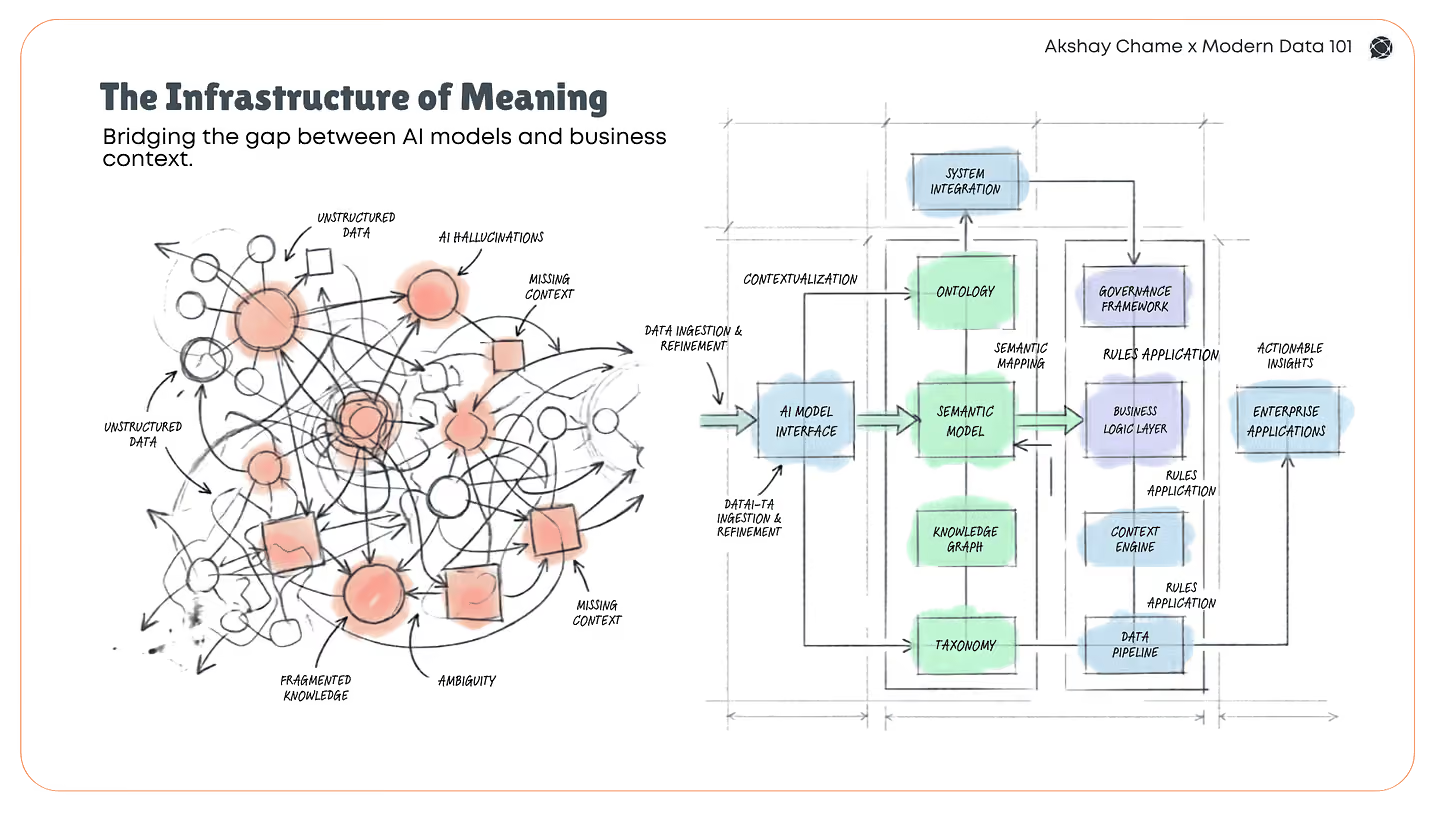
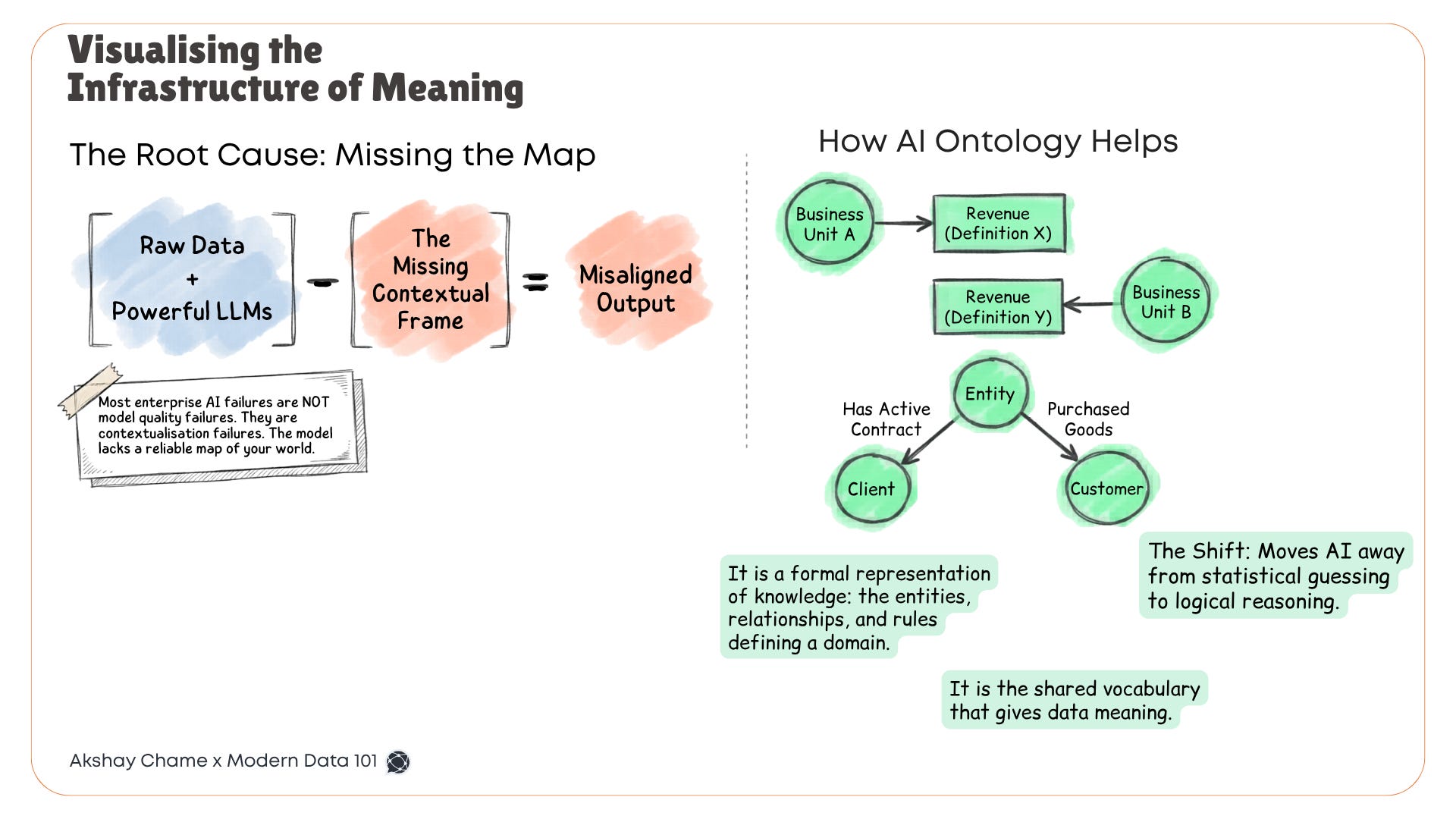
The symptom is familiar: a model that doesn’t know that “client” and “customer” mean different things in your organisation. A system that conflates “revenue” across three business units that measure it differently. A chatbot that answers questions with precision but zero domain relevance.
The root cause, more often than not, is the absence of a well-structured AI ontology.
[state-of-data-products]
What Is an AI Ontology: Why Should Decision-Makers Care
An ontology, in the AI context, is a formal representation of knowledge: the entities, relationships, and rules that define a domain. Think of it as the shared vocabulary and logic that allows AI systems to understand not just data, but meaning.
Without this, AI models operate on statistical patterns, which work well in generic settings but break down the moment your business has nuance, specialised terminology, or complex interdependencies. That breakdown isn’t a model problem. It’s a context problem.
Here’s the business reality: most AI failures at the enterprise level are not failures of model quality. They are failures of contextualisation. The model never had a reliable map of what your world looks like.
This is where ontologies earn their place as a strategic necessity.
[related-1]
Core Capabilities of AI Ontologies
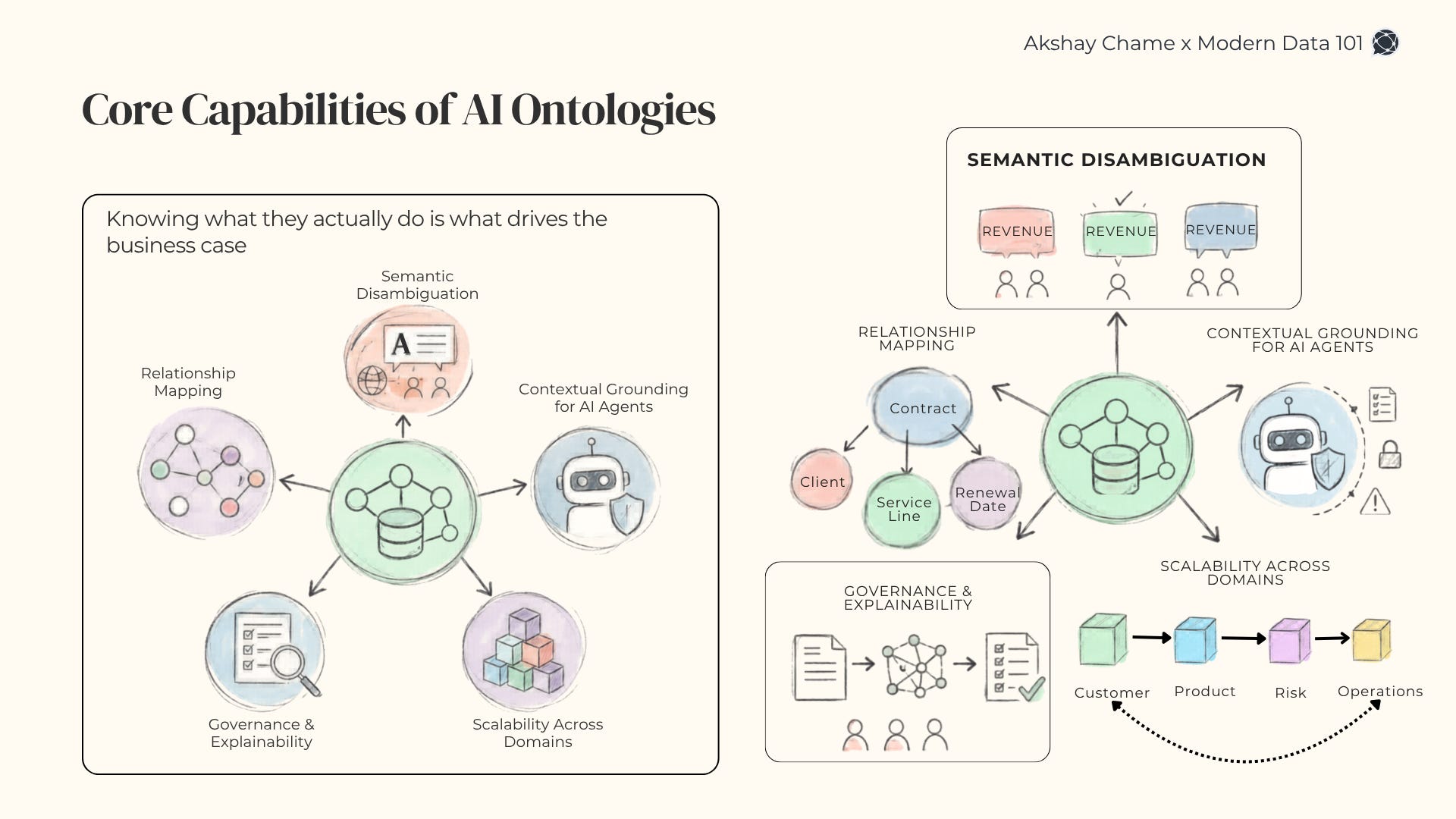
Knowing what they actually do is what drives the business case.
Semantic disambiguation
Different teams, systems, and geographies often use the same word to mean different things. An ontology enforces a single, consistent interpretation across all AI interactions, such as “revenue,” “risk,” or “customer” means the same thing whether the query comes from finance, sales, or a regional office. Without shared controlled vocabularies, even the best-built AI systems collapse under the weight of definitional inconsistency.
Relationship mapping
Ontologies define how entities relate to each other. This allows AI systems to reason across concepts, not just retrieve them. An AI that knows a “contract” is linked to a “client,” a “service line,” and a “renewal date” can answer far more nuanced questions than one working with flat data.
Contextual grounding for AI agents
As organisations move toward agentic AI, ontologies become the guardrails. They define what an agent knows, what it can act on, and what boundaries it operates within. Without this, agentic AI is powerful but ungoverned. Research on agentic AI governance confirms that without structured knowledge boundaries, autonomous agents produce outputs that are difficult to audit or contain. Without an ontology, agentic AI is powerful but ungoverned.
Governance and explainability
Regulators and boards increasingly want to know why an AI reached a conclusion. Ontologies create an auditable reasoning layer, a traceable path from input to output that is grounded in defined, human-approved knowledge structures. Published research in PMC confirms this role, describing ontologies as the semantic bridge that enables interpretable, traceable AI decisions across high-stakes domains.
Scalability across domains
A well-built ontology is modular. Start with one domain, say, customer data, and extend it to product, risk, or operations without rebuilding from scratch. This makes ontologies one of the few AI investments that compound in value the more they are used.
The Operationalisation Gap
Knowing you need an ontology and actually deploying one at scale are two very different things. Many organisations have ontologies that exist on paper, in documentation, in data dictionaries, in knowledge management systems, but never make it into the AI systems that need them most.
Closing this gap requires three things working in concert:
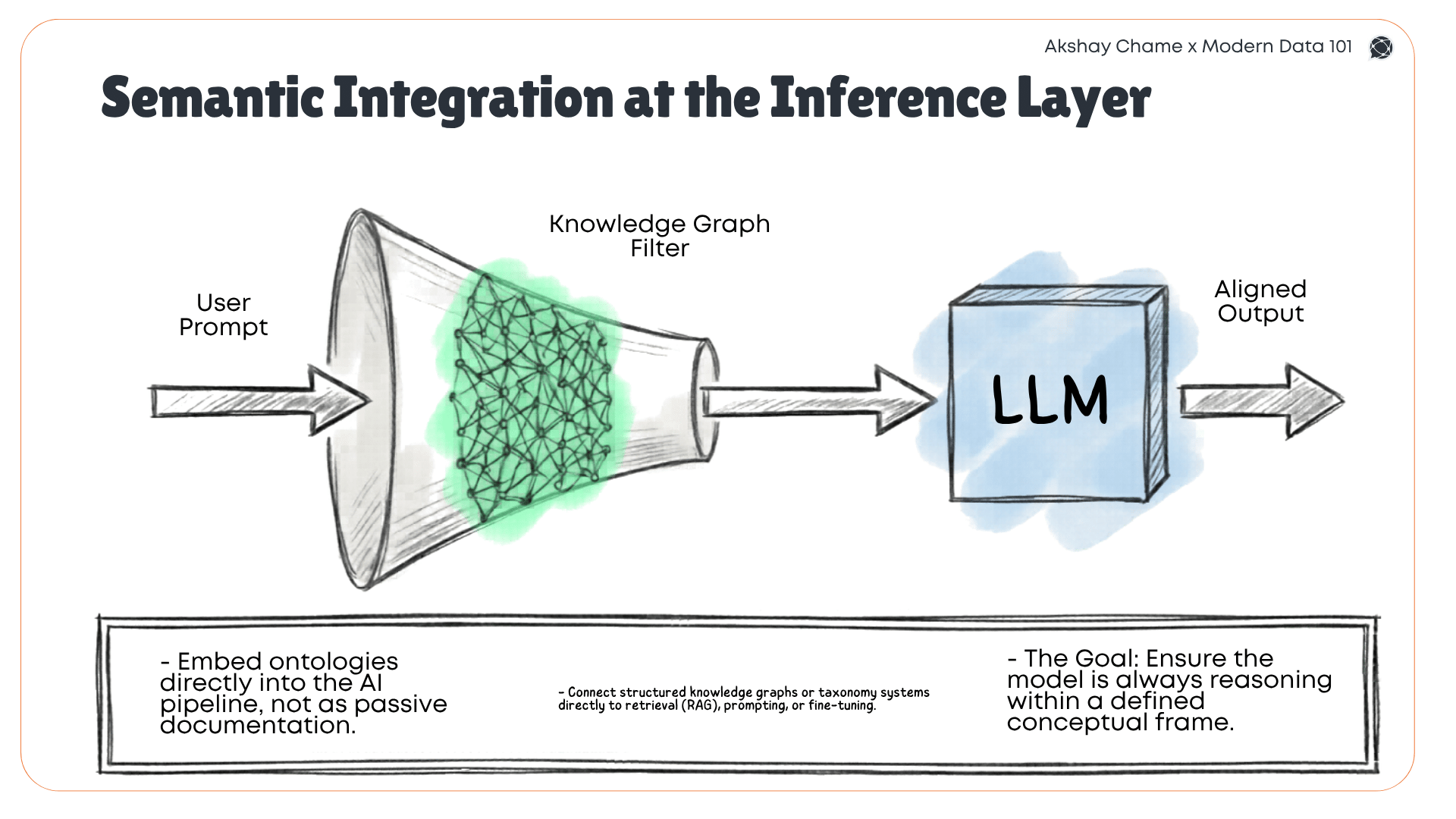
1. Semantic integration at the inference layer
Ontologies must be embedded into the AI pipelines, instead of being referenced as documentation. This means connecting structured knowledge graphs or taxonomy systems directly to the retrieval, prompting, or fine-tuning process so the model is always reasoning within a defined conceptual frame.
2. Governance that travels with the ontology
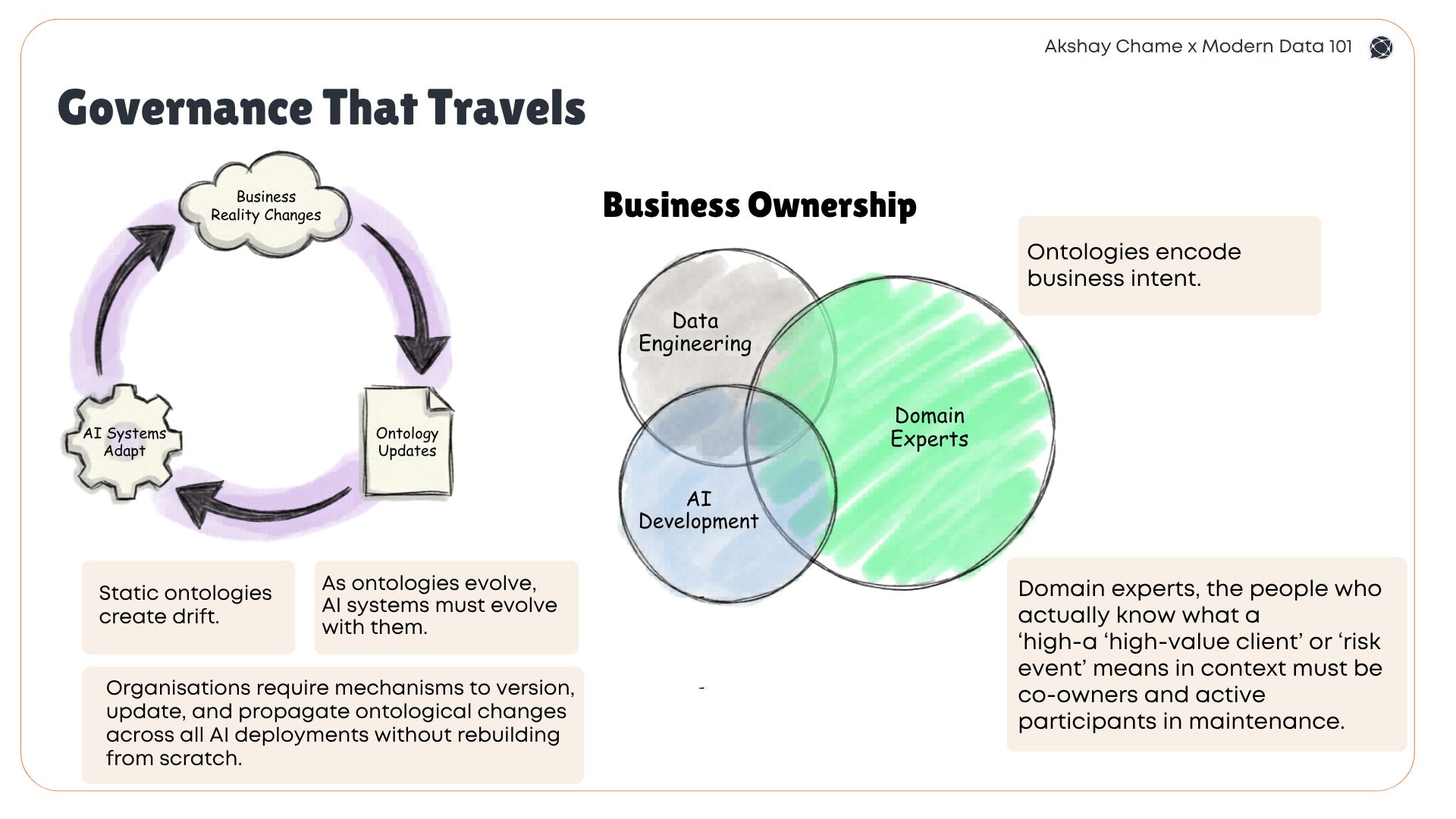
As ontologies evolve, AI systems must evolve with them. Static ontologies create drift. Organisations need mechanisms to version, update, and propagate ontological changes across AI deployments without rebuilding from scratch each time.
[related-2]
3. Business ownership, not just technical ownership
This is the piece most organisations miss. Ontologies that live only in the hands of data engineers become technical artefacts divorced from business intent. Domain experts, the people who actually know what “high-value client” or “risk event” means in context, must be co-owners of the ontology and active participants in its maintenance.
Operationalising AI Ontologies: Where to Start
For decision-makers looking to move from concept to practice, the path forward is more tractable than it might appear:
- Start with a bounded domain. Don’t attempt to ontologise your entire enterprise. Pick one function, such as customer data, product taxonomy, or risk classification, where ambiguity is causing the most AI friction. Build there, demonstrate value, then scale.
Think of self-serve data infrastructures like Data Developer Platforms, which are built around domain-oriented data ownership, and teams own their data products. This gives you the organisational structure to do that without a top-down mandate.
[playbook]
- Invest in knowledge engineering capability. Whether in-house or through a partner, you need people who can translate domain expertise into structured knowledge. This is a distinct skill from both data engineering and AI development. DDPs shift data ownership to domain teams, the same people who should own the ontology. A DDP essentially operationalises the governance model required for AI to be in its’ productive state.
Self-serve data platforms like Data Developer Platforms create the organisational and technical conditions that make ontology operationalisation feasible at scale. Think of the DDP as the infrastructure, and the ontology as the intelligence layer on top.
- Build for interoperability. Your ontology should be designed to connect with the AI systems you use, whether that means integration with your vector database, your RAG pipeline, or your model fine-tuning process. A siloed ontology is a wasted ontology. Data platforms that expose data products through standardised interfaces have an ontology layer built on top. This infra provides clear, consistent connection points into pipelines, RAG systems, and inference layers. No custom wiring per use case.
- Measure contextual accuracy, not just output accuracy. Reframe how you evaluate AI performance. A system can score well on benchmarks and still be misaligned with the business context. Build evaluation criteria that test whether AI outputs reflect your ontological frame, not just factual correctness.
The Strategic Bottom Line
AI without ontology is pattern matching without understanding. It can be useful, but it will always be limited, inconsistent, and difficult to govern. For organisations that operate at scale, with complex domains and high-stakes decisions, that limitation is not acceptable.
The bridge between AI capability and business value is meaning. Ontologies are how you build that bridge as an operational imperative.
The organisations that treat this seriously now will not just have better AI. They will have AI that compounds in value over time.
FAQs
Q1. Why Ontologies Are the Key to Enterprise AI Value?
Ontologies are key to enterprise AI value because they give AI systems shared business context and semantic understanding across data, teams, and applications. They help AI reason consistently, connect fragmented information, improve retrieval accuracy, reduce hallucinations, and make outputs more explainable, reusable, and trustworthy at enterprise scale.
Q2. What is an ontology in the Artificial Intelligence context?
An ontology in AI is a structured semantic model that defines how concepts, entities, relationships, and business meanings are connected within a domain. It gives AI systems shared context and reasoning structure, helping models and agents understand data consistently, retrieve relevant knowledge, and make more accurate, explainable decisions.
Q3. How long does it take to build an enterprise ontology?
A minimum viable ontology for a single domain, let’s say, customer data or product taxonomy, can be built in 6–12 weeks with the right knowledge engineering resource. The mistake most enterprises make is scoping too broadly at the start. A bounded domain ontology that demonstrably improves AI output quality in one area is worth more than an ambitious enterprise-wide model that never ships. Treat the first ontology as a proof of concept, not a foundation for everything.
Connect with a community data expert
A no-cost session with a practitioner who's been where you are.
About Modern Data 101
Modern Data 101 is a movement redefining how the world thinks about data. A community built by the same team behind the world’s first data operating system, Modern Data 101 sits at the intersection of data, product thinking, and AI. Spread across 150+ countries, the community brings together a global network of practitioners, architects, and leaders who are actively building the next generation of data systems.
At its core, Modern Data 101 exists to simplify the journey from raw data to tangible and observable impact. It advocates high-potential data systems and next-gen architectures to unify and activate insights and automation across analytics, applications, and operational workflows at the edge.
In a world shifting from data stacks to AI ecosystems, Modern Data 101 helps teams not just navigate the change but lead it.


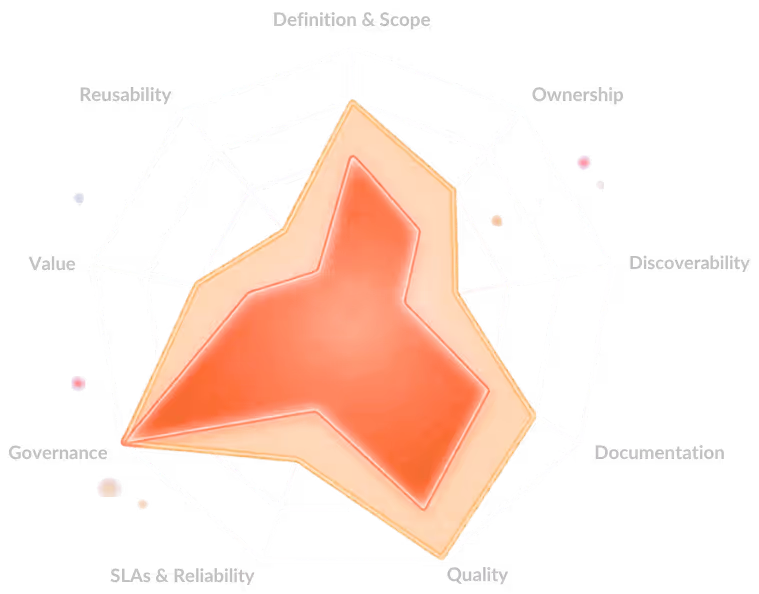
A 9-dimension self-assessment used by 100+ data teams to benchmark strategy, ownership, and platform readiness.


Akshay Chame
Akshay is a GenAI/ML engineer building production-grade AI systems, including RAG pipelines, AI agents, MCP servers, and LLM fine-tuning. An IEEE-published researcher and Smart India Hackathon 2023 winner, he is focused on scalable, reliable AI systems that move intelligent solutions from experimentation to production.
Read the ideas here. Build them with The Modern Data Company.
Modern Data 101 is where the data community thinks out loud. When you're ready to move from articles to architecture, data products, governed AI pipelines, or a full Data Operating System; the team behind this community can help you build it.
Continue reading