
5 Ways AI Agents Will Transform Data Management & Analytics
From brittle pipelines to self-healing architectures, the 2026 and 2027 blueprint for building agent-ready data products.

TL;DR
- The Paradigm Shift: Traditional dashboards are dying. AI agents are transforming enterprise data management from a passive reporting layer into an autonomous, self-healing, and action-oriented ecosystem.
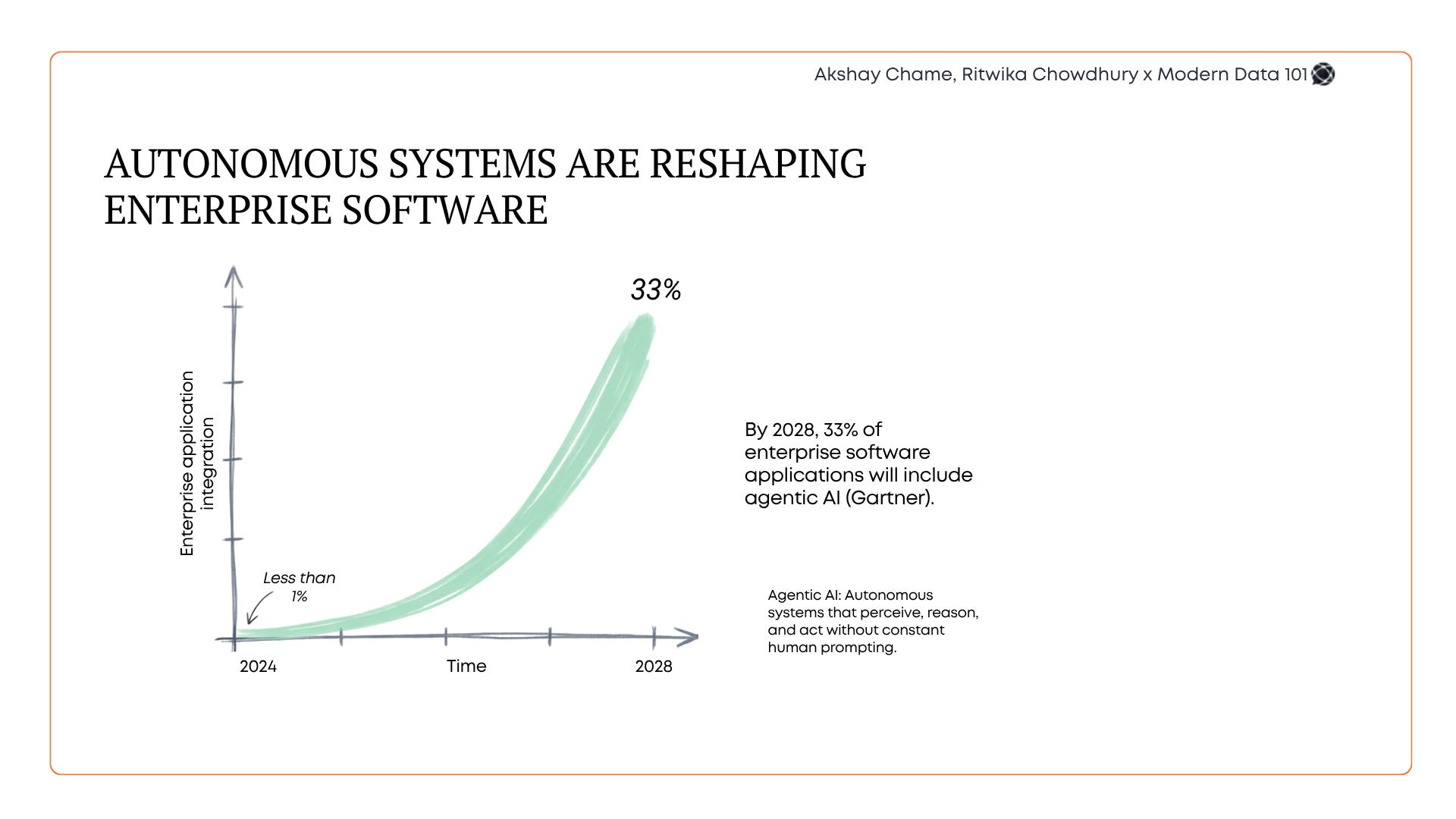
- Massive Adoption: Agentic AI is no longer abstract; Gartner projects that 33% of enterprise software applications will feature agentic AI by 2028, a massive leap from under 1% in 2024.
- The 5 Pillars of Transformation: AI agents are replacing brittle manual engineering, automating data management and governance at scale, eliminating decision latency through real-time analytics, truly democratising data access using natural language, and deploying coordinated multi-agent architectures for end-to-end data discovery.
- The Real Bottleneck: While nearly two-thirds of enterprises are experimenting with ai for data management, fewer than 10% have successfully scaled. The reason? A severe lack of agent-ready, governed data products.
[related-1]
The era of passive dashboards and reactive BI tools is ending. AI agents, autonomous systems that perceive, reason, and act without constant human prompting, are the most significant force reshaping enterprise data infrastructure right now. Gartner named agentic AI its top strategic technology trend for 2025, and the data industry is feeling it most acutely. By 2028, Gartner projects 33% of enterprise software applications will include agentic AI, up from less than 1% in 2024.
But most of the conversation around AI agents is still too abstract. Here is what is concretely changing across data management and analytics, and why it matters now.
1. Self-Healing Pipelines: How AI Data Management Eliminates Manual Engineering
Traditional data pipelines are brittle. They break silently, require specialist intervention, and scale poorly under volume. AI agents change the operating model entirely.
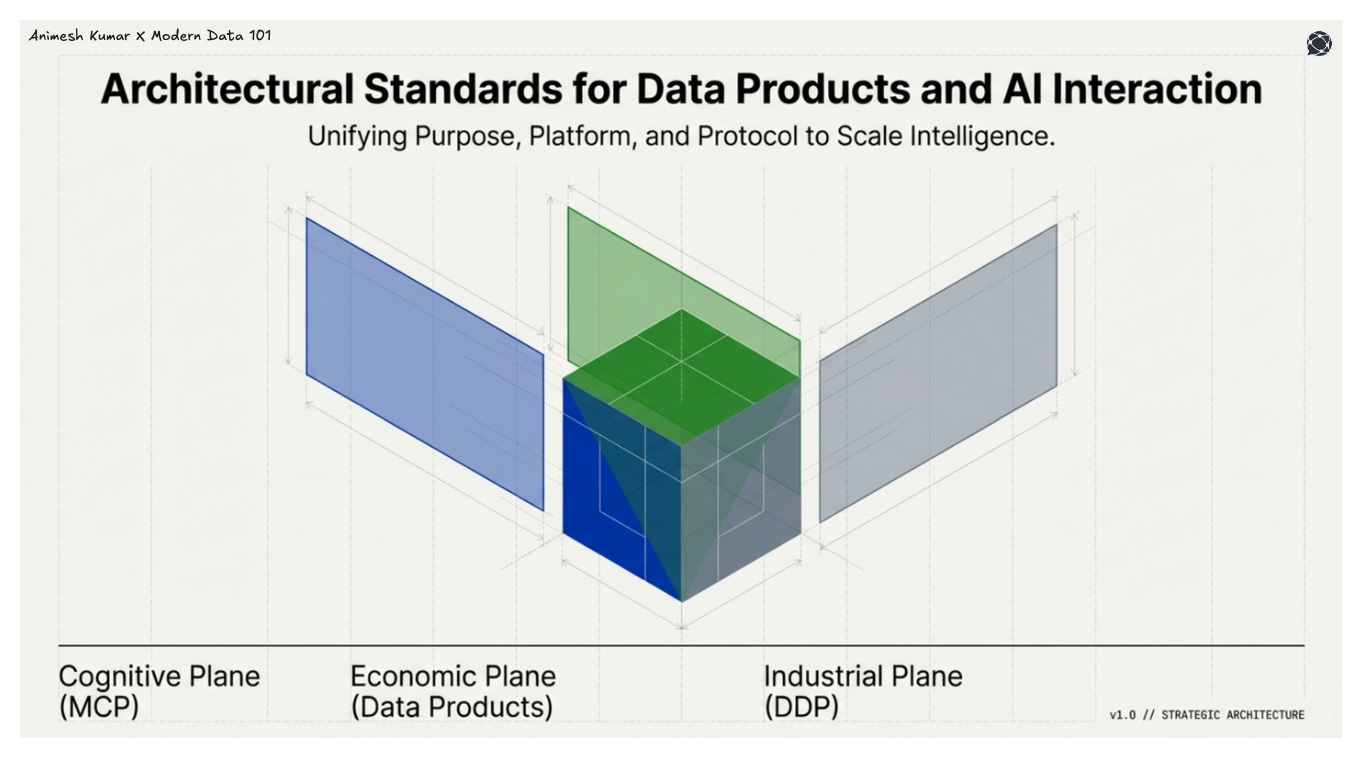
Agentic systems now monitor pipeline health in real time, detect anomalies, trace failures back to root causes, and apply remediation, all without a human in the loop. The modular Data Developer Platform architecture enables purpose-driven agents to be layered over existing infrastructure, handling compute, orchestration, and debugging as discrete, composable building blocks. This is adaptive intelligence embedded into the pipeline itself.
The practical payoff: data engineering teams spend less time firefighting and more time building. For organisations running at scale on data management platforms or modern data operating systems, this shift is already live.
[related-2]
2. Continuous Governance: Using AI Agents to Operationalise Data Quality at Scale
Poor data quality costs enterprises an average of $12.9 million per year. Manual governance, human stewards reviewing lineage, updating access controls, profiling datasets, cannot keep pace with modern data volumes or complexity.
AI agents solve this through continuous, contextual monitoring. They profile datasets as data moves through pipelines, flag anomalies in real time, classify data by sensitivity, apply access controls automatically, and maintain audit trails that satisfy regulatory requirements. McKinsey’s foundational research confirms the bottleneck: eight in ten companies cite data limitations as a roadblock to scaling agentic AI, which means governance is the unlock, not an afterthought.
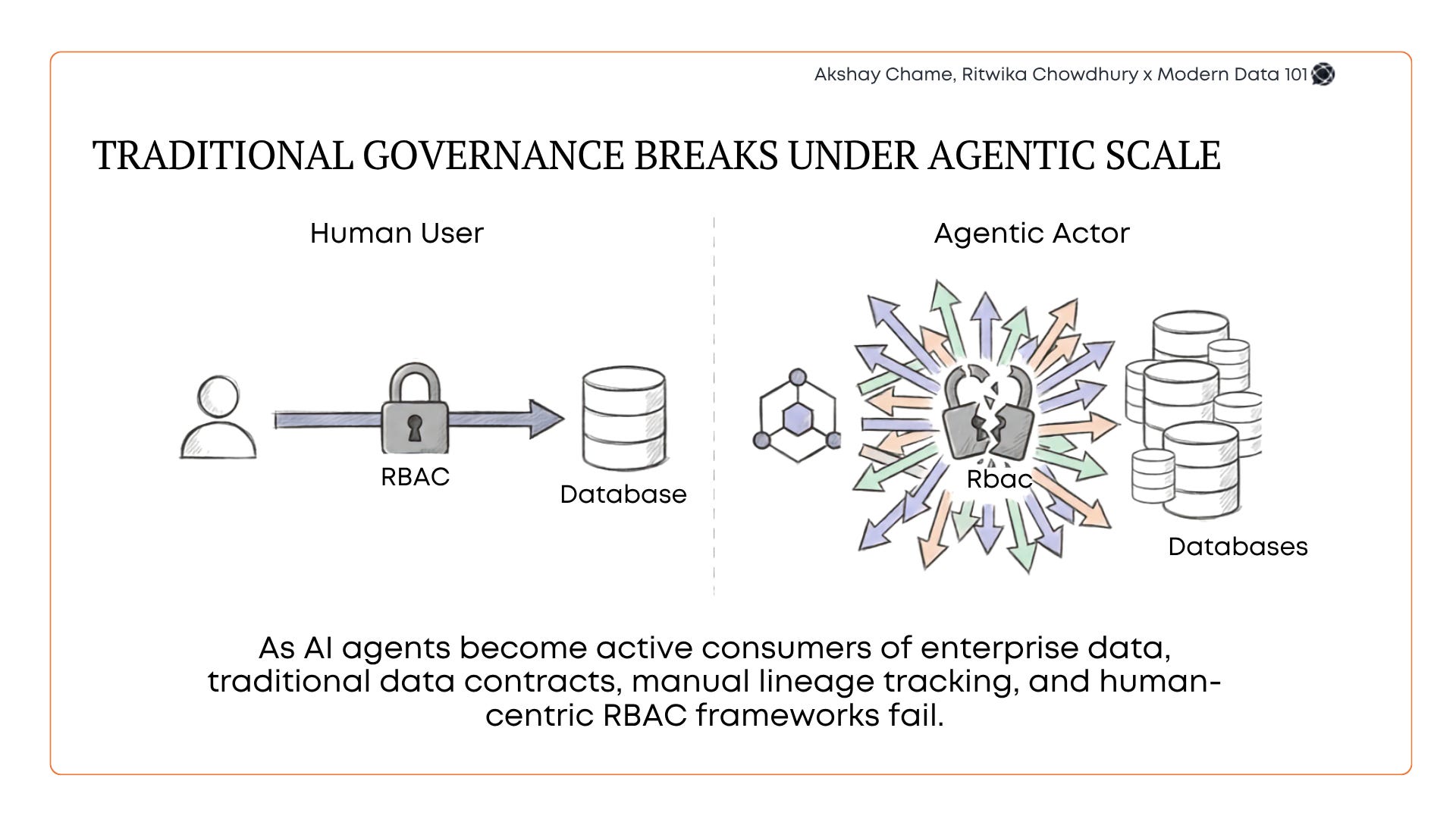
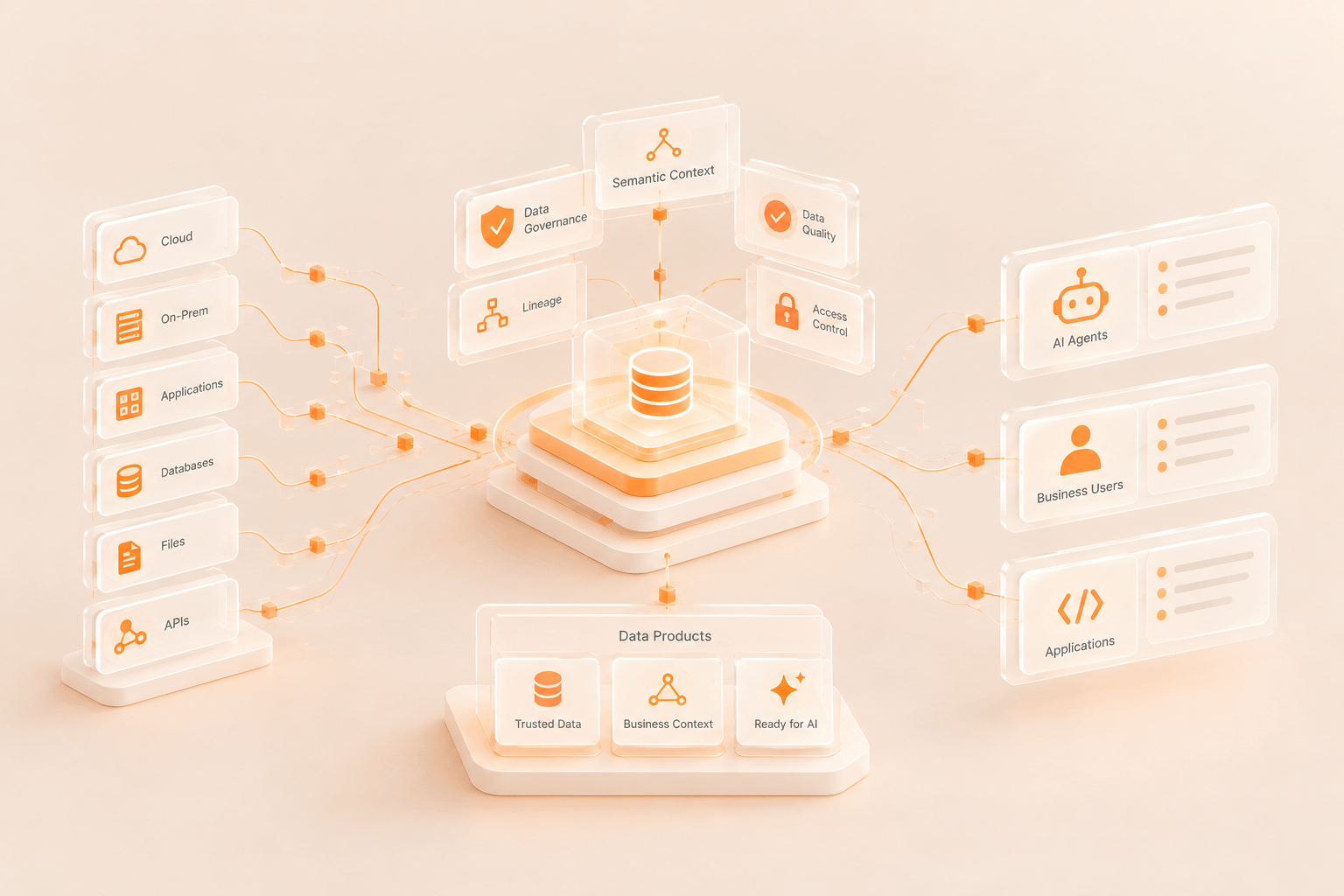
As AI agents become active consumers of enterprise data, querying systems, invoking tools, and making decisions, governance frameworks designed for human users break down. The data contracts, RBAC/ABAC rules, and lineage tracking that govern human access need to be rebuilt for agentic actors. The Data Developer Platform provides a standards-based approach to exactly this problem.
3. Autonomous Decision Intelligence: Slashing Analytics Latency by 48%
The dashboard is an artifact of a world where humans were the last mile of analysis. AI agents eliminate that bottleneck.
Rather than surfacing data for human interpretation, agentic analytics systems continuously monitor information streams, identify patterns, assess significance, and trigger actions, inside CRMs, ERPs, and operational systems, without waiting for a human to run a query. Gartner’s 2025 analytics data shows organisations using autonomous agentic pipelines achieve a 48% reduction in decision latency compared to batch analytics environments. McKinsey research similarly reports that businesses deploying autonomous analytics agents in 2025 saw their insight-to-action cycle accelerate by 32%, with operational decisions becoming 21% more accurate.
AI agents walking into a data warehouse have access to the tables but not the accumulated institutional context a human analyst carries. The solution is not better models; it is better-structured data products with embedded metadata, lineage, and semantic meaning.
[playbook]
4. AI Agents Democratise Data Access Across the Enterprise
One of the most durable failures of the modern data stack has been democratisation. Despite years of investment in self-service BI, most business users still can’t get answers from data without analyst support.
AI agents change the access model. Natural language interfaces allow non-technical users to query data warehouses, validate assumptions, and generate reports through conversational prompts. The AI agent handles schema navigation, query construction, and result interpretation, translating intent into output without SQL expertise. McKinsey’s 2025 AI state-of-the-market report notes that AI agent use is now most commonly deployed in IT and knowledge management, with deep research and query automation leading as early use cases across industries.
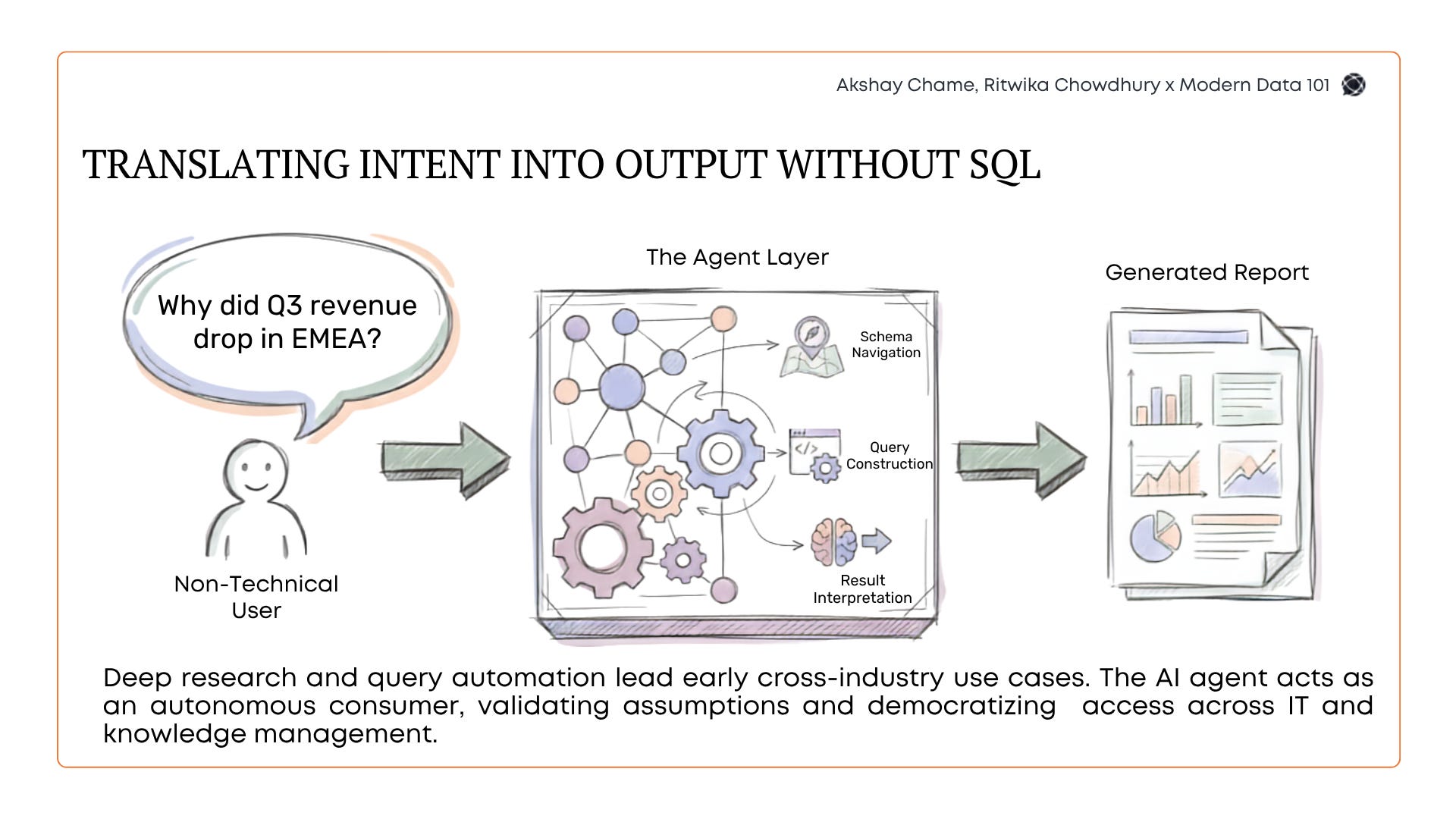
The implications for data team structure are significant. AI agents are not assistants that wait for a question; they are autonomous consumers of enterprise data. This fundamentally changes what data teams need to build and who they serve. The priority shifts from building pipelines for human analysts toward building governed, agent-ready data products.
[related-3]
5. Multi-Agent Systems Enable End-to-End Data Discovery and Lineage
The most advanced organisations are moving beyond single-agent deployments toward coordinated multi-agent architectures, systems where specialised agents handle discrete tasks (access control, semantic enrichment, relevance ranking, anomaly flagging) and share state across a broader workflow.
Think of a framework/ architecture where: an access-control agent reads RBAC/ABAC rules and produces a filtered view of permissible assets; a semantic enrichment agent layers business context; a ranking agent surfaces the most relevant assets for a given query; a feedback loop trains the system on actual usage patterns, turning agent recommendations into organisational memory. Over time, the system learns which datasets are trusted, which lead to incidents, and which are repeatedly relevant for which use cases.
This is how AI transforms data discovery from a search problem into an adaptive intelligence layer. And it only works with the kind of foundational infrastructure with metadata-first design, data contracts, and governed APIs that data developer platforms are built around.
[report-2025]
How to Move from Agent Experimentation to Scaled Value in Upcoming 2027
The biggest confusion today might be about which agents to pick and where to place them in the stack, or rather, how to implement it altogether.
McKinsey reports nearly two-thirds of enterprises have experimented with agents, but fewer than 10% have scaled them to deliver value. The gap here is data readiness.
Before deploying AI agents at scale, organisations must:
- Treat data products as first-class infrastructure with governance, versioning, and semantic context built in
- Rebuild governance frameworks for agentic consumers, not just human users
- Invest in metadata and lineage as the connective tissue that makes agents reliable
- Pilot in high-value, bounded domains before scaling to enterprise-wide orchestration
The organisations that close this gap first will have a structural analytics advantage that compounds, every decision an agent makes right improves the next one.
FAQs
Q1. How are AI agents redefining data analysis?
AI agents automate many parts of the analytics workflow, from discovering and preparing data to generating insights and recommending actions. Instead of manually building queries and reports, users can interact with data through natural language and receive faster, context-aware insights.
Q2. What are the top 5 AI trends in data management in 2026?
- AI Agents for Data Operations: Agents automate data discovery, preparation, quality monitoring, and governance tasks.
- Semantic Layers & AI Ontologies: Organisations are building business context layers to make AI outputs more accurate and trustworthy.
- Data Products for AI: Curated, reusable data products are becoming the preferred way to supply data to AI systems.
- Automated Data Quality Management: AI continuously detects, explains, and helps resolve data quality issues.
- Self-Service Data Platforms: AI-powered platforms enable users to find, access, and use data without relying heavily on central teams.
Q3. What is the role of data integration in AI data management?
Data integration connects data across systems, creating a unified and consistent foundation for AI. It ensures AI models and agents can access complete, accurate, and timely data to generate reliable insights and decisions.
Connect with a community data expert
A no-cost session with a practitioner who's been where you are.
About Modern Data 101
Modern Data 101 is a movement redefining how the world thinks about data. A community built by the same team behind the world’s first data operating system, Modern Data 101 sits at the intersection of data, product thinking, and AI. Spread across 150+ countries, the community brings together a global network of practitioners, architects, and leaders who are actively building the next generation of data systems.
At its core, Modern Data 101 exists to simplify the journey from raw data to tangible and observable impact. It advocates high-potential data systems and next-gen architectures to unify and activate insights and automation across analytics, applications, and operational workflows at the edge.
In a world shifting from data stacks to AI ecosystems, Modern Data 101 helps teams not just navigate the change but lead it.


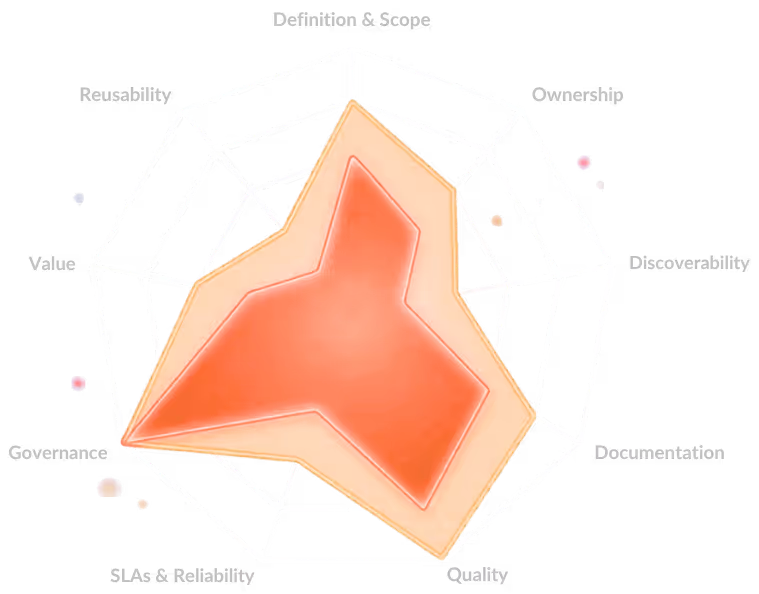
Where does your org stand on data product maturity?
A 9-dimension self-assessment used by 100+ data teams to benchmark strategy, ownership, and platform readiness.


Akshay Chame
Akshay is a GenAI/ML engineer building production-grade AI systems, including RAG pipelines, AI agents, MCP servers, and LLM fine-tuning. An IEEE-published researcher and Smart India Hackathon 2023 winner, he is focused on scalable, reliable AI systems that move intelligent solutions from experimentation to production.

Ritwika Chowdhury
Ritwika Chowdhury is a data and technology professional focused on data products, AI, and modern data architecture. Her work sits at the intersection of data strategy, product thinking, and emerging AI technologies, with a focus on helping organisations turn enterprise data into trusted, usable, and scalable assets.
Read the ideas here. Build them with The Modern Data Company.
Modern Data 101 is where the data community thinks out loud. When you're ready to move from articles to architecture, data products, governed AI pipelines, or a full Data Operating System; the team behind this community can help you build it.
Continue reading

.jpg)
