Takeaways from CXO Insights: Exclusive Interviews with Top Operators
The frameworks that outlast their creators, the expensive lessons leaders learned the hard way, and how AI is changing the way organizations are built and led.

Start with the smallest unit of “data value” you can imagine. That’s one decision. Someone is about to do something, and slightly better information would make that choice slightly better. That’s the whole atom.
Every data platform, governance program, and AI initiative ever built is just an apparatus for making that moment happen more often, more cheaply, more reliably.
Modern Data 101 just launched CXO Insights
A series where we hear how it all happens straight from the Chiefs!
Hear it directly from leaders who have built and scaled data and AI capabilities at some of the world’s most remarkable organisations. Whether it’s one of Latin America’s largest diagnostic medicine and clinical analysis companies, Dasa; one of the most influential names in global entertainment, United Talent Agency; one of India’s largest mutual fund houses, Kotak; or even the White House itself.
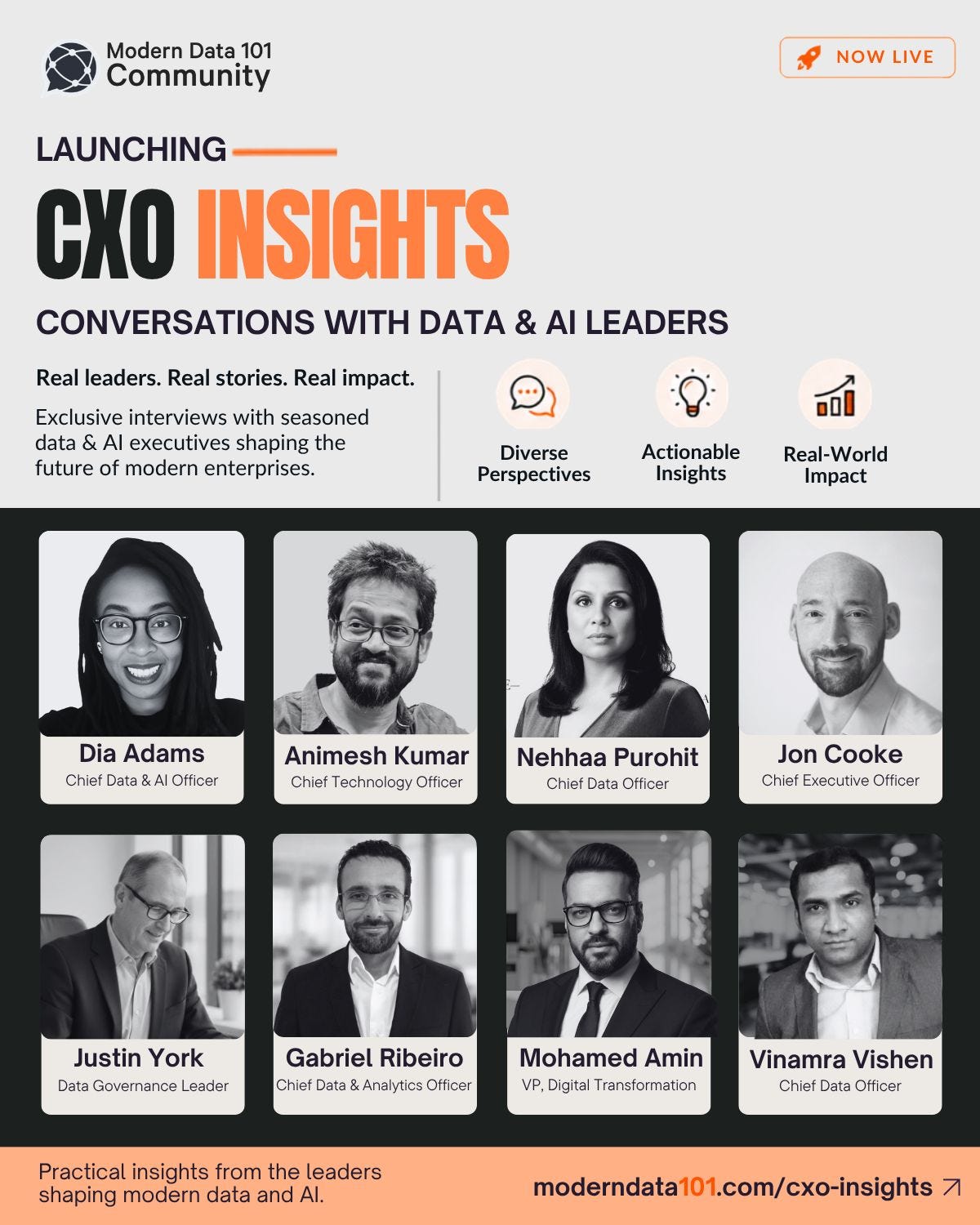
The first set of conversations are in! These remarkable leaders have shared a goldmine of insights on proving value, surviving the chaos speed creates, and what the next generation should look like.
Read across the interviews to get the building blocks of decision, behaviour, systems, and org. Here’s our perspective on their takes!
[playbook]
Takeaway 1: A decision is only as good as its context
Before platforms or governance, ask the prior question: what makes one decision better than another?
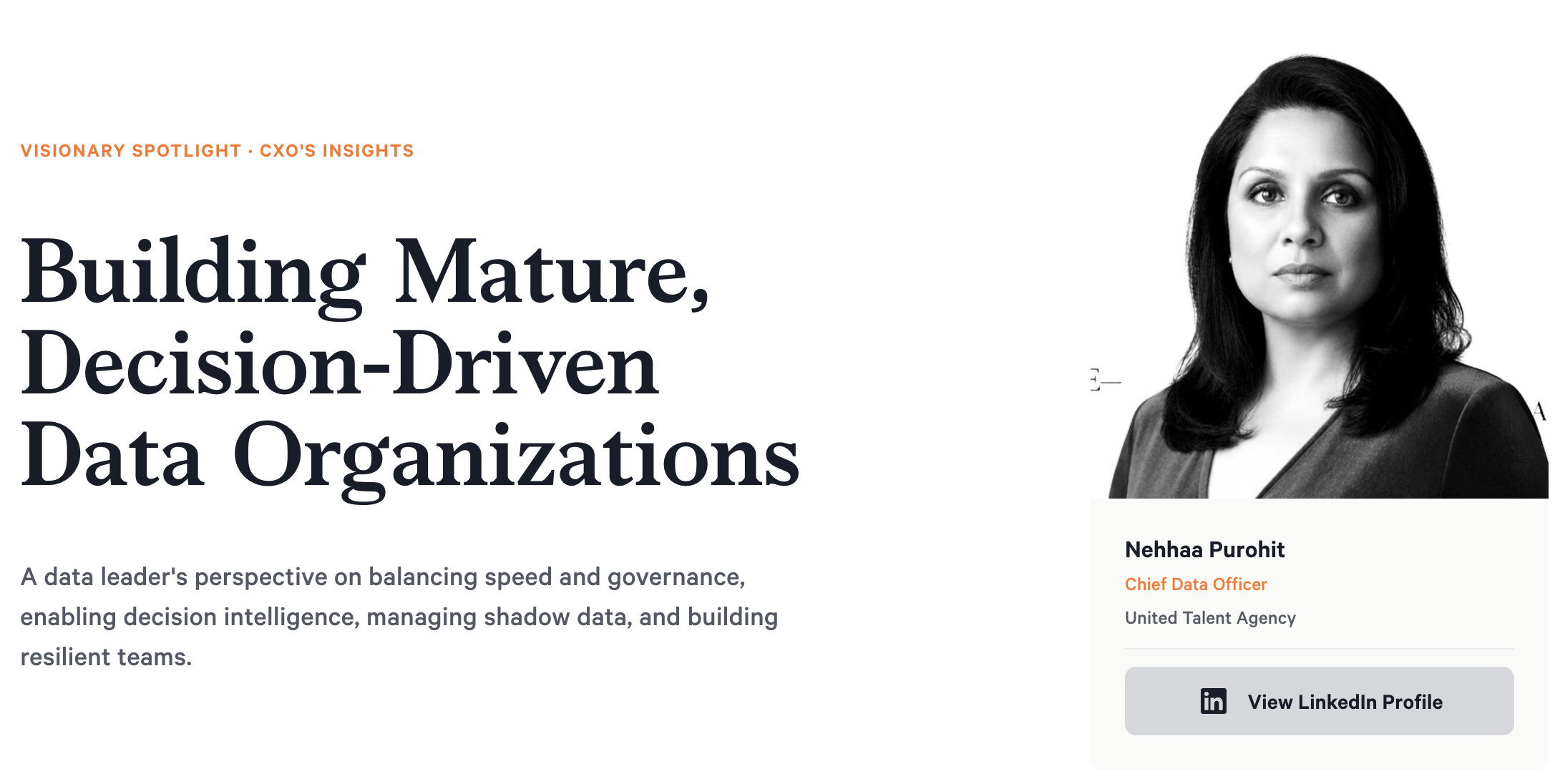
Nehhaa Purohit, CDO at United Talent Agency, shares some interesting experiences here, because she learned it the expensive way.
While her dashboards were green, uptime was at 99.99%, and latency was sub-50ms, underneath it, revenue per inference dropped 2% a month for six months, a $14 million bleed nothing caught, because the intelligence was functioning. The judgment was not.
Uptime measures whether the pipe is open, not whether what’s flowing through it is still true. Purohit calls the gap “Context Debt:” data that’s technically alive but semantically stale, decaying while every monitor keeps reporting green.
A decision is “good” because the data still matches reality at the moment someone acts on it: a much harder property to guarantee than uptime, and almost nobody measures it.
Takeaway 2: One good decision doesn’t compound, but a repeatable one does
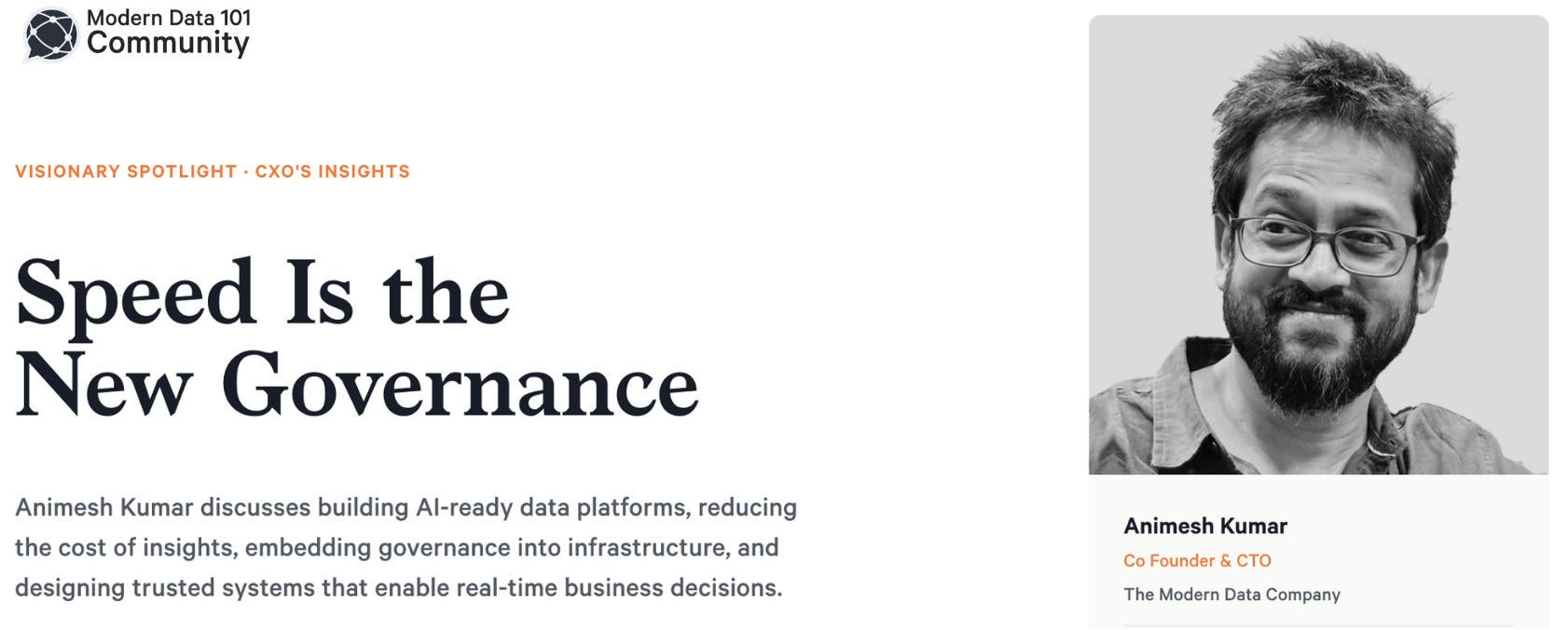
A single well-informed decision is a nice story. Try to make it repeatable across a team or a quarter, and you hit the real constraint every leader is wrestling with: speed versus trust.
Animesh Kumar, CTO at The Modern Data Company, calls the usual framing of this a false tug-of-war. Governance gets bucketed as “defence,” which makes it the first thing cut when growth needs funding.
This is backwards, because ungoverned data is exactly what slows growth down. Nobody trusts a number they can’t trace, so they re-verify it manually, and that’s a hidden tax on every decision downstream. The fix is making governance a default property of the platform, not a competing line item.
Mohamed Amin, VP of Digital Transformation at Hosta, reaches the same place from decision latency: the lag between insight and action. His answer is clarity, prioritisation, and ownership: business-ready signals instead of raw metrics, a small set of decision-driving KPIs instead of exhaustive reporting, a named owner for every metric.
Different vocabulary, same equation: repeatability means removing friction from the next decision, not just informing the current one.
Someone needed an answer faster than the official path delivered, so they built their own. Kumar’s fix is decomposing the problem into structure, behaviour, and incentives, because if the governed path is slower than the workaround, the workaround wins every time.
[data-expert]
Takeaway 3: A repeatable decision doesn’t matter until it moves a number the CFO already watches
Decisions that are informed and repeatable still aren’t a strategy, because nobody upstairs cares about repeatability for its own sake. They care about P&L.
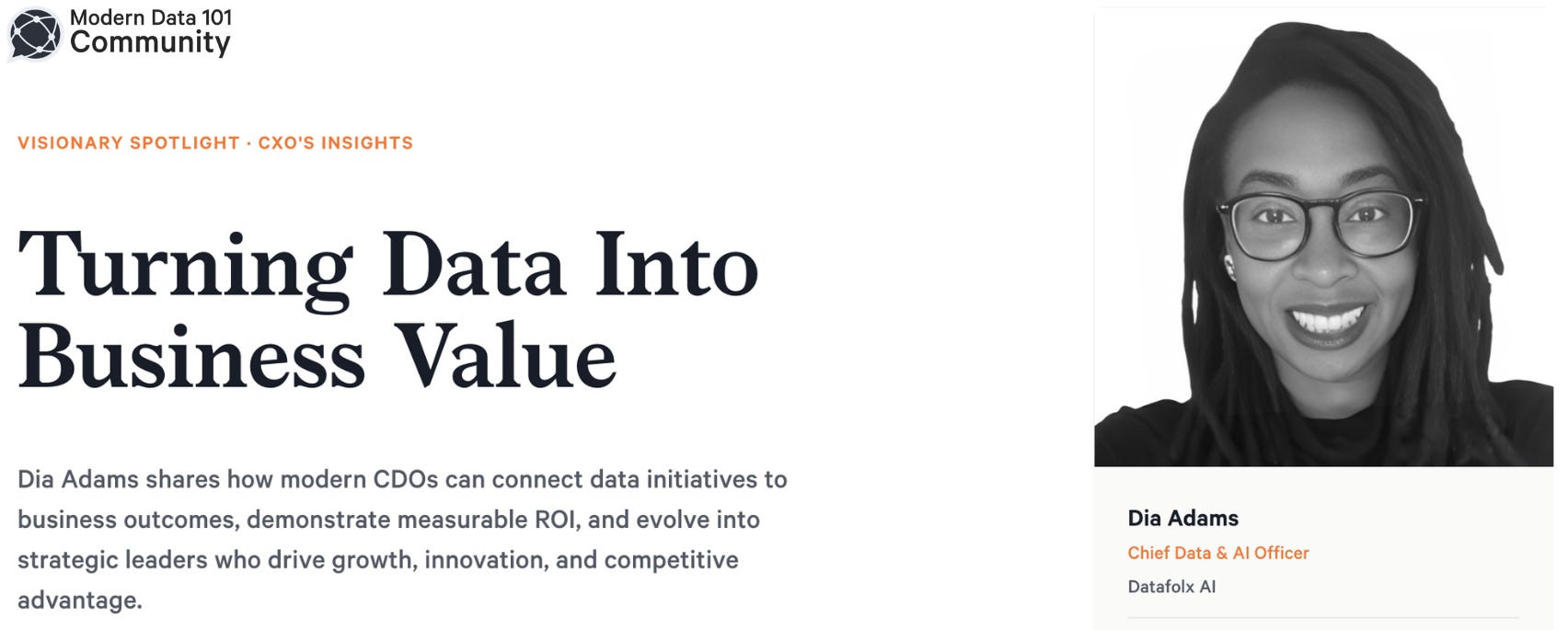
Dia Adams, Chief Data & AI Officer at Datafolx AI and former White House Enterprise Data Strategist, draws a clean conclusion here:
Stop speaking in technical metrics, start speaking in business outcomes.
Instead of “we built a data lake”, go for “this is enabling $X in revenue through hyper-personalisation, and cutting churn by Y%.” Her answer for which line should move is Operating Income, because EBIT captures both sides at once: revenue gained and cost removed, in one number the board already trusts.
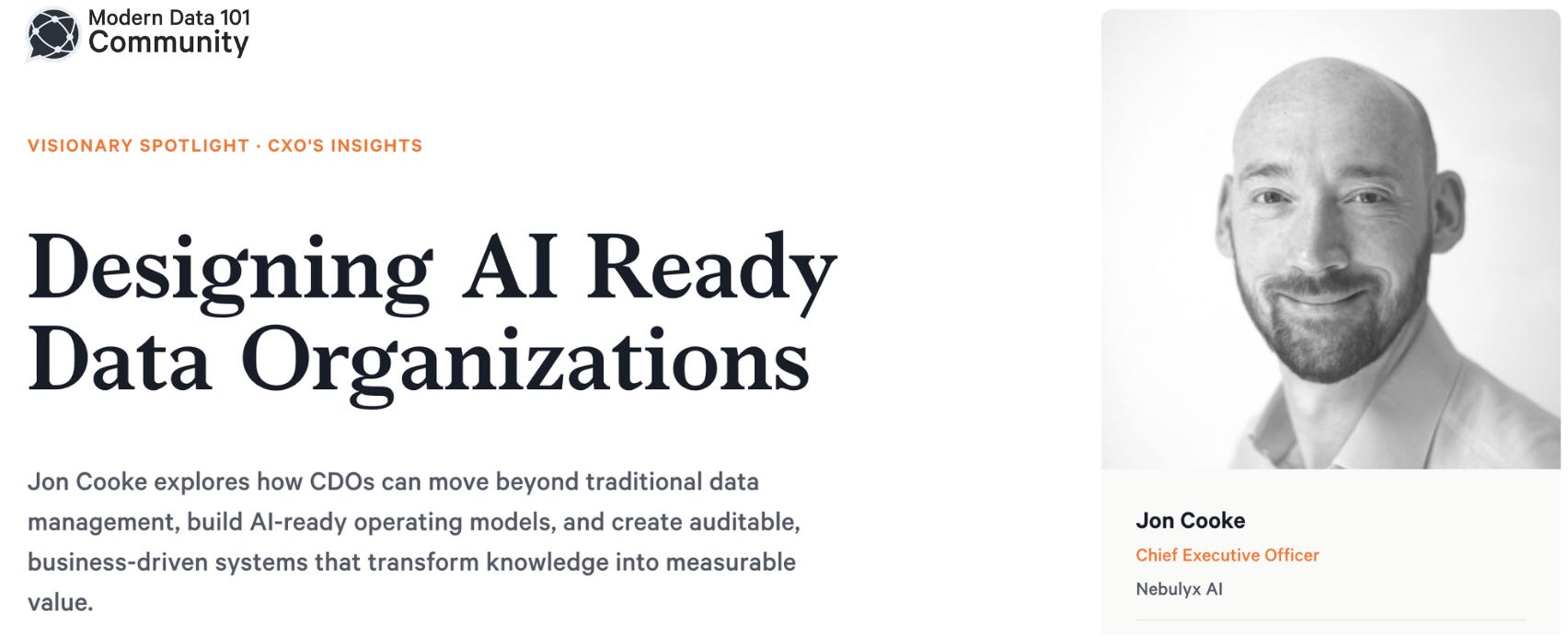
Jon Cooke, CEO of Nebulyx AI, answers with the defence and offence analogy. Defence is governance work that’s non-negotiable in regulated industries: a versioned, cited knowledge base means an auditor’s “why did you decide that, in March?” is one query away.
Offence is the use-case portfolio, each one tied to a metric that visibly moves. They compound, since clean data accelerates offence by removing the quality fires that slow the next use case down.
Justin York, who runs Rubicon, pushes back on the whole premise. Asked which P&L line should move, his answer is: be careful claiming credit you can’t trace. If sales rise, was it the data strategy, or did someone still have to “go and make the sales”?
Often it’s genuinely hard to isolate ROI because data touches everything at once and the bigger risk to credibility is leaders over-claiming “solutions” that collapse against real workload and friction. Adams and Cooke build the confident financial story; York refuses to inflate it. Both are correct, depending on whether the number is attributable.

Takeaway 4: Nothing scales without someone using it
Well-informed, repeatable, P&L-linked decisions can still collapse at the last mile: the moment a non-technical person has to act on the insight in front of them.
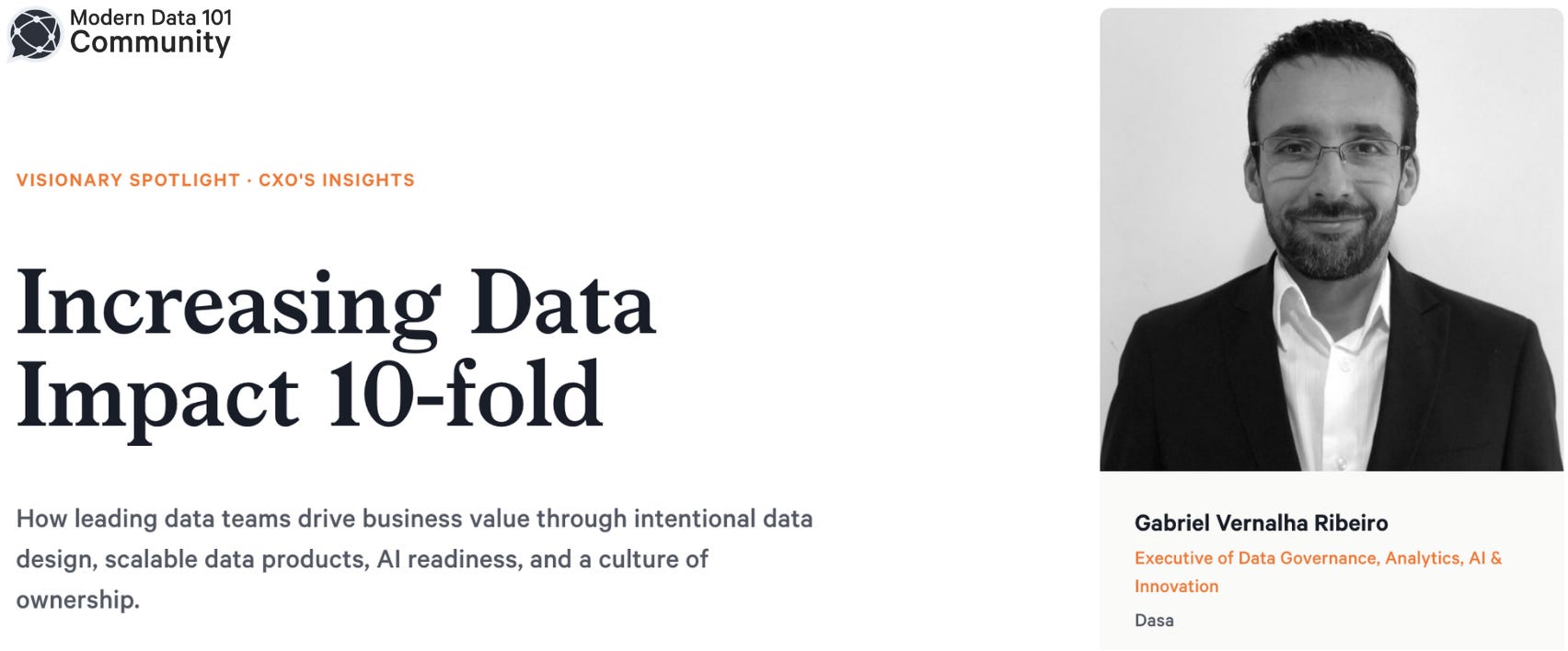
Gabriel Vernalha Ribeiro, who leads data governance and AI at Dasa, suggests locating the failure at the point data is born. His fix is a process change: no project gets approved without a data capture plan and success metrics built in from the start.
Data structured from inception “stops being a maintenance cost and becomes an asset ready for consumption.” His last-mile rule follows: deliver insight inside the tools people already use, with plain “what to do next” recommendations instead of charts that require interpretation.
Cooke’s “Decision Capsules,” built independently by Purohit at UTA, take this further: single interfaces inside the workflow showing a recommended action, a confidence interval, and the top drivers.
Purohit’s version degrades gracefully when context goes stale. It routes the decision back to a human instead of confidently serving a wrong answer, a design choice that prevented an estimated $8 million in misallocated spend.
Ribeiro’s closing point ties it together: culture cannot be imposed; it must be encouraged. Teams take real ownership only when bad data visibly costs them, tied to their own KPIs.
Takeaway 5: The system only holds if the people running it think this way too
The most surprising thread in the series isn’t about data at all, but who you hire to run the system.
Purohit’s hiring filter is the most explicit version of first-principles thinking. She splits candidates into Pattern Matchers, who stabilise steady states, and First-Principles Thinkers, who decompose high-ambiguity problems from scratch.
Her test: diagnose a system with all-green dashboards and quietly falling revenue per inference. Candidates chasing latency and error rates fail. They’re hunting deterministic failures in a probabilistic problem. Candidates who reach for semantic drift pass. One leader manages systems. The other manages value creation.
Cooke describes the same shift through AI agents: the CDO is no longer a librarian curating known knowledge, but an architect of bounded decision spaces. Domains where agents act inside intelligent constraints.
Adams calls it “business architect”, replacing “data plumber.” Different words with the same intent: the job is no longer keeping the pipes full. It’s keeping judgment intact at the moment a decision, human or agentic, gets made on top of what’s in them.
Follow along for ongoing executive insights
CXO Insights will continue as an ongoing series, bringing together real stories, hard-earned lessons, and practical insights from leaders building and scaling modern data and AI systems.
Follow along to receive insights from executives, visionaries, and exceptional operators across industries, delivered directly to your inbox.
Connect with a community data expert
A no-cost session with a practitioner who's been where you are.
About Modern Data 101
Modern Data 101 is a movement redefining how the world thinks about data. A community built by the same team behind the world’s first data operating system, Modern Data 101 sits at the intersection of data, product thinking, and AI. Spread across 150+ countries, the community brings together a global network of practitioners, architects, and leaders who are actively building the next generation of data systems.
At its core, Modern Data 101 exists to simplify the journey from raw data to tangible and observable impact. It advocates high-potential data systems and next-gen architectures to unify and activate insights and automation across analytics, applications, and operational workflows at the edge.
In a world shifting from data stacks to AI ecosystems, Modern Data 101 helps teams not just navigate the change but lead it.


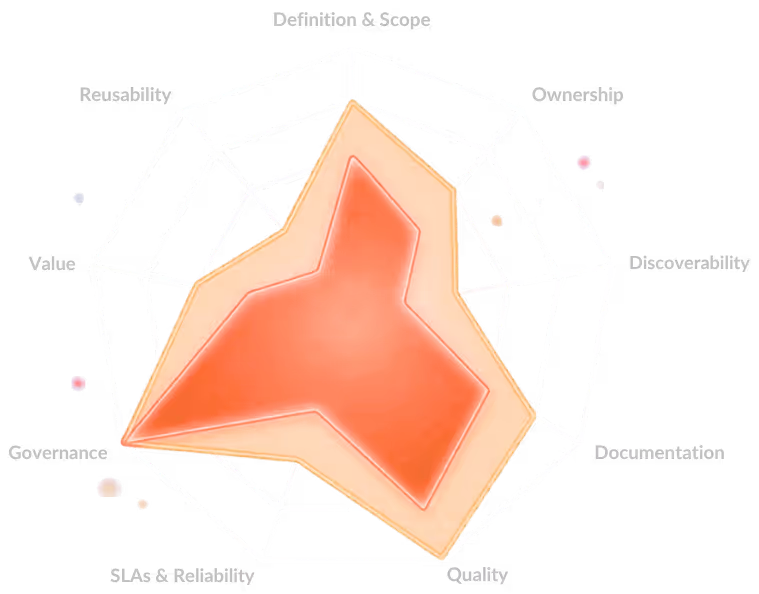
Where does your org stand on data product maturity?
A 9-dimension self-assessment used by 100+ data teams to benchmark strategy, ownership, and platform readiness.


Read the ideas here. Build them with The Modern Data Company.
Modern Data 101 is where the data community thinks out loud. When you're ready to move from articles to architecture, data products, governed AI pipelines, or a full Data Operating System; the team behind this community can help you build it.
Continue reading
.jpg)

.png)

.png)