
The Complete Guide to LLM Evaluation Metrics
Only 34% of enterprises trust their autonomous AI agents. Bridge the gap between demo adoption and production reliability with quantitative LLM evaluation metrics, automated frameworks, and data-layer governance.

Just 34% of enterprises trust the actions their AI agents are taking, even though 86% have already moved past the pilot stage into production. That gap between adoption and trust is exactly what LLM evaluation is built to close. LLM evaluation is the process of scoring a large language model’s outputs against criteria like accuracy, relevance, and safety, so teams know whether a model is production-ready before real users see it.
Once you move from demo to deployment, “it sounds good” stops being a usable standard; you need LLM evaluation metrics that are quantitative, repeatable, and tied to how the system is actually used: a RAG chatbot, a multi-turn assistant, an autonomous agent, or a fine-tuned foundation model.
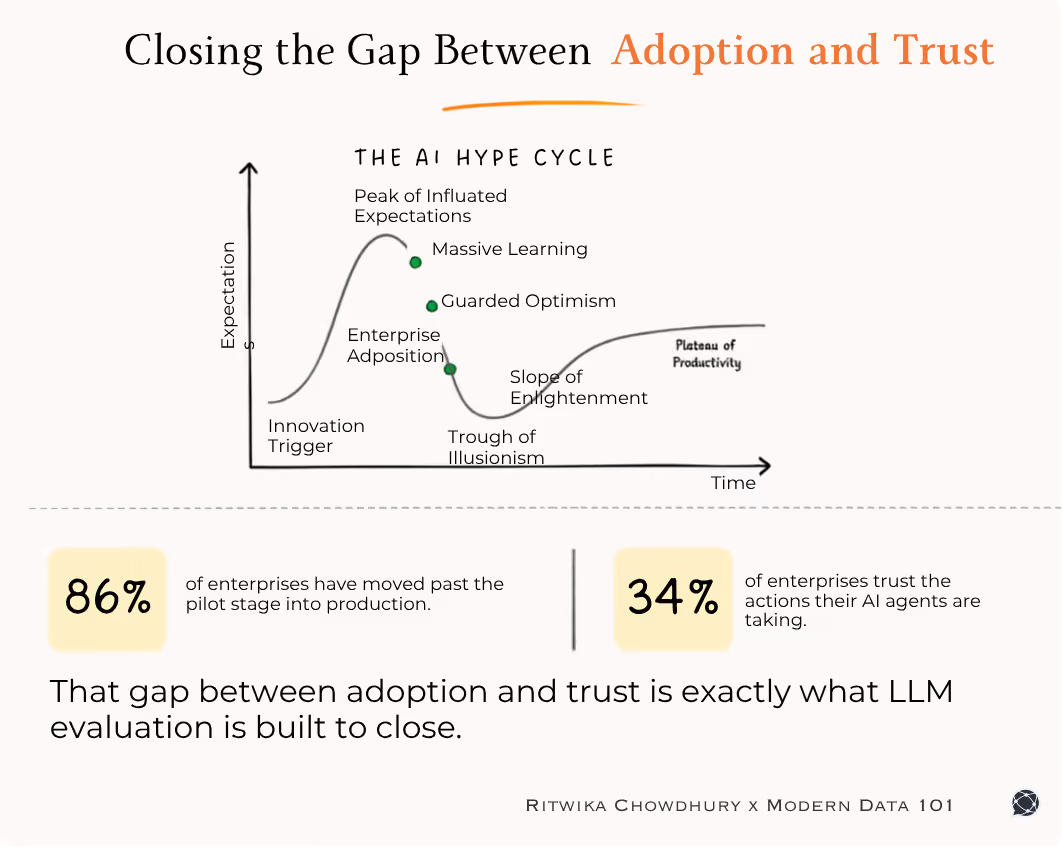
This guide breaks down every layer of LLM evaluation metrics in use today, the LLM evaluation frameworks and benchmarks built to run them at scale, and a practical way to decide which ones belong in your pipeline.
[state-of-data-products]
What Is LLM Evaluation?
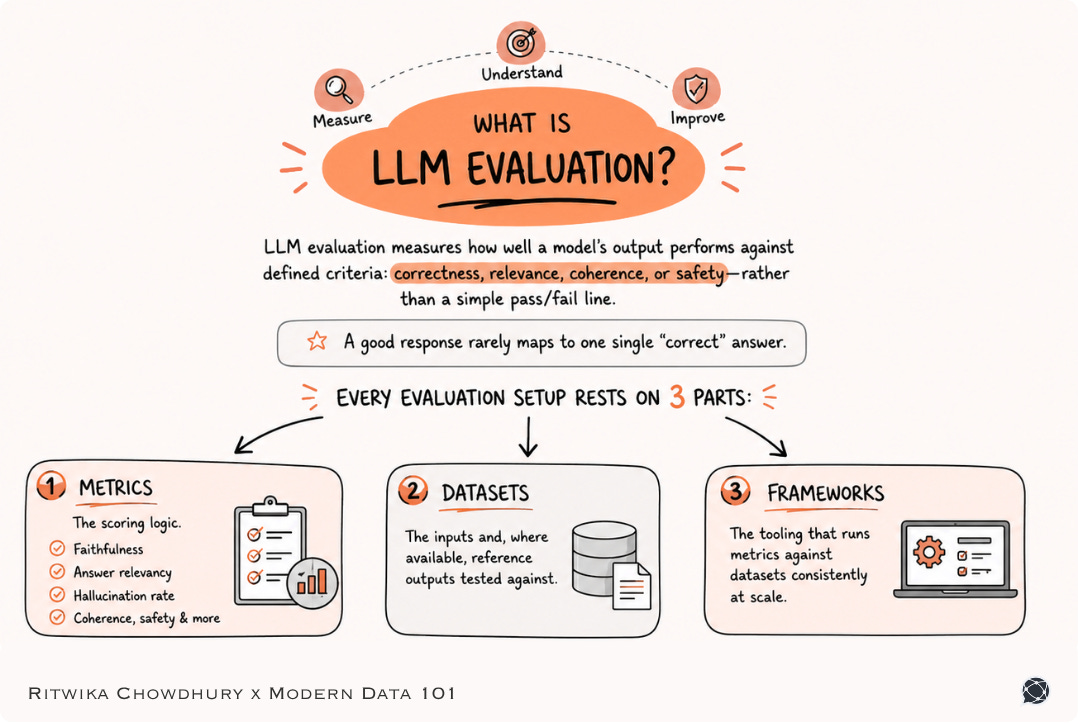
LLM evaluation measures how well a model’s output performs against defined criteria: correctness, relevance, coherence, or safety, rather than a simple pass/fail line, because a good response rarely maps to one single “correct” answer. Every evaluation setup rests on three parts:
- Metrics: the scoring logic (faithfulness, answer relevancy, hallucination rate)
- Datasets: the inputs and, where available, reference outputs tested against
- Frameworks: the tooling that runs metrics against datasets consistently at scale
Skipping any one is usually where pipelines quietly break: strong metrics tested on an unrepresentative dataset, or good data run through no repeatable framework at all.
Why LLM Evaluation Metrics Matter
Monitoring and evaluation, as per several studies, are considered one of the biggest step-changes organisations need versus older AI governance programs, since model behaviour shifts as prompts and data evolve. KPMG’s applied study on evaluating generative AI output reaches the same conclusion from the delivery side: without a structured, quantitative method, teams can’t tell a genuinely good output from a fluent but inaccurate one.
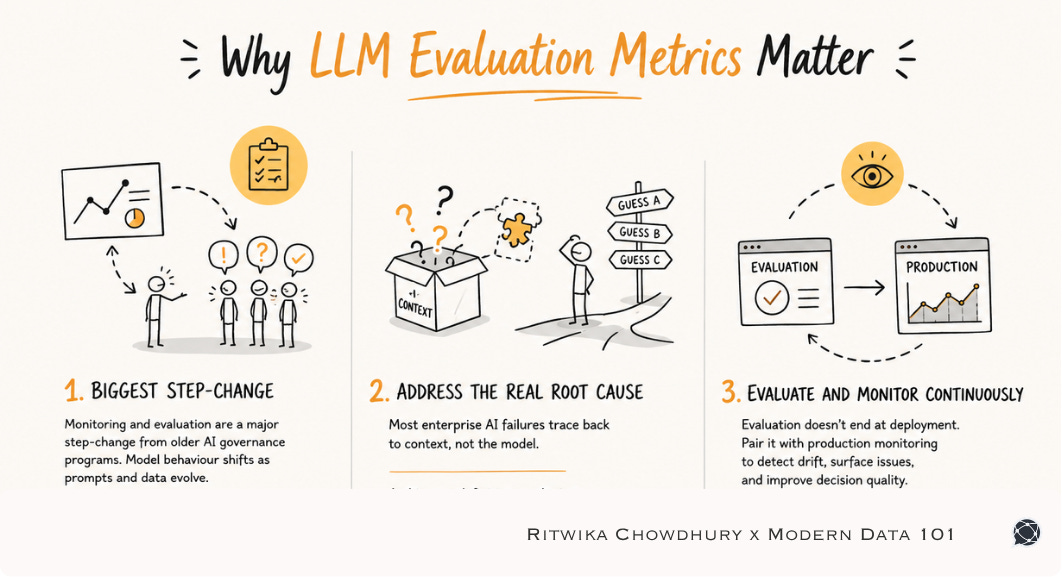
Most enterprise AI failures trace back to context, not the model itself, ambiguous definitions and missing lineage force AI systems to guess, and evaluation is how that guessing gets caught before it reaches a user (data modelling best practices for AI at scale). It is crucial to pair evaluation with production monitoring once live to improve decision quality through AI observability.
Statistical LLM Evaluation Metrics
Statistical metrics score an LLM’s output by comparing word overlap against a reference answer fast and cheap, but blind to meaning. The three most common:
- BLEU (Bilingual Evaluation Understudy), measures n-gram precision between generated and reference text, built originally for machine translation.
- ROUGE (Recall-Oriented Understudy for Gisting Evaluation), measures n-gram recall, commonly used for summarisation tasks.
- METEOR, blends precision and recall and adjusts for synonyms and word order, making it more flexible than BLEU or ROUGE.
The shared weakness: these reward surface-level overlap, not correctness. A well-paraphrased, factually accurate answer can score poorly simply because it doesn’t reuse the reference text’s exact wording, which is what pushed the field toward model-based and LLM-as-a-judge scoring.
Model-Based and LLM-as-a-Judge Metrics
Model-based evaluation uses another model, often an LLM itself, to judge output quality against a rubric, capturing nuance that word-overlap metrics miss entirely.
G-Eval has an LLM generate its own evaluation steps via chain-of-thought reasoning, then score the output against those steps using a form-filling approach. The method, introduced in “NLG Evaluation using GPT-4 with Better Human Alignment,” found it correlated with human judgment far more closely than BLEU/ROUGE-style scorers. Because the scoring criteria are defined in plain language, G-Eval suits subjective, use-case-specific metrics such as tone, helpfulness, brand voice that a fixed formula can’t capture.
Several scorers skip the reference answer entirely, which matters in production where a “correct” answer isn’t predefined:
- QAG (Question-Answer Generation) scoring extracts claims from an output and checks each against source context with confined yes/no answers, keeping scoring reliable without asking an LLM to invent a number directly.
- BERTScore compares contextual embeddings between generated and reference text using cosine similarity, capturing semantic overlap pure n-gram methods miss.
- Prometheus is an open-source, fine-tuned evaluation model that works similarly to G-Eval without depending on proprietary APIs.
Core LLM Evaluation Metrics by Architecture
Regardless of architecture, most production systems need a working handle on the same handful of metrics:
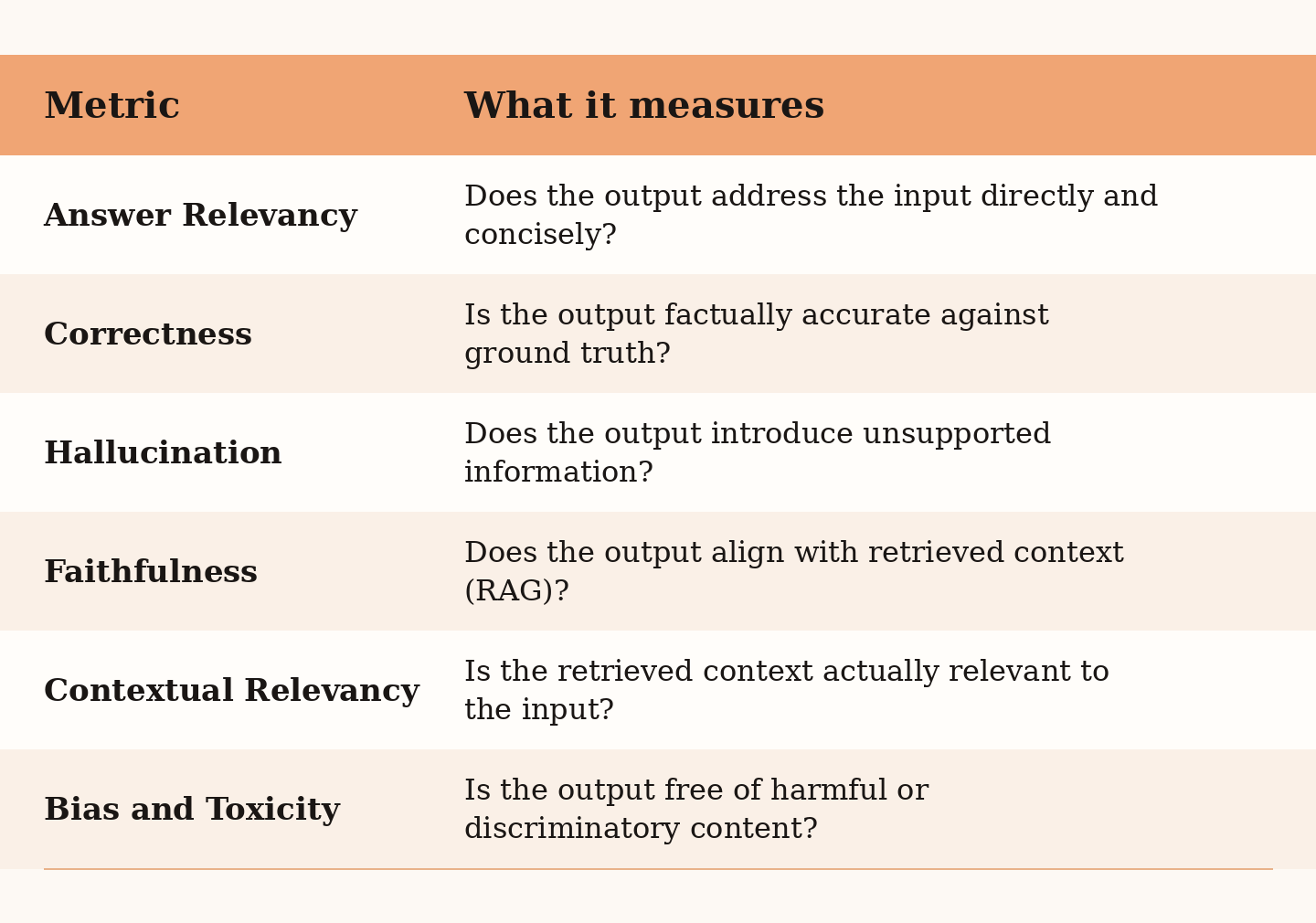
A useful discipline: pick three to five metrics tied directly to your use case rather than scoring everything available. A pipeline evaluating fifteen metrics mostly produces more dashboards and less clear decisions than one evaluating four well-chosen ones; it just produces more dashboards.
RAG Evaluation Metrics
RAG systems can fail in two places: retrieval and generation. Faithfulness and answer relevancy evaluate the generated response, while contextual precision, contextual recall, and contextual relevancy assess whether the retriever surfaced the right context.
This distinction matters because poor retrieval, such as outdated or duplicate context, cannot be fixed through prompt engineering alone. It’s a data-layer issue tied to making data AI-ready. Retrieval quality should be part of evaluation from day one. Enterprise ontologies further improve retrieval by providing shared semantic context, reducing hallucinations at the source.
[related-1]
AI Agent Evaluation Metrics
Agent evaluation metrics need to score the entire execution trace, not just the final text, because an agent’s failure can happen mid-process even when the final answer looks fine. The core metrics to track:
- Task Completion: Did the agent actually accomplish what it was asked to do, end to end?
- Tool Correctness: Did it call the correct tools, compared against an expected tool list?
- Argument Correctness: Were the parameters passed to those tools valid given the input?
- Plan Quality and Plan Adherence: Did the agent build a logical plan, and stick to it during execution?
- Step Efficiency: Did it complete the task without redundant or unnecessary steps?
This is an active research area. A 2026 study on architecture-aware evaluation argues generic, model-centric metrics miss how an agent’s actual components planner, memory, tool router, shape its behaviour, and proposes linking specific metrics to specific architectural components for more diagnostic evaluation.
Enrol in this masterclass on AI agent data readiness and accelerating enterprise agent development with data discovery and catalogs, (if you’re scaling agents across an enterprise stack, evaluation needs a data foundation to run against consistently).
Multi-Turn and Conversational Evaluation Metrics
Multi-turn metrics evaluate an assistant across an entire conversation rather than one input-output pair, which matters for chatbots, voice agents, and any system that carries context across turns. The same core ideas of faithfulness, relevancy, contextual precision and recall apply, but each is calculated across the full turn history instead of a single exchange, since a technically correct answer in isolation can still be a poor one if it contradicts something said three turns earlier. This is a newer, less standardised layer of evaluation than single-turn RAG or agent metrics, and it’s worth building deliberately rather than assuming your single-turn metric set will transfer cleanly.
Foundational Model Metrics: Hallucination, Toxicity, and Bias
These metrics evaluate the base LLM itself rather than the application built around it, making them especially important when selecting or fine-tuning a model.
- Hallucination: Harder to measure than RAG faithfulness because there’s often no definitive ground truth. When reference answers are unavailable, zero-shot consistency checks across repeated model outputs can estimate hallucination.
- Toxicity: Measures whether responses contain harmful, offensive, or inappropriate language. The RealToxicityPrompts benchmark showed that even benign prompts can trigger toxic outputs. Because keyword-based detectors often misclassify humour or context, rubric-based methods such as G-Eval generally provide more reliable assessments.
- Bias: Evaluates political, gender, and social bias, particularly in high-stakes use cases like hiring or lending. Since bias varies across cultures and contexts, it is best assessed using clear evaluation rubrics combined with human review.
Use-Case-Specific Metrics
Generic metrics aren’t sufficient on their own; most production systems need at least one custom metric tied to the specific task:
- Helpfulness: Does the output actually serve the user’s underlying need, not just answer literally?
- Prompt Alignment: Does the output follow every instruction in the prompt template, checked instruction-by-instruction rather than against the whole prompt at once?
- Summarisation: Does the summary stay factually aligned with the source and include the information that matters most, typically scored as the lower of a factual-alignment score and an inclusion score?
Choosing the Right LLM Evaluation Framework
An LLM evaluation framework is the tooling layer that runs your chosen metrics against your datasets consistently, so evaluation becomes repeatable rather than a one-off spreadsheet exercise. When picking one, weigh:
- Use-case coverage; RAG, agents, multi-turn chat, or fine-tuned base models?
- Reference-free support; can it run in production without labelled ground truth for every input?
- CI/CD integration; can evaluation gate a deployment, not just review it afterwards?
- Traceability; can a score be traced back to the exact prompt, model version, and dataset that produced it?
- Human-in-the-loop support; can subject-matter reviewers weigh in where automated scoring falls short?
No framework is complete on its own. Automated scoring is fast and scalable but can inherit the blind spots of whichever LLM is doing the judging, which is why most mature evaluation programs still route a sample of outputs to human reviewers for the nuance.
[related-2]
LLM Evaluation Frameworks vs Benchmarks
Frameworks and benchmarks solve different problems and are easy to conflate. An LLM evaluation framework runs custom and pre-built metrics against your own application’s data, useful for the RAG pipeline, agent, or chat system you’re actively building. A benchmark like MMLU tests a base model’s general knowledge and reasoning across domains, independent of any specific application.
Benchmarks help you pick a base model; a framework tells you whether the system you built on top of that model actually works for your users. Treat them as sequential steps, not substitutes: benchmark first, then evaluate the application layer separately, and re-evaluate the application every time the underlying model changes.
Best Practices for Building an End-to-End LLM Evaluation Pipeline
- Curate a dataset that reflects real usage, including edge cases, not just clean demo prompts.
- Match metrics to architecture: RAG needs retriever/generator metrics, agents need trace-level metrics, chatbots need multi-turn metrics.
- Cap the metric count at three to five per system.
- Combine automated scoring with human review, since LLM-as-a-judge can inherit its own blind spots.
- Re-run evaluation on every meaningful prompt, model, or data change, not just at launch.
- Pair offline evaluation with production monitoring, since evaluation alone can’t catch drift that only appears once a system is live. Know the production side of this loop here, which covers the production side of this loop.
[related-3]
How Data Platforms Support Reliable LLM Evaluation
LLM evaluation depends as much on data quality as model quality. Metrics such as faithfulness, hallucination, and contextual relevancy reflect the state of the underlying data.
Teams often see evaluation scores degrade in production because schemas change, definitions diverge, or source data becomes stale. These issues affect multiple metrics simultaneously and are difficult to diagnose without consistent, governed data.
Data products provide that consistency. With clear ownership, versioning, governance, and data contracts, they give LLMs a reliable source of truth for retrieval. Stable definitions make metrics such as faithfulness and contextual relevancy meaningful across releases. We explore this foundation in our guide to data products for AI agents.
The data platform is equally important. A unified platform standardises data, semantics, and access policies, making evaluation results comparable across teams and over time. Without that consistency, identical metrics can measure entirely different business contexts.
Learn what to evaluate at the platform layer here.
Evaluation metrics measure model performance. Data products and a unified data platform determine whether those results remain reliable in production.
FAQs
Q1. What are the most important LLM evaluation metrics to start with?
Start with answer relevancy, correctness, and hallucination for any system, then add faithfulness and contextual relevancy for RAG, or task completion and tool correctness for agents.
Q2. What metrics are used to evaluate LLMs?
Common LLM evaluation metrics include faithfulness, answer relevancy, contextual precision, contextual recall, contextual relevancy, hallucination, toxicity, bias, and task-specific metrics such as ROUGE, BLEU, or exact match.
Q3. What is LLM-based evaluation?
LLM-based evaluation uses one LLM to assess the output of another against predefined criteria such as correctness, relevance, safety, or faithfulness. It provides scalable evaluation but is often paired with human review for high-stakes applications.
Q4. What are LLM evaluation tools?
Popular LLM evaluation tools include DeepEval, Ragas, LangSmith, TruLens, OpenAI Evals, Promptfoo, and MLflow. They help automate testing, benchmark model performance, and track evaluation results over time.
Q5. What are the challenges of LLM evaluation?
LLM evaluation challenges include domain-specific benchmarks, multiple valid answers, bias in LLM-based judges, difficulty measuring reasoning, and evaluating multi-agent or tool-using systems. Most production teams combine automated metrics with human review to address these gaps.
Connect with a community data expert
A no-cost session with a practitioner who's been where you are.
About Modern Data 101
Modern Data 101 is a movement redefining how the world thinks about data. A community built by the same team behind the world’s first data operating system, Modern Data 101 sits at the intersection of data, product thinking, and AI. Spread across 150+ countries, the community brings together a global network of practitioners, architects, and leaders who are actively building the next generation of data systems.
At its core, Modern Data 101 exists to simplify the journey from raw data to tangible and observable impact. It advocates high-potential data systems and next-gen architectures to unify and activate insights and automation across analytics, applications, and operational workflows at the edge.
In a world shifting from data stacks to AI ecosystems, Modern Data 101 helps teams not just navigate the change but lead it.


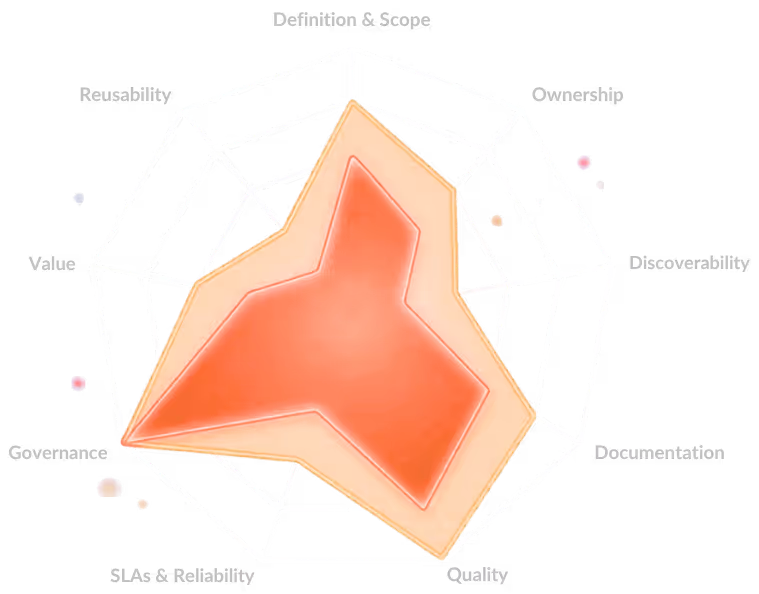
Where does your org stand on data product maturity?
A 9-dimension self-assessment used by 100+ data teams to benchmark strategy, ownership, and platform readiness.


Ritwika Chowdhury
Ritwika is part of Product Advocacy team at Modern, driving awareness around product thinking for data and consequently vocalising design paradigms such as data products, data mesh, and data developer platforms.
Read the ideas here. Build them with The Modern Data Company.
Modern Data 101 is where the data community thinks out loud. When you're ready to move from articles to architecture, data products, governed AI pipelines, or a full Data Operating System; the team behind this community can help you build it.
Continue reading
.png)

.png)

%20(1).png)

