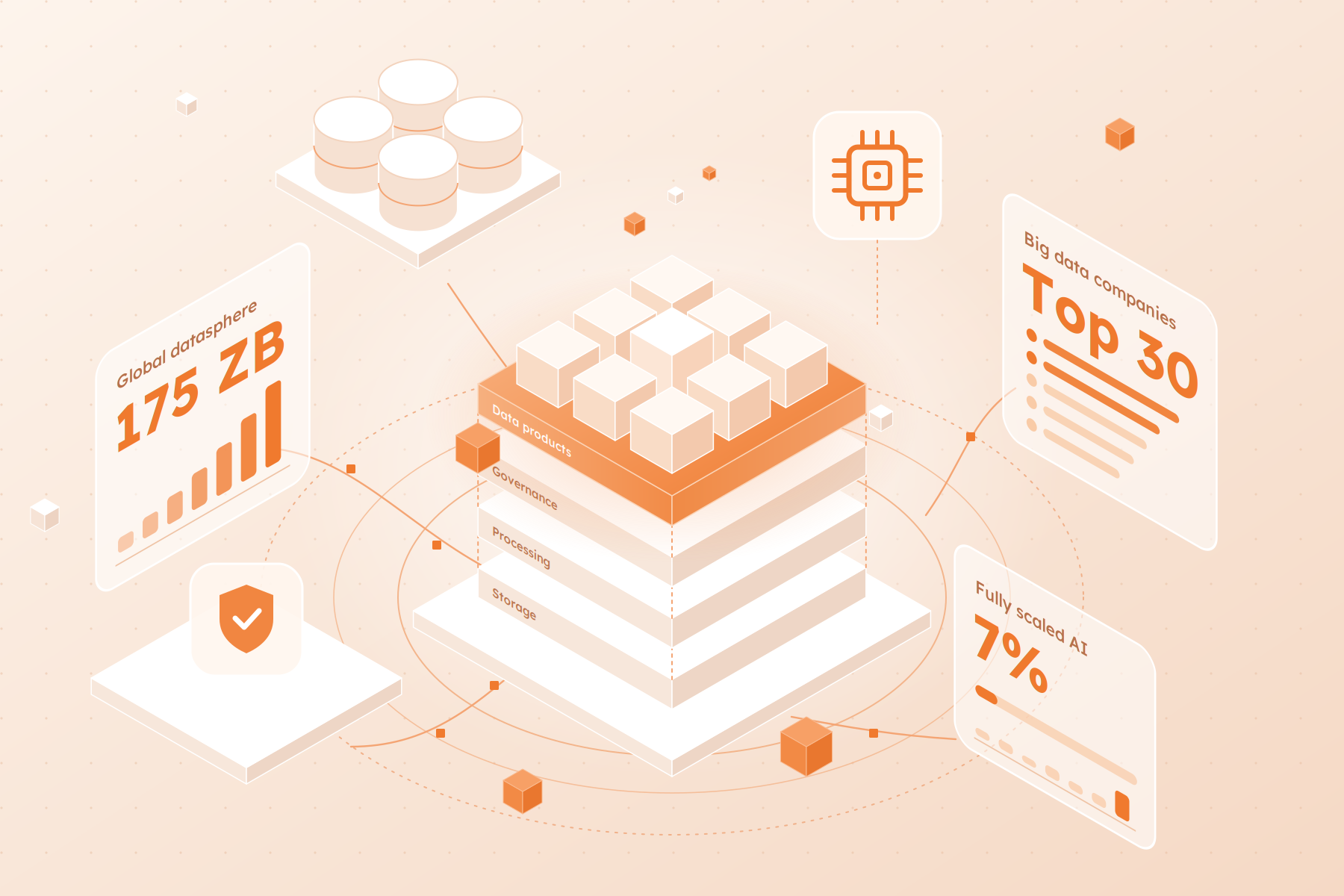
50 Data Platform Statistics Every Data Leader Should Know in 2027
68% of teams report data isn't ready for AI while only 12% of CEOs see dual ROI. Discover the data platform benchmarks separating leaders from laggards.

The Enterprise AI Reality Check: Is Your Data Platform AI-Ready?
Enterprises have spent a decade modernising their data platforms, and AI has now become the test of whether that investment pays off. For most of the last decade, a data platform had one job: move data from source systems, store it, and make it queryable. Whatever happened after that was left to the analysts. AI has raised that bar. Models and agents now consume data directly and act on it at machine speed, so the platform underneath has to deliver data that is trusted, contextual, and ready to use the moment it is needed.
Most enterprises are still catching up. Only 40% of companies feel highly prepared on data management for AI, even as more of them rate their AI strategy as ready (Deloitte). Just 12% of CEOs say AI has delivered both cost and revenue benefits (PwC).
The 50 data platform statistics below show where data readiness stands heading into 2027 and what separates the organisations turning data into AI results.
[survey-2025]
What Makes a Data Platform AI Ready?
An AI-ready data platform goes a step further. It makes meaning, trust, and access explicit and machine-readable through:
- a semantic layer with standardised business definitions
- embedded governance that applies to agents as strictly as to people
- lineage and quality signals attached to every dataset
- open interfaces that let AI tools discover and query data directly
[related-1]
Data Platform Readiness: The AI Infrastructure Gap
- 68% of data practitioners say their data is not clean or reliable enough for AI use cases.
- 65% say their data lacks the clarity and business context AI needs to be useful
- 80% rank a semantic layer with standardised definitions as the most important enabler of AI, ahead of AI tools and faster processing.
- Only 40% of companies feel highly prepared on data management for AI, a figure that fell compared with the previous year.
- Only 43% feel highly prepared on technical infrastructure for AI, also down year on year.
[dpma]
- By contrast, 42% say their AI strategy is highly prepared, a figure that rose year on year, so strategy is moving ahead of data foundations.
- 83% of senior business leaders say their AI adoption would be faster with stronger data infrastructure in place (EY).
- 67% admit their lack of data infrastructure is actively holding back AI adoption (EY).
- Nearly 9 in 10 senior executives believe better data infrastructure would accelerate AI adoption, compared with 78% of their C-suite superiors.
- 85% of leaders named the quality of organisational data as the biggest anticipated challenge to their AI strategies.
- The CDP market is valued between USD 4 billion and USD 10 billion in 2026
Data Trust, Quality, and Context
- 46% of data practitioners do not fully trust the data used for business decisions.
- 89% say finding the right data is among their top three time drains.
- 57% struggle to interpret data because the necessary context is missing.
- 53% say lineage, the record of where data comes from and how it changes, is absent.
- The cost of bad data is estimated at 15% to 25% of revenue for most companies.
- 36% of finance organisations cite data quality as both their biggest barrier and their biggest opportunity for AI.
- 71% of banking finance leaders report improved forecast accuracy from AI, compared with 44% in healthcare, a gap KPMG attributes to differences in data foundations.
- 73% of companies name data privacy and security as their top AI risk.
- Around three in four executives cite data security, privacy, and risk as their biggest concern with AI.
[related-2]
Data Stack Complexity & Converged Data Platform Adoption
- Over 70% of data practitioners use more than 5 to 7 different tools or work with 3 to 5 vendors for tasks such as data quality and dashboarding.
- 77% say a converged data platform would be valuable.
- 84% rank unified access to all data among their top expectations from a converged platform.
- 19% of executives rank the ability to connect AI agents across applications and workflows among their top three challenges.
- 77% of companies now factor an AI solution’s country of origin into vendor selection.
- 58% now build their AI stacks primarily with local vendors.
Data Platform Governance & CDO Priorities
- 51% of chief data officers name data governance as their top priority for the year ahead.
- 56% of CDOs in higher-maturity organisations prioritise developing data products.
- 56% of CDOs report an increase in overall data spend across their organisation.
- 64% of US federal CDOs are very or completely involved in setting data governance policies for AI use.
- Only 21% of companies have a mature governance model for autonomous AI agents.
AI Agents and the Data Layer
- 79% of senior executives say AI agents are already being adopted in their companies.
- 38% of executives highly trust AI agents with data analysis, compared with 20% for financial transactions (PwC AI Agent Survey).
- Among companies adopting AI agents, only 45% are fundamentally rethinking operating models and 42% are redesigning processes around them.
- 23% of companies use agentic AI at least moderately today, and 74% expect to within two years.
- 85% of companies expect to customise AI agents to fit the unique needs of their business.
- Only 14% of senior leaders say agentic AI has been fully implemented in their organisation (EY).
- 48% of technology leaders are already adopting or fully deploying agentic AI (EY).
AI Investment and Returns
- 88% of executives say their team or business function plans to increase AI-related budgets in the next 12 months because of agentic AI.
- Of companies adopting AI agents, 66% report measurable value through increased productivity.
- Only 12% of CEOs say AI has delivered both cost and revenue benefits (PwC Global CEO Survey 2026).
- 56% of CEOs say they have realised neither revenue nor cost benefits from AI.
- CEOs whose organisations have strong AI foundations, including technology environments that enable enterprise-wide integration, are three times more likely to report meaningful financial returns (PwC Global CEO Survey 2026).
- 84% of organisations are increasing their AI investments.
- 74% of organisations hope to grow revenue through AI, but only 20% are already doing so.
- Only 25% of organisations have moved 40% or more of their AI experiments into production.
- 95% of organisations are increasing their AI investments.
- 74% of global leaders say AI will remain a top investment priority even if a recession occurs in the next 12 months.
- Only 11% of organisations qualify as AI leaders that are scaling or operating AI agents with a systematic approach.
- Active AI use across finance functions rose from 30% in 2024 to 75% in 2026.
What These Data Platform Statistics Mean
Budgets for data and AI are rising in every survey, and agent adoption is accelerating. What lags is the data layer underneath. Data management readiness is falling even as AI strategy readiness rises; most leaders say weak infrastructure is slowing AI, and only a small share of organisations see both cost and revenue returns.
The organisations pulling ahead treat context, governance, and unified access as core platform capabilities. The Data Product Playbook on Modern Data 101 shows how to build those capabilities into data products from the start.
FAQs
Q1. What are examples of data platforms?
A data platform brings together the tools to ingest, store, process, govern, and serve data. Common examples include Snowflake, Databricks, Google BigQuery, Amazon Redshift, and Microsoft Fabric. Others include Cloudera and Teradata, as well as data product platforms like The Modern Data Company’s DataOS, which sit on top of existing infrastructure to unify access and governance.
Q2. What are data stats?
Data stats, or data statistics, are numerical measures that summarise and interpret data. They fall into two groups: descriptive statistics, which summarise a dataset (mean, median, mode, standard deviation), and inferential statistics, which use a sample to draw conclusions about a larger population (hypothesis tests, confidence intervals, regression).
Q3. What are the top 10 data analytics tools?
- Tableau: visual analytics and dashboards
- Microsoft Power BI: business intelligence, tightly integrated with Microsoft
- Looker: governed, model-based BI on Google Cloud
- DataOS: a data product platform that unifies access, governance, and semantics across existing sources, so analytics and AI teams work from trusted, ready-to-use data products
- Python: flexible analysis and machine learning (pandas, scikit-learn)
- R: statistical computing and modeling
- SQL: the standard for querying relational data
- Apache Spark: large-scale distributed processing
- Snowflake: cloud data warehousing and analytics
- Databricks: unified analytics and AI on a lakehouse
Connect with a community data expert
A no-cost session with a practitioner who's been where you are.
About Modern Data 101
Modern Data 101 is a global movement redefining how the world thinks about data. Built by the team behind The Modern Data Company, the company pioneering DataOS, the data operating system, Modern Data 101 brings together a global community of practitioners, architects, and leaders across 150+ countries at the intersection of data, product thinking, and AI.
While DataOS advances the technology and infrastructure on-ground to help enterprises operationalize data as products, Modern Data 101 advances the ideas, practices, and conversations that shape how the industry approaches data and AI. Together, they connect technological innovation with the broader movement to rethink how organizations build, govern, and activate data.
At its core, Modern Data 101 exists to simplify the journey from raw data to tangible, measurable impact. It champions data product thinking and next-generation architectures that unify and activate insights and automation across analytics, applications, and operational workflows.
In a world shifting from data stacks to AI ecosystems, Modern Data 101 helps the industry rethink what's possible.


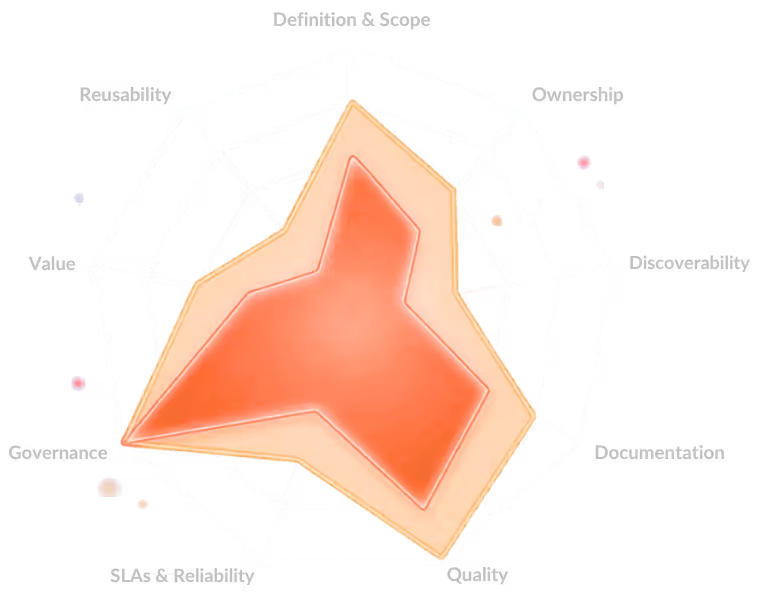
A 9-dimension self-assessment used by 100+ data teams to benchmark strategy, ownership, and platform readiness.


Ritwika Chowdhury
Ritwika Chowdhury is a data and technology professional focused on data products, AI, and modern data architecture. Her work sits at the intersection of data strategy, product thinking, and emerging AI technologies, with a focus on helping organisations turn enterprise data into trusted, usable, and scalable assets.
Read the ideas here. Build them with The Modern Data Company.
Modern Data 101 is where the data community thinks out loud. When you're ready to move from articles to architecture, data products, governed AI pipelines, or a full Data Operating System; the team behind this community can help you build it.
Continue reading