10 Best AI-Ready Data Platforms for 2027: Solved Data Readiness & Semantics

Almost 70% of enterprises said their data isn’t clean or trustworthy enough for AI, and 65% said it lacks the clarity and business context AI needs to be useful. The same survey found that 80% of respondents rank a semantic layer with standardised definitions as the most important enabler of AI, above AI tools themselves and above faster processing.
That shifts the buying question for 2027. Storage and compute are solved problems. The real test for data platforms is data readiness: whether a machine can find, interpret, trust, and act on data without a human filling the gaps.
This guide ranks the 10 AI-ready data platforms best positioned to deliver that in 2027.
[report-2025]
What Makes a Data Platform AI Ready?
AI-ready data carries its own meaning. In an AI-driven system, data doesn’t get the benefit of tribal knowledge: models don’t browse Teams channels, and agents don’t remember why one metric is considered more correct than another. A platform earns the AI-ready label when it makes that context explicit and machine-readable. For a deeper breakdown, read AI-Ready Data vs. Analytics-Ready Data on Modern Data 101.
We evaluated each platform against five criteria:
- Semantic context: shared business definitions, metrics, and ontologies that AI agents can read.
- Embedded governance: access policies, lineage, and quality controls that apply to agents as strictly as to humans.
- Reach across the estate: the ability to work with data across clouds, on-prem systems, and legacy sources.
- Agent access: native interfaces such as MCP, APIs, and natural-language querying.
- Time to value: how quickly an enterprise can move from pilot to production AI.
The 10 Best AI-Ready Data Platforms for 2027
1. Databricks Data Intelligence Platform
Databricks is the lakehouse platform built on Apache Spark and Delta Lake, positioned as a unified data intelligence platform for analytics, ML, and AI agents. More than 20,000 organisations, including over 60% of the Fortune 500, use it, and the platform includes Agent Bricks, Lakeflow, Lakehouse, Lakebase, and Unity Catalog.
At Data + AI Summit 2026, Databricks announced several additions to the platform, according to its user-group recap of the event. A Lake Transactional + Analytical Processing (LTAP) solution unifies OLTP and OLAP into one real-time foundation. Unity Catalog governance now extends across every region and cloud. Unity AI Gateway adds a runtime governance layer for models and agents. Agent Bricks gives teams a governed environment to build and evaluate agents on the same data.
For engineering-heavy teams running ML and agent workloads at scale, Databricks offers one of the most complete build-to-govern loops in a single platform. The trade-off is skill depth: it rewards mature data engineering teams most.
2. DataOS by The Modern Data Company
DataOS is a data operating system from The Modern Data Company, built around the data product as its core unit. It layers over an existing data stack, working with platforms like Snowflake, Databricks, and BigQuery, without requiring migration.
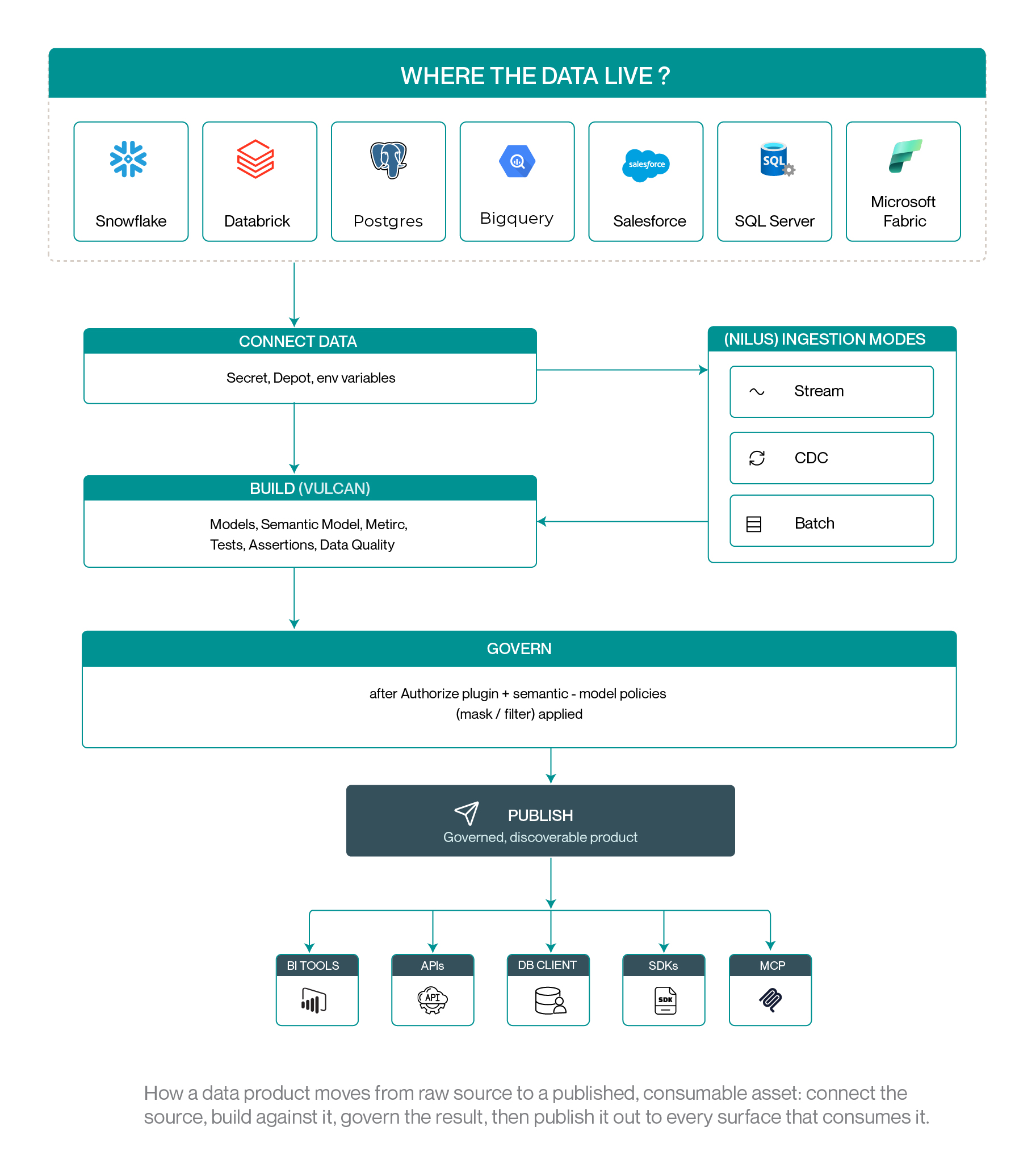
DataOS embeds semantic context, governance, quality controls, and versioning directly into data products. LLMs, AI agents, and applications can then access consistent, trusted data without manual preparation or duplicated engineering effort.
These data products are accessible via REST, GraphQL, and SQL, and are exposed through MCP. AI tools and assistants can discover and interact with them inside existing development workflows.
Deployment is flexible. DataOS queries and activates data across multiple sources without copying everything into one place, and runs on-premises, across multiple clouds, or in hybrid setups. For regulated industries, it adds policy-as-code governance, zero trust data access, and automated metadata management, lineage, and data observability.
DataOS targets the exact gap the Modern Data Report surfaced: missing context and conditional trust. It makes existing investments AI ready instead of replacing them, which matters for enterprises that can’t afford another multi-year migration.
A Fortune 500 global manufacturer accelerated its GenAI timeline by 80% with DataOS, delivering predictive maintenance and quality optimisation across 150M+ devices in weeks. Adoption in high-stakes environments is growing too.
For more insights on this, read the article here.
3. Snowflake AI Data Cloud
Snowflake is a cloud data platform that separates storage from compute and runs across AWS, Azure, and Google Cloud. It began as a data warehouse and now covers data engineering, applications, and AI workloads.
Teams scale compute independently for each workload, and all data stays inside a single security and governance perimeter managed through Horizon Catalog. Cortex AI brings large language models into SQL and Python, so analysts can summarise, classify, or search data where it already lives. Semantic views and Cortex Analyst let business users ask questions in plain language against defined metrics. Secure data sharing lets organisations exchange live, governed data with partners without copying it, and support for Apache Iceberg tables adds open-format flexibility.
Snowflake is a strong fit for SQL-first organisations that want governed analytics, data sharing, and AI in one place with minimal infrastructure management. AI workloads largely assume the data lives in or is accessible to Snowflake.
[state-of-data-products]
4. Microsoft Fabric
Microsoft Fabric is a SaaS analytics platform that brings data integration, engineering, warehousing, real-time analytics, data science, and Power BI into a single product built on one storage layer, OneLake.
OneLake acts as a single logical data lake for the whole organisation, storing data in open Delta format. Shortcuts and mirroring let teams reference data in other clouds and databases without building copy pipelines. Microsoft Purview applies governance and sensitivity labels across Fabric, Power BI semantic models carry shared business definitions, and Copilot helps users build pipelines, write code, and query data in natural language.
For organisations already invested in Microsoft 365, Azure, and Power BI, Fabric reduces tool sprawl and brings AI-ready data closer to the people who use it. Its strongest integrations stay within the Microsoft ecosystem.
[related 1]
5. Google BigQuery
BigQuery is Google Cloud’s serverless data warehouse, designed to analyse very large datasets without infrastructure management.
Storage and compute scale automatically, so teams focus on queries rather than clusters. BigQuery ML lets analysts train and run models using SQL, and native integration with Vertex AI and Gemini extends that to generative AI and agents. BigLake and Apache Iceberg support let BigQuery work with open-format data, including data stored outside Google Cloud, while Dataplex provides cataloging, quality, and governance across the estate.
[related 2]
BigQuery offers one of the fastest paths from data to AI for Google Cloud organisations, with very low operational overhead. Enterprises centred on other clouds will need to weigh the integration effort.
6. IBM watsonx.data
IBM watsonx.data is an open, hybrid data lakehouse for AI and analytics that runs on-premises, in any major cloud, or across both.
Built on open formats such as Apache Iceberg, watsonx.data lets teams use several query engines, including Presto and Spark, on the same data. This way, each workload runs on the most cost-effective engine. It handles both structured and unstructured data, turning documents into content that retrieval and reasoning workflows can use. It also connects with IBM’s governance and real-time streaming tools so AI systems receive fresh, policy-controlled data.
watsonx.data suits regulated and hybrid enterprises, including those with mainframe workloads, that need AI-ready data without moving everything to one public cloud.
7. Amazon SageMaker (Unified Studio and Lakehouse)
Amazon SageMaker is AWS’s unified environment for data, analytics, and AI. It brings services such as Amazon EMR, AWS Glue, Amazon Athena, Amazon Redshift, Amazon Bedrock, and SageMaker AI into a single workspace.
SageMaker Lakehouse unifies data across Amazon S3 data lakes and Redshift warehouses on Apache Iceberg, so any Iceberg-compatible tool can use it. SageMaker Catalog applies one permission model across data, models, and AI applications. Teams can then discover approved data, build pipelines, train models, and create generative AI applications with Bedrock inside shared, governed projects.
For AWS-standardised enterprises, SageMaker offers the broadest set of data and AI services under a common governance layer. The trade-off is a more modular experience that can take more effort to assemble than an all-in-one platform.
8. Informatica Intelligent Data Management Cloud (IDMC)
Informatica IDMC is a cloud-native data management suite covering data integration, data quality, master data management, cataloging, governance, and privacy. Informatica is now part of Salesforce.
IDMC connects to a wide range of sources and moves data through ETL, ELT, and replication. It profiles and cleanses data, and it maintains master records so core entities such as customers and products stay consistent across systems. Its CLAIRE AI engine automates metadata discovery, mapping, and data quality work, which reduces the manual effort of cataloging large estates.
AI is only as reliable as the data it reads, and few platforms match Informatica’s depth in data quality and master data. It suits large enterprises that need to fix trust at the source before any AI layer can use the data.
9. Starburst
Starburst is a federated data platform built on the open-source Trino query engine. It is available as a managed cloud service (Galaxy) and as self-managed software (Enterprise).
Starburst queries data where it lives, across data lakes, warehouses, and on-prem databases, so teams can join and analyse data without first moving it. It adds centralised access controls, a catalogue, and data products that attach business context to curated datasets. Its AI agent and MCP support let users and AI tools query that governed data in natural language.
For enterprises whose data will never consolidate into one system, Starburst offers mature in-place access with governance and business context on top.
10. Denodo Platform
Denodo is a logical data management platform that uses data virtualisation to create a unified, governed view of data spread across many systems.
Denodo connects to sources such as databases, warehouses, lakes, applications, and APIs, and presents them through a semantic layer with shared business definitions. Queries run against live source data, optimised so that only the required data moves. Security, masking, and access policies apply centrally. Its AI SDK and MCP support let AI applications and agents retrieve governed, real-time data for RAG and reasoning workflows.
Denodo gives AI live, governed access to operational data without new pipelines. It works best as a context and access layer alongside a storage platform.
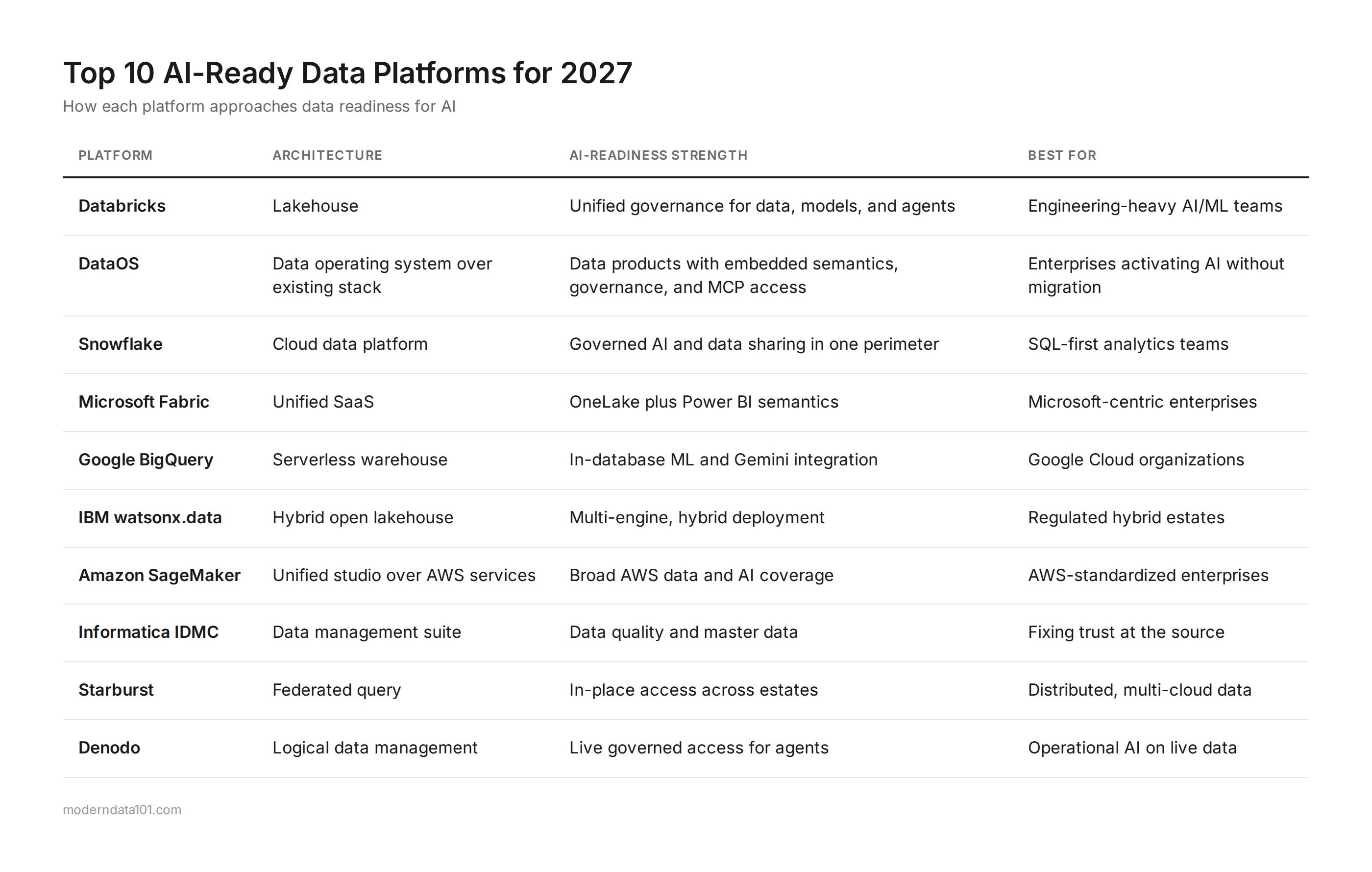
How to Choose the Right Data Platform for Your AI Strategy
Start with where your data readiness breaks today.
- If the gap is compute and ML tooling, a lakehouse or warehouse leader fits.
- If the gap is context, trust, and discoverability, which is the gap most practitioners in the Modern Data Report describe, prioritise platforms that make semantics and governance part of the data itself.
Most enterprises in 2027 will run more than one platform. Favour options that layer over your existing stack and expose data to agents through open interfaces.
For a structured way to assess where your organisation stands, the Data Product Playbook on Modern Data 101 walks through the path from raw data to AI-ready data products.
FAQs
Q1. What is AI-ready data?
AI-ready data is discoverable, governed, and carries enough business context that AI models and agents can use it without human interpretation. Clean data is the starting point; context, lineage, and trust signals complete it.
Q2. What is data readiness for AI?
Data readiness measures whether your data can support AI in production. That means it is accessible, consistently defined, trustworthy, and exposed through interfaces machines can use.
Q3. Do I need to migrate data to become AI ready?
No. Platforms such as DataOS, Starburst, and Denodo work with data in place, and several warehouse vendors now support cross-cloud access.
Connect with a community data expert
A no-cost session with a practitioner who's been where you are.
About Modern Data 101
Modern Data 101 is a movement redefining how the world thinks about data. A community built by the same team behind the world’s first data operating system, Modern Data 101 sits at the intersection of data, product thinking, and AI. Spread across 150+ countries, the community brings together a global network of practitioners, architects, and leaders who are actively building the next generation of data systems.
At its core, Modern Data 101 exists to simplify the journey from raw data to tangible and observable impact. It advocates high-potential data systems and next-gen architectures to unify and activate insights and automation across analytics, applications, and operational workflows at the edge.
In a world shifting from data stacks to AI ecosystems, Modern Data 101 helps teams not just navigate the change but lead it.


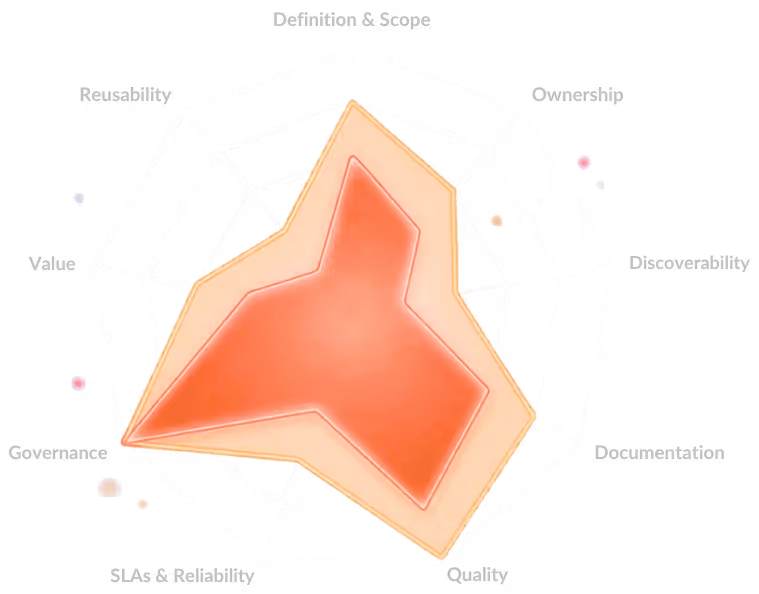
Where does your org stand on data product maturity?
A 9-dimension self-assessment used by 100+ data teams to benchmark strategy, ownership, and platform readiness.


Ritwika Chowdhury
Ritwika Chowdhury is a data and technology professional focused on data products, AI, and modern data architecture. Her work sits at the intersection of data strategy, product thinking, and emerging AI technologies, with a focus on helping organisations turn enterprise data into trusted, usable, and scalable assets.
Read the ideas here. Build them with The Modern Data Company.
Modern Data 101 is where the data community thinks out loud. When you're ready to move from articles to architecture, data products, governed AI pipelines, or a full Data Operating System; the team behind this community can help you build it.
Continue reading

.jpg)
.png)