
Close the Action Gap: How Agent Orchestration Turns AI Pilots Into ROI
How leading enterprises use agent orchestration to move beyond isolated scripts and turn multi-agent workflows into measurable P&L value.

TL;DR
AI agent orchestration coordinates multiple agents, so they complete real workflows, not isolated tasks. But coordination isn’t the hard part. Gartner expects 40% of agentic AI projects to be cancelled by 2027, and most of that failure traces back to a question nobody assigned: who answers for a decision an agent made. This guide gives CDOs the checkpoints to close that gap.
[report-card]
What’s Causing the AI Action Gap?
Your organisation probably already has agents. Sales has a chatbot, ops has a script, finance is piloting something that drafts reports. None of them talks to each other, and none of them shows up on your P&L.
Most teams read that as a coordination problem and buy an orchestration tool to wire the agents together. That fixes routing. It doesn’t fix the actual gap: when an agent approves a refund, escalates a ticket, or flags a transaction, nobody has decided in advance who is accountable if it gets that wrong.
Gartner predicts over 40% of agentic AI projects will be cancelled by 2027, citing cost and unclear value, not model quality. McKinsey’s research puts it plainer: fewer than 10% of enterprises that have piloted agents have scaled them into measurable value. Coordination without accountability is why.
[playbook]
[related-1]
What Is AI Agent Orchestration?
AI agent orchestration is the layer that decides which agent acts, on what data, in what sequence, and who it hands off to next. It turns a set of independent agents into a workflow that can be measured, governed, and traced back to a decision-maker.
[related-2]
Related read: What are data agents? The bridge between agentic AI and enterprise data
The Four Mistakes That Widen the Action Gap
- Automating in isolation. A single agent filing a ticket isn’t orchestration; it’s a script with better marketing.
- No named owner for agent decisions. Teams orchestrate routing and skip the harder question: whose name is on the decision an agent makes at 2 am?
- Ungoverned data access. Agents fail quietly when they reach data that isn’t governed or trustworthy, not because the reasoning was wrong.
- Audit trails bolted on late. Retrofitting a decision record after an incident is expensive, and in regulated industries, sometimes impossible.
Step 1: Name an Owner Before You Name an Agent
Before you deploy a single agent, assign a person accountable for every decision that agent makes, the same way you’d assign an owner to a P&L line. If no one can answer “who signs off when this goes wrong,” the workflow isn’t ready for an agent, orchestrated or not.
This is the step most orchestration vendors skip, because it’s organisational, not technical.
Step 2: Govern the Data Before You Connect a Second Agent
Every agent needs access to governed data, and nothing more. Before scaling past one agent, confirm your organisation has moved from ad hoc pipelines toward AI-ready data platforms that expose data as governed, reusable products.
Without that foundation, orchestration just multiplies the number of places a bad decision can originate. A shared semantic layer also means a handoff between agents carries meaning.
Step 3: Build an Audit Trail That Can Reconstruct Every Decision
Treat the decision record as what you’re actually buying, not a logging feature bolted onto the agent framework. Every action needs a trace: what was decided, on what data, and by whose authority.
Gartner’s warning about “agent washing” applies here too: many platforms log activity but can’t reconstruct a decision after the fact. Test that before you buy. Zero Trust controls that verify agent behaviour continuously, not just at login, are what make the accountability question answerable six months later.
The Complete Guide to Evaluating AI Orchestration Platforms
.png)
Run your current agent rollout against the eight checkpoints above before your next planning cycle. If more than two come back unresolved, that’s your answer on whether to add another agent yet.
Before you commit budget to a third, pressure-test your infrastructure against Lean AI’s discipline for scaling agentic systems.
FAQs
Q1. What is AI agent orchestration?
It’s the layer that coordinates multiple AI agents, deciding which one acts, on what data, and how the result gets handed off. It turns isolated agents into an accountable workflow rather than parallel experiments.
Q2. How is agent orchestration different from robotic process automation?
RPA follows fixed, scripted steps. Orchestrated agents reason about a task, adapt to context, and hand off to other agents or humans when a decision falls outside their remit.
Q3. What’s the biggest reason agentic AI projects fail to show ROI?
Gartner attributes most cancellations to cost, unclear value, and weak risk controls, not model quality. Underneath those numbers sits a simpler cause: no one was assigned to own the outcome of an agent’s decision.
Q4. Do I need a new data platform to orchestrate AI agents?
Not necessarily new, but it must be AI-ready: agents need governed, product-based access to data rather than ad hoc pipelines built one agent at a time.
Connect with a community data expert
A no-cost session with a practitioner who's been where you are.
About Modern Data 101
Modern Data 101 is a movement redefining how the world thinks about data. A community built by the same team behind the world’s first data operating system, Modern Data 101 sits at the intersection of data, product thinking, and AI. Spread across 150+ countries, the community brings together a global network of practitioners, architects, and leaders who are actively building the next generation of data systems.
At its core, Modern Data 101 exists to simplify the journey from raw data to tangible and observable impact. It advocates high-potential data systems and next-gen architectures to unify and activate insights and automation across analytics, applications, and operational workflows at the edge.
In a world shifting from data stacks to AI ecosystems, Modern Data 101 helps teams not just navigate the change but lead it.


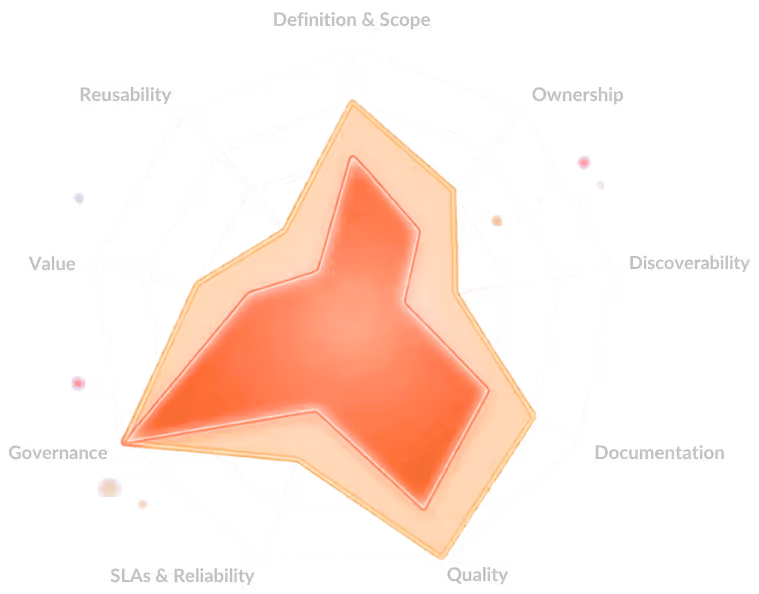
Where does your org stand on data product maturity?
A 9-dimension self-assessment used by 100+ data teams to benchmark strategy, ownership, and platform readiness.


Rachana Medishetti
Rachana is a data engineer with 5+ years of experience with a deep passion for how businesses leverage data, focusing on building end-to-end data systems, from ingestion and pipelines to analytics. She is skilled in PySpark, SQL, Python, and Snowflake, focused on turning data into reliable, real-world business value.
Read the ideas here. Build them with The Modern Data Company.
Modern Data 101 is where the data community thinks out loud. When you're ready to move from articles to architecture, data products, governed AI pipelines, or a full Data Operating System; the team behind this community can help you build it.
Continue reading
.png)

.png)

%20(1).png)

