State of Enterprise AI Adoption 2026: Gap Between AI Activity and Business ROI
Why layering autonomous AI agents onto legacy human workflows fails to deliver value, and how top performers are restructuring for scale.

TL;DR
- Over 89% of organizations regularly use AI and 40% of large enterprises are scaling autonomous AI agents, yet the share of companies reporting measurable EBIT contribution remains frozen at 37%.
- Personal employee productivity gains are often not translating into balance-sheet value because enterprises layer AI agents on top of legacy workflows rather than redesigning processes for native AI execution.
- Technology isn’t the primary blocker; process readiness (21%), workforce preparation (25%), missing data foundations (42%), and agent governance trust (39%) represent the true barriers to enterprise AI scaling.
- Capturing ROI requires moving beyond quick-win efficiency tools. High-performing organizations focus on deep process redesign, robust data governance, and workforce upskilling to turn AI adoption into measurable financial return.
The Challenges of AI ROI
Enterprise AI adoption has crossed a strange threshold in 2026. Nearly every large organisation has AI “in production” somewhere. Individual employees say it’s making them measurably more productive. And yet, ask most CFOs whether AI has moved the P&L, and the honest answer is still “not really.” This year’s enterprise research, from McKinsey, IBM, and Deloitte, converges on the same pattern: activity is scaling far faster than results.
[related-1]
AI adoption is Broad, but Scaling is Not
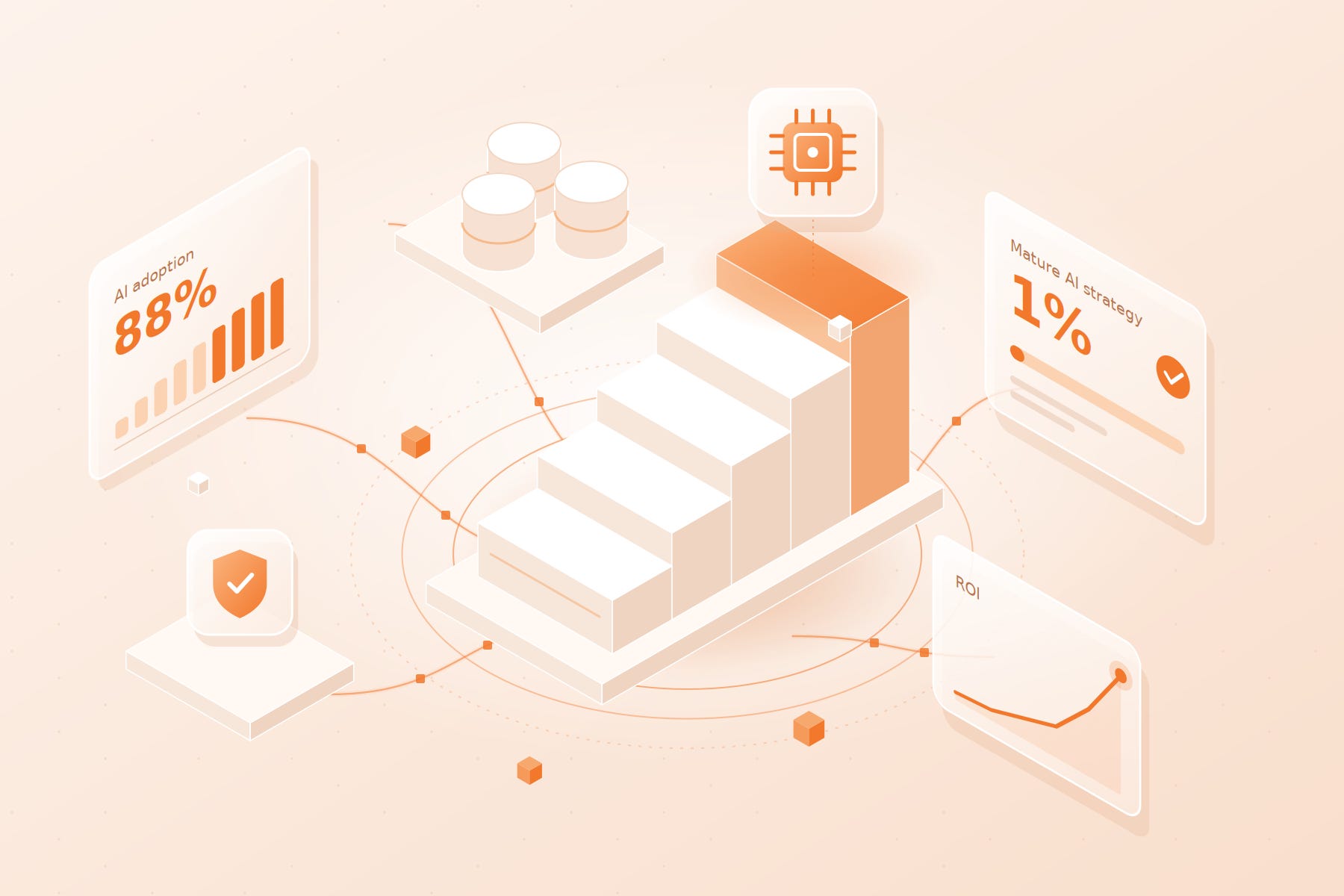
Nearly nine in ten organisations now use AI regularly in at least one business function, and the share running AI in three or more functions has climbed to 56% (McKinsey, “The State of AI in 2026”). Agent adoption specifically is accelerating fastest at large enterprises: 40% of companies with $1B+ in revenue are now scaling AI agents in at least one function, up from 27% a year ago, while smaller organisations have stayed essentially flat at 22% (McKinsey).
.png)
The ROI Gap Hasn’t Closed
This is the number that should worry every AI budget owner: the share of organisations reporting any enterprise-level financial impact from AI, measured as EBIT contribution, has stayed essentially flat at 37% year-over-year, even as scaled deployment has grown substantially. Only 6% of organisations qualify as true “AI high performers” (5%+ EBIT impact, “significant” reported value), and that figure hasn’t moved either (McKinsey).
[related-2]
.png)
The disconnect shows up in forward-looking expectations too. 79% of executives now expect AI to meaningfully drive revenue by 2030, nearly double today’s 40%, but only 24% say they have a clear view of where that revenue will actually come from. 68% worry their AI initiatives will fail simply because they aren’t integrated with core business operations. Spend priorities are shifting in response: about 47% of AI budgets go toward efficiency today, but executives expect 62% to be redirected toward innovation by 2030, and investment overall is projected to grow roughly 150% between now and then (Source: IBM Institute for Business Value, Jan 2026).
Why Agentic AI Stalls Without Workflow Redesign
The clearest explanation for the ROI gap comes from readiness data rather than adoption data. Among organisations already piloting agentic AI, preparedness across seven capability areas tells its own story: vision and strategy is the strongest area at just 52% “prepared,” while everything downstream trails behind; technology infrastructure (48%), data foundations (42%), governance (39%), ecosystem partnerships (34%), workforce readiness (25%). Business process redesign is the weakest link of all, with only 21% of leaders saying their processes are ready for agentic operation, and just 15% having scaled true cross-functional, multi-agent deployment (Deloitte, “AI Agents Are Only the Beginning,” Aug 2026).
The reason is structural: 72% of leaders cite fragmented, inaccessible data as a blocker, 70% don’t yet trust their own governance of autonomous agents, and 67% say integration is too costly and complex to execute at scale. Most organisations are still layering agents onto existing workflows in search of a quick win; only 31% expect to actually redesign the majority of their processes around agentic AI within the next two years (Deloitte).
Workforce disruption is coming faster than workforce investment
74% of leaders expect nearly half their business processes to be redesigned around AI agents within four years, and 75% agree that human–AI collaboration creates more value than automation alone. On the workforce side, 43% expect significant disruption within 12–18 months, rising to 72% over two to three years, yet half say their organisations aren’t adequately investing in AI-related workforce transformation (Deloitte).
What This Means for 2027 Planning
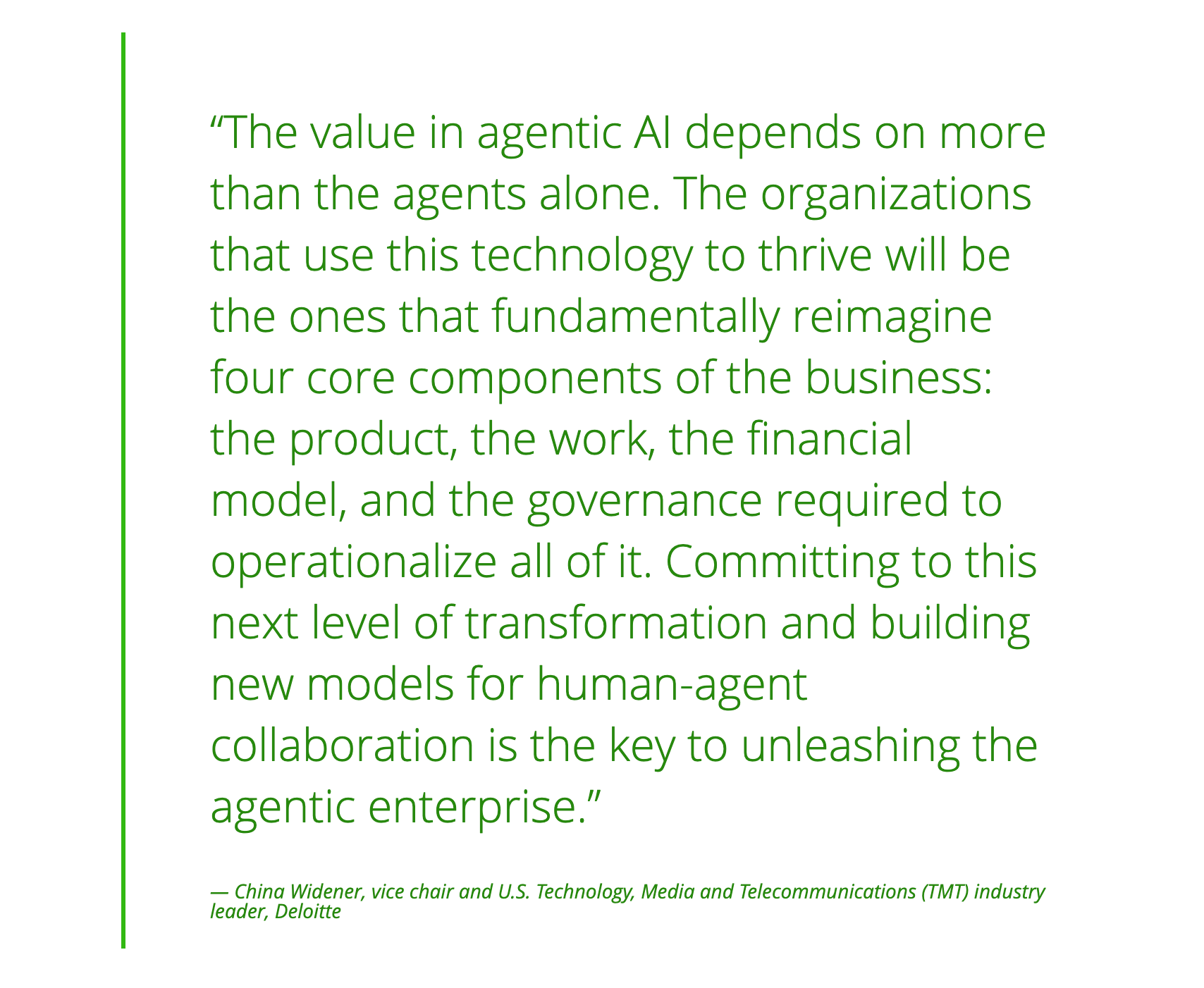
The throughline across this year’s data is simple: expectations, headcount plans, and press releases are all scaling ahead of the operational foundation needed to capture value from AI. The organisations reporting real financial impact aren’t necessarily spending more; they’re the ones redesigning workflows around AI instead of layering agents onto processes built for humans. Until data foundations, governance, and process redesign catch up with adoption, the gap between AI ambition and AI ROI will keep showing up in next year’s numbers too.
FAQs
Q1. Which country ranks No.1 in AI?
The United States is consistently ranked No. 1 in AI, leading Stanford HAI’s Global AI Vibrancy Index, which ranks countries using 42 indicators across research, investment, and infrastructure, with China typically second and the UK third (Primary source: businesswire).
That said, rankings vary by methodology; some indices (like readiness-focused or youth-adoption ones) put other countries like Singapore or the UK on top for narrower criteria. If you want, I can point you to a specific index depending on what “No. 1” should mean for your article (overall capability vs investment vs adoption readiness).
Q2. Which 3 jobs will not survive AI?
Roles built on repetitive, rules-based tasks are most at risk: data entry/basic clerical work, telemarketing/customer service (scripted), and entry-level content/copywriting or transcription, primarily jobs where AI can already match output quality at a fraction of the cost.
What’s worth noting is most research (WEF, McKinsey) frames this as task automation rather than full job elimination; few jobs disappear entirely, but the number of humans needed per role shrinks sharply in these categories.
Q3. What is the current state of AI?
AI in 2026 has moved from experimentation to broad deployment but not yet to proven ROI: nearly 90% of enterprises use it in some function; agentic AI (autonomous task-executing agents) is the fastest-growing frontier, and individual productivity gains are real, yet only ~37% of organisations report measurable financial impact, and enterprise-wide scaling remains the exception rather than the norm.
In a nutshell: widespread adoption, strong capability growth, but still an unresolved gap between AI activity and business value.
Q4. How is AI driving revenue?
AI drives revenue mainly through three levers: personalisation and demand generation (better targeting, recommendation engines, dynamic pricing), new product/service lines built natively on AI capabilities, and agent-driven efficiency that frees capacity for revenue-generating work rather than cost-cutting alone.
Right now, this is more promise than proof at scale, 79% of executives expect AI to meaningfully drive revenue by 2030, but only 24% say they have real clarity on where that revenue will come from.
Connect with a community data expert
A no-cost session with a practitioner who's been where you are.
About Modern Data 101
Modern Data 101 is a movement redefining how the world thinks about data. A community built by the same team behind the world’s first data operating system, Modern Data 101 sits at the intersection of data, product thinking, and AI. Spread across 150+ countries, the community brings together a global network of practitioners, architects, and leaders who are actively building the next generation of data systems.
At its core, Modern Data 101 exists to simplify the journey from raw data to tangible and observable impact. It advocates high-potential data systems and next-gen architectures to unify and activate insights and automation across analytics, applications, and operational workflows at the edge.
In a world shifting from data stacks to AI ecosystems, Modern Data 101 helps teams not just navigate the change but lead it.


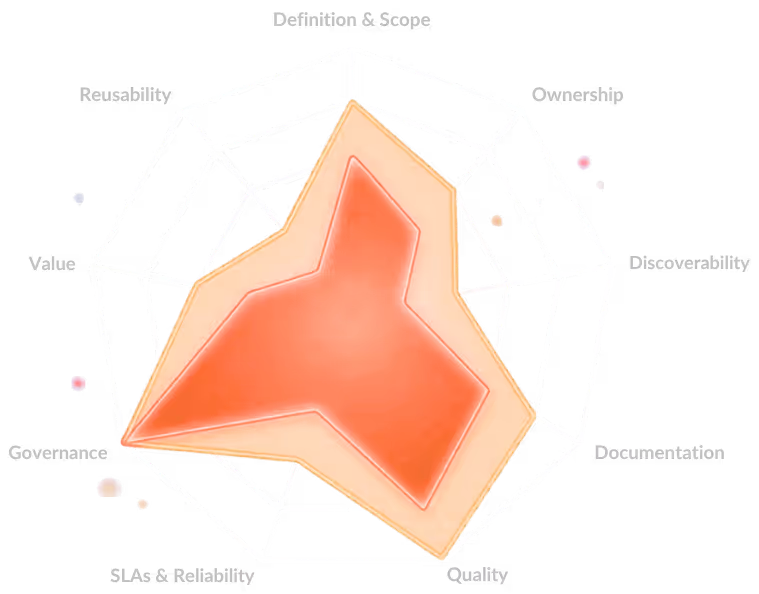
A 9-dimension self-assessment used by 100+ data teams to benchmark strategy, ownership, and platform readiness.


Ritwika Chowdhury
Ritwika Chowdhury is a data and technology professional focused on data products, AI, and modern data architecture. Her work sits at the intersection of data strategy, product thinking, and emerging AI technologies, with a focus on helping organisations turn enterprise data into trusted, usable, and scalable assets.
Read the ideas here. Build them with The Modern Data Company.
Modern Data 101 is where the data community thinks out loud. When you're ready to move from articles to architecture, data products, governed AI pipelines, or a full Data Operating System; the team behind this community can help you build it.
Continue reading