Enterprise AI Observability Trends of 2026: Scaling LLMs & Agentic Systems
How Enterprise Leaders Trace Agentic Loops, Cut Token Costs, and Enforce Real-Time Governance.

TL;DR
- Gartner predicts 40% of organisations will use AI observability to monitor model performance by 2028.
- In 2026, enterprise teams must adapt to five key shifts:
- Agentic Tracing: Monitoring non-deterministic, multi-step agent paths and inter-agent handoffs.
- Open Telemetry (OTel): Standardising on vendor-neutral GenAI semantic conventions.
- FinOps & Cost Control: Granularly tracking expensive output and reasoning tokens to avoid budget overruns.
- Governance Convergence (AI TRiSM): Linking trace logs and data lineage directly to real-time compliance policies.
- Production Evaluation: Shifting from pre-deployment testing to continuous, in-production LLM-as-judge scoring.
[playbook]
What Is AI Observability? Moving Beyond Traditional APM
Running production LLMs without AI observability is an operational and governance risk. Unlike traditional APM that only tracks uptime, an AI observability platform evaluates whether models reason correctly, trace multi-step agent actions, and control runaway token costs.
AI observability is full-stack visibility into how AI systems behave in production, not just whether they run, but whether they reason correctly. Three concepts to hold in mind:
1. LLM monitoring, tracking performance metrics: response times, error rates, token usage, cost
2. LLM tracing, the complete causal chain of a single request, from user input through every retrieval and tool step to final output
3. LLM observability, the fuller discipline combining both with evaluation, enabling teams to debug, govern, and continuously improve AI systems
For how data lineage underpins this in AI-native architectures, read Data Lineage is Strategy.
[related-1]
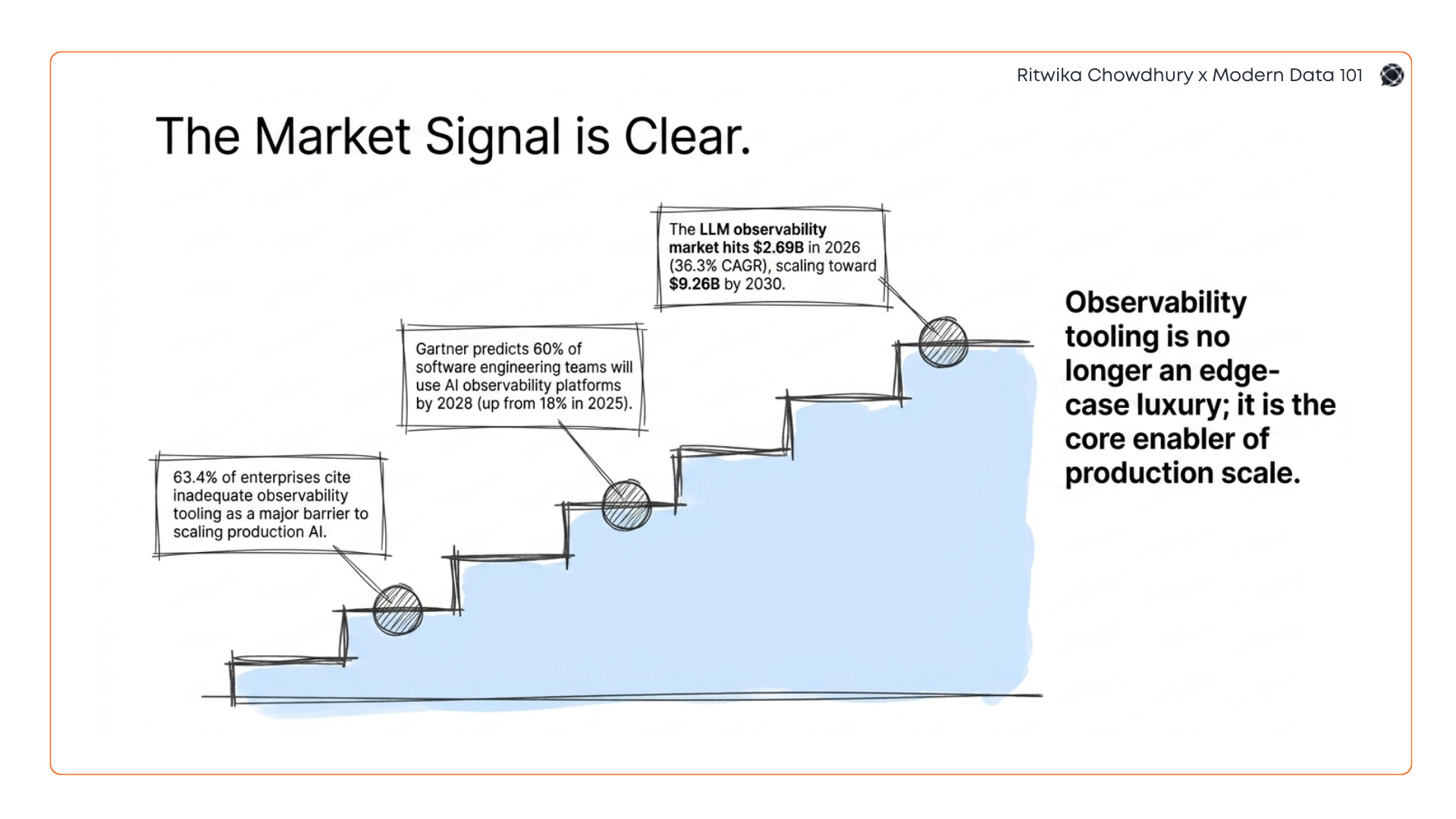
The Market Signal: Why Enterprises Need an AI Observability Platform
The LLM observability platform market is projected to grow from $1.97B in 2025 to $2.69B in 2026 (36.3% CAGR), reaching $9.26B by 2030. Gartner predicts 40% of organisations deploying AI will use AI observability to monitor model performance by 2028.
Traditional monitoring answers one question: did the system respond? An LLM can respond in 400 milliseconds with a completely wrong answer while your dashboards show everything healthy. AI observability answers a different question: Was the response any good? Conflating the two is where production AI failures are born.
6 Trends Reshaping AI Observability Tools in 2026
Following are the six trends reshaping AI observability in 2026, and what they mean for teams building for production.
Trend 1: Agentic AI Has Broken Traditional Observability
The biggest driver of AI observability urgency in 2026 is the explosion of autonomous agents in production.
Traditional APM tracked deterministic HTTP paths. Agents are non-deterministic: a single user request can involve five LLM calls, three tool invocations, two vector lookups, and an inter-agent handoff, each a potential failure point, each invisible to standard monitoring. Without observability, agents can drift, hallucinate, or overspend without detection.
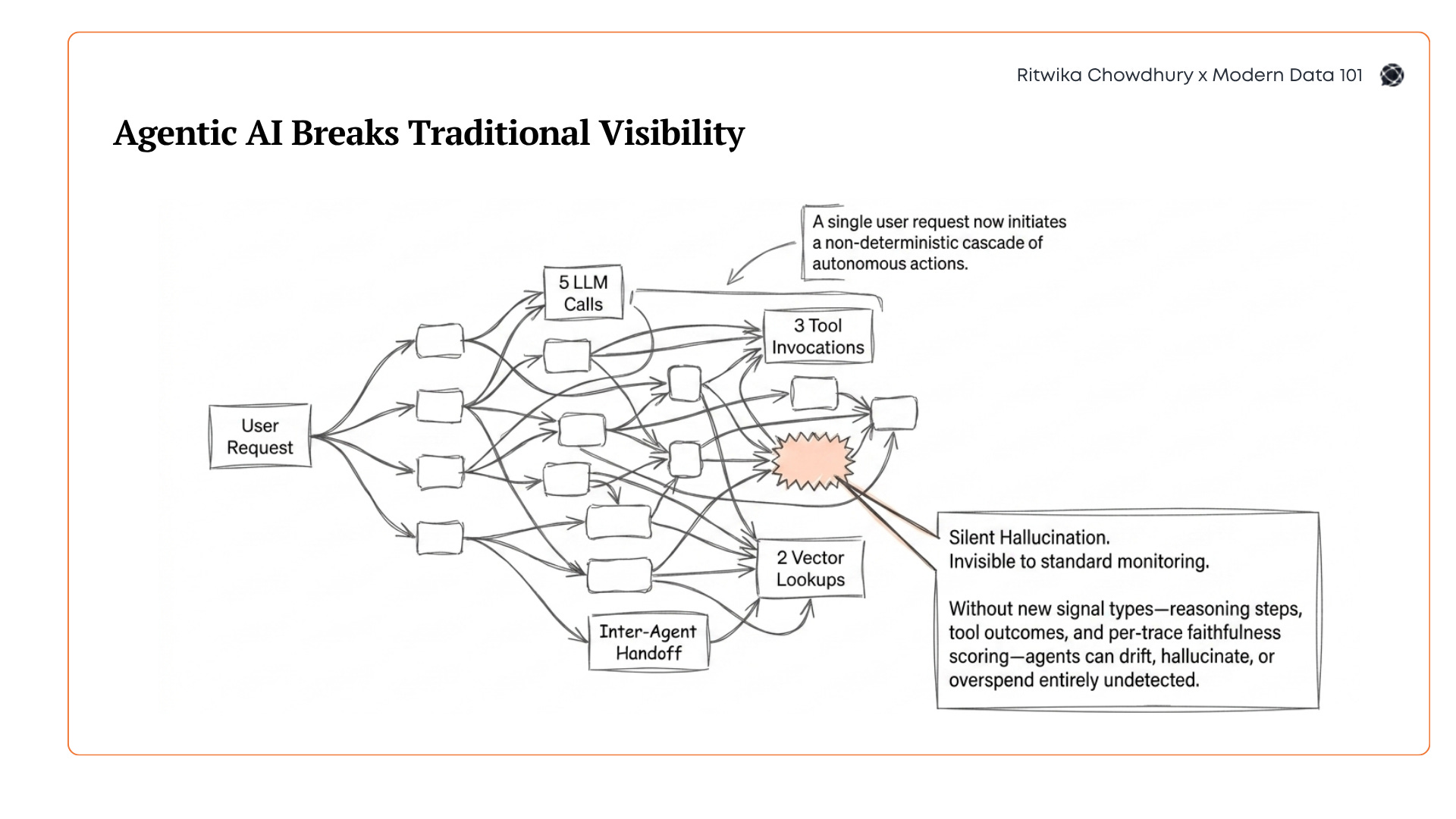
Agentic observability requires new signal types: intermediate reasoning steps, tool selection outcomes, inter-agent handoffs, and per-trace hallucination and faithfulness scoring. Security observability, like prompt injection detection, PII scanning, and output validation, is now a production requirement.
Trend 2: OpenTelemetry Becomes the AI Telemetry Standard
OpenTelemetry (OTel) is the vendor-neutral standard for AI telemetry in 2026. It’s GenAI semantic conventions like gen_ai.usage.input_tokens, gen_ai.request.model, let teams instrument once and route to any compatible backend without re-instrumentation. A 2026 Elastic survey found 89% of production users consider OTel compliance “at least very important.”
The OTel Collector also enables programmable sampling pipelines to filter low-value telemetry before storage, a meaningful cost lever at scale. One caveat: many gen_ai, attributes still carry “Development” stability badges, so attribute names may still shift.
Trend 3: Token Cost Monitoring Is Now a FinOps Priority
AI tokens are a financial resource in 2026, not a technical metric.
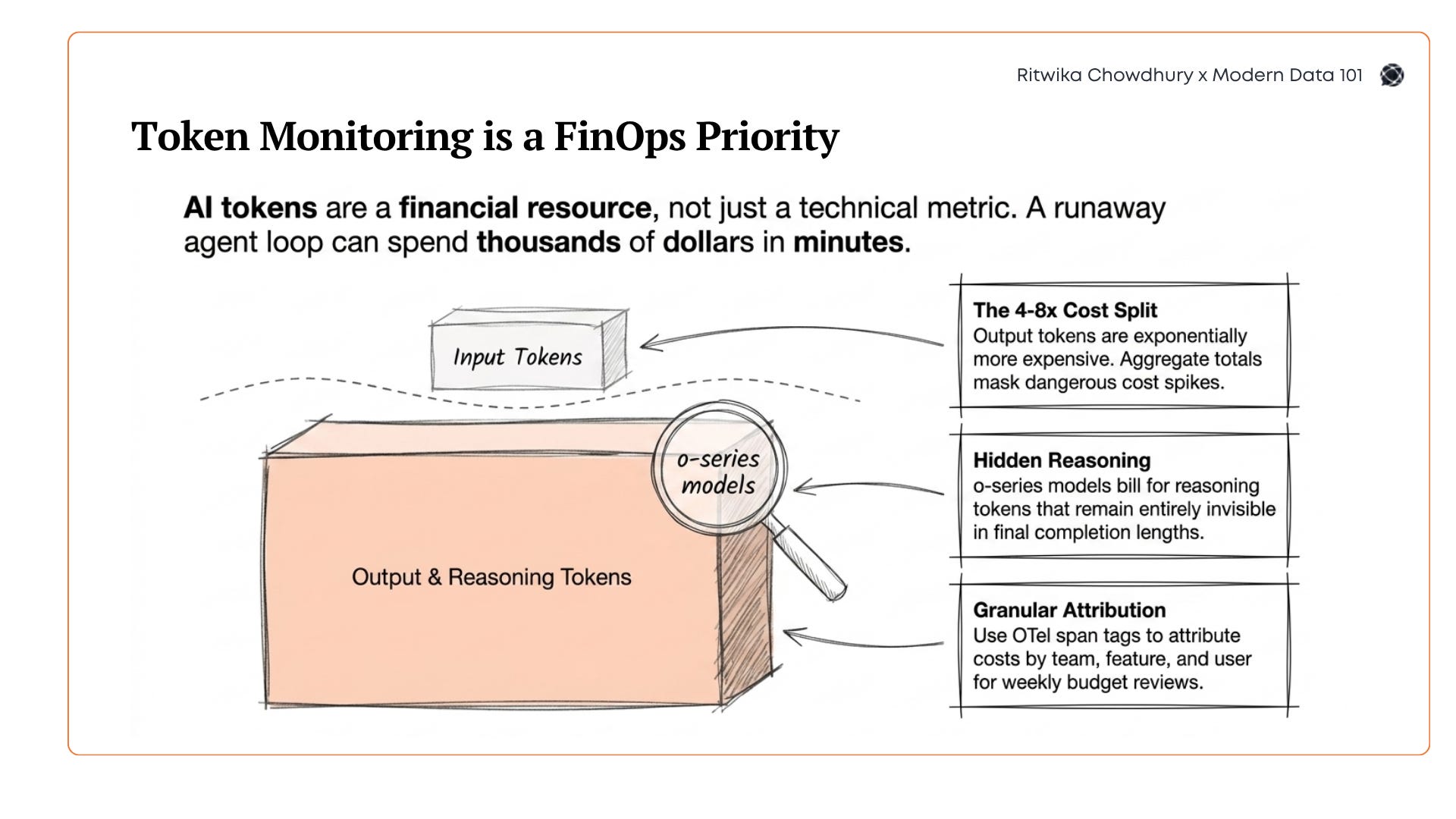
A runaway agent loop can spend thousands of dollars in minutes, and request-rate monitoring won’t catch it. Key practices:
- Track prompt and completion tokens separately: Output tokens run significantly more expensive than input tokens; aggregate totals hide the cost split
- Attribute costs by team, feature, and user via OTel span tags; weekly reviews catch overruns before they become budget emergencies
- Account for reasoning tokens in o-series models, which are billed but not visible in completion length
Trend 4: AI Governance and Observability Are Converging
Governance requires auditability: proving, for any AI output, what data informed it, what model produced it, and whether it met policy thresholds. Observability infrastructure, including trace logs, evaluation scores, tool invocation records, is the raw material governance systems consume.
Gartner groups these capabilities under AI TRiSM (AI Trust, Risk and Security Management). In practice: hallucination thresholds enforced as policy objects with real-time violation alerts, automated shadow agent discovery, and regulatory audit trails. Data lineage is a first-class governance signal, the causal chain from data source to agent decision must be traceable across agent boundaries.
Trend 5: Evaluation Moves Into Production
Pre-deployment evaluation doesn’t protect against silent quality decay. LLMs are continuously exposed to novel inputs, provider model updates, and upstream data changes that degrade output quality without any infrastructure-level signal.
How to Evaluate the Best AI Observability Platforms
The 2026 approach: continuous online evaluation against live production traffic, automated quality baselines, LLM-as-judge scoring at scale, and evaluation-to-dataset feedback loops where reviewed traces flow directly into evaluation sets. As Modern Data 101 has covered in exploring knowledge graphs for AI, the quality of AI reasoning in production is only as good as the context and evaluation infrastructure supporting it.
The Bottom Line
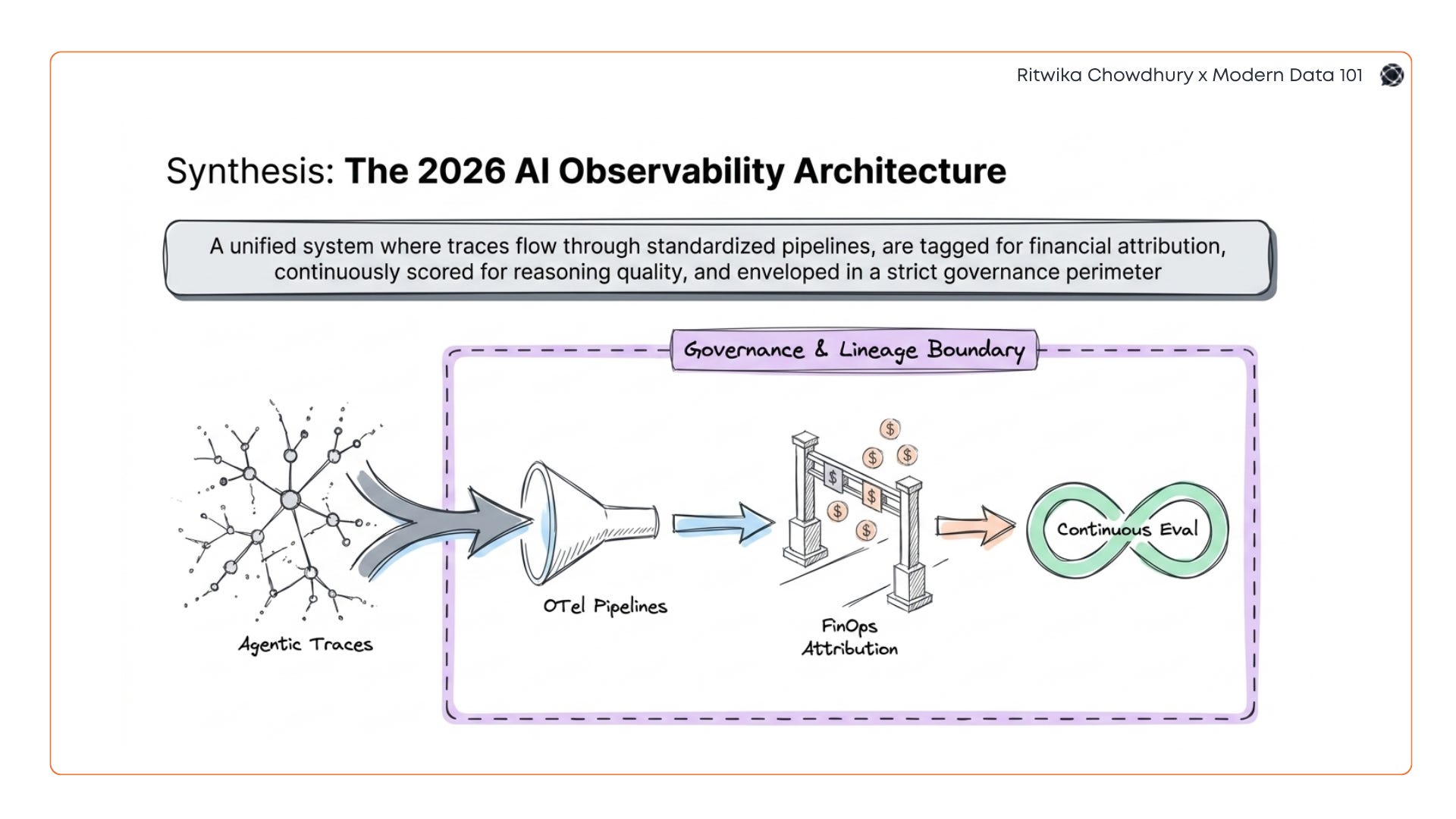
AI observability in 2026 is the operational infrastructure that makes responsible AI scaling possible. Instrument with open standards. Evaluate in production. Attribute costs granularly. Connect observability to governance. The teams getting this right aren’t treating visibility as optional, and neither should yours.
FAQs
Q1. How does observability differ for RAG systems versus standalone LLM calls?
RAG-specific observability requires tracing the retrieval step separately from generation, monitoring retrieval relevance/precision, whether retrieved chunks were actually used in the final answer, and whether the answer is faithful to retrieved content versus the model's own (potentially hallucinated) knowledge.
Q2: How do you measure the hallucination rate in production, practically?
Common approaches include LLM-as-judge scoring against retrieved source documents (checking whether claims are grounded in context), embedding-based similarity checks between output and source material, and human-in-the-loop sampling to calibrate automated scores against ground truth.
Q3: How do compliance frameworks like the EU AI Act affect observability requirements specifically?
The EU AI Act, for instance, mandates extensive logging and traceability for high-risk AI systems, with significant penalties for non-compliance, making trace retention and lineage documentation a legal requirement, not just a best practice, for certain use cases.
Q4: What are observability trends for 2026
In 2026, AI observability is defined by a shift toward tracing non-deterministic multi-step agents, standardising vendor-neutral telemetry via OpenTelemetry, managing skyrocketing token expenses with strict FinOps controls, unifying monitoring with AI TRiSM governance policies, and adopting continuous, in-production LLM-as-judge evaluations.
Connect with a community data expert
A no-cost session with a practitioner who's been where you are.
About Modern Data 101
Modern Data 101 is a movement redefining how the world thinks about data. A community built by the same team behind the world’s first data operating system, Modern Data 101 sits at the intersection of data, product thinking, and AI. Spread across 150+ countries, the community brings together a global network of practitioners, architects, and leaders who are actively building the next generation of data systems.
At its core, Modern Data 101 exists to simplify the journey from raw data to tangible and observable impact. It advocates high-potential data systems and next-gen architectures to unify and activate insights and automation across analytics, applications, and operational workflows at the edge.
In a world shifting from data stacks to AI ecosystems, Modern Data 101 helps teams not just navigate the change but lead it.


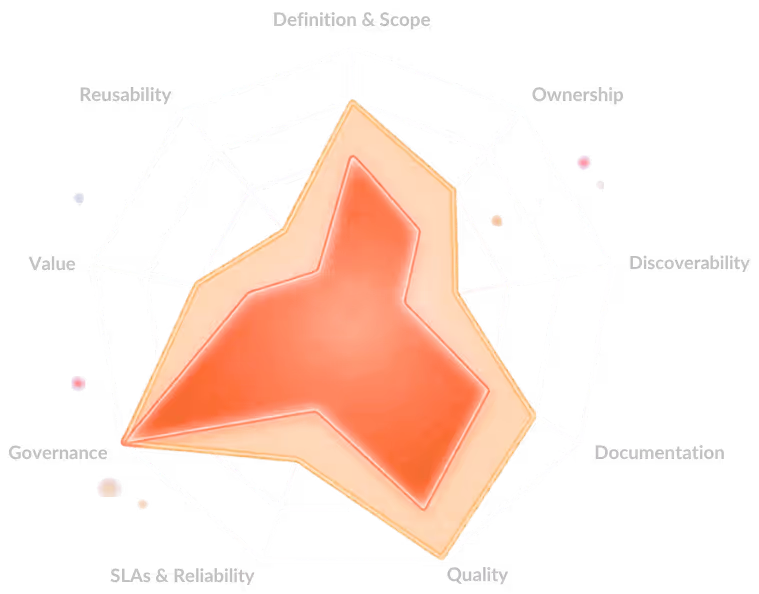
A 9-dimension self-assessment used by 100+ data teams to benchmark strategy, ownership, and platform readiness.


Ritwika Chowdhury
Ritwika Chowdhury is a data and technology professional focused on data products, AI, and modern data architecture. Her work sits at the intersection of data strategy, product thinking, and emerging AI technologies, with a focus on helping organisations turn enterprise data into trusted, usable, and scalable assets.
Read the ideas here. Build them with The Modern Data Company.
Modern Data 101 is where the data community thinks out loud. When you're ready to move from articles to architecture, data products, governed AI pipelines, or a full Data Operating System; the team behind this community can help you build it.
Continue reading