What Is the AI Data Governance Gap? Why It Keeps Getting Worse

TL;DR
The AI data governance gap is the growing disconnect between rapid AI adoption and slower governance maturity. As enterprises deploy more AI, weak lineage, fragmented metadata, and inconsistent controls reduce trust, increase compliance risks, and limit AI's business value. Closing this gap requires embedding governance into operational data management; not simply adding more policies.
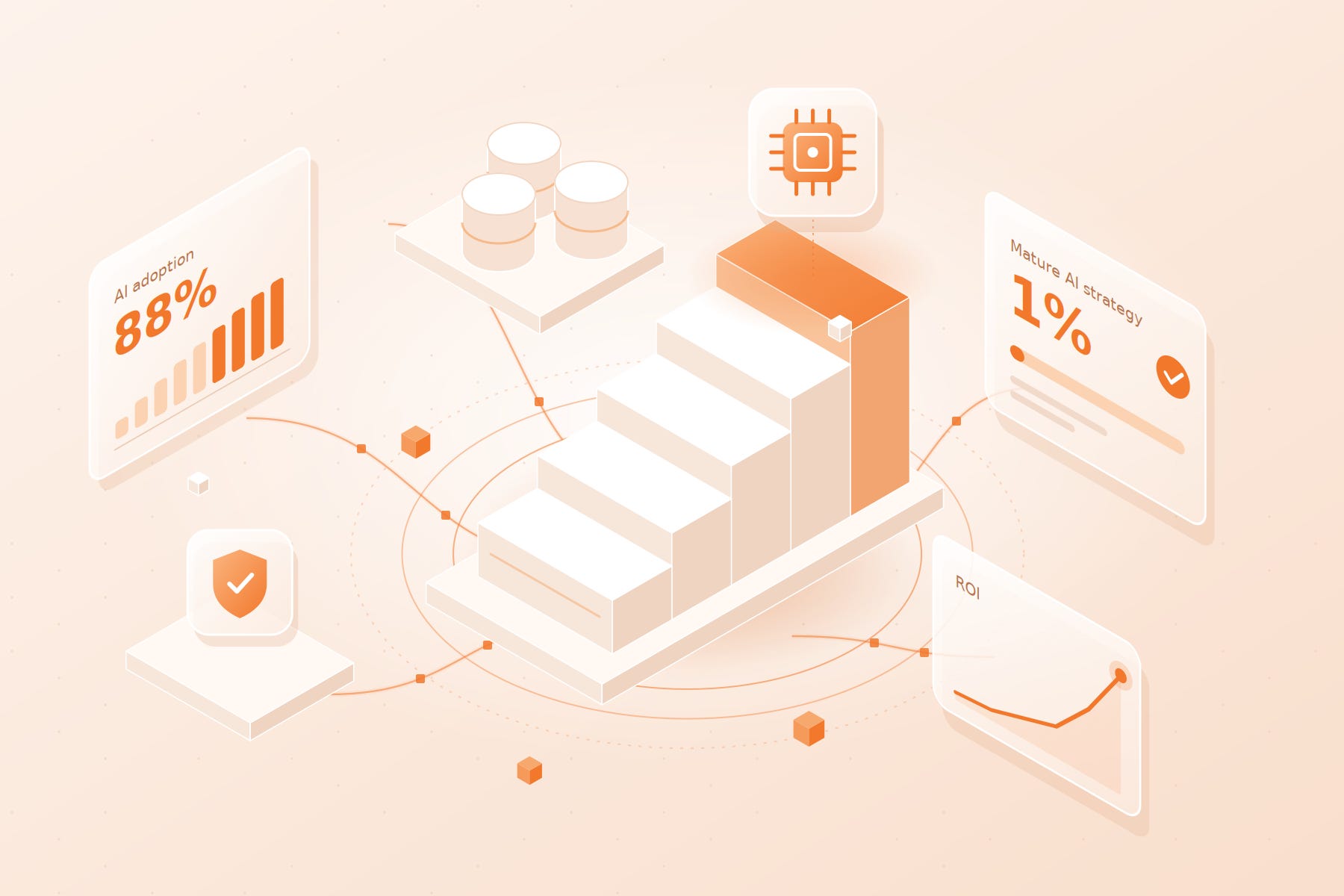
Enterprise AI initiatives are scaling faster than the governance systems meant to control them. As this gap widens, organisations face declining trust, compliance risks, and AI outputs they cannot confidently explain or defend.
Think of this as a train moving at high speed on a track originally built for lighter trains. The engine is powerful but the infrastructure is not robust enough to support the speeds. AI is quitely imitating the same pattern in enterprise setup. Adoption is happening in full swing, but weak governance paints a different picture.
Artificial Intelligence looks impressive on the surface, but when it comes to delivering outcome, data behind the scenes play a crucial role. If the data is poorly controlled, inconsistently defined, or impossible to trace, the outputs are rarely reliable.
Why the AI Data Governance Gap Exists
The gap didn’t appear on one fine day, it kept widening because adoption outpaced the maturity of the governance practices. Many organisations built governance for reporting, compliance checklists, and periodic reviews. This worked smoothly like a magic trick till the data systems changed slowly and use cases were limited.
When the gears changed and AI adoption happened at an accelerated speed, the workflow, across data teams increased in relatively less time. And suddenly governance turned into a moving target instead of being a steady one.
When this turns into a loop where the policy does exists, but the practice is inconsistent, the gap does not stay theoretical. It starts showing up in real outcomes.
What the AI Data Governance Gap Looks Like
At the superficial surface, one sees nothing at all. Think shifting of tectonic plates. Though the changes happen right in front you, the signs are generally invisible in plain sight.
Inconsistent glossary, incomplete lineage making AI inputs impossible to trace. Access controls lack uniformity, and business has scattered or vintage metadata.
All these keep accumulating over time until the business hits the reality. But by then the train has already moved past the platform. The business find it difficult to answer questions such as how the model was trained, was the data transformed and made ready for the AI, was the model trained on siloed data and alike.
This lack of clarity is not just inconvenient but also dangerous when seen from AI-for-the-enterprise POV.
[report-2025]
Business Impact of the AI Data Governance Gap
The users do not understand where the data came from, they hesitate to act on the output. This results in lack of trust. The business find it difficult to trace data use or prove control, it is operating with compliance risks and assured unnecessary exposure. Validating, correcting, and explaining becomes a necessity in day-to-day tasks resulting in teams investing more time there than actually using AI.
Business feels this like a slow burner, heat is low but continuous. This is a major governance failure making fresh AI initiatives harder to scale. The trail runs might be perfect, but can impact the business when put into production. What seemed more like a technology problem will turn out to be an operating model problem.
That’s the brass tacks. AI is not failing because it lacks ambition. It is failing because the data governance layer underneath it is not strong enough to carry the load.
Where a Data Management Platform Fits
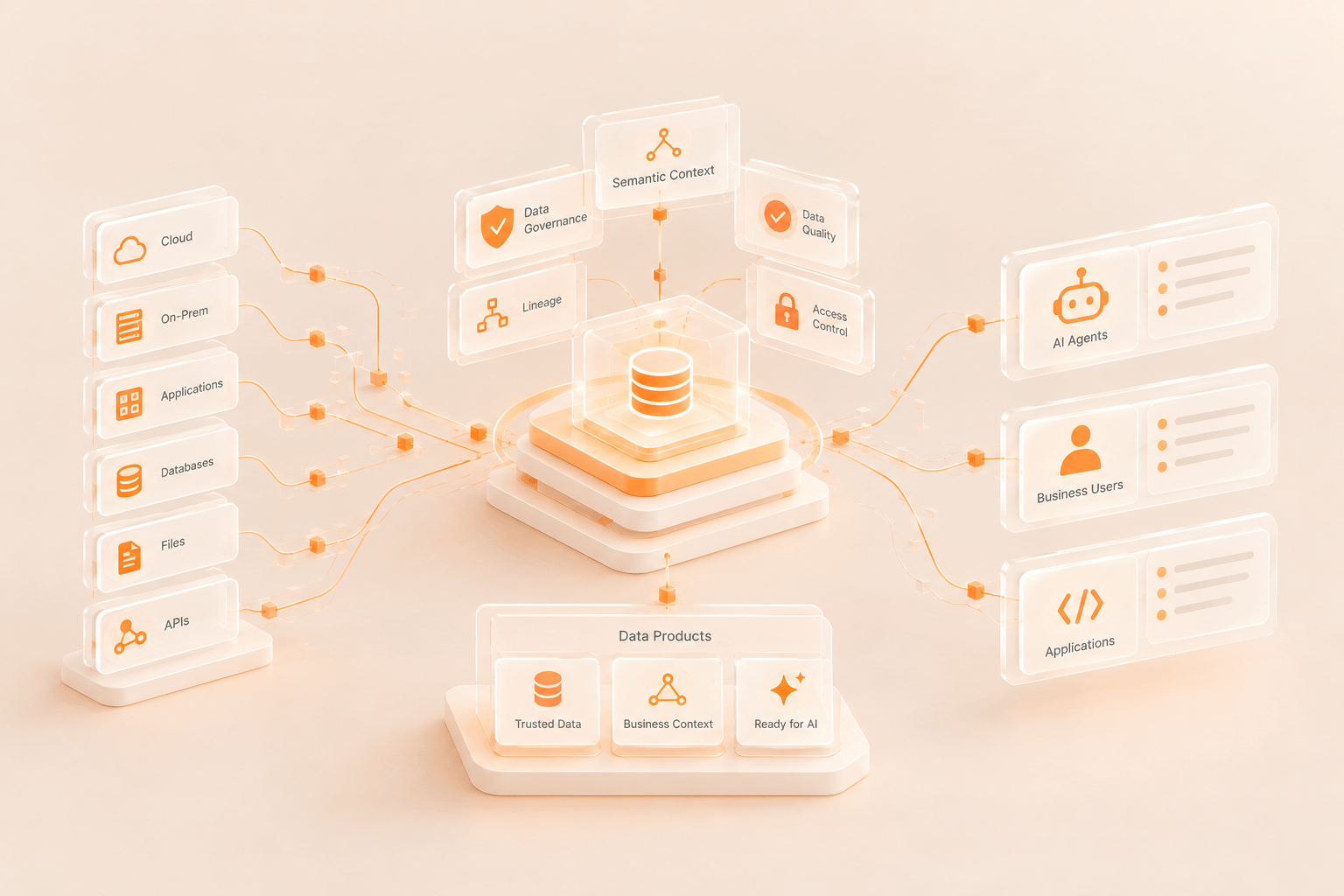
Enter, the data management platform construct. DMP is the operational layer that lets the governance actually function. By stitching metadata, lineage, access, and policy enforcement together into a single structured environment, the DMP empowers business to make governance more consistent and scalable without turning it into a manual exercise.
Once you have AI in the picture, the control layer has to be embedded into the system itself. A data management platform assists with creating that same structure.
Why The Gap Keeps Widening
Put simply, the rapid AI adoption keeps creating larger surface area for governance before it can catch up to cover it. It is like the classic production line failure where the products are falling out at a larger speed than the human packing it could handle.
Every new model, workflow, and data source keeps adding to the complexity. Plus, each new team using AI adds more questions about ownership, quality, access, and accountability. If governance does not evolve at the same speed, it begins to lag behind on every front, and it keeps compounding.
Over a period of time, the organisation ends up with a messy patchwork of controls that looks okay from a distance but breaks down when put under pressure. This is why AI governance and data governance are said to be connected at the roots. The AI layer will inherit the weakness of poor data foundations and amplify it.
.gif)
What Good AI Data Governance Looks Like
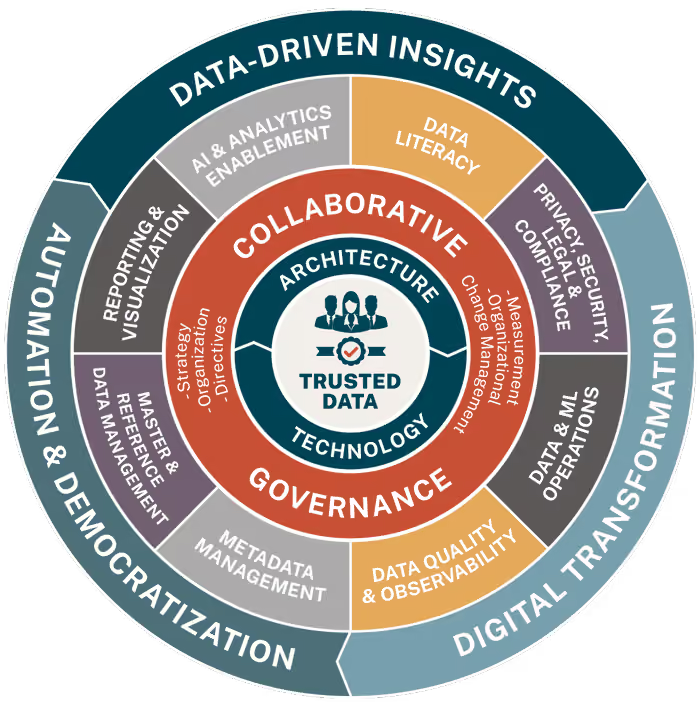
Good governance is about creating more clarity. It means the business can easily answer the 5Ws and 1H about the data and ownership of the data being used. It reflects that governance is embedded into day-to-day operations and is not treated as a review process. The goal is to make AI trustworthy to scale.
When governance functions well, teams stop guessing and start leveraging. With good governance, people can trace, validate, and rely on the information they are using. That is what gives AI real business value at speed, and with confidence.
[data-expert]
Policy: A Bigger Risk?
Most organisations approach AI governance by creating more policies, review boards, and compliance checklists. The assumption is that stronger oversight will naturally lead to better AI governance.
But that assumption overlooks the real bottleneck. AI doesn’t fail because organisations lack governance policies; it fails because governance isn’t operationalised. When metadata, lineage, ownership, and access controls aren’t embedded into everyday data operations, policies become documents rather than enforceable capabilities.
Instead of expanding governance through manual reviews, organisations should build governance into the operational fabric of the data platform. When governance becomes part of how data is discovered, accessed, transformed, and monitored, AI inherits trust by design rather than through after-the-fact controls.
Closing Thoughts
Let’s understand this, AI governance gap is not a technical weakness. It surfaces the pace at which business is functioning and speed of innovation in AI. This imbalance will keep getting worse if governance is treated as a side function instead of a core capability.
A robust DMP can bring structure but the greater shift will always be the business. Governance must become a part of business’s spine and not just a documentation exercise.
The AI mountain will keep moving, but the real question is whether businesses give governance the pace to catchup before the bill becomes a headache.
FAQs
What is the AI data governance gap?
The AI data governance gap is the difference between how fast organisations are adopting AI and how slowly their governance practices are evolving to control, trace, and trust the data behind those systems.
Why does the AI data governance gap keep getting worse?
It keeps getting worse because AI is expanding across more teams, tools, and workflows, while governance often remains fragmented, manual, and too slow to keep up.
How does weak data governance affect AI outcomes?
Weak data governance can lead to unreliable outputs, low trust, poor traceability, compliance exposure, and slower adoption of AI across the business.
What role does a data management platform play in AI governance?
A data management platform helps bring metadata, lineage, access control, and policy enforcement into one operational layer, making governance more scalable and consistent.
Connect with a community data expert
A no-cost session with a practitioner who's been where you are.
About Modern Data 101
Modern Data 101 is a movement redefining how the world thinks about data. A community built by the same team behind the world’s first data operating system, Modern Data 101 sits at the intersection of data, product thinking, and AI. Spread across 150+ countries, the community brings together a global network of practitioners, architects, and leaders who are actively building the next generation of data systems.
At its core, Modern Data 101 exists to simplify the journey from raw data to tangible and observable impact. It advocates high-potential data systems and next-gen architectures to unify and activate insights and automation across analytics, applications, and operational workflows at the edge.
In a world shifting from data stacks to AI ecosystems, Modern Data 101 helps teams not just navigate the change but lead it.


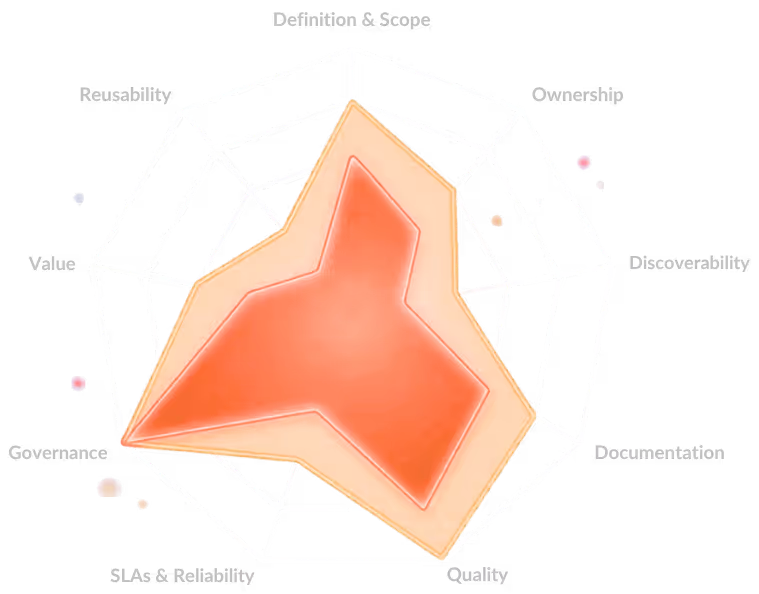
Where does your org stand on data product maturity?
A 9-dimension self-assessment used by 100+ data teams to benchmark strategy, ownership, and platform readiness.


Rachana Medishetti
Rachana is a data engineer with 5+ years of experience with a deep passion for how businesses leverage data, focusing on building end-to-end data systems, from ingestion and pipelines to analytics. She is skilled in PySpark, SQL, Python, and Snowflake, focused on turning data into reliable, real-world business value.
Read the ideas here. Build them with The Modern Data Company.
Modern Data 101 is where the data community thinks out loud. When you're ready to move from articles to architecture, data products, governed AI pipelines, or a full Data Operating System; the team behind this community can help you build it.
Continue reading