
AI vs. Traditional Data Management: Which One Actually Saves Time?
AI redistributes data management efforts instead of eliminating them. Learn where automation delivers measurable time savings and why data readiness determines long-term AI ROI.

TL;DR
AI cuts real time out of data management, but only where the underlying foundation already exists. Where it doesn't, AI just moves the delay upstream, into preparation and governance, instead of removing it.
This comparison breaks down where AI's time savings compound and where they're deferred, across ingestion, quality, governance, scalability, and decision speed, for data leaders sequencing where to invest first.
The "AI saves time" argument is technically true and practically incomplete. Ask any data engineering team that spent three months preparing data before a single model could run: AI relocates time cost in data management rather than eliminating it. The effort shifts upstream, from execution to preparation, from fixing errors to preventing them, from maintaining pipelines to governing the systems that feed them.
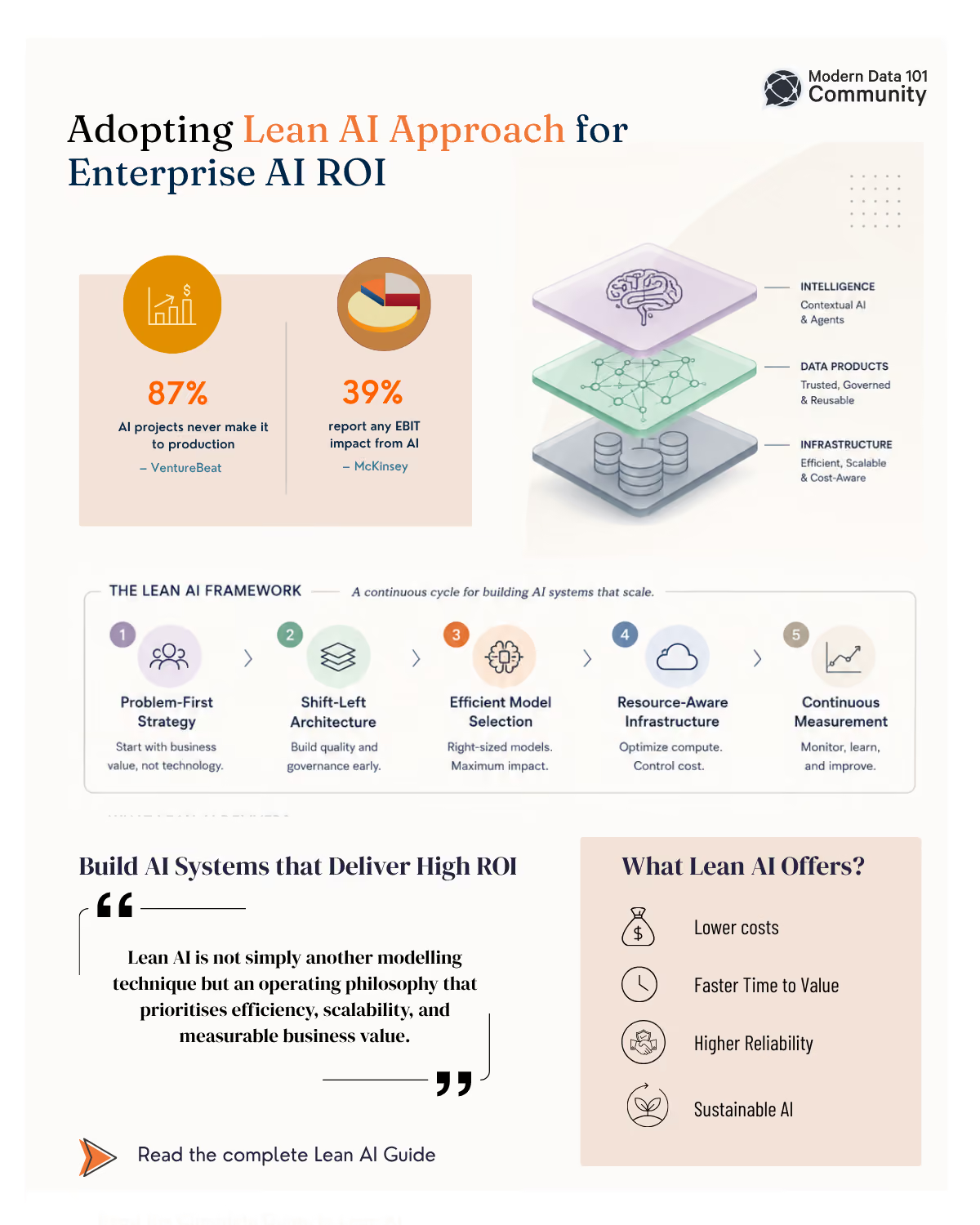
AI-driven data management genuinely speeds things up, but it also moves where teams spend their time and attention. The bottleneck shifts from handling data manually to managing scale, oversight, and system complexity. Teams that succeed with AI are the ones who prepare for that shift early, rather than assuming automation alone fixes operational inefficiency.
.avif)
[state-of-data-products]
At a Glance: How AI and Traditional Data Management Compare
Here's how the two approaches stack up across the dimensions that matter most.
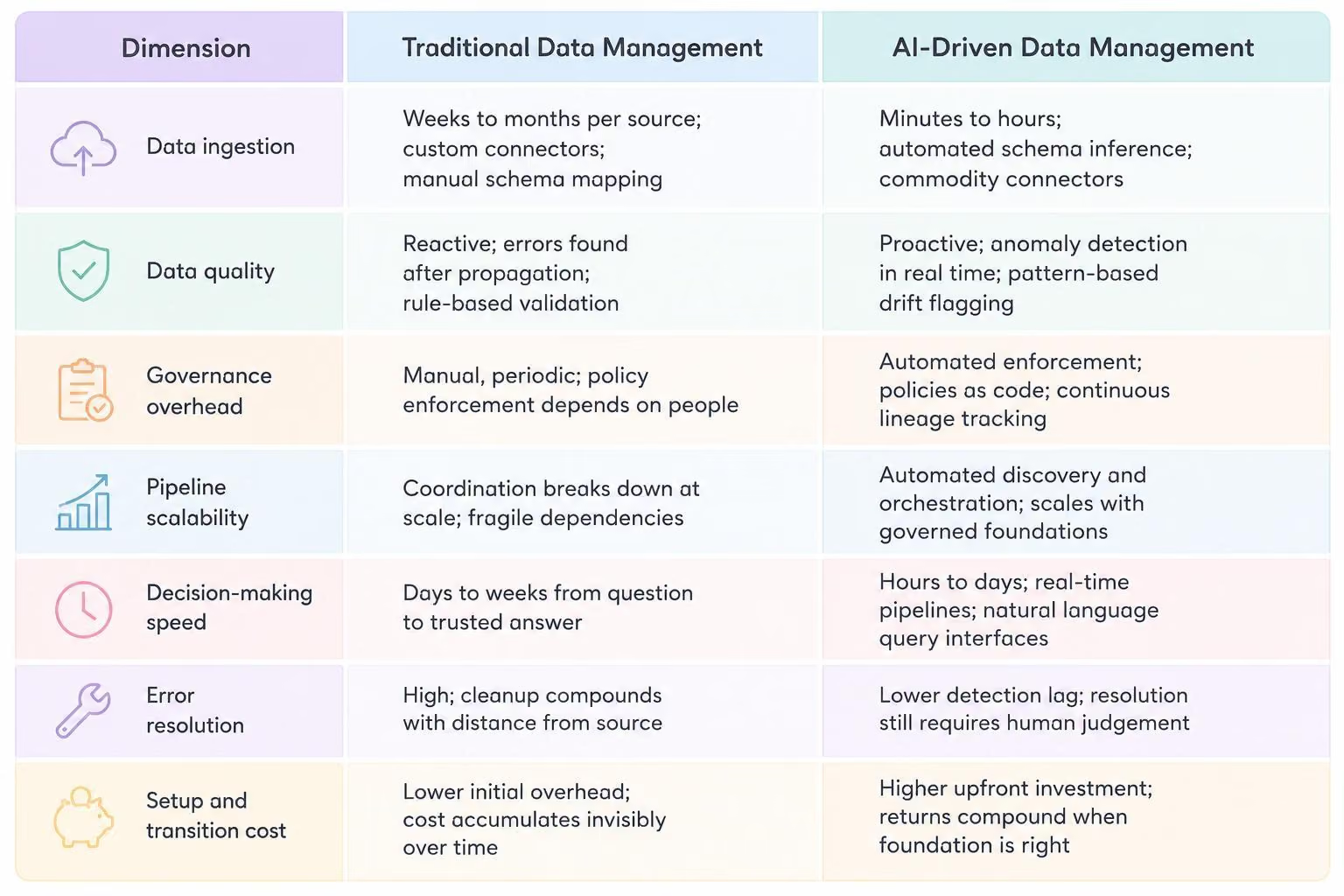
The table tells the broad story; the sections below show where those savings are real and compounding, and where they're just deferred.
1. Data Ingestion: How Much Faster Is AI at Bringing Data In?
.avif)
Traditional ingestion is slow: every new source needs custom setup, schema mapping, and validation, and connecting a single source can take weeks before anyone checks whether the data is even fit for purpose.
AI compresses the execution layer considerably.
- Schema inference reduces manual mapping from days to minutes,
- Automated connectors reduce integration build time,
- Deduplication and structuring happen during ingestion instead of happening afterwards.
Standardised ingestion patterns built around data products and multiple commodity tools have pushed source connection time down sharply.
What AI doesn't compress is context. Ownership, lineage, and data meaning still require humans to define them before ingestion is reliable, and no amount of connector automation can resolve that on its own.
AI cuts ingestion execution time substantially. It does not cut the thinking time that makes ingestion trustworthy.
2. Data Quality: Does AI Reduce the Cost of Bad Data?
According to IBM research (via Harvard Business Review), poor data quality costs the US economy an estimated $3.1 trillion annually, a figure that reflects not catastrophic failures but the slow accumulation of undetected errors across pipelines nobody is watching closely enough.
Traditional quality systems fail in a specific way:
- A schema change in a source system silently breaks a downstream report
- A field that was always populated starts arriving null without warning
AI shifts quality management from reactive to continuous. Anomaly detection runs in real time, statistical drift gets flagged before it reaches outputs, and pattern-based validation catches deviations that rule-based systems would miss entirely.
[related-1]
The limitation is resolution: a human still has to decide whether a flagged anomaly is a source problem, a pipeline issue, or a legitimate change, and reusable, governed data products at the point of ingestion are what reduce how often that step is needed.
AI finds problems faster but still can’t yet understand them.
3. Governance Overhead: Does Automation Actually Reduce Oversight Work?
.avif)
Traditional governance depends on human process: access reviews happen quarterly, lineage gets documented manually if at all, and compliance checks are point-in-time audits rather than continuous signals.
AI-driven governance changes the execution layer:
.avif)
The data governance market, which encompasses lineage tooling, reached $3.91 billion in 2026 and is projected to grow to $9.62 billion by 2030, driven by regulatory mandates and AI explainability requirements. But governance automation also surfaces debt that was previously invisible. Teams frequently report an initial spike in detected issues after adoption because the system is now looking properly for the first time.
Treating governance as a function of people, process, and technology working together is the right lens here. Automating one layer without the others moves it somewhere less visible rather than reducing total overhead.
[related-2]
4. Pipeline Scalability: Why Do Traditional Systems Break at Scale?
Pipelines fail at scale because coordination overhead grows faster than a team's capacity to manage it, not because of infrastructure limits.
- Dependencies multiply and become undocumented
- Ownership of datasets becomes unclear
- Metric definitions diverge across teams
- Pipelines grow fragile; nobody is confident about what breaks if something changes
AI improves scalability in two ways: automated discovery keeps the map of what exists current without manual curation, and AI-assisted orchestration maintains pipeline logic at a scale no human team can sustain across hundreds of sources.
Gartner predicts organisations will abandon 60% of AI projects that lack AI-ready data through 2026, which is exactly the sequencing problem here: scalability depends on a foundation most enterprises haven't finished building. Data products with documented ownership scale well under AI; automation layered onto ungoverned pipelines just propagates errors faster.
5. Decision-Making Speed: Does AI Actually Deliver Faster Answers?
In traditional environments, the lag between a business question and a trusted answer is measured in days or weeks, and by the time an answer arrives, the decision context has often shifted.
AI compresses that cycle at multiple points:
- Natural language interfaces remove the queue between business users and data engineers
- Automated preparation and real-time pipelines mean data is fresh when it is needed
- Data products with consistent, documented interfaces remove the discovery and trust-building steps that add days to every analysis cycle
The real constraint is trust. Faster access only improves decision speed when the people consuming that data believe it is accurate. AI-generated outputs from poorly governed pipelines produce fast answers to wrong questions, and in most organisations, a few of those experiences are enough to erode confidence in the entire system. Speed without trust is a liability.
.avif)
6. Why AI Time Savings Are Not Immediate
Every "AI saves time" comparison has a starting point, and almost none account for the cost of reaching it. The gap between AI ambition and AI achievement is almost always a data readiness gap, not a technology one: practitioners consistently report spending the majority of AI project time on preparation, cleaning, structuring, and validating data before modelling begins.
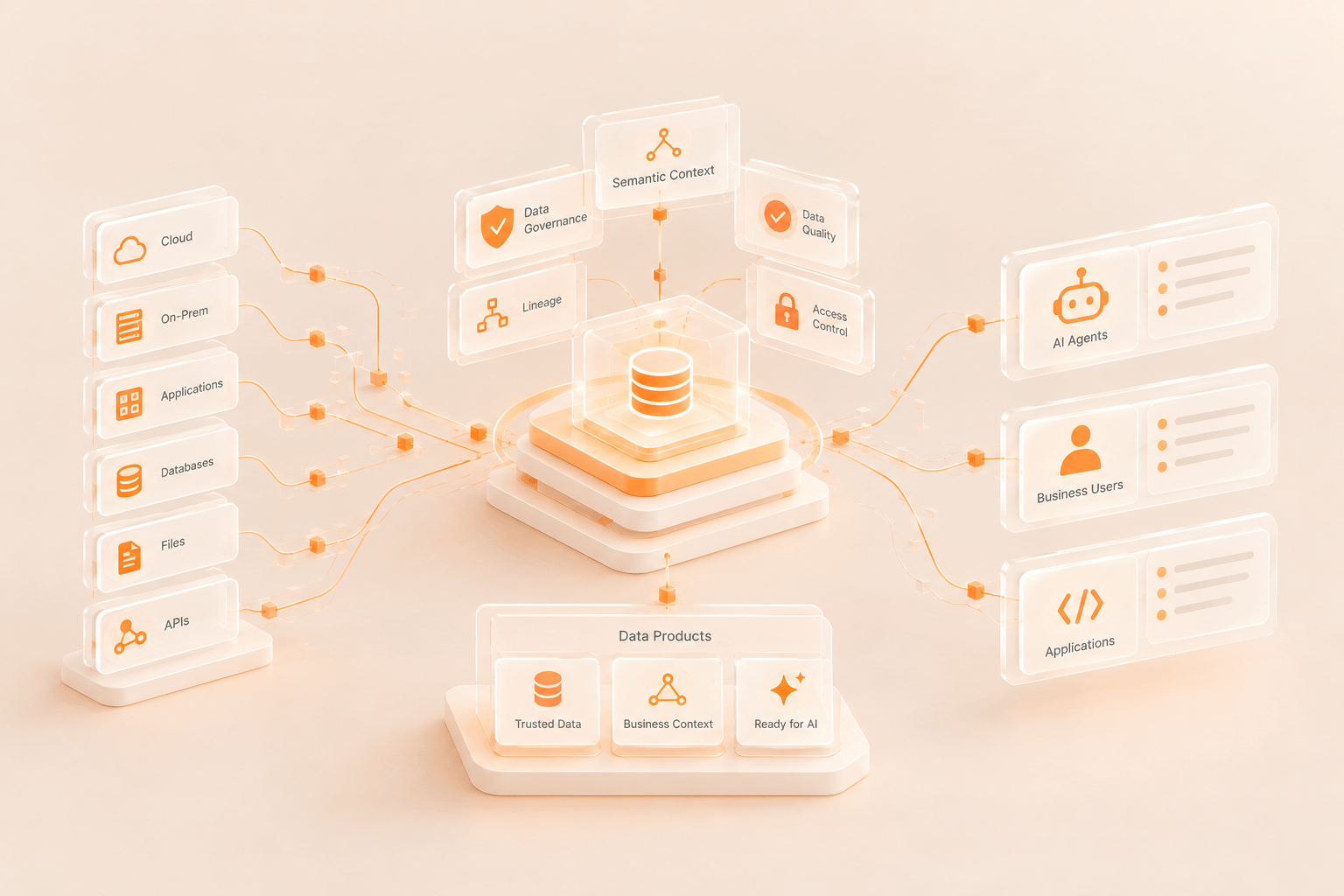
Teams treat that phase as an unfortunate delay before the real work starts, but it is the real work. Organisations that productise data ahead of time, with defined owners, documented interfaces, and a platform layer that serves both human analysts and AI agents from the same governed source, see their upfront investment compound instead of resetting with every new use case.
.avif)
Does AI Actually Save Time?
.avif)
Across every dimension above, AI eventually outperforms traditional data management on time, wherever the foundation is right: governed data, documented lineage, clear ownership, and quality enforced at the source.
Where that foundation is weak, AI doesn't save time; it accelerates the accumulation of debt, errors, audits, and pipeline breaks, all of which arrive sooner instead of later. Whether AI saves your organisation time comes down to how ready your data environment already is.
FAQs
Q1: What are the core dimensions of data quality?
A: Data quality is generally evaluated across several key dimensions: accuracy, completeness, consistency, timeliness, uniqueness, and validity.
Q2: What is governance automation?
A: Governance automation uses software and AI to enforce data policies, monitor compliance, and streamline access controls with minimal manual intervention.
Q3: What does scalability refer to?
A: Scalability refers to a system’s ability to handle increasing amounts of data, users, or workload by efficiently adding resources or optimising processes.
Q4: Does saving time with AI just lead to more work?
A: While AI can free up time by automating repetitive tasks, it may also shift focus to higher-value or more complex activities, not necessarily reducing overall workload.
Connect with a community data expert
A no-cost session with a practitioner who's been where you are.
About Modern Data 101
Modern Data 101 is a movement redefining how the world thinks about data. A community built by the same team behind the world’s first data operating system, Modern Data 101 sits at the intersection of data, product thinking, and AI. Spread across 150+ countries, the community brings together a global network of practitioners, architects, and leaders who are actively building the next generation of data systems.
At its core, Modern Data 101 exists to simplify the journey from raw data to tangible and observable impact. It advocates high-potential data systems and next-gen architectures to unify and activate insights and automation across analytics, applications, and operational workflows at the edge.
In a world shifting from data stacks to AI ecosystems, Modern Data 101 helps teams not just navigate the change but lead it.


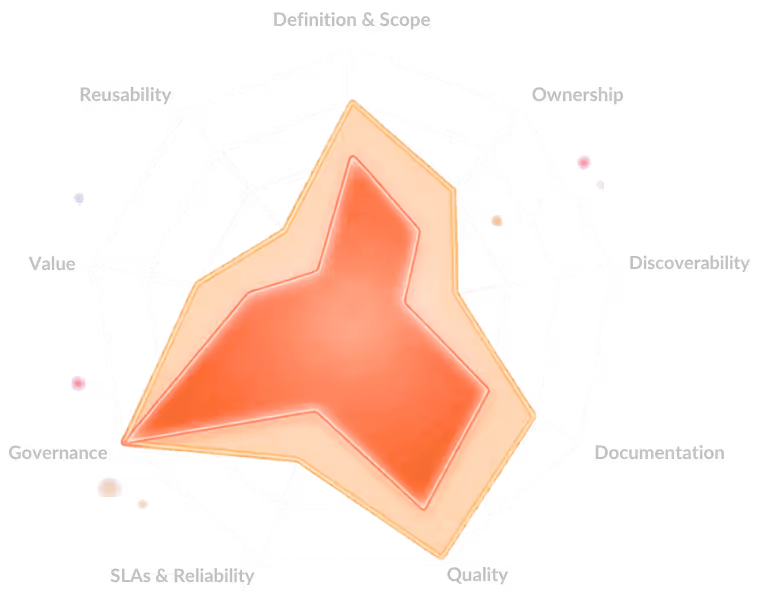
Where does your org stand on data product maturity?
A 9-dimension self-assessment used by 100+ data teams to benchmark strategy, ownership, and platform readiness.


Aishwarya Sharma
Aishwarya is a Senior Analytics Engineer at The Modern Data Company, focused on building end-to-end data solutions that bridge engineering and analytics. He works across data pipelines, modelling, and visualisation to deliver reliable, business-ready insights, combining strong technical expertise with a practical, problem-solving approach to modern data systems.
Read the ideas here. Build them with The Modern Data Company.
Modern Data 101 is where the data community thinks out loud. When you're ready to move from articles to architecture, data products, governed AI pipelines, or a full Data Operating System; the team behind this community can help you build it.
Continue reading


.jpg)
