Why is a Data Marketplace Critical for Organisations?
Enterprise marketplaces are crucial for organisational success, and we tell you why!

Data Marketplaces: The Harbingers of AI-Ready Data
Organisations today work in a world where data is always abundant, but rarely accessible in a governed, sensible, or timely manner. Legacy models built around siloed warehouses, scattered data lakes, and ad-hoc sharing mechanisms can’t really keep pace with the pace at which modern businesses expect innovation. Consequently, teams are increasingly in need of immediate and trusted access to high-quality data, not after weeks of ticket queues, but as and when they genuinely need it.
🎢 The global market size for enterprise data marketplaces is projected to grow to USD 111.28 billion by 2032 at a CAGR of 11.8% between 2025 to 2032- Fortune Business Insights
This shift is further amplified by the rise of AI. As AI adoption becomes mainstream, enterprises need data that’s not just accessible but also high-quality, discoverable, well-documented, and compliant.
An enterprise data marketplace becomes critical here. As an interface between producers and consumers, data marketplaces transform fragmented data assets into accessible, governed products. To add to it, when combined with a data product approach and an AI-ready Data Developer Platform (DDP), organisations unlock a step-change in efficiency, governance, and innovation.
In short: data products + AI-ready infrastructure + marketplace = enterprise leverage in the AI era.
[state-of-data-products]
What is a Data Marketplace
A data marketplace is referred to as a centrally governed platform, internal or external, where data assets are discovered, published, shared, requested, or traded. It differs from a traditional data catalog, which provides documentation but not necessarily access, and is designed to operationalise adequate consumption. It projects and presents data as products with clear ownership, SLAs, quality signals, metadata, and standardised access interfaces.

This distinction is pretty crucial. A raw data lake stores information; a catalog describes it, but a data marketplace enables real usage. It abstracts all complexity, providing a clean, self-serving entry point for engineers, analysts, domain teams, and AI systems.
Types of Data Marketplaces
Data marketplaces are of two types:
- An internal marketplace that’s focused on enterprise-wide sharing of governed datasets.
- An external marketplace, also known as a public marketplace, that offers commercial or third-party datasets.

[related-1]
Why Enterprises Need Data Marketplaces
The need for an enterprise data marketplace stems from the following reasons:
Overcoming Fragmentation
Many enterprises struggle with inconsistent yet sprawling data scattered across multiple cloud platforms, business units, and legacy systems. In such a situation, a marketplace consolidates these assets into a comprehensive, governed portal, taking out duplication and shadow data practices in the process.
Enabling Speed and Self-Service
It’s not possible for teams to wait days or weeks for access approvals and then go about their work. A data marketplace significantly cuts down this time-to-access by providing ready-to-use, requestable, and often instantly provisioned datasets.
Ensuring Trust and Governance
AI and analytics need accurate, auditable, and compliant data. A marketplace enforces right governance through lineage, access control, metadata, and automated policy enforcement, cutting down organisational risk while also boosting reliability at the same time.
As automation, AI, and regulatory pressures increase, an enterprise data marketplace becomes a fundamental capability rather than an optional convenience.
You might also like going through a collaborative piece with Thoughtworks, where Animesh Kumar shared practical insights on better data adoption for a superlative customer experience.
Organisational Benefits of an Enterprise Data Marketplace
As far as enterprises go, a data marketplace offers quite a few benefits from strategic and operational perspectives. Have a look:
Faster, reliable access, and reduced time-to-insight
A data marketplace creates a flawless, self-service experience. Analysts and product teams can search, filter, and request data instantly without depending on overloaded IT teams. This significantly reduces cycle times for analytics, reporting, and experimentation.
Data democratisation and cross-team collaboration
Non-technical teams often find it challenging to navigate complex data ecosystems. Marketplaces provide a user-friendly interface where data is rated, described, documented, and governed, assisting more people within the enterprise to make data-driven decisions.
Improved data governance, quality, and compliance
Marketplaces ensure every published asset meets organisational standards by enforcing lineage, standard metadata, ownership, and quality signals. This boosts data governance and cuts down the risk of inaccurate or inconsistent data that flows across the organisation.
Cost efficiency and better ROI
Dataset duplication, multiple external data purchases, and ad-hoc pipelines tend to generate various hidden costs. Data marketplaces eliminate such redundancy by centralising assets and then encouraging reuse, maximising returns on all existing investments.
Accelerated AI, analytics, and innovation
AI works effectively with well-structured, high-quality, and explainable data. As a data marketplace that offers curated datasets and model-ready inputs, it helps cut down feature engineering cycles, boost model accuracy, and accelerate deployment. In such situations, data becomes not just available, but it also becomes AI-ready.
[related-2]
How Data Products and Data Marketplaces Complement Each Other
Data marketplaces alone cannot transform organisations. They become truly effective only when supported by data productisation and an AI-ready Data Developer Platform (DDP).
Marketplace Enables Discoverability of Data Products
Even if a data product is high-quality and governed, it is futile if consumers cannot discover them. A data product marketplace provides a searchable & intuitive “shop window” where users can browse, discover, and understand data products with rich metadata, descriptions, lineage, and context. This turns hidden assets into visible solutions ready for consumption.
Marketplace Shapes Consumption Experience
The marketplace flips the mindset from traditional data delivery (build first, hope it’s useful) to a more demand-driven data accessibility. This starts with a consumer needing the dashboard, model, or insight required, and surfaces the right data product that fits that need with assured quality and governance already embedded.
Marketplace Amplifies Adoption and Reuse
By making products discoverable and accessible, the marketplace drives higher adoption and repeated reuse across domains. Data products get reused rather than recreated, accelerating time-to-insight and reducing redundancy in data work.
Marketplace Boosts Trust, Context & Feedback
In the marketplace experience, users see lineage, usage metrics, quality scores, and ownership, all of which make data products more trustworthy and contextual. Feedback loops from consumers help product owners improve their offerings, improving both the quality and relevance of the product ecosystem.
Marketplace Shifts Culture from Cataloguing to Consumption
Unlike traditional data catalogs that list assets, the marketplace enables more consumption-centricity. This activates the data product layer by focusing on ease of discovery, usability, and trust rather than just metadata documentation, causing a cultural shift that helps organisations treat data as usable business units rather than a passive inventory.
[data-expert]
Final Thoughts
In a world that’s consistently being defined by rapid AI adoption, scale, and regulatory inspection, data marketplaces have become essential. They transform how enterprises discover, trust, and use data, and provide the much-needed self-service foundation for modern AI and analytics.
When clubbed with data productisation and an AI-ready Data Developer Platform, this marketplace becomes much more than a portal, becoming the foundation of a future-ready, data-driven enterprise. This trio can unlock stronger governance, faster insights, better collaboration, and a dramatically improved capability to operationalise AI at scale.
For organisations looking to modernise their data strategy, investing in an enterprise data marketplace is going to be the road to sustainable innovation and competitive edge.
FAQs
Q1. How does a data marketplace help in balancing governance with data democratisation?
Data marketplaces offer curated, governed data products that have proper access controls, clear ownership, and rich metadata. Such a mechanism allows enterprises free up better access without compromising compliance or quality in any way, powering teams while also keeping control and trust intact.
Q2. How an internal data marketplace changes the operating model of data teams?
Internal data marketplaces change data teams from focusing on reactive delivery to data enablement. When governed data products are published for consumption, teams succeed in removing bottlenecks, support scalable analytics, as well as AI without any dependency.
Q3. Why do data marketplaces fail to get the right kind of adoption within enterprises?
A lot of data marketplaces struggle with unclear ownership, lack of integration with workflows, and poor signals for data quality. When datasets are not treated as products and governance is not embedded early, marketplaces cannot become actively used platform, and only stay passive catalogs.
Connect with a community data expert
A no-cost session with a practitioner who's been where you are.
About Modern Data 101
Modern Data 101 is a movement redefining how the world thinks about data. A community built by the same team behind the world’s first data operating system, Modern Data 101 sits at the intersection of data, product thinking, and AI. Spread across 150+ countries, the community brings together a global network of practitioners, architects, and leaders who are actively building the next generation of data systems.
At its core, Modern Data 101 exists to simplify the journey from raw data to tangible and observable impact. It advocates high-potential data systems and next-gen architectures to unify and activate insights and automation across analytics, applications, and operational workflows at the edge.
In a world shifting from data stacks to AI ecosystems, Modern Data 101 helps teams not just navigate the change but lead it.


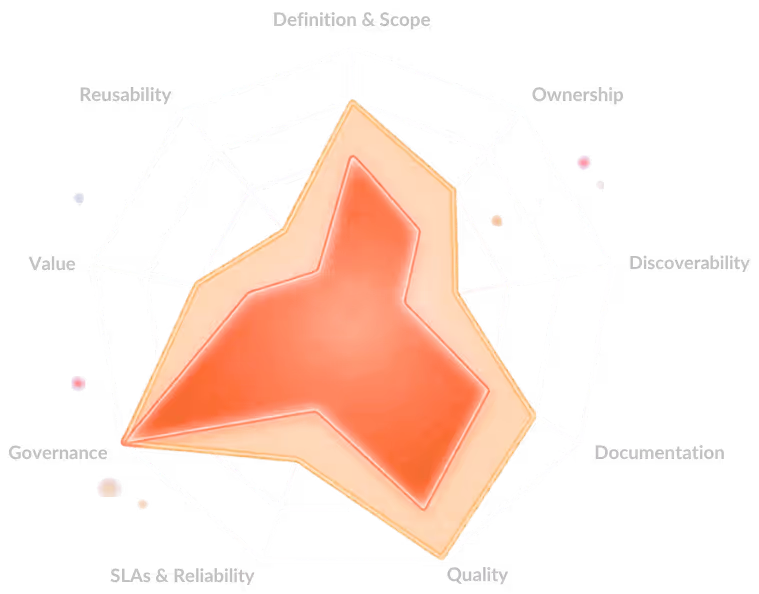
Where does your org stand on data product maturity?
A 9-dimension self-assessment used by 100+ data teams to benchmark strategy, ownership, and platform readiness.


Ritwika Chowdhury
Ritwika Chowdhury is a data and technology professional focused on data products, AI, and modern data architecture. Her work sits at the intersection of data strategy, product thinking, and emerging AI technologies, with a focus on helping organisations turn enterprise data into trusted, usable, and scalable assets.
Read the ideas here. Build them with The Modern Data Company.
Modern Data 101 is where the data community thinks out loud. When you're ready to move from articles to architecture, data products, governed AI pipelines, or a full Data Operating System; the team behind this community can help you build it.
Continue reading
.jpg)
.png)

.png)