AI for Agriculture: What AI-Driven Data Platforms Enable
From precision crop monitoring to autonomous farm management, here's how AI is transforming agriculture and and why modern data management platforms are a necessary infra to achieve these.

From sensor-driven soil monitoring to predictive yield models, AI for smart farming is delivering measurable gains that previous generations of agricultural technology could not.
This article explores the key applications of AI and machine learning in crop production and farm management, and examines why we need a modern data management platform. Additionally, to understand how to build an AI-ready data platform, enterprises must first realise that raw data warehouses do not provide model context.
How AI in Agriculture Is a $100 Billion Opportunity
Global food demand is projected to rise 50% by 2050 while arable land, water, and labour remain constrained. McKinsey estimates that AI could add $100 billion in value to global farms through improved yields and reduced input costs. A 2025 systematic review in Cogent Food & Agriculture synthesising 95 studies reported that AI-driven precision agriculture delivers a 25% increase in yield, 28% reduction in production costs, 22% water savings, and up to 35% lower nitrogen runoff.
.avif)
These numbers reflect a structural shift. A unified, AI-ready data infrastructure, even the most sophisticated agricultural AI stalls at the level of insight and never becomes action.
[report-2025]
Key Applications of AI in Agriculture:
1. Precision Crop Monitoring and Disease Detection
AI for agriculture enables computer vision models, particularly Convolutional Neural Networks (CNNs), to analyse satellite imagery, drone footage, and in-field photos to detect crop diseases, pest infestations, and nutrient deficiencies at early stages. A systematic review of 153 research articles (2016–2024) confirmed that deep learning models achieve accuracy rates in crop disease detection across diverse geographies and crop types.
.avif)
This directly improves crop management by reducing reliance on reactive, broad-spectrum pesticide application.
2. Yield Prediction and Resource Optimisation
Machine learning models like decision trees, neural networks, and Long Short-Term Memory (LSTM) networks, are being used to forecast yield outcomes based on soil health data, weather patterns, and historical performance. Farms using these tools report up to 40% efficiency gains in resource allocation, including fertilizer, water, and labor. This is precision agriculture at scale.
.avif)
3. Intelligent Irrigation Management
AI-driven irrigation platforms integrate soil moisture sensors, weather APIs, and crop water requirement models to automate irrigation scheduling. The result: significant reductions in water use without compromising yield, which is a critical capability as water scarcity intensifies globally.
Read a use case on enabled intelligence in BFSI sector here.
4. Autonomous Machinery and Robotics
From GPS-guided tractors to AI-equipped harvesting robots, AI for smart farming increasingly includes autonomous equipment that performs planting, spraying, and harvesting with sub-inch precision. These systems reduce labor dependency while increasing operational consistency.
Current Challenges of Using AI in Agriculture
Despite the compelling numbers, widespread adoption of artificial intelligence for agriculture faces serious structural barriers. Understanding these challenges is essential, because they point directly to where the solution must come from.
Fragmented and Siloed Agricultural Data
The OECD’s 2025 analysis of AI in agriculture identifies a “fragmented data landscape” as the single biggest obstacle: inconsistent data formats, lack of interoperability between devices and systems, and gaps in both real-time and historical datasets.
As one industry CEO put it plainly: “Agriculture doesn’t have a data problem, it has an intelligence problem. The data exists.” It’s trapped in incompatible silos across sensors, farm management software, ERP systems, and satellite feeds. Key focus needs to be on managing unstructured data for AI training.,
Infrastructure Gaps in Rural Environments
A 2024–2025 PMC systematic review on IoT and AI in agriculture highlights that high sensor infrastructure costs, weak rural connectivity, and limited digital literacy remain persistent barriers, particularly for smallholder farmers. AI models require continuous data pipelines; when connectivity fails, so does the model.
Poor Data Quality and Annotation Scarcity
Research published in Frontiers in AI (2025) identifies three persistent barriers in AI-driven crop monitoring: scarcity of annotated datasets, poor model generalisation across environments, and the challenge of fusing multi-source data streams (satellite, UAV, ground sensors) into coherent inputs. Ensuring the optimal quality of data is an important step for laying data foundation requirements for machine learning.
.avif)
The Need for Open Data Standards in Precision Agriculture
Academic research on AI adoption challenges in agriculture notes that AI analytics are limited by lack of quality data, biased and fragmented datasets skewed toward large industrial farms. Improved metadata standards and open, interoperable data platforms are essential prerequisites for any meaningful AI deployment at scale.
Skills Gap and Governance Deficits
Deploying AI in agriculture requires expertise at the intersection of agronomy, data engineering, and ML operations. Beyond skills, there is also a growing concern around data ownership, privacy, and algorithmic transparency. Farmers and cooperatives are hesitant to share granular field data without clear governance frameworks.
[related-1]
.avif)
Why Agricultural Sector Needs a Dedicated Data Platform for AI
Every challenge listed above converges on one root cause: the absence of unified data management designed for AI-readiness.
Agricultural AI models are only as good as the data fed into them. Disconnected sensor outputs, unstructured field logs, and proprietary vendor formats create the very “intelligence problem” the industry is struggling to solve. This is where AI for data management, and more specifically, modern data management platforms, become the critical enabler.
AI is only as reliable as the context it receives.
Resolving the "Semantic Layer vs Feature Store" Conflict
Historically, a semantic layer (governing data context in analytics) and a feature store (optimiing data for machine learning inputs) existed in separate silos. When processing complex agricultural data, this separation strips raw tabular data (like soil moisture logs) and unstructured files (like drone imagery) of their relationship before they ever reach an AI model.
A modern platform acts as a unified data architecture for multimodal AI to bridge this gap. It resolves the conflict through three condensed mechanisms:
- Unified Ingestion: Ingests heterogeneous streams simultaneously, storing tabular telemetry alongside vector embeddings of unstructured image files, sensors, ERP systems, satellite feeds, and weather APIs into a single interoperable layer
- Semantic Contextualisation: Applies a standardied semantic layer to mathematically link the drone imagery and soil logs to the exact same geospatial data product. This allows enforcing data quality and metadata standards to allow AI models receive clean, labeled, and contextually rich inputs
- Context-Aware Features: Automatically extracts pre-reconciled, model-ready variables. The AI model doesn’t just receive isolated pixels or raw numbers; it receives a highly contextualied, combined feature pipeline.
- Enable governed data sharing: Addressing ownership, privacy, and regulatory concerns that currently block cross-farm or cross-region AI training datasets is crucial. Since precision agriculture decisions are both immediate (irrigation alerts) and strategic (seasonal yield forecasts)
[related-2]
A data product platform simplifies the process of building and managing the APIs through which AI agents interact with operational data, enabling rapid, scalable integration of AI into field-level applications.
The Roadmap: Building an AI-Ready Data Platform for Architecture
AI for agriculture is delivering transformative outcomes, but only where the data foundation supports it. The farms, cooperatives, and agri-enterprises that will lead in the next decade are those investing not just in AI models, but in the data management platforms that make those models work reliably, at scale, and across diverse agricultural contexts.
The challenges of fragmented data, poor interoperability, and governance gaps are mostly never inherent to agriculture, rather they are infrastructure problems. And infrastructure problems have infrastructure solutions.
FAQs
Q1. What is AI in agriculture and how does it work?
AI in agriculture applies machine learning, computer vision, and predictive analytics to farming decisions. Models are trained on soil data, satellite imagery, weather patterns, and yield history to automate tasks like irrigation scheduling, disease detection, and resource allocation, replacing reactive, labour-intensive farm management with data-driven precision.
Q2. How much can AI improve crop yields?
A 2025 systematic review of 95 studies found AI-driven precision agriculture delivers an average 25% yield increase alongside a 28% reduction in production costs. Gains vary by crop type, data quality, and infrastructure maturity, farms with unified data pipelines consistently outperform those running siloed systems.
Q3. What are the biggest barriers to AI adoption in agriculture?
The three most cited barriers are fragmented data across incompatible systems, poor rural connectivity that breaks continuous data pipelines, and a shortage of annotated training datasets. Governance gaps around data ownership also slow adoption, smallholder farmers are reluctant to share field-level data without clear protective frameworks.
Q4. Why does data infrastructure matter for agricultural AI?
Agricultural AI models are only as reliable as their inputs. Disconnected sensors, unstructured field logs, and proprietary formats degrade model accuracy before a prediction is made. A unified data management platform that enforces quality standards, enables interoperability, and supports real-time processing is the prerequisite for any AI delivering consistent agronomic value.
Q5. Can smallholder farmers benefit from AI-driven precision agriculture?
They can, but current barriers disproportionately affect them. High sensor costs, weak connectivity, and limited digital literacy are structural obstacles that larger operations can absorb more easily. Scalable impact for smallholders depends on low-cost sensor infrastructure, offline-capable AI models, and governance frameworks that make data sharing safe and worthwhile.
Connect with a community data expert
A no-cost session with a practitioner who's been where you are.
About Modern Data 101
Modern Data 101 is a movement redefining how the world thinks about data. A community built by the same team behind the world’s first data operating system, Modern Data 101 sits at the intersection of data, product thinking, and AI. Spread across 150+ countries, the community brings together a global network of practitioners, architects, and leaders who are actively building the next generation of data systems.
At its core, Modern Data 101 exists to simplify the journey from raw data to tangible and observable impact. It advocates high-potential data systems and next-gen architectures to unify and activate insights and automation across analytics, applications, and operational workflows at the edge.
In a world shifting from data stacks to AI ecosystems, Modern Data 101 helps teams not just navigate the change but lead it.


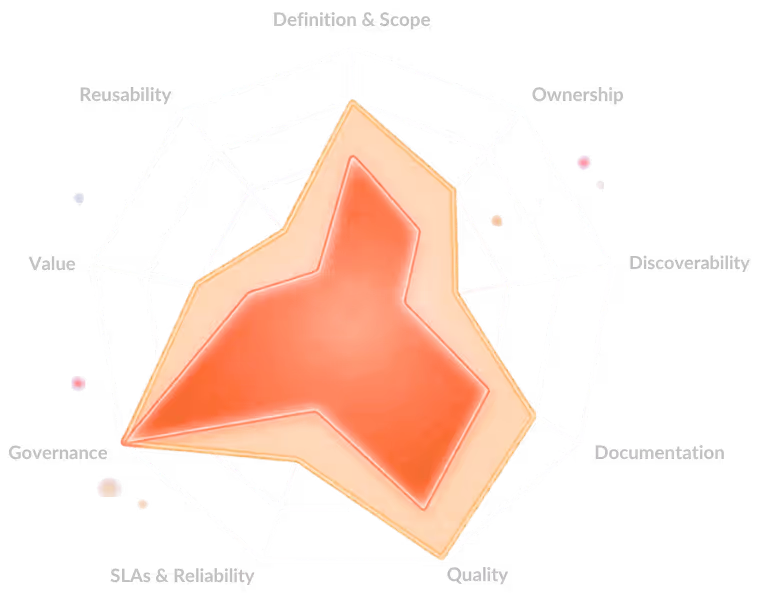
Where does your org stand on data product maturity?
A 9-dimension self-assessment used by 100+ data teams to benchmark strategy, ownership, and platform readiness.


Akshay Chame
Akshay is a GenAI/ML engineer building production-grade AI systems, including RAG pipelines, AI agents, MCP servers, and LLM fine-tuning. An IEEE-published researcher and Smart India Hackathon 2023 winner, he is focused on scalable, reliable AI systems that move intelligent solutions from experimentation to production.
Read the ideas here. Build them with The Modern Data Company.
Modern Data 101 is where the data community thinks out loud. When you're ready to move from articles to architecture, data products, governed AI pipelines, or a full Data Operating System; the team behind this community can help you build it.
.png)

.png)

.png)