AI Governance Implementation Strategies: Moving from Principles to Practice
Why most governance programmes still fail in practice.

AI Governance Is Not Failing Because of a Lack of Policies
AI is no longer confined to labs and pilots. Today, it is helping real teams across the business functions. From helping customer support teams to resolve queries faster, marketing teams to create content at speed, improve financial forecasting, and to even assist engineers with software development. Yet, the real question remains unanswered for many: whether outputs generated can be trusted fully?
The reason for that is precisely why AI governance has become one of the most important priorities for data leaders.
Despite the massive investments in AI governance over a few years, businesses continue to face the same challenges. The struggle to explain what logic was used by an AI model to arrive at a decision is real. Also, unclear ownership remains a bottleneck when multiple teams contribute to the same application. Even organisations with documented governance frameworks often discover that the frameworks fail to translate into everyday practice.
Industry research like the EY 2025 Responsible AI Pulse survey talks about the widening gap between AI adoption and governance maturity. The survey found that while 72% of organisations have integrated and scaled AI across most of their initiatives, only around one-third of them have the governance controls needed to govern AI responsibly and at scale.
This is where many discussions around AI governance fall short. Focus on principles, policies, and regulatory requirements remains prime. And unarguably, those are important, but they rarely answer the question leaders are asking.
How do we make AI governance work in a real business setup?
The answer might be beyond the governance documentation and in the way AI is actually built, deployed, and used across an organisation.
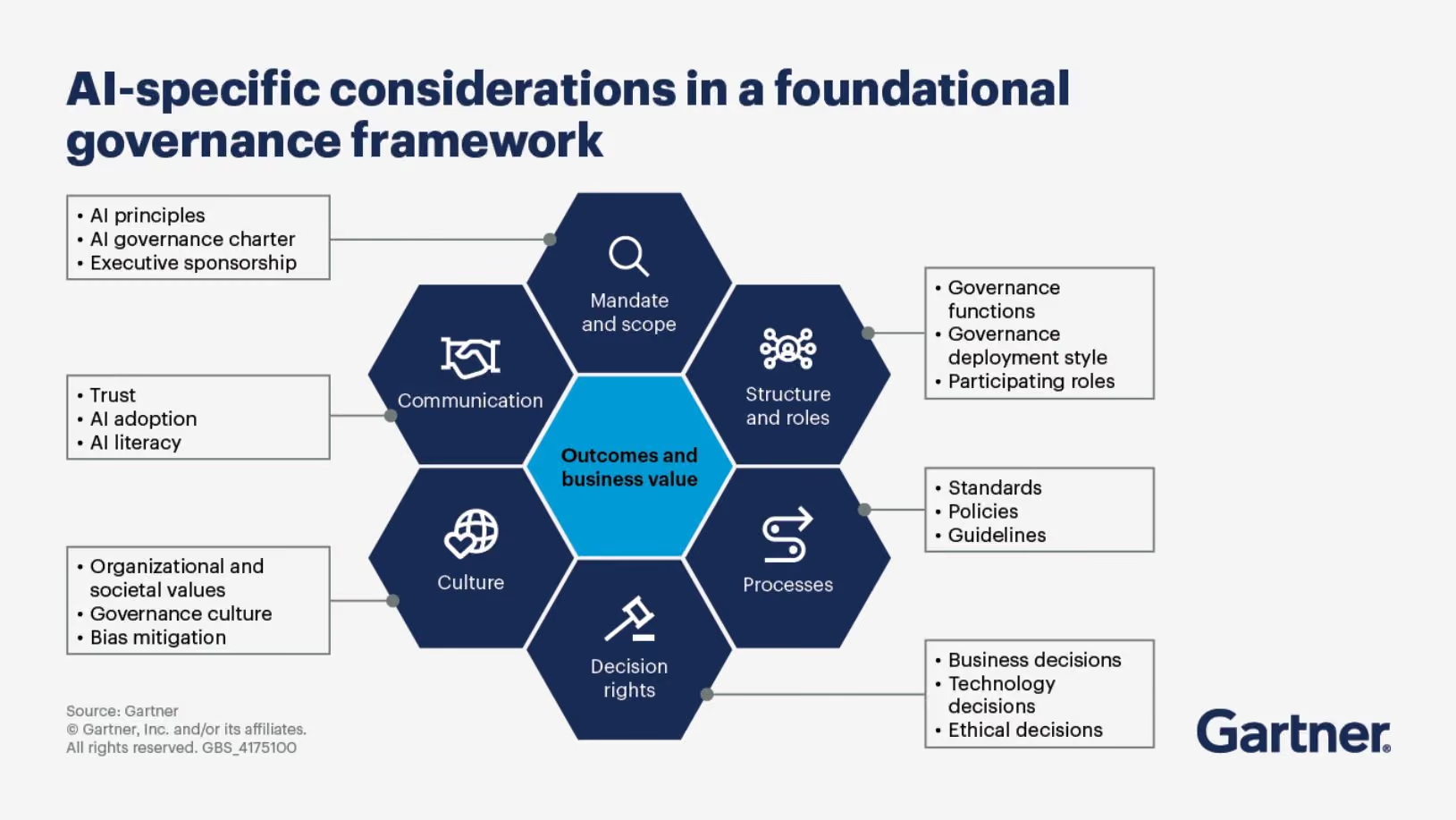
Why AI Governance Is Struggling to Keep Pace
Almost every organisation starts its AI journey in a similar pattern. One team identifies a promising use case, and that foundation model is integrated into an application. Users run tests. As the project delivers value, confidence grows. This encourages more experimentation, and soon AI is adopted across several teams.
At first glance, this might come across as progress. But behind the scenes, the story might appear differently.
Every new AI initiative introduces another dataset, model, prompt library, business owner, and a set of decisions that need to be governed. What began as a single project gradually ended up becoming an entire ecosystem of AI applications, each operating with different objectives, different risks, and different expectations. And that’s exactly where governance starts to choke.
[related-1]
Traditional governance approaches were never designed for AI. They were designed to govern systems that remain unchanged for years, if not decades. AI systems are different altogether. Models evolve, and prompts are refined dynamically. Governance relying on periodic reviews or static documentation is just not the right fit.
💡It is like rubbing stones to start a fire in an ultramodern kitchen setup.
[state-of-data-products]
Furthermore, the moment AI starts interacting with enterprise data, complexity increases.
Think of a sales team asking an AI assistant to identify customers who are most likely to churn. The request is plain, but the answer depends entirely on the quality of the underlying data. If marketing, sales, and customer support maintain different definitions of an active customer, the AI has no single version of the truth to start with. And still, if the recommendation turns out to be inaccurate, the model is blamed.
The problem didn’t appear out of the blue; it was already there. AI has simply exposed inconsistencies that already existed from long ago.
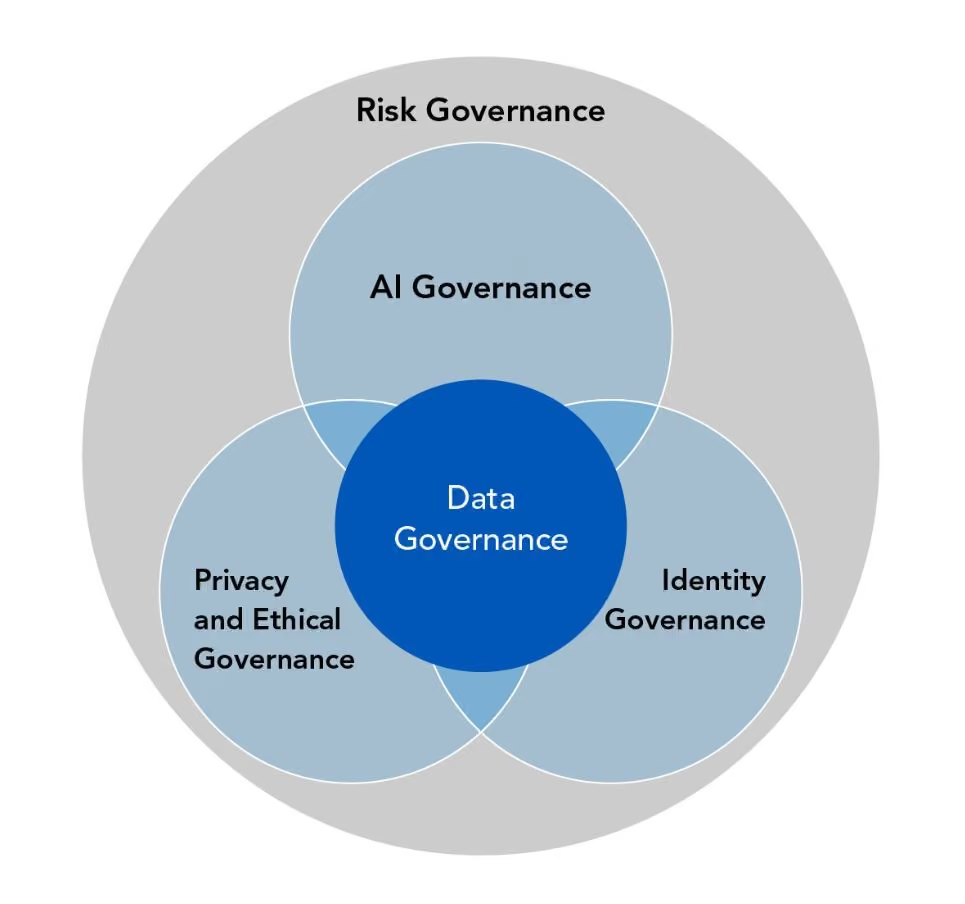
This shift in perspective is critical because it fundamentally changes how organisations should think about AI governance. Instead of treating AI governance as an entirely new discipline, it should be built upon the existing foundations such as data governance, metadata management, ownership, lineage, and access control.
Why AI Governance Initiatives Fail
If organisations understand these challenges, why do so many governance initiatives still fall short? The answer rarely lies in a lack of commitment.
Most organisations invest a considerable amount of time defining governance principles. They establish steering committees, publish responsible AI guidelines, and introduce approval processes for new AI projects. These efforts are necessary, but they often focus on governance as a separate programme rather than thinking of it as an operational capability.
Think of how modern software engineering teams work with Agile and DevOps environments. Testing, version control, and code reviews are not an afterthought at the end of development. They are built into the delivery process. AI governance can move in the same way.
However, in reality, organisations introduce governance after AI development has already begun. Predictably, it starts to feel like friction. The consequences extend beyond slow delivery.
💡Imagine a champion runner who trained on the ground barefoot, but on the day of actual competition, he was asked to wear shoes. Of course, it is a prerequisite for the race, but it’ll impact the runner’s speed and confidence.
This also projects governance as a barrier, and forces teams to search for shortcuts. Different business units adopt different practices to overcome the situation. Documentation slips the mark. Ownership becomes fragmented. Before long, the organisation has governance policies on paper but very little consistency in how those policies look in practice.
Separating AI governance from data governance is another mistake businesses often tend to make. Organisations often approach AI as though it introduces an entirely new governance challenge, but in reality, it only amplifies problems that existed long before.
Poor data quality, inconsistent business glossaries, ownership dilemma, and limited view into the data movement have always affected decision-making. That’s why successful organisations spend less time asking how to govern models in isolation and more time asking whether the underlying data, processes, and ownership structures are ready to support trustworthy AI at scale.
The good news is that we can overcome these challenges. Organisations that succeed are not writing better governance policies. They are embedding governance into the way AI is developed, managed, and improved from day one.
[data-expert]
Five AI Governance Implementation Strategies That Deliver Tangible Results
Once organisations accept that AI governance is an operational challenge rather than a documentation exercise, the next question becomes much more practical.
What does good implementation actually look like?
There is no one-size-fits-all framework. Different industries have different regulations, businesses have different risk tolerances, and AI use cases continue to evolve. Even so, organisations that successfully scale AI tend to approach governance in remarkably similar ways.
1. Start with Trusted Data, Not Smarter Models
When organisations begin an AI initiative, the first discussion usually revolves around models. Which LLM should be used? Should we fine-tune it?
Those are important decisions, but they are rarely the most important ones.
An AI system can only be as reliable as the data foundation it stands on. If the records are inconsistent, product information is incomplete, or business definitions have versions across various departments, even the most advanced model will end up struggling to produce reliable outcomes.
Organisations need confidence in the quality, ownership, and lineage of their data before they can expect trustworthy outputs from AI.
[related-2]
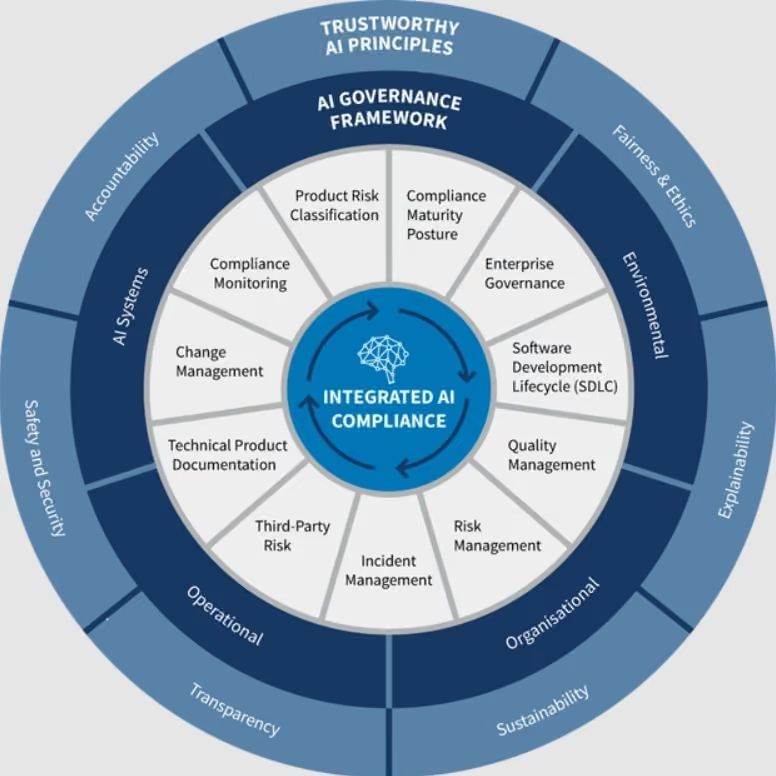
2. Embed Governance into the AI Lifecycle
One of the biggest reasons governance fails is because it is bolted often too late.
Generally, governance enters the conversation only after a model is developed, and business users begin testing it. Teams are asked to document decisions, review risks, and introduce monitoring after most of the work has already been completed. This is when governance starts to feel like an additional task rather than part of the development process. Successful organisations reverse this approach.
The shift in the approach might be subtle but an important one. Governance no longer delays delivery because it is woven into the delivery process itself.
3. Define Ownership Before AI Goes into Production
AI systems rarely belong to a single team. Every team in a business contributes with their expertise, and with so many stakeholders involved, ownership can quickly become blurred.
That becomes a serious problem when an AI system produces an unexpected result. Accountability and ownership are given a toss.
Every AI application should have clearly defined ownership across its lifecycle. Someone should own the data; someone else owns the model. One team is responsible for the business outcome. Clear accountability removes uncertainty and empowers organisations to respond much faster when systems need to evolve.
Also, governance becomes far more effective when these questions are answered before deployment rather than after an incident occurs.
4. Monitor AI Continuously, Not Periodically
Traditional governance programmes often rely on scheduled reviews. That approach worked reasonably well for systems that changed rarely or almost never. But AI is different.
An AI application that performs well today may produce very different outcomes six months from now if its underlying data or operating environment changes. That is why AI governance should never end when a model is deployed. Continuous monitoring should become a core part of the governance strategy.
Governance should evolve at the same pace as the AI systems it is designed to support. The objective is to ensure that trust does not diminish as AI continues to learn and adapt.
5. Measure Trust, Not Compliance
Many governance programmes measure success by the number of policies created, reviews completed, or controls implemented. While these metrics are important, they do not answer the question that matters most.
Do people trust the AI systems they are using?
Executives need confidence that AI decisions can be explained when required. Regulators expect organisations to demonstrate accountability. Customers want reassurance that AI is being used responsibly. Trust sits at the centre of each of these expectations.
Compliance becomes the natural outcome the moment governance starts to focus on trust.
Governance Should Empower Innovation, Not Slow It Down
Poor governance introduces approval bottlenecks, duplicate reviews, and disconnected processes that slow teams down. Over time, governance mirrors delay rather than value.
When teams know which data they can use, who owns an AI application, how decisions should be documented, and what standards need to be met, they spend less time dealing with uncertainty and more time delivering value. Transparency takes the lead and governance provides a common operating model that allows different teams to move faster without increasing organisational risk.
Organisations that recognise this will find it easier to scale AI across the business. Those that continue to treat governance as a compliance exercise are likely to discover that innovation slows not because governance exists, but because it was implemented in the wrong way.
Final Thoughts
As enterprise AI adoption accelerates, AI governance implementation will become just as important as the model development itself. Organisations are no longer asking whether they need AI governance; rather, they are asking how to operationalise it without creating unnecessary complexity. The answer lies in changing the way governance is perceived and understood.
Rather than existing as a separate programme managed through policies and periodic reviews, governance should become part of the everyday practices that support AI development.
Ultimately, successful AI governance is not measured by the number of frameworks an organisation adopts. It is measured by whether people across the business are confident enough to rely on AI in their daily decisions.
FAQs
Q1:Why do organisations with documented AI governance policies still struggle in practice?
They struggle because even the most sophisticated documented policies can never enforce anything. EY’s research found that while 72% of organisations have integrated and scaled AI across most initiatives, only around a third have the governance controls to match. This is the gap between having a policy and having a policy embedded into how AI is actually built, deployed, and monitored.
Q2: Is AI governance really just data governance with a new name?
Not entirely, but it builds directly on the same foundations. AI amplifies existing data problems rather than introducing entirely new ones, which is why organisations that already have strong data governance tend to find AI governance far easier to operationalise.
Q3: Does AI governance slow down innovation and time to market?
It does, but only when it’s implemented as a separate, after-the-fact review process. When governance is embedded, it removes uncertainty rather than creating delay.
Connect with a community data expert
A no-cost session with a practitioner who's been where you are.
About Modern Data 101
Modern Data 101 is a movement redefining how the world thinks about data. A community built by the same team behind the world’s first data operating system, Modern Data 101 sits at the intersection of data, product thinking, and AI. Spread across 150+ countries, the community brings together a global network of practitioners, architects, and leaders who are actively building the next generation of data systems.
At its core, Modern Data 101 exists to simplify the journey from raw data to tangible and observable impact. It advocates high-potential data systems and next-gen architectures to unify and activate insights and automation across analytics, applications, and operational workflows at the edge.
In a world shifting from data stacks to AI ecosystems, Modern Data 101 helps teams not just navigate the change but lead it.


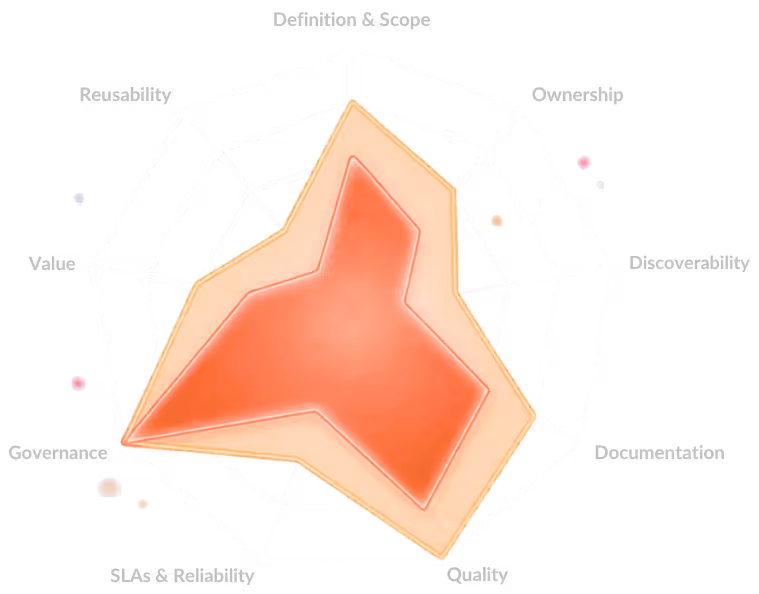
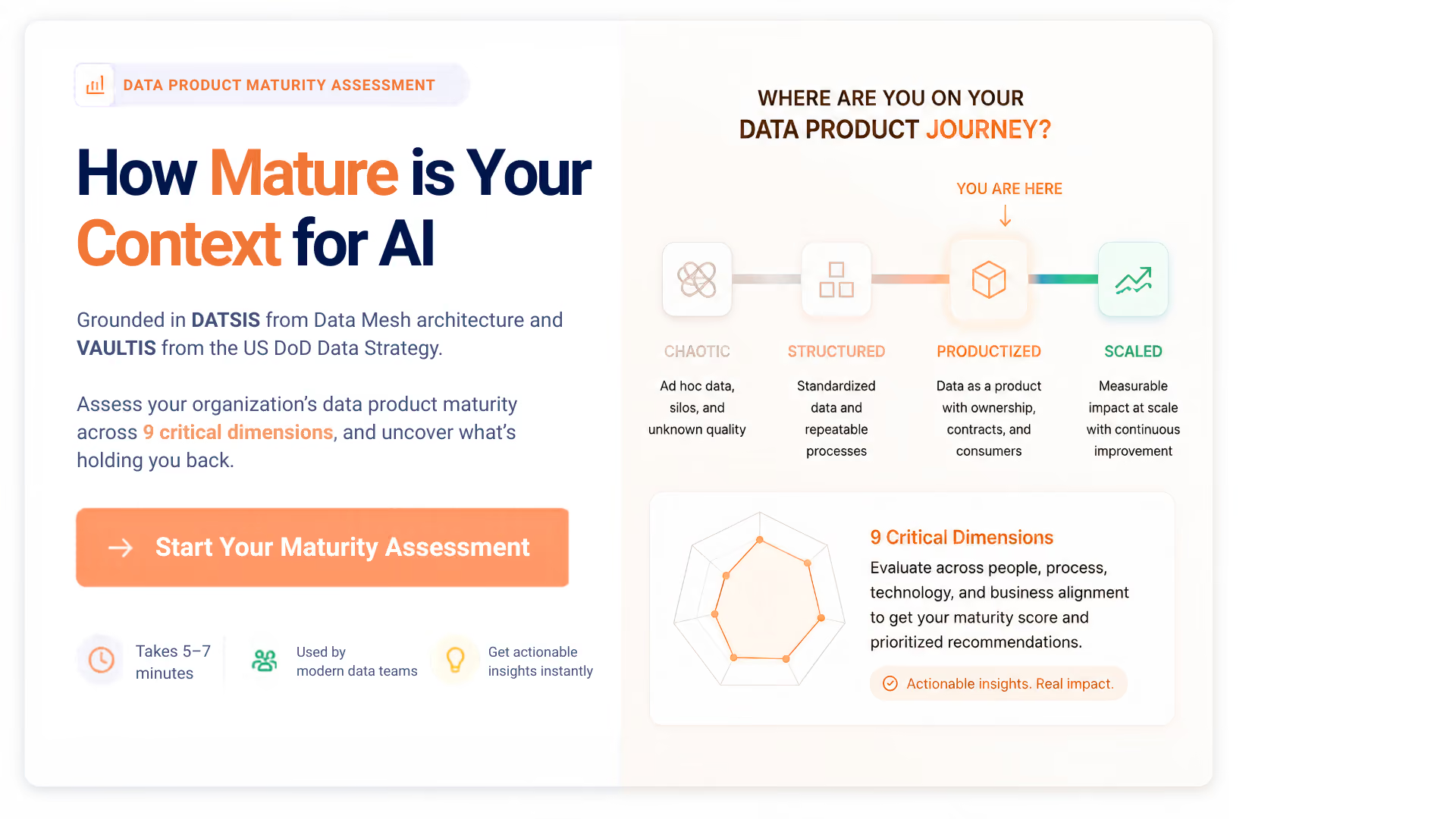
Where does your org stand on data product maturity?
A 9-dimension self-assessment used by 100+ data teams to benchmark strategy, ownership, and platform readiness.



Aishwarya Sharma
Aishwarya is a Senior Analytics Engineer at The Modern Data Company, focused on building end-to-end data solutions that bridge engineering and analytics. He works across data pipelines, modelling, and visualisation to deliver reliable, business-ready insights, combining strong technical expertise with a practical, problem-solving approach to modern data systems.
Read the ideas here. Build them with The Modern Data Company.
Modern Data 101 is where the data community thinks out loud. When you're ready to move from articles to architecture, data products, governed AI pipelines, or a full Data Operating System; the team behind this community can help you build it.
.png)
.png)

.png)