Is AI Changing How People Use Data Analytics?
CDOs treating AI analytics as a speed upgrade are missing the real story: nearly half of data leaders admit they can't fully trust their own data for decisions. Layer AI on top of that gap, and the wrong answers don't slow down. They just get faster and more convincing.

TL;DR
- AI is genuinely changing data analytics: faster prep, plain-English queries, quicker anomaly detection.
- But nearly half of 540+ data leaders surveyed say they can't fully rely on their own data for decisions, which exposes how much analytics has run on assumed trust instead of verified data.
- This piece covers what's different, what CDOs get wrong, and what to fix before adding more AI.
Most writing on AI and data analytics circles the same four points: cleaner data, plain-English queries, sharper predictions, analysts who need to upskill. All of it is true, and none of it explains why teams that adopted these tools last year still don't trust the numbers in front of them.
[report-2025]
What AI in Data Analytics Looks Like Right Now
Data analytics is the practice of turning raw data into decisions: collecting it, cleaning it, modelling it, presenting it. AI hasn't replaced that chain; it's inserted itself into almost every link of it, most visibly through natural language interfaces that let anyone query data without writing SQL.
What's changed in practice:
.png)
That's the visible layer, and it's genuinely useful. It's also where most vendor content stops.
[related-1]
What are the benefits of AI-powered data analytics?
The clearest gains are speed and accessibility: faster data prep, instant plain-English querying, and anomaly detection that no longer depends on someone scrolling a spreadsheet at the right moment. Those benefits compound when they sit on top of a genuine data product platform rather than ad hoc pipelines.
Learn more about the current state of data platforms in the AI era in this report.
How does AI improve modern data analytics?
AI improves analytics by removing manual bottlenecks: writing queries, cleaning inconsistent formats, catching outliers a human would miss. What it can't do on its own is fix bad data definitions or stale lineage, which is why the improvement is only as real as the data foundation underneath it.
What Speed Can't Fix
Here's what that story leaves out: nearly half of 540+ data leaders surveyed say they can't fully rely on their own data for decisions.
Deloitte's 2026 enterprise research shows the other side of that same coin: two-thirds of organisations report productivity gains from AI, sitting on top of data foundations many of those same leaders don't fully trust.
Related read: Why Inaction Feels Easier Than Action in Data Quality
AI doesn't solve that but rather makes this fail quieter. A model fed stale or loosely defined data can't tell it's wrong, so it answers anyway, cleanly and with total confidence.
What helps is a governed data platform underneath the AI: agreed definitions, known lineage, a freshness guarantee, and the kind of AI observability that catches drift before it reaches a decision.
Skip that step and scale works against you: more dashboards, more queries, more wrong answers moving faster. The organisations avoiding this are the ones who built for AI ROI from the start, rather than patching governance in after the first bad call reaches a decision-maker.
How Will AI Affect Data Analytics Roles?
Every CDO fields some version of this question sooner or later. The honest answer is that AI is reshaping the analyst's job more than eliminating it.
- Shrinking: hours spent writing SQL, formatting charts, building the same report twice.
- Growing: hours spent asking "does this number make sense?" and "what changed upstream?"
.png)
That's a validation skill, not a query-writing one. Catching a broken pipeline is the easy half of the job now; catching a model quietly making the wrong call is the other half.
The bigger change is who counts as a data consumer at all. AI agents and copilots have joined analysts as regular consumers of enterprise data, and that raises the documentation bar that human analysts used to fill in informally.
[related-2]
What Changed, and What Didn't in Data Analytics
Incorrect results aren’t new to analytics. The difference now is that there may be very little time to catch them before they influence what happens next.
Organisations treating this as a tooling upgrade will keep shipping faster dashboards on shakier ground. The ones seeing real value fixed their underlying data strategy first, then let AI move at whatever speed that foundation could actually support.
If your organisation has the governance policy but not the follow-through, that gap is usually where the real damage happens. From Policy to Practice: Making Data Governance Real walks through closing it.
Frequently Asked Questions
What is AI data analytics?
AI data analytics combines machine learning and natural language interfaces with traditional analysis to automate prep, surface patterns, and let users ask questions in plain English. It speeds up the workflow, but it doesn't replace agreed definitions and clean data as what makes an insight trustworthy.
How are AI and data analytics connected?
AI now sits inside nearly every stage of the analytics workflow, from cleaning and modelling to querying and visualisation. The connection runs both ways: AI accelerates analytics, but analytics (specifically, well-governed data) is what determines whether AI's outputs can be trusted.
What is AI-ready data?
AI-ready data is data with documented lineage, a clear owner, an agreed definition, and a known freshness window, all things AI systems need but can't infer on their own the way a human analyst can.
Will AI replace data analysts?
No. AI automates the mechanical parts of analysis, but someone still has to decide which questions matter and catch when an output doesn't match business reality. Getting there depends on how AI-ready the underlying data is, which is a data problem before it's a headcount one.
Connect with a community data expert
A no-cost session with a practitioner who's been where you are.
About Modern Data 101
Modern Data 101 is a movement redefining how the world thinks about data. A community built by the same team behind the world’s first data operating system, Modern Data 101 sits at the intersection of data, product thinking, and AI. Spread across 150+ countries, the community brings together a global network of practitioners, architects, and leaders who are actively building the next generation of data systems.
At its core, Modern Data 101 exists to simplify the journey from raw data to tangible and observable impact. It advocates high-potential data systems and next-gen architectures to unify and activate insights and automation across analytics, applications, and operational workflows at the edge.
In a world shifting from data stacks to AI ecosystems, Modern Data 101 helps teams not just navigate the change but lead it.


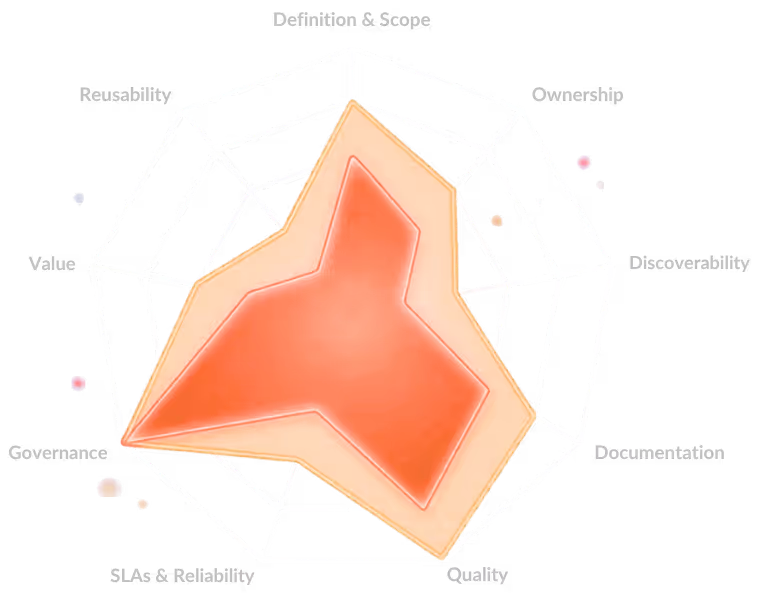
Where does your org stand on data product maturity?
A 9-dimension self-assessment used by 100+ data teams to benchmark strategy, ownership, and platform readiness.


Aishwarya Sharma
Aishwarya is a Senior Analytics Engineer at The Modern Data Company, focused on building end-to-end data solutions that bridge engineering and analytics. He works across data pipelines, modelling, and visualisation to deliver reliable, business-ready insights, combining strong technical expertise with a practical, problem-solving approach to modern data systems.
Read the ideas here. Build them with The Modern Data Company.
Modern Data 101 is where the data community thinks out loud. When you're ready to move from articles to architecture, data products, governed AI pipelines, or a full Data Operating System; the team behind this community can help you build it.
Continue reading
.png)

.png)

.png)