From Policy to Practice: Making Data Governance Real
How governance starts having measurable returns only after disappearing

About Our Contributing Expert
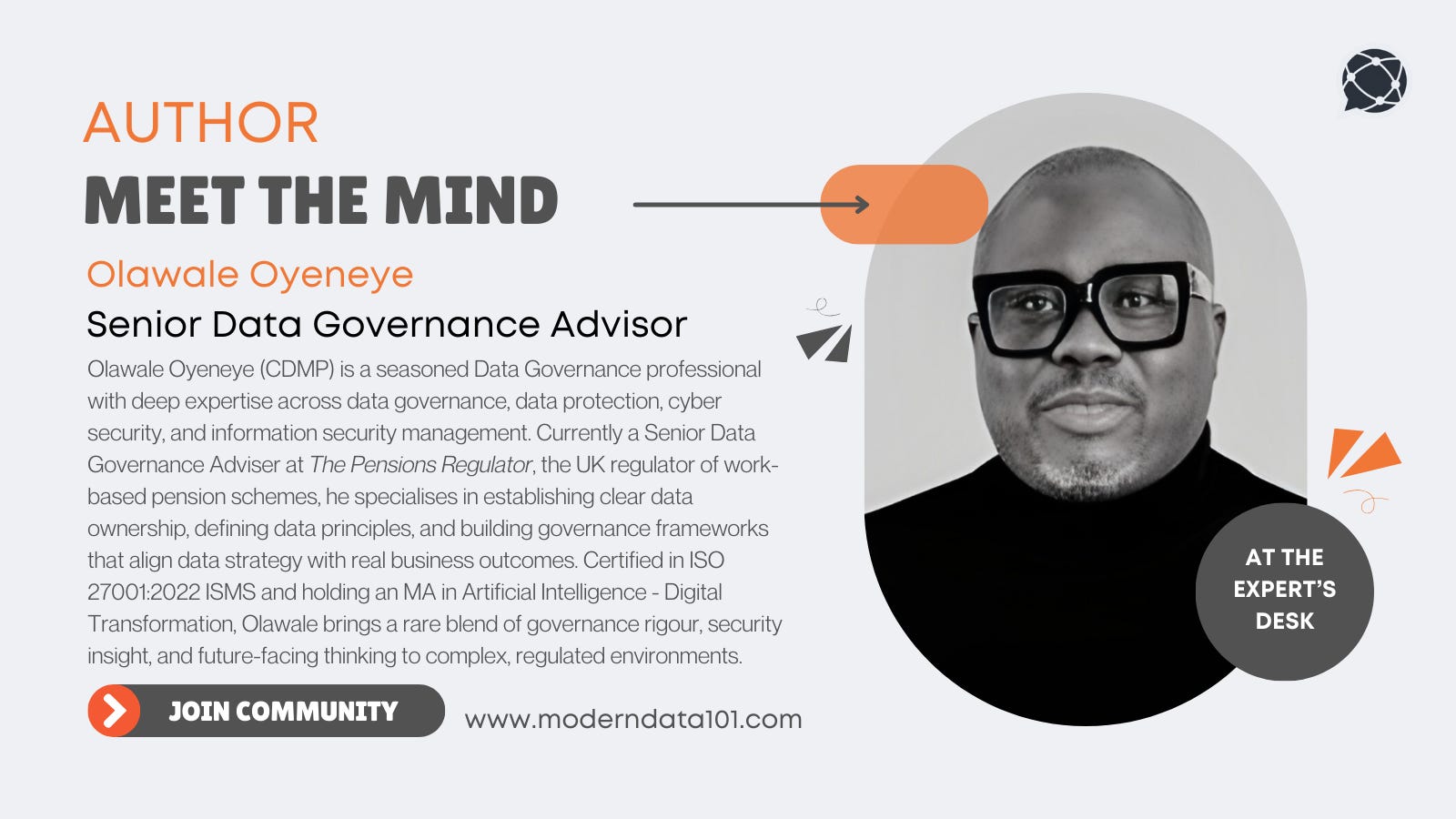
Olawale Oyeneye | Senior Data Governance Advisor

Olawale Oyeneye is an accomplished Data Governance leader with extensive experience designing and implementing enterprise-wide data governance frameworks across complex, regulated organisations. As Senior Data Governance Adviser at The Pensions Regulator, the UK regulator of work-based pension schemes, he plays a pivotal role in strengthening governance controls across cloud platforms, applications, and systems.
A Certified Data Management Professional (CDMP) and ISO 27001:2022 ISMS-certified practitioner, Olawale is widely recognised for his expertise and has successfully delivered governance programmes spanning multiple business units and regions, defining critical data elements, building business glossaries, establishing data ownership, and championing the adoption of governance tooling. We’re thrilled to feature his unique insights on Modern Data 101!
We actively collaborate with data experts to bring the best resources to a 15,000+ strong community of data leaders and practitioners. If you have something to share, reach out!
🫴🏻 Share your ideas and work: community@moderndata101.com
*Note: Opinions expressed in contributions are not our own and are only curated by us for broader access and discussion. All submissions are vetted for quality & relevance. We keep it information-first and do not support any promotions, paid or otherwise.
Let’s dive in
Most organisations believe they have a data governance problem. But what they actually have is a practice problem. Governance, in its formal sense, is rarely missing.
Policies, frameworks, maturity models, all exist. What is missing is their presence in the ordinary moments where data is created, interpreted, and acted upon.
If governance were working, it would show up in the flow of everyday decisions.
It would shape which metric is trusted in a meeting, which dataset is reused instead of recreated, and which issue is escalated before it becomes visible in an audit.
Instead, governance tends to live outside the work itself: captured in documents and decks, consulted only after something has already gone wrong.
But governance cannot be defined by its existence on paper. It can only be defined by its effect on behaviour.
Anything that does not change how people act, decide, or take responsibility in their daily work does not govern anything at all. It may inform, it may advise, but it does not govern.
This reframes how governance artefacts should be understood. Policies and frameworks are not truths to be adopted by default. They are just hypotheses. Each one makes an implicit claim: if this is followed, outcomes will improve.
That claim is only validated when the policy survives contact with real workflows, real incentives, and real time pressure. Until then, governance is not something an organisation has, but something it assumes.
Reduce Governance to Irreducible Components
Governance fails when it is treated as something large, centralised, and abstract. When it becomes an artefact to be owned by a function, a compliance exercise to be satisfied periodically, or a retrospective control applied after damage has already been done, it loses contact with reality. In those forms, governance is always too far away, too slow, and too detached from the moments that actually matter.
To understand why, the problem has to be reduced to its smallest truths. Governance does not begin with committees or tools.
- It begins with behaviour: what people actually do with data when no one is watching.
- It continues with language: whether people can explain what the data means, where it comes from, and when it should or should not be trusted.
- It depends on authority: who is allowed to fix issues, make decisions, and say no.
- And it is sustained by feedback: what gets measured, noticed, and reinforced over time.
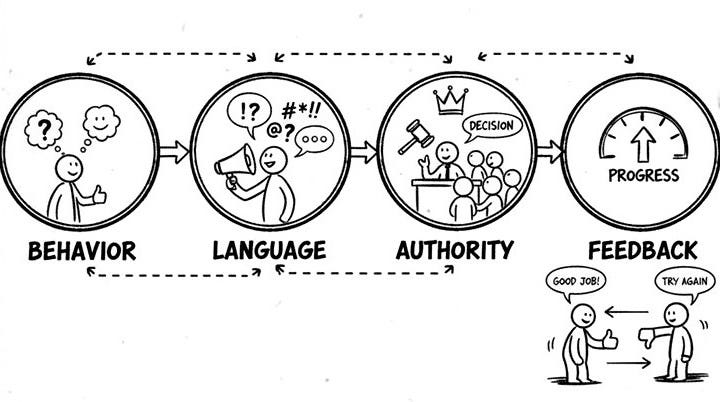
Strip away everything else, and these are the irreducible components. Change behaviour without changing language, and confusion follows. Define roles without authority, and governance stalls. Measure artefacts instead of actions, and adoption becomes performative.
Each element only works in relation to the others.
Governance is not a system that can be installed or rolled out. Systems are static. Governance is dynamic: a pattern of repeated, local decisions, made under pressure, with imperfect information. When those decisions converge toward trust, governance exists. When they don’t, no framework, however elegant, can compensate.
[related-1]
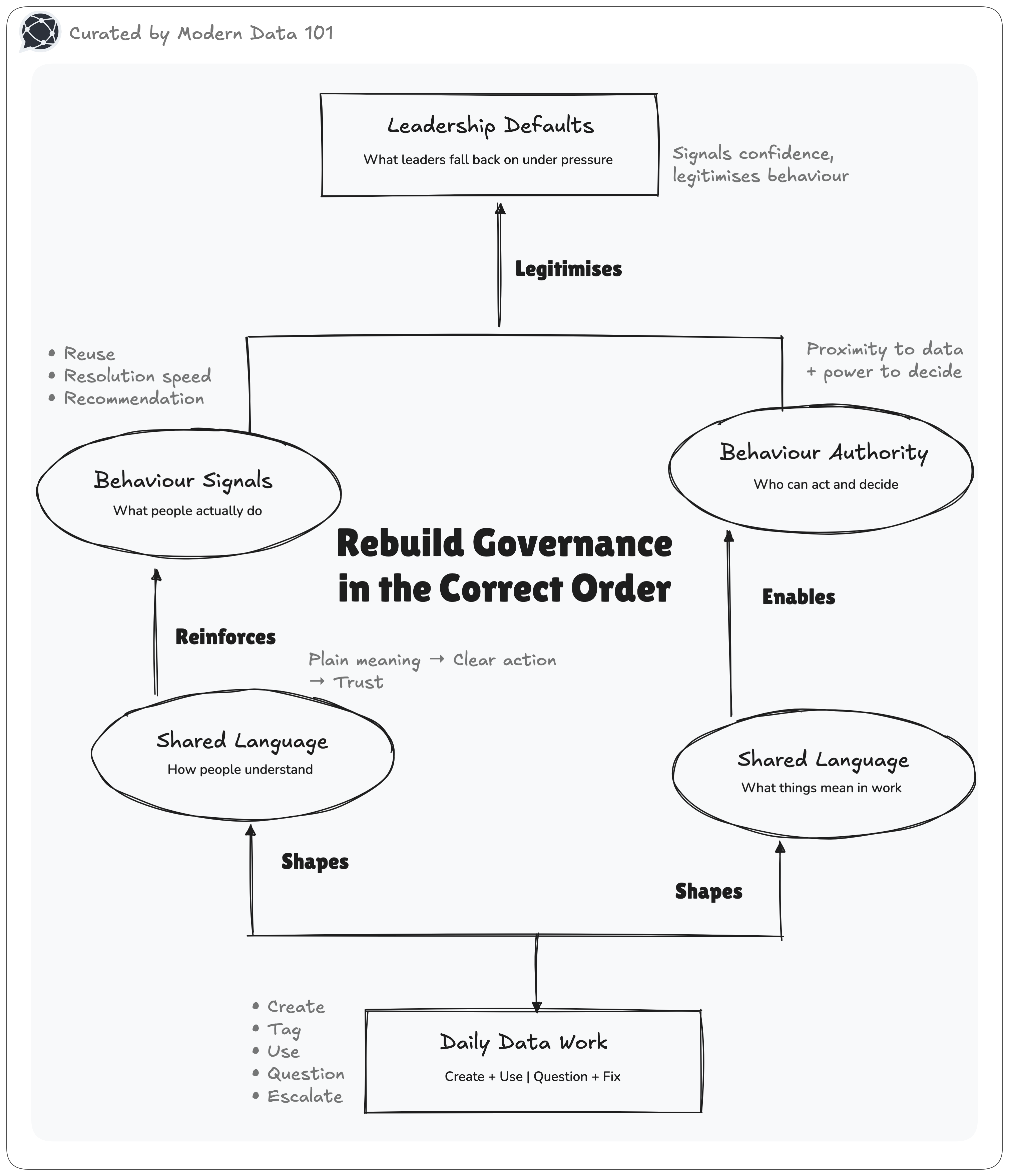
Rebuild Governance in the Correct Order
From simple, observable actions to complex outcomes.
Start with Behaviour over Policy
Governance begins at the moment data is created, touched, reused, or questioned. If governance is not present there, it is already too late. The aim is not to ask people to remember rules, but to shape environments where the right behaviour is the default.
When tagging, validation, and checks happen naturally in the flow of work, governance stops feeling like an extra task. It becomes muscle memory.
Governance succeeds not when people comply, but when they don’t have to think about complying at all.
Translate Policy into Human Language
Most governance policies crumble because they are written to satisfy auditors instead of guiding users. If the people using data cannot explain what a policy means for their work in a short conversation, the policy has no operational value.
Governance only becomes real when it is expressed in everyday language. Language that connects abstract principles to concrete actions. Understanding must come before compliance, and comprehension must come before trust. Without that sequence, policies remain technically correct and practically irrelevant.
Empower the Roles Closest to the Data
Frameworks do not fix issues. People do. Governance collapses when authority is centralised far away from the data, or when responsibility is assigned without the power to act.
Authority without proximity produces bureaucracy, while proximity without authority produces frustration.
Trust only scales when the people closest to the data are trusted to make decisions, resolve issues, and escalate when needed. Governance moves from theory to practice when decision rights move downward, while visibility and accountability remain upward.
🔖 Related Read
Universal Truths of How Data Responsibilities Work Across Organisations
Measure Behaviour Over Artefacts
What gets measured defines what gets taken seriously. Counting how many assets are catalogued or how many policies are signed measures effort instead of impact. Real governance shows up in behaviour: which datasets are reused, how quickly issues are resolved, and whether people recommend governed data to others.
Voluntary trust is the strongest signal of success. When people choose governed data without being told to, governance is no longer enforced since it is already working.
Leadership as Living Proof
Governance becomes culture only when it is modelled. Culture is not shaped by what leaders approve in principle, but by what they default to in practice. When leaders ask for data quality in reviews, use governed datasets in decisions, and reward teams for doing the right thing with data, governance gains legitimacy. When they don’t, no amount of policy can compensate.
🔖 Related Read
Data Leadership Extends Beyond Core-Data Professionals
Review Until Nothing Is Missing
Most conversations about governance end with structures like new councils, new checkpoints, or new artefacts. That instinct is understandable, but it misses the point.
The goal of governance is not to become stronger or more visible, but to disappear.
Governance succeeds when it no longer needs to announce itself, when it no longer requires a meeting, a reminder, or a mandate.
When governance vanishes as an agenda item and reappears as instinct, something fundamental has shifted. People no longer ask whether they should follow governance, they assume it as part of how work gets done.
Decisions are made with an implicit awareness of quality, lineage, ownership, and impact, without anyone having to invoke the framework by name.
Governance that must be enforced has already failed.
The future of data governance will not be written into longer documents or stricter controls. It will be enacted subtly, repeatedly, and everywhere data moves. The goal is to get to a day when governance becomes reflex rather than a requirement.
Author Connect
Connect with Olawale Oyeneye on LinkedIn 💬
From MD101 team 🧡
🌎 Global Modern Data Report 2026
The Modern Data Report 2026 is a first-principles examination of why AI adoption stalls inside otherwise data-rich enterprises. Grounded in direct signals from practitioners and leaders, it exposes the structural gaps between data availability and decision activation.
With hundreds of datapoints, this report reframes AI readiness away from models and tooling, and toward the conditions required and/or desired for reliable action.
🧡 The Data Product Playbook
Here’s your own copy of the Actionable Data Product Playbook. With 3500+ downloads so far and quality feedback, we are thrilled with the response to this 6-week guide we’ve built with industry experts and practitioners. Stay tuned to moderndata101.com for more actionable resources from us!
Connect with a community data expert
A no-cost session with a practitioner who's been where you are.
About Modern Data 101
Modern Data 101 is a movement redefining how the world thinks about data. A community built by the same team behind the world’s first data operating system, Modern Data 101 sits at the intersection of data, product thinking, and AI. Spread across 150+ countries, the community brings together a global network of practitioners, architects, and leaders who are actively building the next generation of data systems.
At its core, Modern Data 101 exists to simplify the journey from raw data to tangible and observable impact. It advocates high-potential data systems and next-gen architectures to unify and activate insights and automation across analytics, applications, and operational workflows at the edge.
In a world shifting from data stacks to AI ecosystems, Modern Data 101 helps teams not just navigate the change but lead it.


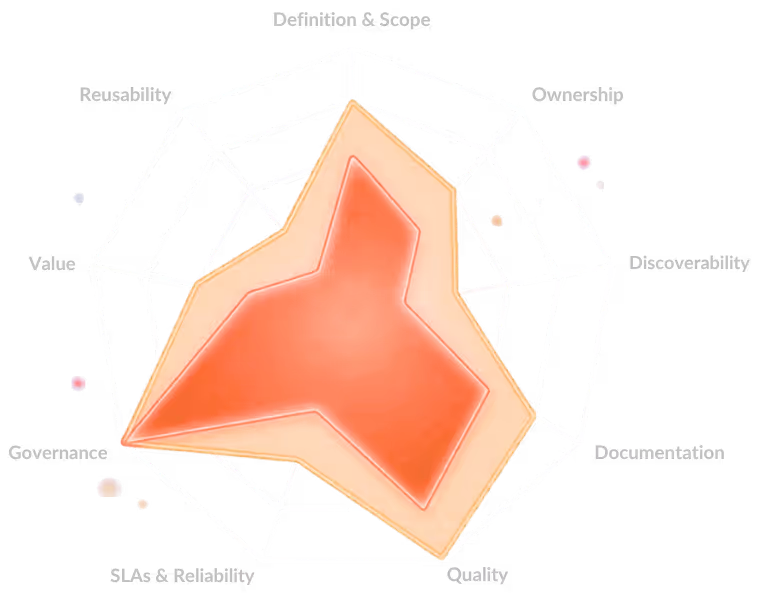
A 9-dimension self-assessment used by 100+ data teams to benchmark strategy, ownership, and platform readiness.


Olawale Oyeneye
Olawale Oyeneye is an accomplished Data Governance leader with extensive experience designing and implementing enterprise-wide data governance frameworks across complex, regulated organisations.
Read the ideas here. Build them with The Modern Data Company.
Modern Data 101 is where the data community thinks out loud. When you're ready to move from articles to architecture, data products, governed AI pipelines, or a full Data Operating System; the team behind this community can help you build it.
Continue reading
.png)