
Data Product Maturity
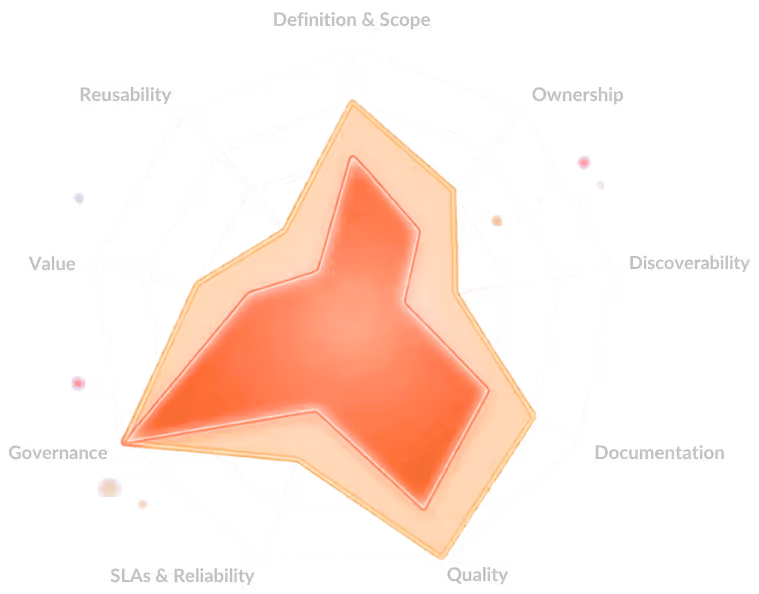
Evaluate your organization's data product maturity across 9 critical dimensions.
Start Assessment

.svg)
Data as a Strategic Asset
Data product maturity can be defined as the extent to which a data product is strategically established and equipped with the necessary features to maximize the extraction of value from data.
This assessment helps you evaluate your organization's data product maturity across critical dimensions such as ownership, quality, governance, reuse, and value delivery.

- 01. Definition & Scope
- 02. Ownership
- 03. Discoverability
- 04. Documentation
- 05. Quality
- 06. SLAs & Reliability
- 07. Governance
- 08. Consumption & Value
- 09. Reusability
What is Data Product Maturity?
Data product maturity can be defined as the extent to which a data product is strategically established and equipped with the necessary features to maximise the extraction of value from data. This assessment helps you evaluate your organization's data product maturity across critical dimensions such as ownership, quality, governance, reuse, and value delivery.
Start Assessment
The Five Levels of Data Product Maturity
The levels capture how data moves from reactive delivery to productized assets that scale trust, reuse, and impact.
AdHoc
Reactive, unstructured approach. Data is a byproduct, not a product. No standards, inconsistent outputs.
Emerging
Initial recognition of data as valuable. Basic practices exist but inconsistent. Often point-to-point, use-case driven.
Defined
Standardized processes and clear ownership. Data products are intentionally designed with repeatable patterns.
Managed
Proactive management with monitoring and automation. Data products are strategic assets with measurable outcomes.
Optimised
Continuous improvement and innovation. Data products drive competitive advantage and faster time-to-market.
Grounded in Two Industry Frameworks
Grounded in DATSIS ↗ from Data Mesh architecture and VAULTIS ↗ from the US DoD Data Strategy.
Data Mesh Architecture
DATSIS
Principles for well-designed data products
Discoverable
Easily found through catalogs with rich metadata, tags, and descriptions
Addressable
Unique, permanent identifier enabling consistent access across systems
Trustworthy
Accurate, reliable, and transparently sourced with clear quality guarantees
Self-describing
Includes schema, semantics, and documentation for self-service understanding
Interoperable
Standardized protocols enabling seamless integration and composition
Secure
Robust access controls, encryption, and compliance safeguards
US DoD Data Strategy
VAULTIS
Principles to maximize usability & protect against misuse
Visible
Information organized, catalogued, and discoverable by those with access needs
Accessible
Data retrievable in usable format within appropriate environment and timeframe
Understandable
Data recognizable with context and rules ensuring correct interpretation
Linked
Data connected via tagging and lineage for analytics and AI use
Trustworthy
Confidence that information hasn't been tampered with or altered
Interoperable
Common representation across missions, organizations, and systems
Secure
Protected from unauthorized use, manipulation, and data misuse
How This Assessment Maps to DATSIS & VAULTIS
Each assessment dimension addresses specific principles from both frameworks:
Note: Dimension 9 (Consumption, Adoption & Value) extends beyond DATSIS/VAULTIS to address organizational capability and business value realization, critical for enterprise maturity assessment.
Get Started With Your Assessment
Let's get to know you a bit
Your Copy of the Modern Data Survey Report
Better decisions start with shared insight.
Pass it along to your team →


Evaluate Your Data Maturity
Answer all 9 dimensions to receive your unique data product maturity fingerprint.
Who we are
The Modern Data Company
The Modern Data Company is redefining data management for the Al era. The company's flagship platform, DataOS, serves as the foundational analytics and Al-ready data layer for any data stack. This unified platform gives enterprises the ability to build and deploy data products, simplify data management, and optimize data costs. DataOS frees teams to focus on driving real value from data, accelerating the journey to becoming a truly data-driven and Al- enabled organization.

The Modern Data 101 Community
Modern Data 101 is a publication and community for data leaders, practitioners, and visionaries building data platforms, designing data teams, and architecting the invisible. In a world of countless tools, trends, and templated thought leadership, Modern Data 101 slows things down down to ask deeper questions: Why was this actually built? And what business problem can it solve? We explore architecture, semantics, and organisational design, the invisible foundations that determine whether data works.