Data Products Architecture: The Interface Between Enterprise Data & AI
Here is how modern data leaders use versioned contracts, domain ownership, and semantic layers to scale trust.

TL;DR
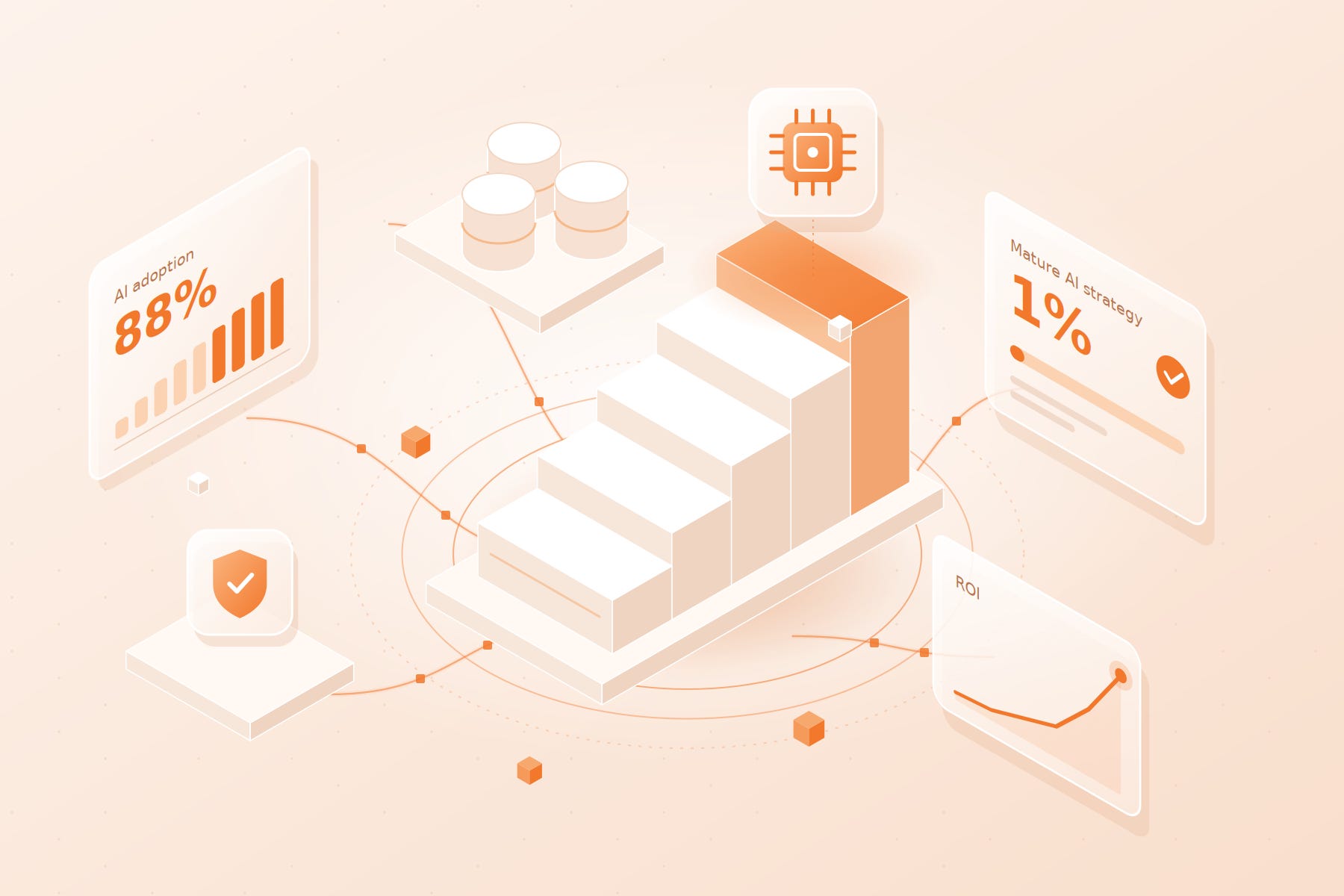
- Data product architecture determines how data is packaged, governed, and exposed to AI systems. Gartner projects 60% of AI projects will be abandoned through 2026 without AI-ready data, making architecture a prerequisite for ROI.
- AI deployments rarely fail because of bad algorithms; they fail due to brittle pipelines, missing domain ownership, and schema drift that breaks models without warning.
- A resilient architecture relies on stable consumption interfaces (APIs), explicit domain ownership, unified semantic layers, and real-time observability contracts.
- Treat data quality as an API design problem. Define versioned contracts and quality gates upstream before attempting to scale downstream AI models.
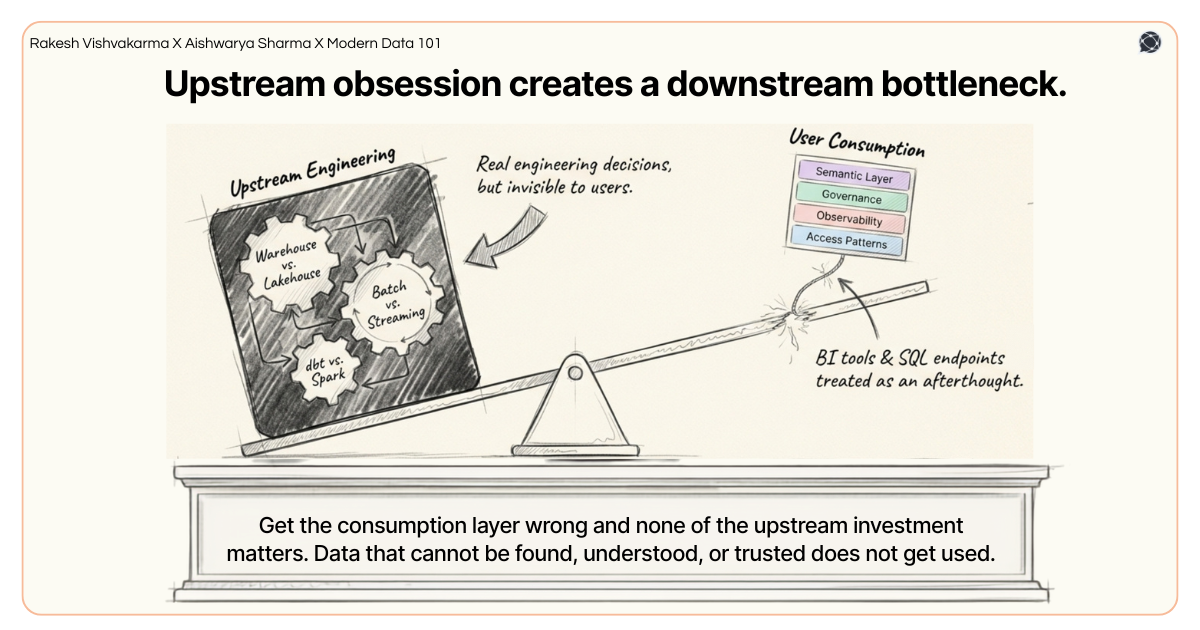
Six months into an enterprise AI deployment, the failure rarely traces back to the model. It leads to data that is inconsistent across domains, undocumented at the schema level, and too slow to reach the system that needs it. The architecture decisions behind that failure were made months earlier, in conversations that never included the AI team.
[related-1]
Data product architecture determines whether your AI systems can find the data they need, trust what they find, and act on it reliably. It is the structural precondition for everything that follows.
[playbook]
What Is Data Product Architecture
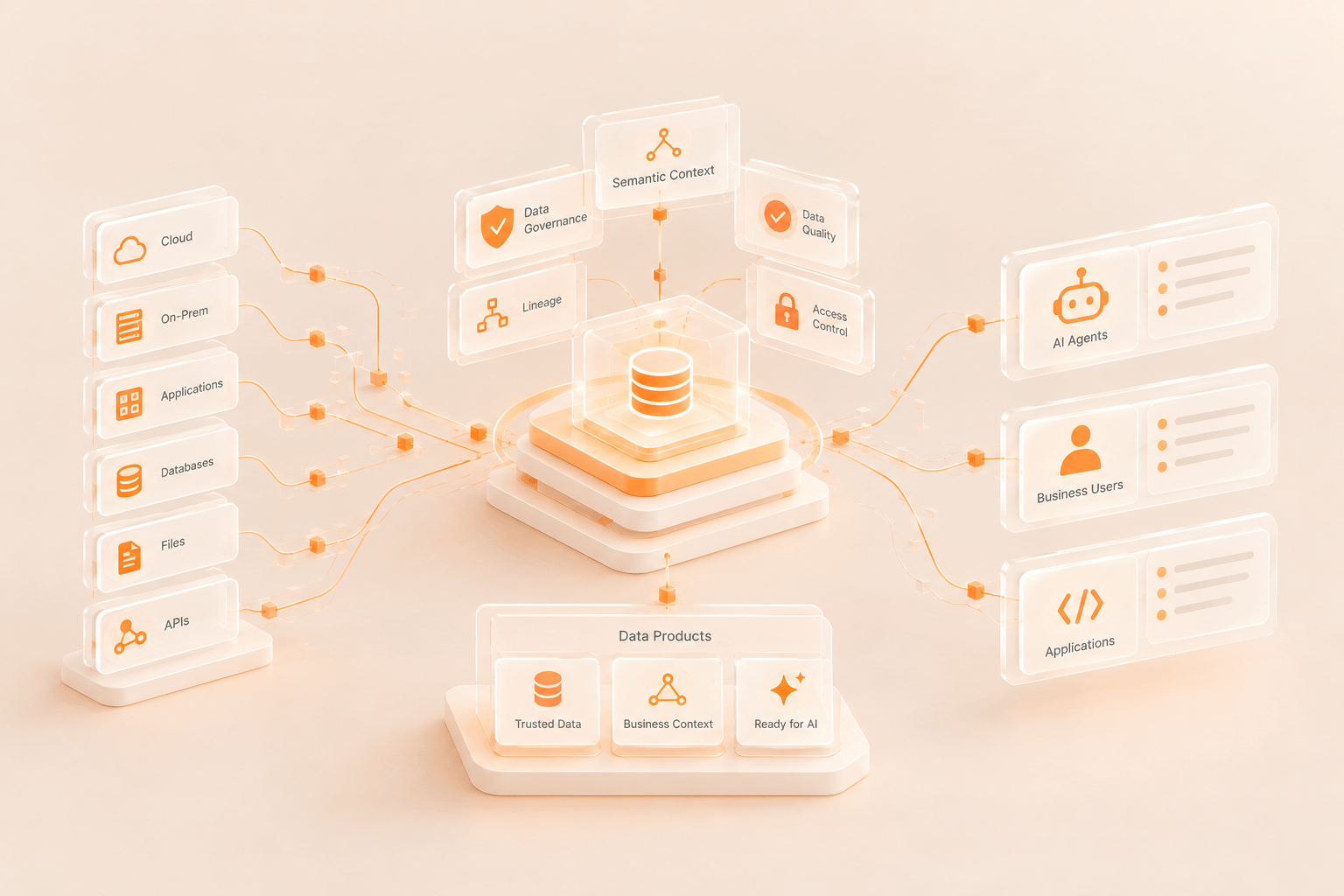
A data product is a discrete, governed unit of data, built for reuse, with a defined owner, documented schema, quality guarantees, and a consumption interface. Data product architecture is the system of decisions that determines how those units are structured, how they relate to each other, and how downstream systems access them.
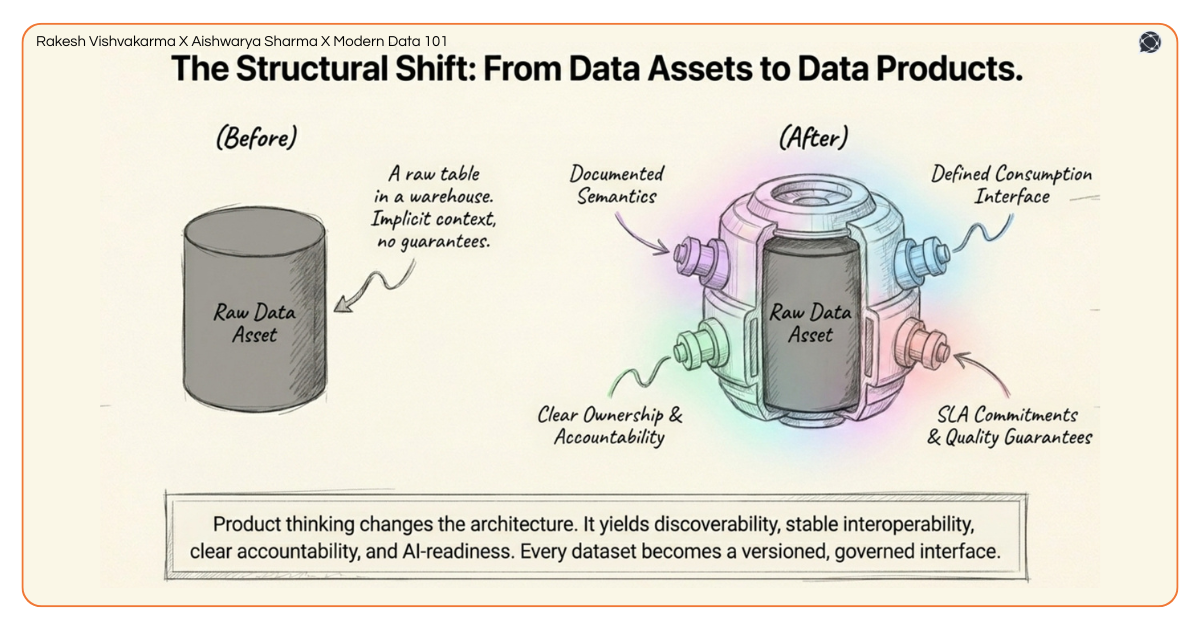
It is the foundational layer of any enterprise data management programme built to perform at AI scale. Key components:
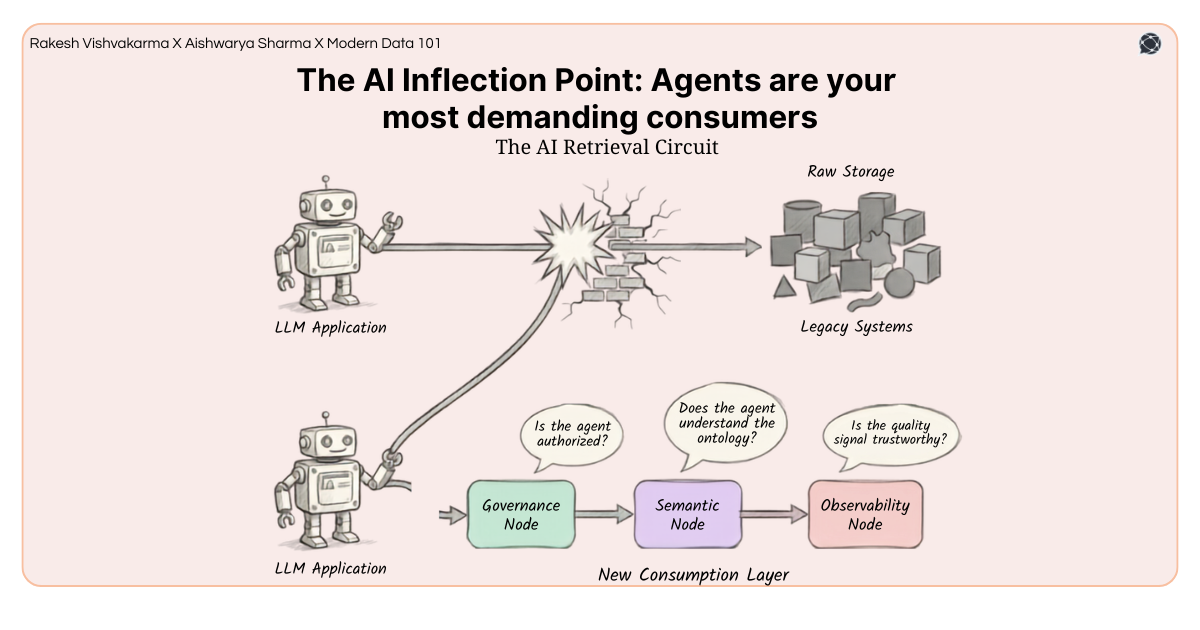
- The consumption interface: how data is exposed through APIs, event streams, or query endpoints. A stable, documented interface lets AI systems consume data without re-engineering on every schema change.
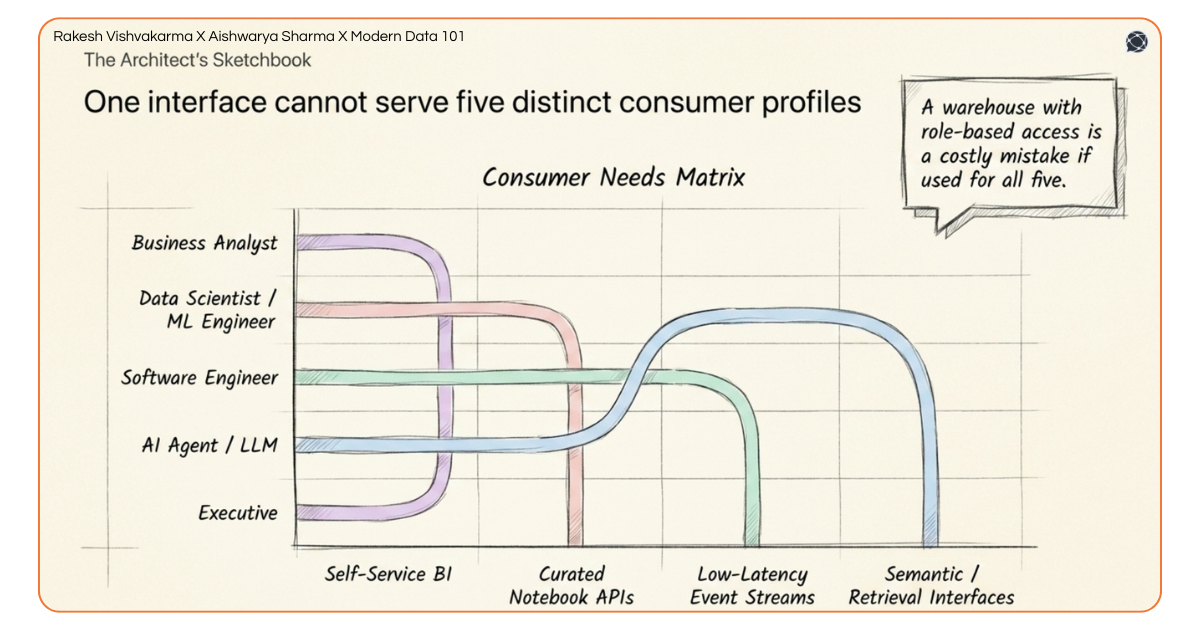
- The ownership and governance layer: who is accountable for quality, freshness, and access control. Without a named owner per product, governance becomes a centralised bottleneck or dissolves entirely.
- The semantic layer: the shared definitions that make data readable across domains. A customer ID that means different things in CRM and billing is an architecture problem, and AI systems queried across both domains inherit that inconsistency.
- The observability contract: the quality signals that tell consumers whether the product is trustworthy right now. For AI, that means metrics updated in hours, not quarterly audit cycles.
Why Enterprise Data Strategy Needs the Architecture Layer
McKinsey's 2025 State of AI survey identifies workflow redesign as a key success factor for AI high performers, alongside strong technology and data foundations for scaling AI and capturing enterprise-wide value.
That transformation starts at the data architecture layer. When domains publish governed data products with stable interfaces, AI systems gain a reliable foundation for cross-functional insights, one that matters as much as the models themselves.
[report-2025]
What are the 3 Architecture Decisions For Enterprise AI Solutions
Lakehouse, mesh, fabric: these are enterprise data platform decisions. What actually determines enterprise AI solutions is organisational.
Centralised vs domain-owned production:
Who creates data products: a central platform team, or the domain that understands the data? Most enterprises need a hybrid: centralised standards, domain execution.
Static schemas vs versioned contracts:
AI systems break when schemas change without notice. Treating the consumption interface as a versioned contract with deprecation policies separates a stable AI pipeline from a brittle one.
Reactive quality vs embedded quality gates:
Embedding automated quality gates into the delivery pipeline shifts quality left, removing a major source of AI failure at the data layer. Reporting-cadence checks aren't enough for AI workloads.
[related-2]
What Data Quality Means in Enterprise Data Strategy
The standard advice tells data leaders to invest in data quality before deploying AI. That framing is incomplete: data quality work without an architecture to contain it is remediation on a treadmill, fixing one inconsistency while another propagates through a different pipeline.
The more precise framing treats data product architecture as an API design problem: define the interface first, enforce the contract, then build the models that consume it. Organisations that sequence it this way build enterprise data platforms where domain teams publish governed, versioned data products independently, outlasting any single system built on them.
FAQs
What is data product architecture in the context of enterprise AI?
Data product architecture defines how data is packaged, owned, and exposed to consumers, so enterprise AI systems can reliably access trusted, documented data instead of raw, ungoverned tables. Without it, model performance is capped by the underlying data layer's quality, regardless of how sophisticated the model is.
How does data product architecture differ from enterprise data warehouse architecture?
Enterprise data warehouse architecture is built for storage and reporting, optimised for BI dashboards and scheduled queries. Data product architecture packages data for reuse across AI, analytics, and applications, with clear ownership, documented schemas, and quality contracts attached to every unit.
Why do enterprise AI failure rates trace back to data architecture?
Without clear ownership, stable interfaces, and quality controls, AI models receive inconsistent data and produce unreliable results that no amount of model tuning can fix. The enterprise AI failure rate traces back to data architecture far more often than to the model itself.
What is the role of a semantic layer in data product architecture?
A semantic layer keeps definitions, identifiers, and business logic consistent across every data product in the organisation. Every consumer, human or AI, works from the same interpretation of the data, one of the fundamentals of software architecture applied directly to the enterprise data layer.
You've read the argument for the interface. Here's what building one actually looks like: Complete guide to data products.
Connect with a community data expert
A no-cost session with a practitioner who's been where you are.
About Modern Data 101
Modern Data 101 is a movement redefining how the world thinks about data. A community built by the same team behind the world’s first data operating system, Modern Data 101 sits at the intersection of data, product thinking, and AI. Spread across 150+ countries, the community brings together a global network of practitioners, architects, and leaders who are actively building the next generation of data systems.
At its core, Modern Data 101 exists to simplify the journey from raw data to tangible and observable impact. It advocates high-potential data systems and next-gen architectures to unify and activate insights and automation across analytics, applications, and operational workflows at the edge.
In a world shifting from data stacks to AI ecosystems, Modern Data 101 helps teams not just navigate the change but lead it.


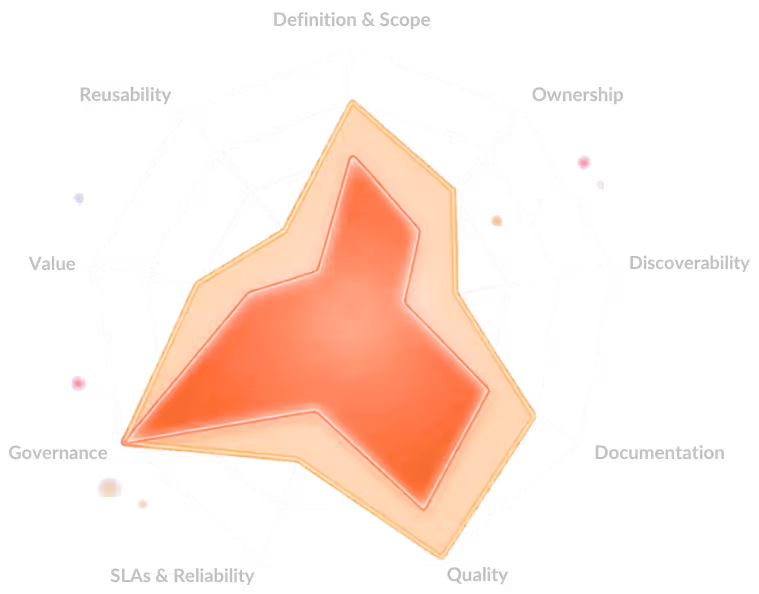
A 9-dimension self-assessment used by 100+ data teams to benchmark strategy, ownership, and platform readiness.


Rakesh Vishvakarma
Rakesh is a data engineer who transforms raw data into fine wine. When he's not using AI to tag tables or make spot-on recommendations, he's deep into philosophical books or ones with more twists than his latest ETL pipeline, pondering existence and data governance.

Aishwarya Sharma
Aishwarya is a Senior Analytics Engineer at The Modern Data Company, focused on building end-to-end data solutions that bridge engineering and analytics. He works across data pipelines, modelling, and visualisation to deliver reliable, business-ready insights, combining strong technical expertise with a practical, problem-solving approach to modern data systems.
Read the ideas here. Build them with The Modern Data Company.
Modern Data 101 is where the data community thinks out loud. When you're ready to move from articles to architecture, data products, governed AI pipelines, or a full Data Operating System; the team behind this community can help you build it.
Continue reading