What Is MLOps? 2026 Enterprise Guide to Scaling Production AI
Master the essentials of modern Machine Learning Operations, from feature stores and model monitoring to cross-functional governance and platform evaluation.

TL;DR
- The Core Problem: Up to 87% of data science projects never make it into production due to manual workflows, fragmented tools, and a lack of standardised operations between data science and IT teams.
- What MLOps Solves: Machine Learning Operations (MLOps) applies software engineering discipline (CI/CD, version control, automated monitoring) to the machine learning lifecycle, reducing deployment timelines from months to days.
- The 6 Core MLOps Pillars: To bridge this gap, modern MLOps unifies the AI lifecycle by combining unified versioning (code, data, and lineage), automated CI/CD pipelines, enterprise feature stores to avoid training-serving skew, real-time observability for data drift, rigorous governance trails, and cross-functional collaboration between data science and IT teams.
What Is MLOps: Why Does It Matter in 2026?
Machine learning models often fail in production. That gap between a model that performs well in a notebook and one that delivers consistent value in a live system is exactly what MLOps is designed to close.
MLOps applies DevOps principles to the ML lifecycle, spanning data preparation, model training, deployment, monitoring, and retraining. As AI adoption scales across industries, organisations that skip MLOps discipline pay the price in model degradation, compliance gaps, and engineering bottlenecks.
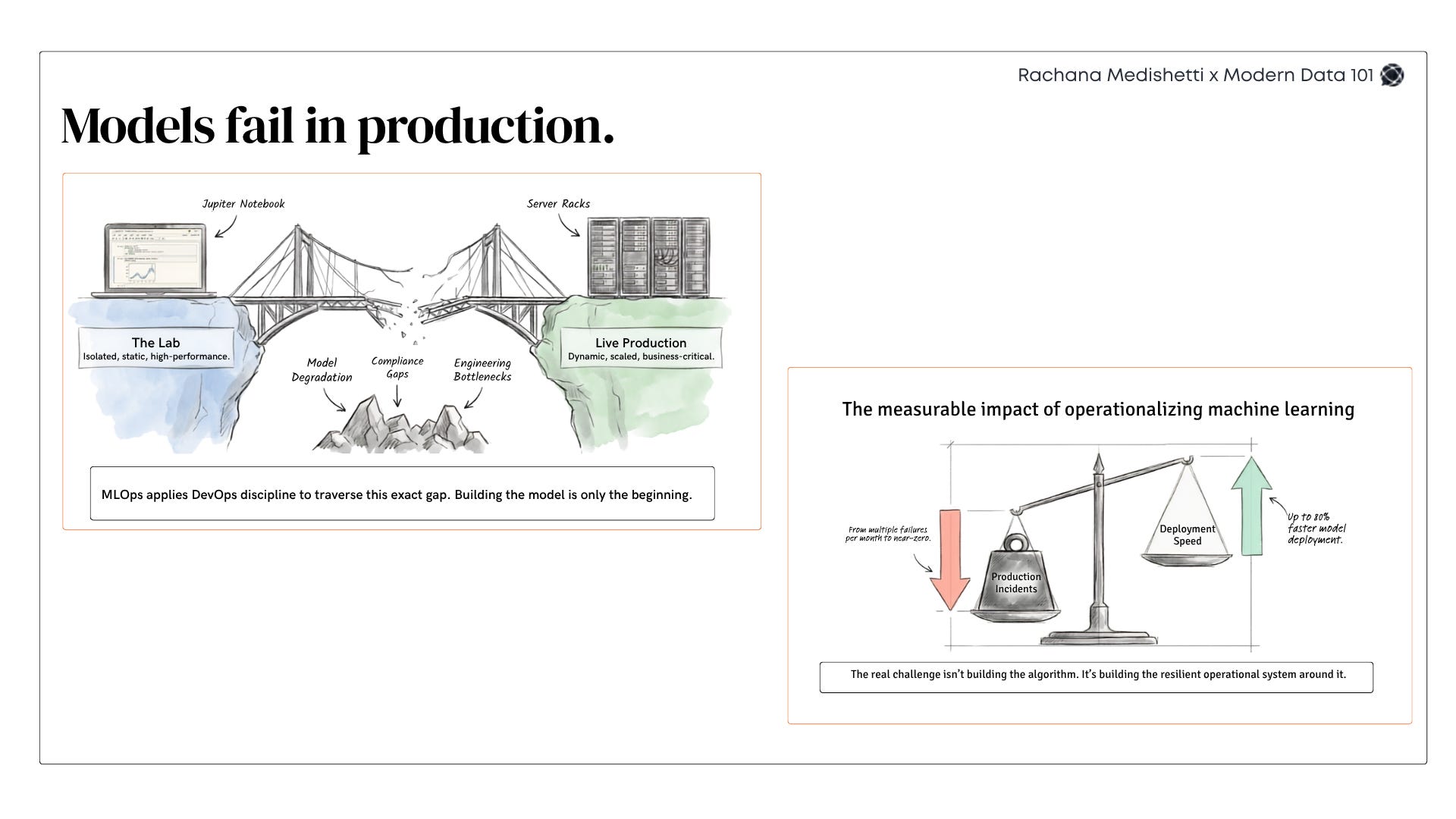
The stakes are measurable. Companies that implement robust MLOps frameworks report significantly faster model deployment and a dramatic reduction in production incidents, from multiple failures per month to near zero. Yet for most teams, the real challenge isn’t building the model. It’s building the operational system around it.
This guide covers the MLOps best practices that matter most, drawn from top-ranked industry resources, and academic research.
6 MLOps Best Practices for High-Velocity Data Teams
1. Version Everything Code, Data, and Models
The first principle of sound MLOps: treat code, data, and models as first-class versioned artefacts.
Git handles code. But data is where most teams fall short. Without data versioning, experiments become irreproducible, the “it worked on my machine” problem that quietly undermines AI credibility. Tools like DVC (Data Version Control) pair with Git to create a complete audit trail: which dataset trained which model, at which point in time. MLflow or Weights & Biases then closes the loop on model registry and experiment tracking.
This isn’t optional for teams operating at scale. A systematic literature review on MLOps best practices published in Information and Software Technology (2025) identifies version control across all ML artefacts as among the most consistently validated practices across the academic literature.
[related-1]
2. Automate CI/CD for Machine Learning Pipelines
If a model update requires manual intervention at any stage, it’s already a bottleneck.
Continuous Integration and Continuous Deployment (CI/CD) for ML pipelines means every code or data change triggers automated testing, validation, and deployment. This is distinct from software CI/CD; ML pipelines must validate not just code correctness, but also model performance, data schema integrity, and fairness constraints before anything reaches production.
A well-structured CI/CD pipeline for ML covers automated unit and integration testing, model performance gating (challenger vs champion comparisons), containerised packaging via Docker and Kubernetes, and staged rollout with blue-green or canary deployment strategies.
For teams building on the data product platforms, it provides native orchestration capabilities that integrate ML pipeline automation with broader data product workflows, removing the need to stitch together disparate CI/CD tools.
3. Use a Feature Store to Prevent Training-Serving Skew
Training-serving skew is the silent killer of production ML. It happens when the features used at inference time differ, even subtly, from those used during training. The result is a model that performed well in the lab and underperforms in production, with no obvious error to surface.
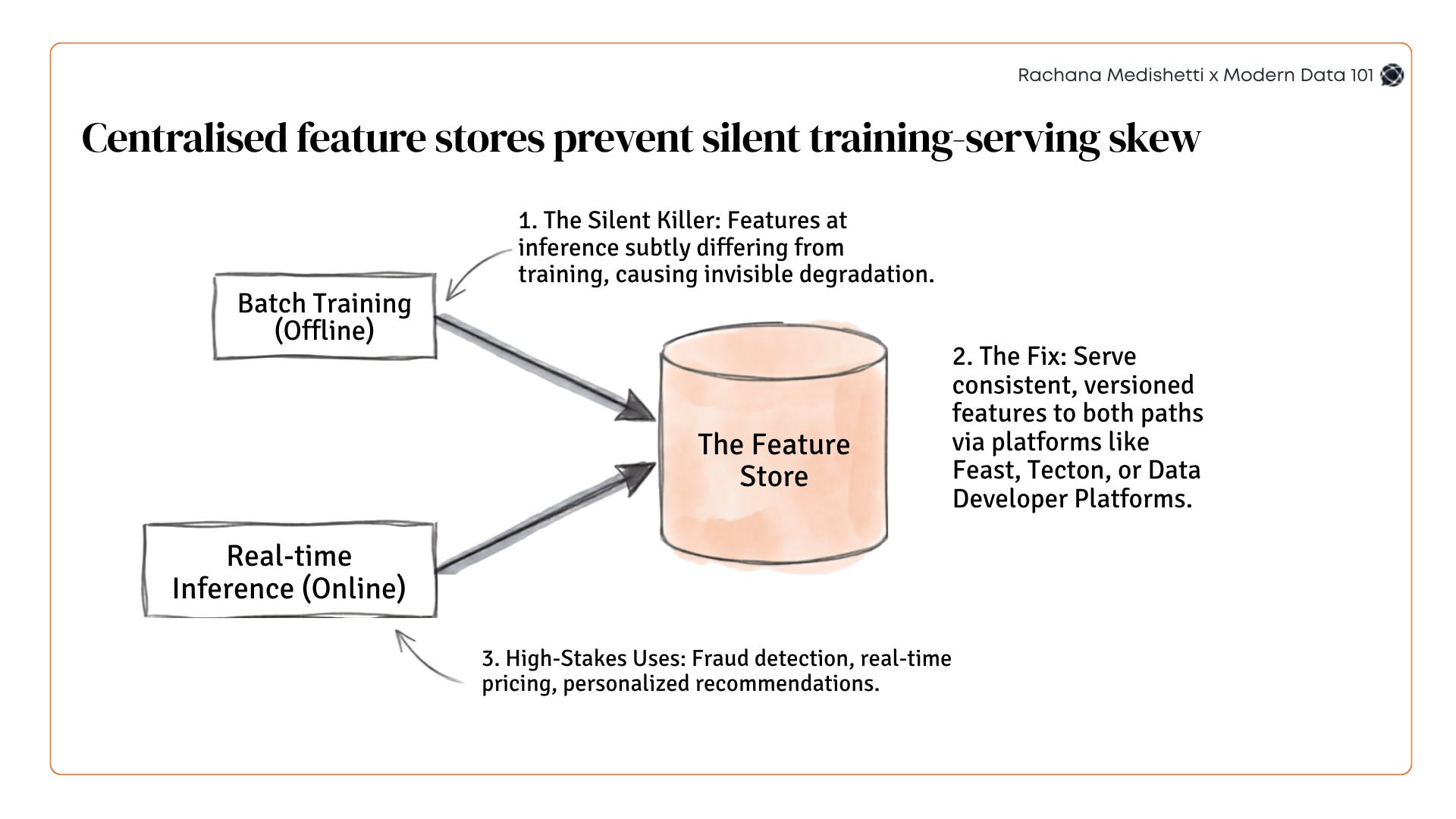
A feature store solves this by centralising feature computation and serving consistent, versioned features across both training and inference paths. Several market tools purpose-built for this; platforms built around the Data Developer Platform specification can integrate feature management natively into the broader data infrastructure.
This is particularly critical for high-frequency use cases like fraud detection, personalised recommendations, and real-time pricing, where stale or inconsistent features directly translate to business risk.
4. Monitor Models and Data in Production
Deployment is not the finish line. It is where the real work begins.
Production monitoring in MLOps covers two overlapping concerns: model drift, degradation in predictive accuracy as real-world conditions shift, and data drift, changes in the statistical distribution of input features over time. Both erode model value gradually, and often silently, unless monitoring systems are actively watching for them.
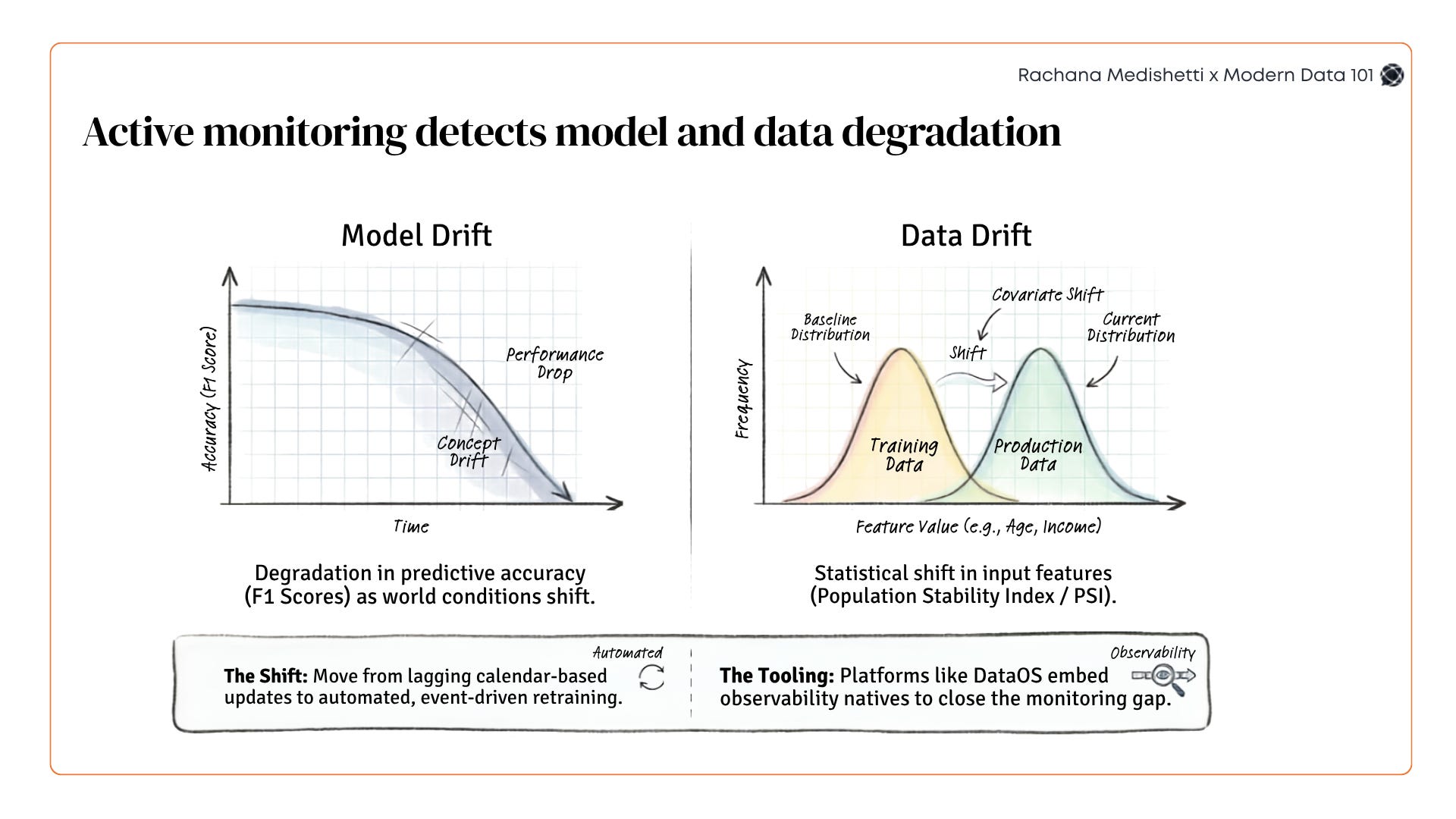
Key metrics to track: accuracy and F1 scores, Population Stability Index (PSI) for feature drift, prediction distribution shifts, and inference latency. Multiple data platforms embed monitoring natively into the data and ML pipeline layer, reducing the observability gap that plagues teams relying on ad hoc tooling.
The retraining trigger question, when to retrain, not just whether to, is a strategic one. Automated, event-driven retraining workflows are increasingly the standard for production-grade MLOps, replacing calendar-based schedules that lag behind real-world data changes.
5. Implement Governance, Lineage, and Compliance from Day One
As AI systems touch regulated industries- finance, healthcare, public sector, MLOps governance is no longer optional. Model lineage (tracking exactly what data, code, and configuration produced a given model), explainability, and audit trails are prerequisites for responsible AI deployment.
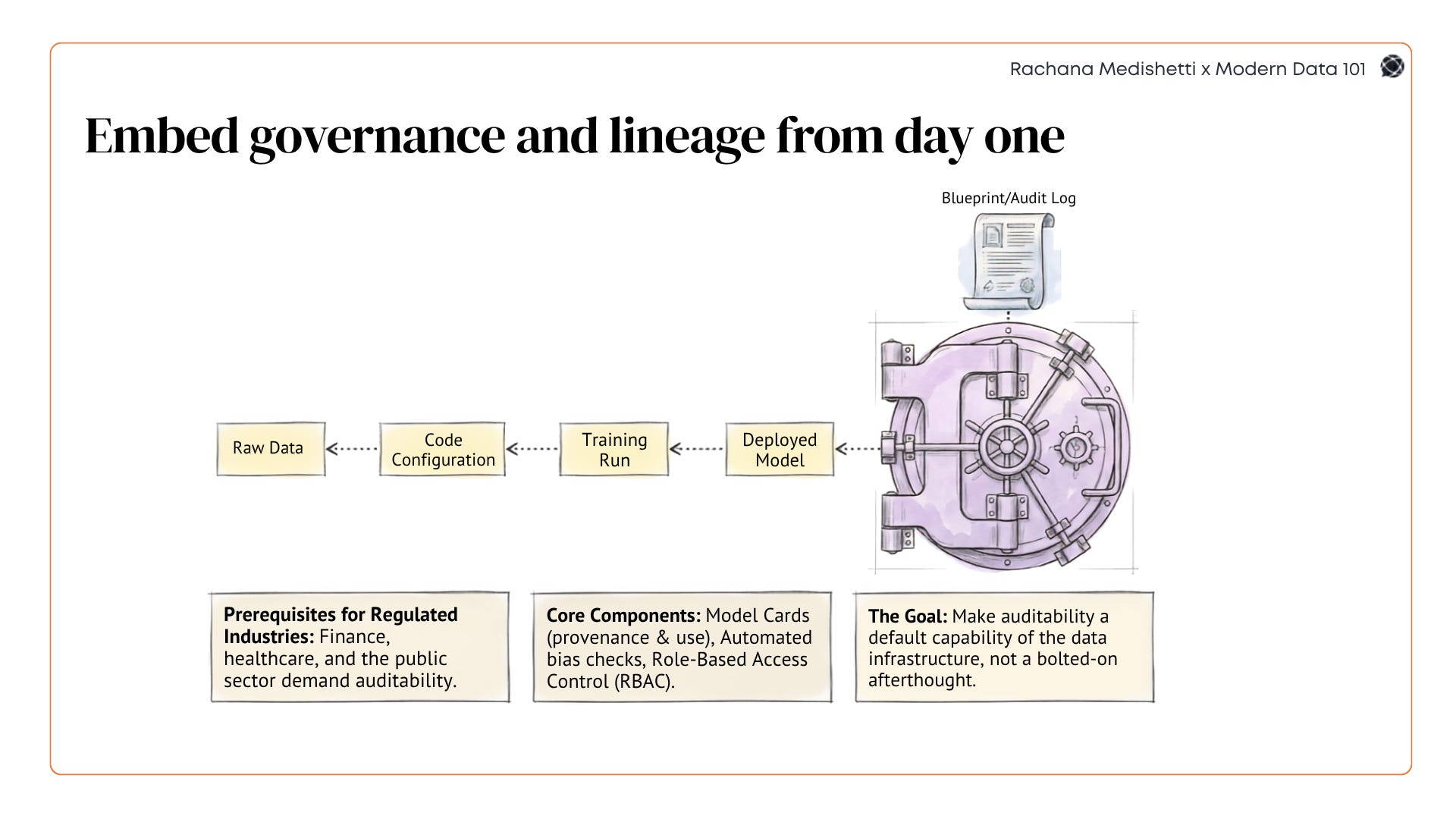
Governance-ready MLOps frameworks typically include model cards documenting training data provenance and intended use, automated bias and fairness checks within CI/CD gates, role-based access control on model registries, and compliance-ready audit logs for every training run and deployment.
The Data Developer Platform specification offers an open framework for embedding governance into data and ML infrastructure at the platform level, making auditability a default, not an afterthought.
6. Build for Collaboration
MLOps is as much a cultural practice as a technical one. The most common failure mode is the organisational wall between data scientists who build models and engineers who deploy them.
Effective MLOps requires shared ownership of the full ML lifecycle. Data scientists need to write production-grade code. Engineers need to understand model behaviour. Operations teams need visibility into model health. Standardised containerised environments, shared experiment tracking dashboards, and unified data platforms are the infrastructure that makes this collaboration possible at scale.
A data product platform leverages an approach to unified data infrastructure reflects this principle directly: the goal is a single operational environment where every team, from data engineering to data science to BI, works from the same trusted, governed layer.
Evaluating MLOps Tools and Platform Maturity
MLOps implementation follows a maturity arc. Level 0 is manual and ad hoc, no CI/CD, no monitoring, script-driven deployments. Level 1 introduces pipeline automation and version control, enabling continuous training on new data. Level 2 is full CI/CD with automated testing, model validation, active monitoring, and drift detection.
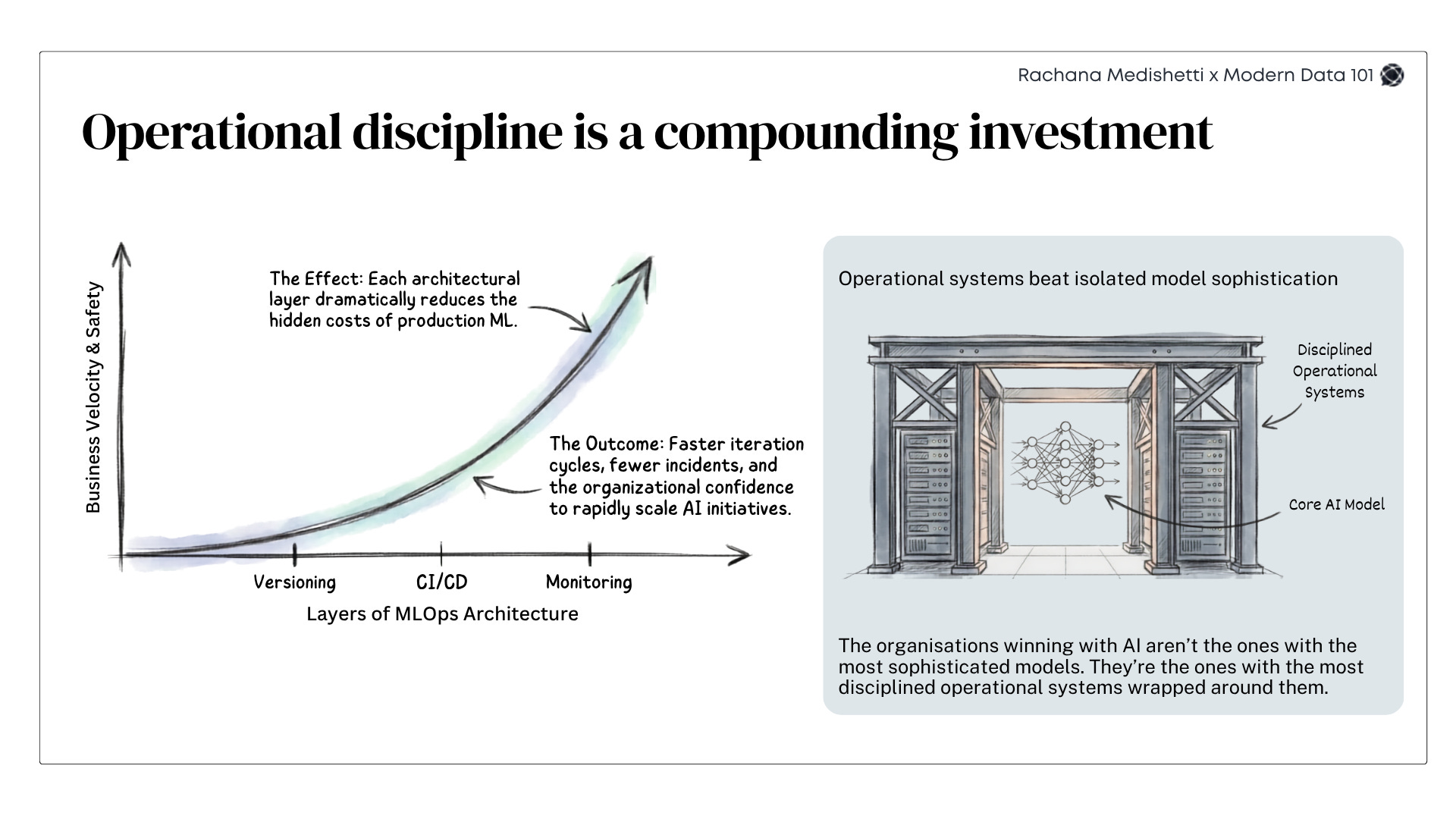
Most enterprise teams sit between Level 0 and Level 1. Reaching Level 2 is where compounding returns begin: faster iteration cycles, fewer production incidents, and the organisational confidence to scale AI initiatives.
The Bottom Line: Moving from Experimental AI to Operational Scale
MLOps best practices are a compounding investment. Each layer, from version control to CI/CD to monitoring to governance, reduces the hidden cost of production ML and increases the velocity at which teams can safely ship improvements.
The organisations winning with AI aren’t the ones with the most sophisticated models. They’re the ones with the most disciplined operational systems wrapped around those models. For teams building on the modern data stack, the path forward runs through platforms designed with MLOps as a first-class concern.
FAQs
Q1: What are MLOps principles?
MLOps rests on four core principles: automation of the ML lifecycle (from data ingestion to deployment), continuous integration/continuous delivery adapted for models and data (not just code), reproducibility through versioning of data, code, and model artifacts, and continuous monitoring of both model performance and data quality in production. Underlying all four is collaboration: MLOps only works when data scientists, engineers, and operations teams share ownership of outcomes rather than handing off across a wall.
Q2: What are MLOps best practices?
Key best practices include automating testing and validation at every pipeline stage, using a feature store to eliminate training-serving skew, gating deployments with champion-challenger performance comparisons, containerising environments for consistency across training and serving, and monitoring for model and data drift with automated retraining triggers rather than fixed schedules. Teams that treat these as a connected system, not isolated tools, see the fastest maturity gains.
Q3: What does an MLOps lifecycle diagram typically show?
An MLOps lifecycle diagram typically maps a closed loop: data ingestion and validation, feature engineering, model training, model validation and testing, deployment (often staged via canary or blue-green rollout), and production monitoring, which feeds signals like drift detection back into retraining. The loop is circular by design; production monitoring output is what triggers the next training cycle rather than the process ending at deployment.
Q4: What three things are typically included in an MLOps process?
Most definitions converge on three pillars: continuous integration and delivery (automated testing, validation, and deployment of code, data, and models), continuous training (automated retraining as new data or drift signals arrive), and continuous monitoring (tracking model performance, data quality, and infrastructure health in production). Some frameworks split this into more stages, but these three represent the practice's essential loop.
Connect with a community data expert
A no-cost session with a practitioner who's been where you are.
About Modern Data 101
Modern Data 101 is a movement redefining how the world thinks about data. A community built by the same team behind the world’s first data operating system, Modern Data 101 sits at the intersection of data, product thinking, and AI. Spread across 150+ countries, the community brings together a global network of practitioners, architects, and leaders who are actively building the next generation of data systems.
At its core, Modern Data 101 exists to simplify the journey from raw data to tangible and observable impact. It advocates high-potential data systems and next-gen architectures to unify and activate insights and automation across analytics, applications, and operational workflows at the edge.
In a world shifting from data stacks to AI ecosystems, Modern Data 101 helps teams not just navigate the change but lead it.


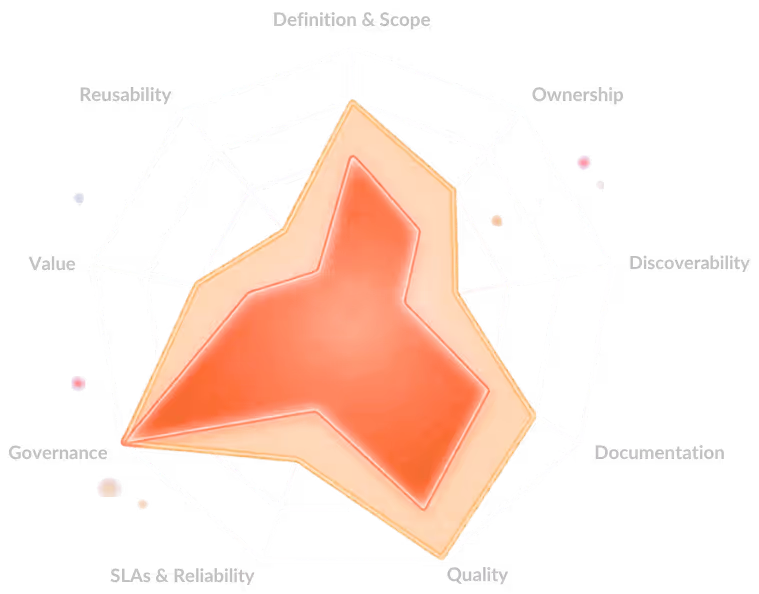
A 9-dimension self-assessment used by 100+ data teams to benchmark strategy, ownership, and platform readiness.


Rachana Medishetti
Rachana is a data engineer with 5+ years of experience with a deep passion for how businesses leverage data, focusing on building end-to-end data systems, from ingestion and pipelines to analytics. She is skilled in PySpark, SQL, Python, and Snowflake, focused on turning data into reliable, real-world business value.
Read the ideas here. Build them with The Modern Data Company.
Modern Data 101 is where the data community thinks out loud. When you're ready to move from articles to architecture, data products, governed AI pipelines, or a full Data Operating System; the team behind this community can help you build it.
Continue reading