
What is Shift Left Testing and Why is It Critical for DevOps Success?
A practical guide to embedding quality earlier in your development lifecycle, and why the cost of waiting is higher than you think.

For much of software development’s early history, testing wasn’t even a distinct discipline. Developers built software, tested it themselves, and shipped it. Over time, as systems grew more complex and production defects began costing teams significant time and money, a formal testing phase emerged, but it sat firmly at the end of the development pipeline, right before deployment.
Now imagine the software development lifecycle as a timeline running from left (requirements/planning) to right (release/production). Traditionally, testing only happened at the far right, just before launch. This caused major problems: bugs discovered late are expensive and time-consuming to fix, releases get delayed, and teams end up in firefighting mode.
Research from the Ponemon Institute drives this home starkly: vulnerabilities detected in the early development process may cost around $80 on average, but the same vulnerabilities may cost around $7,600 to fix if detected after they have moved into production.

Shift Left simply means moving testing earlier in the lifecycle, to the left of that timeline. Instead of testing being a final checkpoint, it becomes a continuous activity woven into every stage of development, starting from requirements gathering itself.
[playbook]
What is Shift-Left Testing
Shift left testing refers to a software quality philosophy that repositions testing from a final gate before release to a continuous, collaborative practice woven throughout every stage of the development lifecycle. Rather than treating quality as a checkpoint, it treats it as a shared responsibility, one that begins the moment requirements are conceived and evolves through design, development, and deployment.

This late-stage testing model was formalised under the waterfall methodology, where requirements, design, development, and testing occurred as sequential, linear phases.
[related-1]
Why is Shift-Left Approach in DevOps Important?
Shift-Left testing moves quality assurance earlier in the software development lifecycle, identifying problems when they're cheapest and easiest to fix, rather than after they've been baked into the product. Following are the benefits of shift left:
- Lower Cost of Defects. Bugs identified and fixed early are far less expensive to address than those discovered after deployment. The cost of fixing a defect grows exponentially the later it’s identified; a flaw caught in design costs a fraction of what it takes to remediate in production.
- Faster Feedback Loops. By embedding tests directly into the CI/CD pipeline, developers get near-instant feedback on code quality. This tight loop means issues surface within minutes of being introduced, not days or weeks later when context has been lost, and the fix is harder to scope.

- Higher Software Quality. Because bugs are resolved before they can impact users, the overall application becomes more reliable and stable. Fewer defects reaching production means less firefighting, fewer hot fixes, and a better end-user experience.
- Faster Time to Market. With defects reduced and the development process optimised, teams can iterate faster and release software continuously. When testing doesn’t pile up at the end of a cycle, releases become predictable and frequent rather than stressful and delayed.
- Stronger Collaboration. Shift-left breaks down the traditional wall between developers and QA. When testing is everyone’s responsibility from day one, teams develop shared ownership of quality, and engineers naturally write more testable, well-structured code.
[data-expert]
Best Practices for Shift-Left Testing
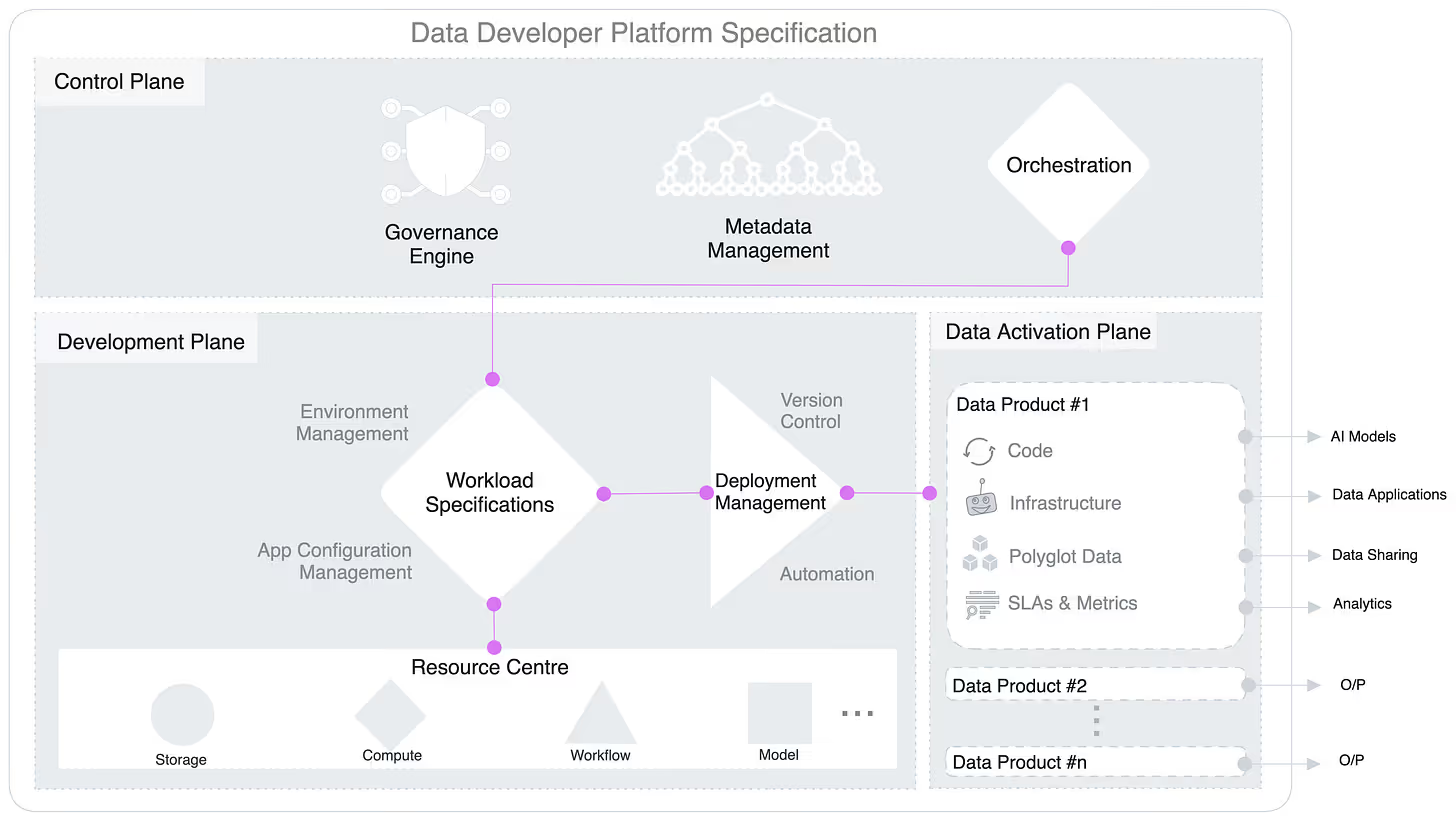
In traditional data engineering, quality checks happen late, after pipelines are built and consumers have already been impacted by bad data. This mirrors the classic "shift right" problem in software development, where testing is an afterthought rather than a foundation. As we onboard data developer platforms and data product platforms, we are now able to garner a structural solution by embedding shift-left principles directly into how data is built, governed, and delivered.
The following are best practices for implementing shift left approach in devops, enabled by data developer platforms.
Define Quality expectations upfront, not downstream
Shift-left testing demands that acceptance criteria be written before code is developed, and data and devops teams should define quality expectations before pipelines are built. Data developer platforms enable this through data contracts and SLO (Service Level Objective) monitoring, ensuring that what “good data” looks like is agreed upon at design time, not discovered after consumers have been burned.

Follow a structured product lifecycle
Ad-hoc pipeline development leads to the “build first, fix later” trap. Instead, treat data like a product with a formal lifecycle. A data developer platform structures this as four phases: Design, Develop, Deploy, and Iterate, starting with translating business goals into architecture before a single transformation is written. Quality and testing are built into each phase, not layered on at the end.
Apply software engineering best practices to data
Data pipelines should be treated with the same rigour as application code. Data developer platform brings an artefact-first approach with full Git integration, making data products versionable, reviewable, and auditable. This enables practices like peer code review, automated validation on every commit, and safe rollbacks, disciplines that software teams have used for years to catch issues early.
Build for Discoverability and Reuse to Prevent Quality Debt
When every team builds its own version of the same dataset, quality becomes inconsistent and untested variants proliferate. Data developer platforms make data products discoverable and reusable across teams, so the same trusted, validated data asset serves analytics, marketing, finance, and AI use cases, eliminating redundancy and the quality debt that comes with it.
Embedded Governance
Embedded governance scales effortlessly across data products, ensuring consistency and trust from source to consumption. Rather than governance being a downstream audit, it's baked into the product structure itself, a textbook shift left move.
[related-2]
The Shift Left + Shift Right Unified View
Both approaches of testing are often not pure antonyms. Rather shift right and shift left are 2 sides of a coin, like two halves of a continuous feedback loop. As organisations modernise their application stacks around cloud-native constructs like micro services and containers, a best practice is to adopt both shift left and shift right strategies.
Shift left testing reduces software defects and speeds up time to market, while shift right testing better ensures reliability in production by testing under real-world conditions.
In a Nutshell
Shift-left testing requires a mindset shift today. The core idea is simple: the earlier you find a problem, the cheaper and faster it is to fix. What once might cost $60 to resolve earlier in the development cycle, can balloon to $6000 by the time it reaches production (hypothetical numbers). That delta alone makes the case.
A shift left strategy focuses on quality from a final checkpoint to a continuous, shared responsibility. It breaks down silos between developers, testers, and stakeholders; it integrates testing into every stage of the lifecycle from requirements to release; and it transforms CI/CD pipelines into real-time quality radars rather than delivery conveyors.
The benefits compound over time. Teams that embed shift-left practices consistently ship faster, spend less on rework, and build software that simply works better for end users.
As data teams adopt developer platform principles, contracts, versioning, and governance-by-design, the same quality-first culture that transformed application development will reshape how data products are built and trusted.
The Shift-Left + Shift-Right loop will become the standard. Leading organisations won’t choose between the two; they’ll use Shift-Left to prevent defects and Shift-Right to validate resilience under real-world conditions, creating a closed-loop quality system across the entire lifecycle.
FAQs
Q1. What are the types of shift left testing?
There are four primary types: Unit Testing, Integration Testing, API/Contract Testing, and UI Testing. Each targets a different layer of the application and is applied progressively as development moves forward.
Q2. How to measure shift left testing success?
Five metrics that help measure:
- Defect Escape Rate, fewer bugs reaching production over time
- Defect Detection Distribution, more bugs caught early in the lifecycle, fewer in production
- Mean Time to Detect (MTTD), issues surfacing in minutes, not days
- Early-Stage Test Coverage, growing unit, and integration test coverage signals testing is embedded, not bolted on
- Cost Per Defect, a drop in average remediation cost, confirms that defects are being fixed at the cheapest possible point
Q3. What is shift left code quality?
Shift-Left code quality means embedding code quality checks, such as static analysis, linting, and code reviews, early in the development process, before code is merged or tested. Rather than catching poor code quality late in QA or production, developers get immediate feedback on maintainability, security vulnerabilities, and coding standards right in their IDE or at the point of commit. The goal is simple: make quality a development habit, not a downstream audit.
Connect with a community data expert
A no-cost session with a practitioner who's been where you are.
About Modern Data 101
Modern Data 101 is a movement redefining how the world thinks about data. A community built by the same team behind the world’s first data operating system, Modern Data 101 sits at the intersection of data, product thinking, and AI. Spread across 150+ countries, the community brings together a global network of practitioners, architects, and leaders who are actively building the next generation of data systems.
At its core, Modern Data 101 exists to simplify the journey from raw data to tangible and observable impact. It advocates high-potential data systems and next-gen architectures to unify and activate insights and automation across analytics, applications, and operational workflows at the edge.
In a world shifting from data stacks to AI ecosystems, Modern Data 101 helps teams not just navigate the change but lead it.


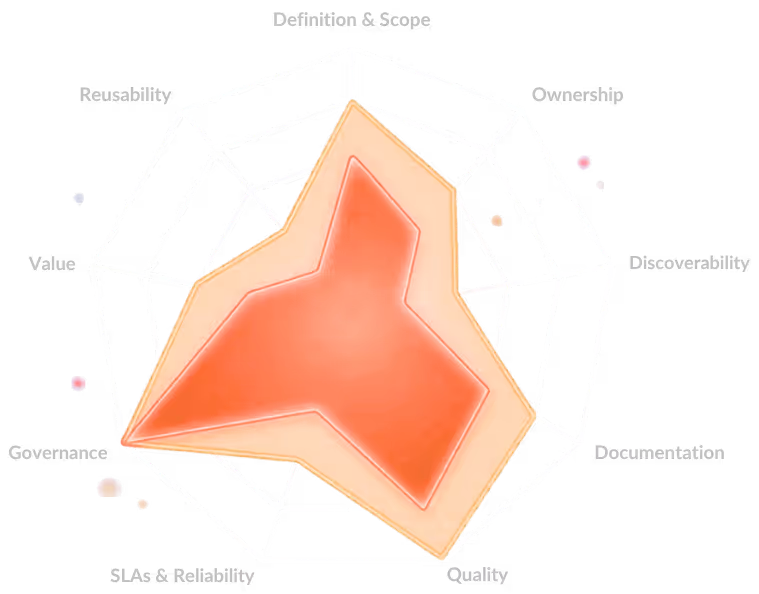
Where does your org stand on data product maturity?
A 9-dimension self-assessment used by 100+ data teams to benchmark strategy, ownership, and platform readiness.




Rakesh Vishvakarma
Rakesh is a data engineer who transforms raw data into fine wine. When he's not using AI to tag tables or make spot-on recommendations, he's deep into philosophical books or ones with more twists than his latest ETL pipeline, pondering existence and data governance.

Ritwika Chowdhury
Ritwika is part of Product Advocacy team at Modern, driving awareness around product thinking for data and consequently vocalising design paradigms such as data products, data mesh, and data developer platforms.
Read the ideas here. Build them with The Modern Data Company.
Modern Data 101 is where the data community thinks out loud. When you're ready to move from articles to architecture, data products, governed AI pipelines, or a full Data Operating System; the team behind this community can help you build it.
Continue reading
.png)

.png)

%20(1).png)
