Why Inaction Feels Easier Than Action in Data Quality
The latent signals of inaction, the business awakening curve, and the mindset shift.

When it comes to Data Quality, there is a standard piece of advice: “The business side must own the data.” We are told that every data initiative needs to be tied to a business use case, and the business should own the data issues.
While true, this advice often fails to solve the real problem. Why? Because simply telling a business leader that data quality matters doesn’t automatically make them want to fix it.
Knowing something is important is different from doing something about it. Action is hard.
It feels uncertain, disruptive, and uncomfortable. Inaction, on the other hand, feels safe. Here is why your organization might be stuck in a cycle of inaction, and how to break free.
[playbook]
The Comfort of “Just How We Do Things”
In many companies, ignoring data issues isn’t a malicious choice. It’s a coping mechanism. When leaders don’t fix known data problems, the organization finds ways to survive around them.
- Workarounds become standard procedure.
- Broken processes get patched with quick fixes instead of repairs.
- Data teams stop raising flags to avoid awkward conversations.
Slowly, a dangerous narrative takes over: “This is just how it works around here.”
This is Cultural Inertia.
It happens when legacy mindsets (“we’ve always done it this way”) and decision fatigue collide. It’s safer to do nothing than to expose flaws in a process or risk being blamed for a problem.
The Latent Signals of Inaction
Inaction doesn’t always look like a dramatic failure. It is usually quiet, slow, and embedded in the daily routine. You might recognize it in scenarios like these:
- The “Cleanup” Delay: A monthly report takes two weeks to publish. Not because the analysis is hard, but because someone spends ten days manually fixing the data.
- The “Shadow” Expert: An executive doesn’t trust the official dashboard. Instead, they ask for a report from “Steve in Finance” because he’s the only one who knows how to filter out the errors.
- The Stalled Launch: A project is delayed because no one can agree on which dataset is the “real” one, and not because the strategy is bad.
- The Excel Trap: Your highest-paid analysts spend 60% of their time acting as janitors, cleaning rows in spreadsheets.
When you live with broken data for too long, it becomes normal. You stop fighting the bad data and start fighting the culture that accepts it.
How to Shift the Mindset: The Business Awakening Curve
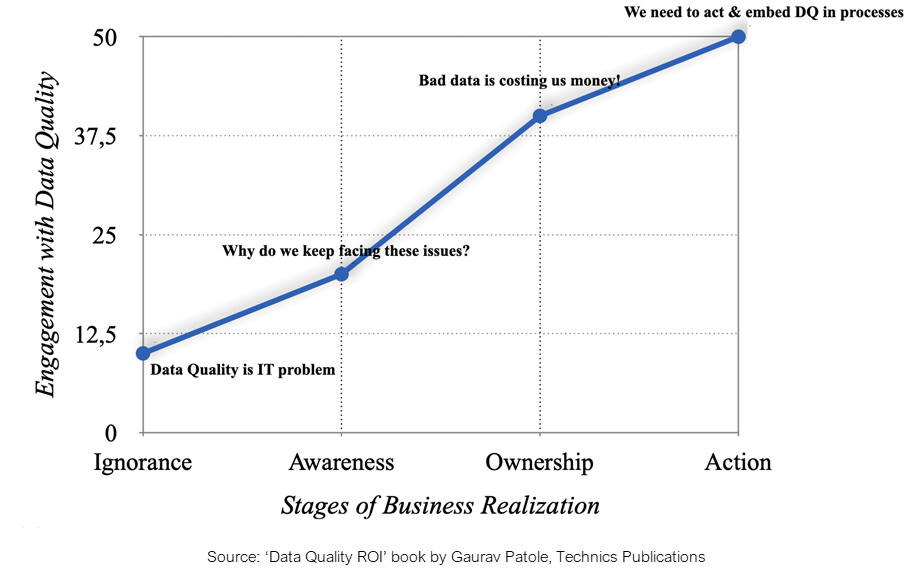
To move from inaction to action, you can’t just implement a new tool.
You have to guide your stakeholders through a psychological journey.
I call this The Business Awakening Curve. It is not a technical maturity model, but a human one. It tracks how a business evolves from detachment to total ownership.
[data-expert]
Stage 1: Ignorance
The Mindset: “That’s IT’s problem, not mine.”
Here, the business assumes data quality is a technical issue. If the report is wrong, they blame the dashboard or the system. The cost of bad data is accepted as the “price of doing business.” There is zero accountability.
Stage 2: Awareness
The Mindset: “We know it’s broken, but who is going to fix it?”
Usually triggered by a crisis, a wrong decision or a customer complaint, the business finally sees the impact of bad data. However, they are stuck in a loop of frustration. They ask, “Why isn’t this fixed?” but they aren’t ready to help fix it. This is a dangerous stage where teams often get stuck circling the problem.
Stage 3: Ownership
The Mindset: “This affects my results. We need to fix it.”
This is the turning point. Leaders realize that if Sales targets the wrong customers, or Finance can’t balance the books, it isn’t a “glitch” but a real strategic risk. Finger-pointing stops. Business teams start collaborating with data teams and assigning clear owners to their data.
Stage 4: Action
The Mindset: “We don’t just care about data quality, we design for it.”
This is the North Star. Data quality becomes part of the daily workflow. It is tracked in KPIs and discussed in planning meetings. Teams don’t just react to errors; they proactively design processes to prevent them.
Moving Forward
If your organization is stuck in the Ignorance or Awareness stages, you are vulnerable. Awareness without ownership leads to frustration. Ownership without action leads to cynicism.
You cannot “sell” data quality just by explaining its ROI. You have to guide people through this curve.
Sometimes that means showing them the uncomfortable cost of their inaction.
Remember: Action leads to motivation, not the other way around. Good data doesn’t happen by default. It happens because you decide to act.
Connect with a community data expert
A no-cost session with a practitioner who's been where you are.
About Modern Data 101
Modern Data 101 is a movement redefining how the world thinks about data. A community built by the same team behind the world’s first data operating system, Modern Data 101 sits at the intersection of data, product thinking, and AI. Spread across 150+ countries, the community brings together a global network of practitioners, architects, and leaders who are actively building the next generation of data systems.
At its core, Modern Data 101 exists to simplify the journey from raw data to tangible and observable impact. It advocates high-potential data systems and next-gen architectures to unify and activate insights and automation across analytics, applications, and operational workflows at the edge.
In a world shifting from data stacks to AI ecosystems, Modern Data 101 helps teams not just navigate the change but lead it.


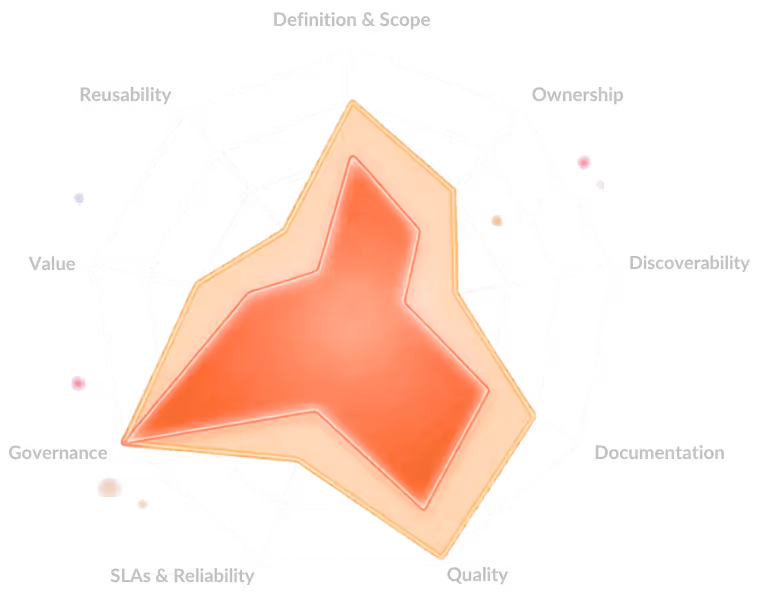
A 9-dimension self-assessment used by 100+ data teams to benchmark strategy, ownership, and platform readiness.


Gaurav Patole
Gaurav Patole is a Principal Data Strategy & Governance Advisor at ThoughtWorks and the author of Data Quality ROI. A seasoned data governance and data quality practitioner, he brings deep, hands-on experience helping global organisations turn trust in data into measurable business value. Formerly with BCG, Gaurav has led end-to-end data governance and quality programs across industries and geographies, bridging business and technology through his People-Process-Technology (PPT) approach. A frequent speaker and active community contributor, he is known for making data governance practical, people-centric, and ROI-driven
Read the ideas here. Build them with The Modern Data Company.
Modern Data 101 is where the data community thinks out loud. When you're ready to move from articles to architecture, data products, governed AI pipelines, or a full Data Operating System; the team behind this community can help you build it.
Continue reading