
Introducing Banking Customer Segmentation Commons

A community focused on customer segmentation in small and regional banks
Read article
Why a trusted customer product-holdings view depends on shared definitions, connected records and clear source boundaries.
A sales leader asks for customers with a deposit relationship but no loan. A product head wants to understand how Treasury services are used across existing relationships. A relationship manager needs a consolidated picture before a customer meeting.
Each request starts with the same question:
Which customers hold which products across the bank?
The answer appears straightforward. The bank already holds customer records, account information, loan details, and Treasury service records. Yet assembling a reliable view can involve multiple extracts, spreadsheets, reconciliation, and clarification from people who understand the systems.
For small and regional banks, that effort competes with reporting, modernization, and other business priorities. The question is simple to ask because it reflects how bankers think about relationships. It is difficult to answer because the information is recorded across systems built for different purposes.
Core banking holds customer and account records. Lending systems contain borrower information. Treasury teams maintain service relationships. CRM systems capture contacts, activities, and opportunities.
Each system contributes a useful perspective, but connecting them requires decisions.
A business may appear under slightly different names. A Treasury record may refer to an account rather than a customer identifier. A loan may involve several borrowers or guarantors. A relationship manager may recognize related businesses that are not explicitly linked in the data.
A shared Customer Information File identifier can provide a starting point. Its coverage and consistency still need examination across the sources being combined.
Until those connections are understood, a missing product record is ambiguous. It may indicate a genuine absence, a failed match, or a source that has not yet been included.
Even when records can be connected, the business question remains open to interpretation.
Consider a request for “deposit customers without a loan.”
Does a deposit customer include someone with a dormant account? Does a zero-balance account count? Should a closed loan exclude a customer from the segment? Is a guarantor treated as a borrower? Does a joint account represent a holding for every named party?
Different answers produce different customer lists.
The following are illustrative decisions a bank would need to make:
Illustrative decisions a bank would need to make
These definitions belong with the business owners who will use the results. Data teams can implement the rules, but the meaning should be agreed across the relevant stakeholders.
A customer view assembled from different refresh cycles can create another source of confusion.
Deposit information may reflect the previous business day. A Treasury file may have been updated earlier in the week. A recently opened loan may not yet appear in the analytical view.
The resulting segment could be internally consistent while still presenting an incomplete picture of the current relationship.
A useful view therefore needs to show when its information was refreshed and which sources it covers. “No recorded loan in the connected sources as of this date” is a more precise statement than “no loan.”
That precision helps business teams interpret the result appropriately.
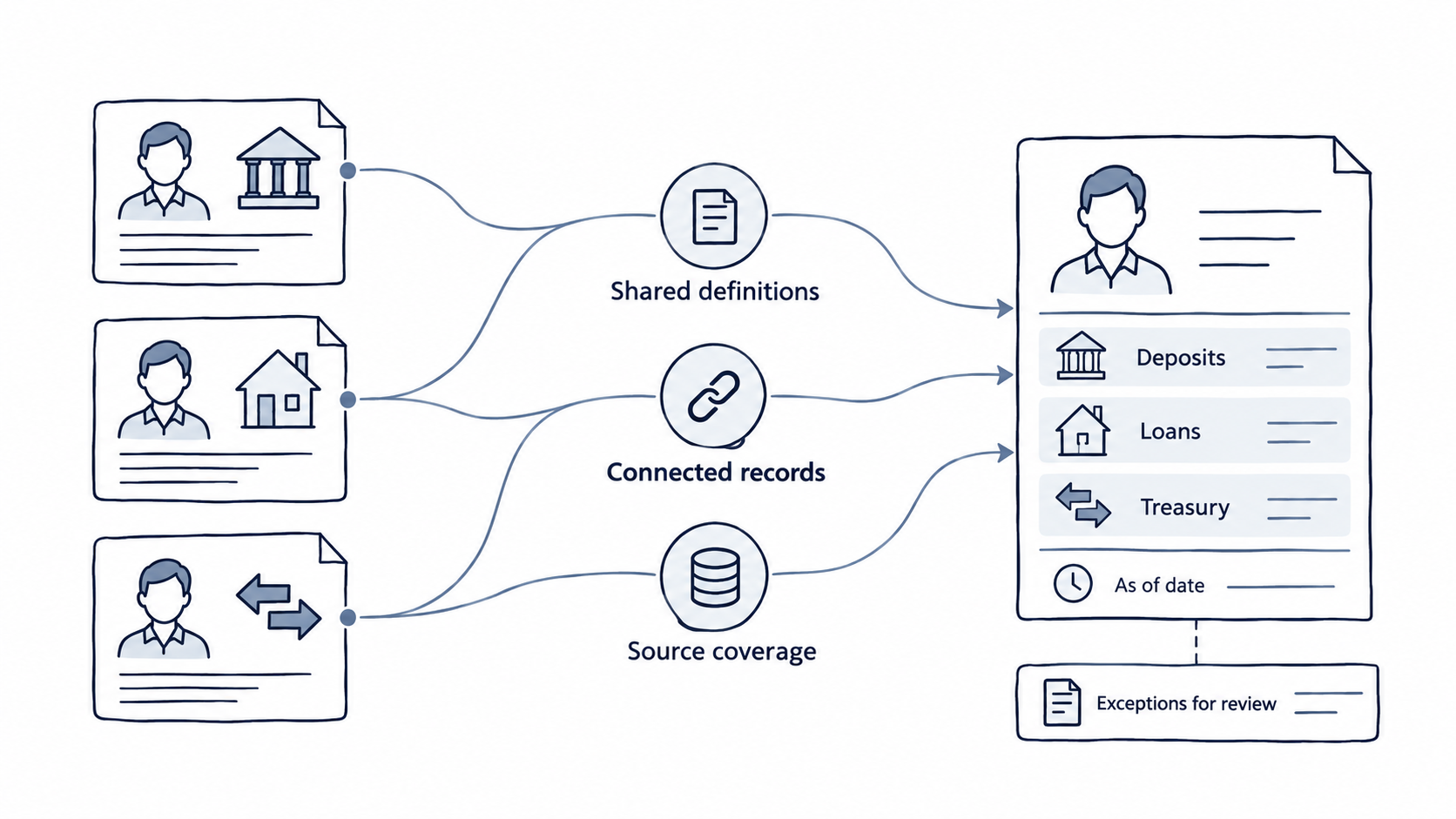
A customer product-holdings view brings the relevant records together around an agreed representation of the customer relationship. Its usefulness depends on the context accompanying those records.
Business users should be able to understand:
For example, a deposit-only segment might be defined as customers with at least one qualifying active deposit account and no qualifying active loan in the connected sources. Records with unresolved customer identifiers could be separated for review.
The definition makes the segment reproducible. The exceptions make its limitations visible.
A shared view can give relationship teams a consistent starting point for reviewing product coverage.
Instead of assembling information separately for each review, teams can examine a defined segment, inspect the underlying holdings, and assess whether further investigation is worthwhile.
A deposit relationship without a recorded loan does not automatically represent a lending opportunity. The customer may have no borrowing need, may borrow elsewhere, or may already be in discussion with another team.
Segmentation helps direct attention. Relationship knowledge and customer conversations determine what follows.
Product leaders can use a shared view to examine how holdings vary across customer groups and relationships.
That can support questions about adoption, product combinations, and areas requiring closer investigation. It can also help distinguish a genuine pattern from an artifact of inconsistent definitions or incomplete source coverage.
Interpretation remains important. A recorded holding does not establish active usage, satisfaction, profitability, or suitability for another product. Those questions require additional information.
A clear foundation makes that next analytical step easier to define.
Treasury discussions benefit from visibility across the broader banking relationship.
Connecting Treasury service records with customer, deposit, and loan information can help teams prepare for relationship reviews and investigate where further conversations may be relevant.
It also exposes an important distinction: a customer may have enrolled in a service without actively using it. Holdings and usage answer different questions.
An initial implementation can establish the holdings view and make that boundary explicit. Usage information can be added when the relevant sources and business need are understood.
The work can begin with one bounded question and the sources needed to answer it.
A deposit-only segment, for example, provides a concrete reason to agree on customer identity, account status, loan status, source coverage, and refresh expectations. Business teams can review a sample of results and identify where the rules or mappings need adjustment.
The resulting definitions and customer relationships can then support further segments. Documentation, ownership, and exception handling help preserve that work as the scope grows.
This is also relevant to AI-assisted analysis. A conversational interface asked “Which customers have deposits but no loan?” still needs the bank’s definitions and source boundaries. Making those explicit gives both people and AI applications a clearer basis for answering the question.
Banking Customer Segmentation Commons is being formed to explore these practical issues with professionals working in small and regional banks.
Customer matching, product definitions, source coverage, and business adoption are useful subjects for shared learning. An unresolved issue can be as valuable to the discussion as a completed implementation.
The group welcomes experiences and questions about building a trusted customer product-holdings view—and making it useful in everyday business decisions.
Which part of the question has proved hardest: connecting the records, agreeing on the definitions, or putting the resulting segments to work?
A community focused on customer segmentation in small and regional banks
Read article