What Makes the Best Data Platform for AI in 2026? New Research Has an Answer
Bridging the gap between multi-million dollar data platform investments and actual, scalable enterprise AI returns.



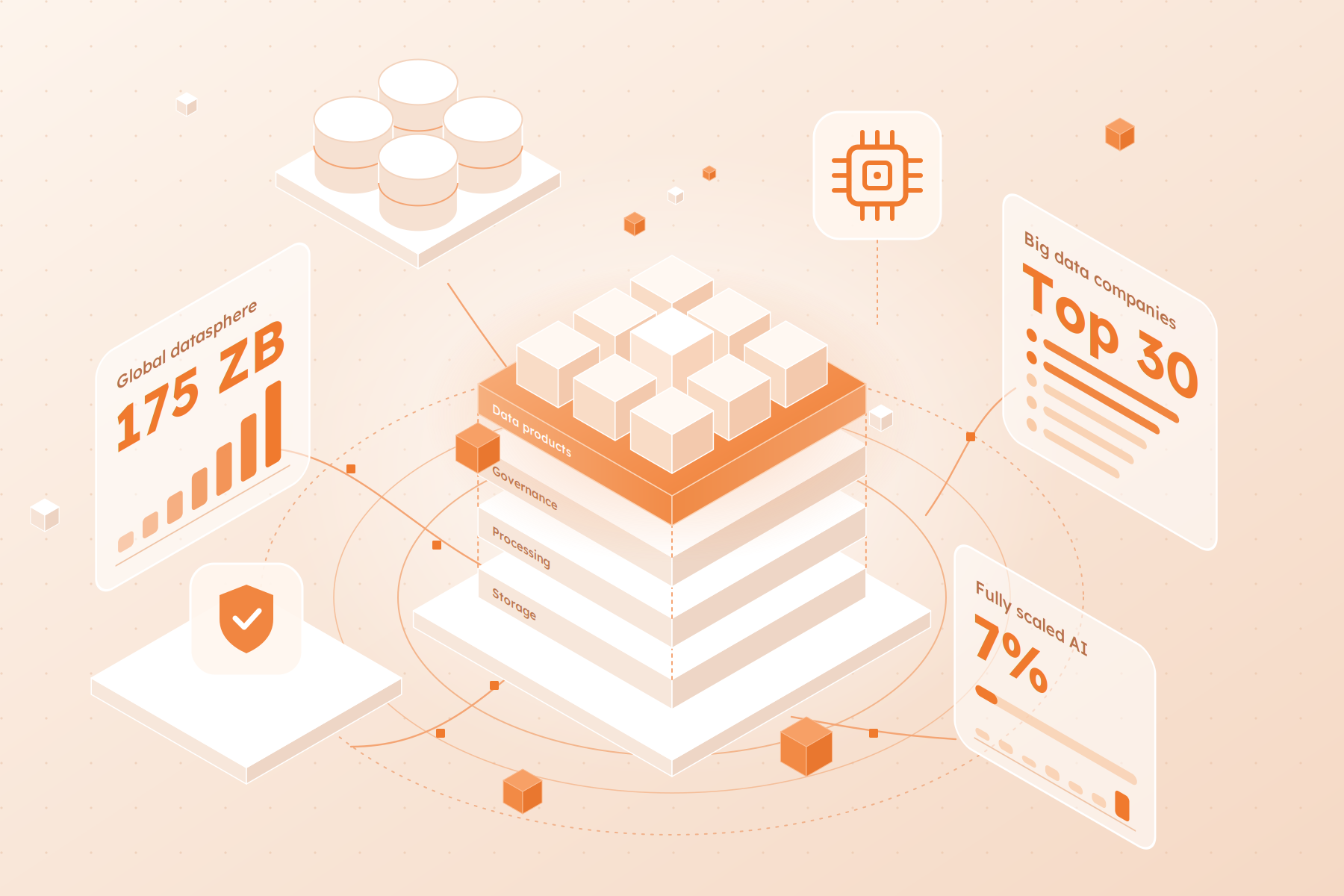
of businesses lack a data foundation that is “very ready” to support generative AI. [MIT Technology Review Insights & Snowflake]
cite that finding the right data is one of the top-three time drain
of AI projects through 2026 due to poor data quality alone [Gartner]
of leaders prioritise data governance, security, or privacy above all other AI considerations.

- Up to 78% of enterprise leaders report lacking a data foundation "very ready" for generative AI, proving that legacy platforms optimized for static reporting fail under AI workloads.
- Data initiatives stall due to three core structural failures: Discovery (89% waste time finding data), Context (57% struggle with missing metric definitions), and Trust (84% regularly encounter conflicting metric versions).
- A production-grade data platform architecture requires five integrated layers: Multi-Modal Ingestion (combining batch and streaming), Tiered Refinement (medallion model), Dependency Graph Orchestration, a Unified Semantic Layer, and Embedded Governance/Observability.
- High-performing architectures prioritize data liquidity (ease of reuse) and treat security as core infrastructure rather than a post-incident audit. This ensures agents query governed, contextual data at machine speed without inflating token costs.
Every enterprise data team believes it has invested in the best data platform available. Yet according to new research from the Modern Data 101 Community, that investment isn’t converting into AI that works. The reason isn’t the platform vendor. It’s whether the architecture underneath earns the label “best data platform” at all.
Modern Data 101’s 2026 survey of 540+ practitioners across 64 countries, The Modern Data Report 2026: The Data Activation Gap, found that 68% of respondents say their organisation’s data isn’t clean or trustworthy enough for AI operations. A parallel MIT Technology Review Insights and Snowflake survey of 275+ leaders puts the number even higher: 78% lack a data foundation “very ready” for generative AI. Deloitte’s research calls this the “AI paradox”: most pilots succeed in testing, but few scale. Across every source, the pattern holds: few organisations have built the best data platform architecture the moment demands.
Why Most Platforms Aren’t One Of the Best Data Platforms for AI
The Modern Data 101 survey traces the gap to three failures. First, discovery: 89% of practitioners cite finding the right data as a top-three time drain, ahead of governance or analysis itself. Second, context: 57% struggle to interpret data because definitions don’t travel with it. Third, trust: 46% cannot fully rely on their data for decisions, and 84% hit conflicting versions of the same metric regularly. None of this is a tooling gap. It’s an architecture gap where platforms are built around storage and reporting, not around what makes the best data platform for AI: governed, contextual, discoverable data at machine speed.
The Five Layers For Building the Best Data Platform Architecture
Datamatics’ research breaks the best data platform’s architecture into five layers, each of which has to work before the next adds value:
- Ingestion combining batch, streaming, API, and change-data-capture; batch alone can’t support real-time AI, and Gartner forecasts streaming adoption for agentic AI will exceed 60% of organisations by 2028.
- Refinement through a tiered “medallion” structure, moving raw data into curated, AI-ready datasets.
- Orchestration that models pipelines as dependency graphs, halting bad data before it spreads.
- A semantic layer standardising definitions so every dashboard and AI agent means the same thing by a metric.
- Governance and observability, built continuously into the pipeline rather than audited after the fact.
This is what separates the best data platform from a merely capable one: not feature count, but whether these five layers are engineered together. Gartner research cited by Datamatics estimates enterprises will abandon up to 60% of AI projects through 2026 without it.
Why is Data Liquidity Important for Data Platforms
MIT’s Center for Information Systems Research adds a second dimension: data liquidity, or how easily data can be reused across the business. A multiyear study of Caterpillar found liquidity depends on three deliberate levers: architecture designed for reuse, quality-checked master data, and least-privilege permissioning. Organisations with high liquidity outperform peers on decision speed and customer experience. It’s also what turns a capable platform into the best data platform for AI, as value moves freely through it.
Why Trust and Governance Non-Negotiable for The Best Data Platforms
The MIT Technology Review Insights and Snowflake survey found 59% of leaders rank governance, security, or privacy above every other AI consideration, ahead of accuracy or cost. That’s precisely why the best data platform treats governance as infrastructure, built in from the start, rather than bolted on after an incident. Gartner projects inference costs will fall by over 90% by 2030, but agentic AI needs 5–30x more tokens per task, so the best data platform is also the one architected to route work efficiently.
What Practitioners Say They Want From the Best Data Platforms
Practitioners aren’t asking for more tools. 80% rank a semantic layer as the top AI enabler, and 77% say a converged, well-governed platform would be valuable, with 40% calling it “extremely valuable.” Read together, those numbers describe the best data platform practitioners don’t yet have: one where discovery, context, and governance are native to the architecture, instead of being layered on top of it.
The research also points to a layer beyond the stack itself. MIT Sloan Executive Education’s research finds AI literacy is now a leadership competency, because even the best data platform still needs literate leadership to interpret what it produces.
The Bottom Line
The gap between AI ambition and AI results isn’t closing on its own. It closes when organisations stop asking which vendor makes the best data platform and start asking whether their own architecture, discovery, context, liquidity, and governance, actually qualifies as one.
Get the full report
- Complete 9-page PDF
- Insights from industry leaders like Deloitte, MIT, Gartner, Snowflake & more
- 5 strategic imperatives for building an AI-ready data foundation
%20(1).png)
Get the full report
- Complete 9-page PDF
- Insights from industry leaders like Deloitte, MIT, Gartner, Snowflake & more
- 5 strategic imperatives for building an AI-ready data foundation


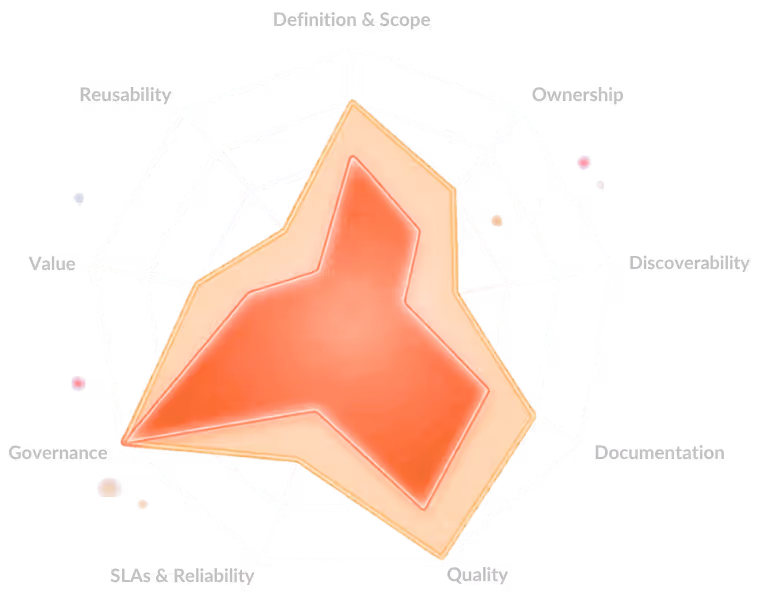
Where does your org stand on data product maturity?
A 9-dimension self-assessment used by 100+ data teams to benchmark strategy, ownership, and platform readiness.

You're all set
Your report is opening in a new tab
Tab didn't open? Open it manually
Ritwika Chowdhury
Ritwika Chowdhury is a data and technology professional focused on data products, AI, and modern data architecture. Her work sits at the intersection of data strategy, product thinking, and emerging AI technologies, with a focus on helping organisations turn enterprise data into trusted, usable, and scalable assets.
Akshay Chame
Akshay is a GenAI/ML engineer building production-grade AI systems, including RAG pipelines, AI agents, MCP servers, and LLM fine-tuning. An IEEE-published researcher and Smart India Hackathon 2023 winner, he is focused on scalable, reliable AI systems that move intelligent solutions from experimentation to production.
Soumadip De
Soumadip De is an AI Product Manager at The Modern Data Company, working on ontology, context management, and knowledge systems for enterprise AI agents. His work spans data-productisation, context mining, and agentic workflow enablement that help teams move from raw enterprise data to reliable answers and governed action.
The State of Data Architecture for Enterprise AI
- Complete 9-page PDF
- Insights from industry leaders like Deloitte, MIT, Gartner, Snowflake & more
- 5 strategic imperatives for building an AI-ready data foundation
You're all set
Your report is opening in a new tab
Tab didn't open? Open it manually
You're subscribed
You'll get every new Modern Data Report in your inbox — check your email to confirm.
Done.png)