What Do You Need to Know to Be a Senior Data Analyst?
Only a third of enterprises get AI past the pilot stage; the analysts who make that leap share three traits: defensible analysis, platform fluency, and visualisation sharp enough to drive a decision on its own.

TL;DR
Only about a third of enterprises have scaled AI past the pilot stage, per McKinsey’s 2025 Global AI Survey. That scaling gap comes down to trust in the data; the same gap separating junior from senior analysts.
This piece covers the traits CDOs and VPs of Data should hire and promote for: trustworthy analysis, platform fluency, and decision-ready visualisation.
.avif)
[playbook]
What Actually Makes a Data Analyst “Senior”?
Type “how to become a senior data analyst” into Google, and you’ll get two answers: promotion checklists or tool-certification lists. Neither answers what a hiring manager actually means by “senior”: can this person take an ambiguous problem and be trusted with the answer?
That trust rests on three traits: defensible data analysis, systems-level data analytics thinking, and data visualisation that drives a decision rather than just describing a metric. Fluency across modern data platforms underpins all three.
[related-1]
Data Analysis Skills That Separate Senior Analysts
Junior data analysis is about correctness: did you join the right tables, filter the right rows. And senior data analysis is about defensibility: will this number survive a VP asking “why” three times in a row.
.avif)
That shift shows up in habits like:
.avif)
This is the difference between analysis that’s technically correct and analysis that’s operationally trustworthy; the gap behind most “garbage in, garbage out“ failures.
[state-of-data-products]
Why Senior Analysts Think in Data Analytics Systems
Where analysis is the individual query, data analytics is the discipline of doing that repeatedly, reliably, at scale. A senior analyst thinks about the system, not the single report, asking:
- Will this metric definition still hold up next quarter?
- Will the dashboard silently break when an upstream schema changes?
- Are five different teams using five different definitions of “active user”?
AI raises the bar further. As BI stacks add AI-generated summaries and natural-language querying, senior analysts are increasingly judged on whether they can catch a wrong model output. This can also be defined as two separate jobs: validating the pipeline, and validating the decision built on top of it.
Why Data Platform Fluency Defines Senior Analysts
A decade ago, “technical range” meant Excel plus one BI tool. Today, a senior analyst moves comfortably across the modern data platform stack: the ingestion, transformation, and governance layers underneath the dashboard they publish. They don’t need to build the pipeline, but they need to know enough about it to trust, or challenge, what it hands them.
.avif)
A data platform turns fragmented data into governed, reusable assets, and analysts who understand that architecture ask sharper questions than those who only see the dashboard layer. That fluency is what lets them catch a broken join before it reaches a board deck.
Self-serve platforms are accelerating this shift, changing what “senior” technical competency means: knowing which governed data product already answers a question now matters more than query complexity.
[related-2]
Data Visualisation Skills That Drive Business Decisions
This is the point our editorial team specifically wanted foregrounded, and for good reason: data visualisation is where most “almost senior” analysts fall short. A junior analyst builds an accurate chart. A senior analyst builds a chart that’s unambiguous; one a stakeholder can read in five seconds and reach the intended conclusion without a caption.
Picking the right chart type matters more than most analysts assume:
.avif)
Done well, visualisation becomes the connective tissue between the analytics layer and the business decision, turning BI from a passive reporting function into a proactive intelligence engine.
Mentoring: The Multiplier Skill of Senior Data Analysts
One theme resurfaces across every competing piece on this topic: the shift from adding your own output to multiplying the team’s. A senior analyst documents definitions clearly, reviews a peer’s SQL before it ships, and becomes the person others check their numbers against. Shared data products increasingly do some of that multiplying work structurally, freeing mentorship to focus on judgment rather than repetition.
That’s the throughline across all three traits: earned trust. Analysis that doesn’t need double-checking, platform fluency that catches problems early, and visualisation sharp enough to persuade on its own. The promotion and the title tend to follow from that.
Catching a broken pipeline is the easy half of the job. Catching a model quietly making the wrong call is the other half. That’s why AI observability is becoming as core to a senior analyst’s skill set as SQL once was.
FAQs
Q1. What skills does a senior data analyst need?
Beyond SQL and BI tools, a senior data analyst needs defensible analysis that survives scrutiny, systems-level thinking about data quality at scale, and visualisation sharp enough to drive a decision without extra explanation. Platform fluency ties all three together, letting analysts catch problems before they reach a dashboard.
Q2. What are the top 3 skills for a data analyst?
The top three are trustworthy data analysis (numbers that hold up under questioning), data platform fluency (understanding the pipeline behind the dashboard), and data visualisation that makes a decision obvious at a glance. Together, these separate analysts trusted with ambiguous problems from those who aren’t.
Q3. What do senior data analysts do?
Senior data analysts turn ambiguous business questions into trusted answers, not just accurate ones. Day-to-day, that means validating data before it ships, catching pipeline or model errors early, building visualisations stakeholders can act on immediately, and mentoring other analysts so the whole team moves faster.
Connect with a community data expert
A no-cost session with a practitioner who's been where you are.
About Modern Data 101
Modern Data 101 is a movement redefining how the world thinks about data. A community built by the same team behind the world’s first data operating system, Modern Data 101 sits at the intersection of data, product thinking, and AI. Spread across 150+ countries, the community brings together a global network of practitioners, architects, and leaders who are actively building the next generation of data systems.
At its core, Modern Data 101 exists to simplify the journey from raw data to tangible and observable impact. It advocates high-potential data systems and next-gen architectures to unify and activate insights and automation across analytics, applications, and operational workflows at the edge.
In a world shifting from data stacks to AI ecosystems, Modern Data 101 helps teams not just navigate the change but lead it.


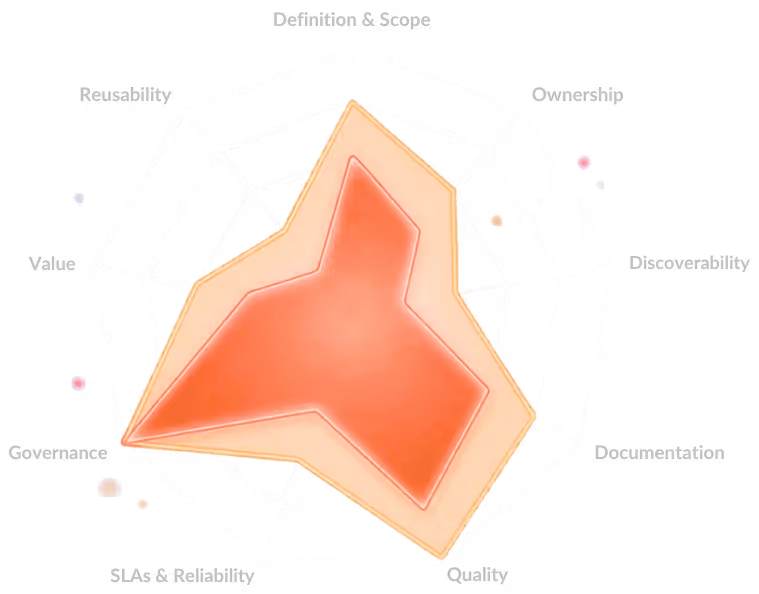
Where does your org stand on data product maturity?
A 9-dimension self-assessment used by 100+ data teams to benchmark strategy, ownership, and platform readiness.


Aishwarya Sharma
Aishwarya is a Senior Analytics Engineer at The Modern Data Company, focused on building end-to-end data solutions that bridge engineering and analytics. He works across data pipelines, modelling, and visualisation to deliver reliable, business-ready insights, combining strong technical expertise with a practical, problem-solving approach to modern data systems.
Read the ideas here. Build them with The Modern Data Company.
Modern Data 101 is where the data community thinks out loud. When you're ready to move from articles to architecture, data products, governed AI pipelines, or a full Data Operating System; the team behind this community can help you build it.
Continue reading
.jpg)

.png)
.png)