Best Agent Harnesses in 2026: 34 AI Agent Harnesses Compared
From Claude Code and Codex to open-source runtimes and cloud-managed SDKs, the definitive framework for evaluating 34 agent harnesses.

An agent harness is the runtime that turns a language model into an AI agent that can act. It runs the loop, executes tools, holds memory, manages context, and enforces limits. In 2026 the harness shapes agent quality as much as the model does, which is why searches for the best agent harness keep climbing and why the field now spans AWS, Anthropic, Google, Microsoft, NVIDIA, OpenAI, and a long list of open-source teams. This guide compares 34 options by what each one does, how it works, and where it fits.
What is an Agent Harness?
An agent harness is every piece of code, configuration, and execution logic around a model that is not the model itself. LangChain’s anatomy of an agent harness uses that definition. This covers the loop that keeps calling the model, the tools the agent may run, the sandbox those tools run in, memory that survives restarts, context management, and the hooks and approvals that enforce policy.
The big AI labs now publish their harness thinking openly. Anthropic’s harness design for long-running application development describes a planner, generator, and evaluator structure with context resets, built to handle two failures: loss of coherence as the context window fills and overly generous self-grading. OpenAI’s harness engineering post reports that three engineers driving Codex produced roughly 1,500 merged pull requests and about a million lines of code by designing the environment, feedback loops, and repository knowledge around the agent.
The harness moves results. LangChain raised a coding agent from 52.8% to 66.5% on Terminal Bench by changing only the harness, and Vercel removed most of an agent’s tools and saw its success rate rise from 80% to 100%, both collected in MongoDB’s engineering write-up. NVIDIA’s research team reports that harness design alone can swing benchmark results by double digits and change token cost sharply on the same model, as described in its six agent harness capabilities post. On Terminal-Bench 2.0, Letta Code scored 59.1% against Claude Code’s 41.6% with the same Claude Opus 4.5 model, per Han Lee’s analysis.
Agent Harness vs Agent Framework vs Agent Platform
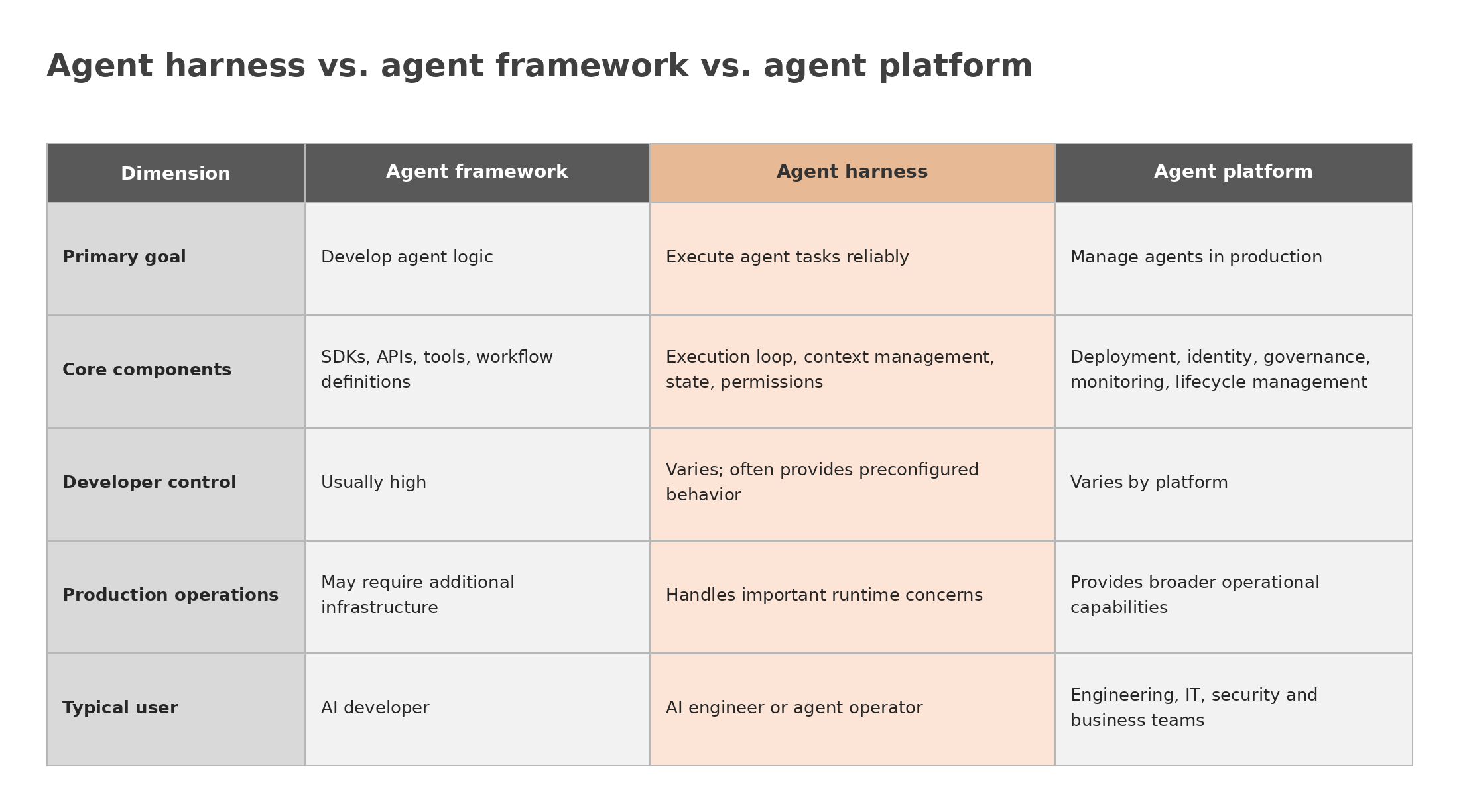
The agent stack has four layers. The model reasons. The harness runs one agent. The framework composes several agents with explicit state and branching. The platform runs many harnesses across a team with durable execution, cost attribution, and governance.
The key distinction is where the agent’s execution logic lives, what developers use to build it, and what infrastructure is needed to run it reliably in production.
These terms are related, but they are not always used consistently across the AI industry. In particular, agent harness is a newer, less standardised term than agent framework or agent platform.
Why Agent Harnesses Matter for Enterprises in 2026
Gartner’s 2026 Hype Cycle for Agentic AI reports that 17% of organisations have deployed AI agents while more than 60% expect to within two years. KPMG’s Q1 2026 AI Pulse found 54% of organisations actively deploying agents, up from 12% in 2024.
The harness covers half of the production picture. In The Modern Data Company’s interim findings from its third annual Modern Data Survey, 57.3% of organisations were piloting or running AI agents in data and analytics workflows, while fewer than 1 in 10 said the data feeding their AI is production-ready.
Read the article for further context: AI Agents Are Advancing Faster Than Enterprise Data Is Ready for Them.
KPMG’s Q3 2026 survey of asset management and private equity leaders names data readiness and access as the top barrier to agent deployment, cited by 76%. That is why this list includes data and context layers next to coding harnesses. Modern Data 101’s piece on why data products anchor AI success covers the same gap.
How to Compare Agent Harnesses
Feature grids age fast because harnesses are converging on the same core. These criteria separate them in practice:
- Model support. Single vendor, many providers, or local models through Ollama or vLLM.
- License and governance. MIT and Apache-2.0 differ on patents, and a foundation-hosted project answers to different pressures than a vendor-owned one.
- Sandboxing. Whether code runs in a container, a micro-VM, or on your machine.
- Memory and context. How state survives restarts and how the harness keeps the context window clean.
- Extension model. Skills, MCP servers, plugins, or typed Python code.
- Path to production. A documented route to team deployment, authentication, and tracing.
- Data access. How the agent reaches governed business data with its meaning attached.
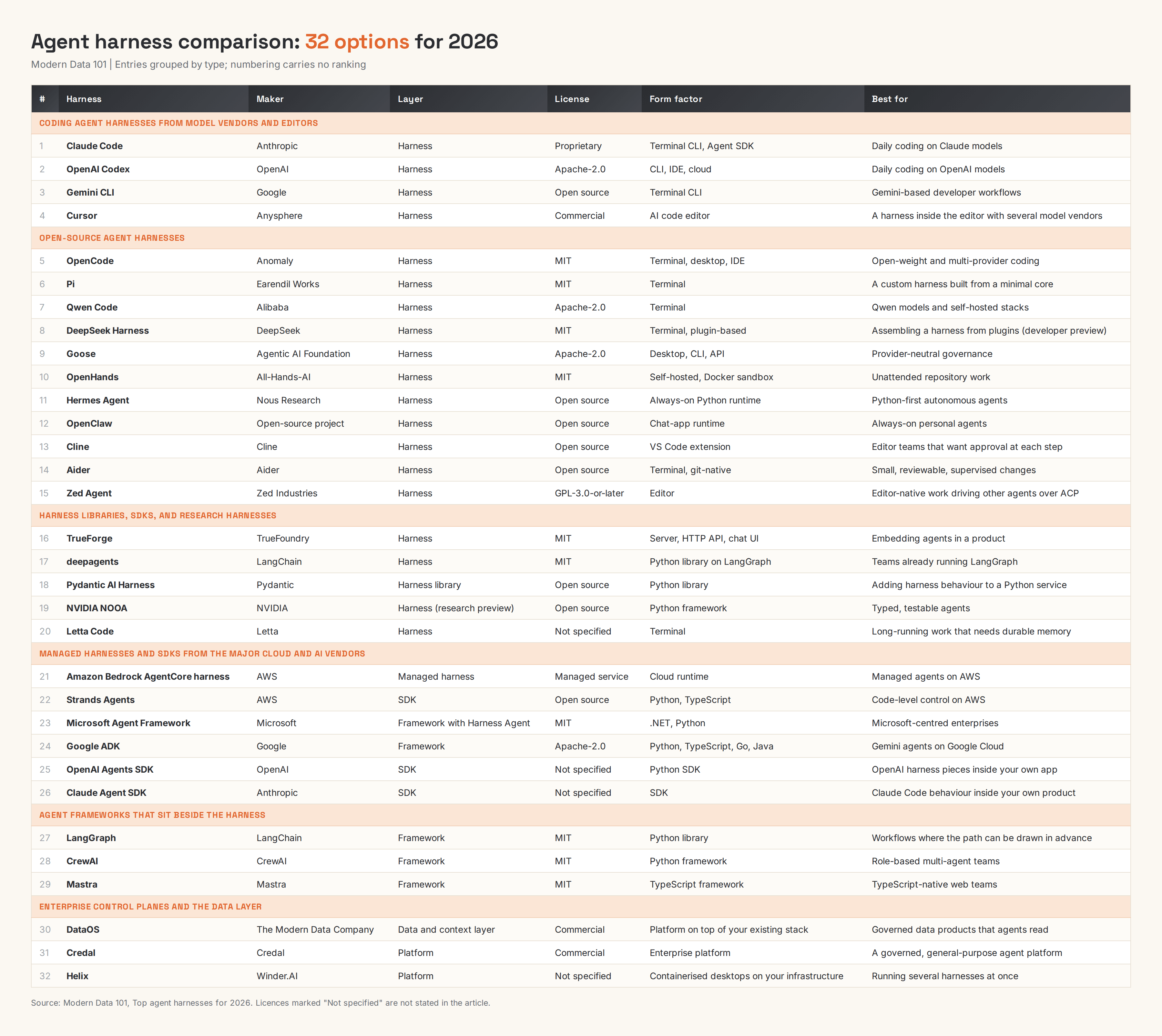
Entries below are grouped by type, and the numbering carries no ranking.
Best agent harnesses in 2026
Coding Agent Harnesses from Model Vendors and Editors
1. Claude Code
Claude Code is Anthropic’s terminal coding agent, written in TypeScript and tied to Anthropic models. Its harness handles the agent loop, file and shell tools, permissions, sub-agents, hooks, and MCP connections, and the same harness is available to custom agents through the Claude Agent SDK. It leads most shortlists because other harnesses are measured against it. Its limits are single-vendor model support and a light durable-memory design. Visit Claude Code
2. OpenAI Codex
Codex is OpenAI’s open-source coding agent, built in Rust and TypeScript under Apache-2.0 and tied to OpenAI models. It runs an agent loop with sandboxed command execution and AGENTS.md instructions, and OpenAI uses it as the reference harness in its harness engineering write-up. It earns its place because one Codex runtime serves the CLI, IDE, and cloud surfaces, and because AGENTS.md has become a shared instruction format under the Linux Foundation’s Agentic AI Foundation. Visit Codex
3. Gemini CLI
Gemini CLI is Google’s open-source terminal agent for Gemini models. It runs a tool-calling loop with file and shell tools, extensions, and MCP support. Google’s Data Agent Kit ships skills and plugins that work inside Gemini CLI, VS Code, and Claude Code, so it sits at the centre of Google’s agent tooling for developers. It is on the list as Google’s own command-line harness. Visit Gemini CLI
4. Cursor
Cursor is an AI code editor whose agent mode runs a harness inside the editor, with codebase indexing, multi-file edits, terminal commands, and diff review in one place. O’Reilly Radar’s essay on agent harness engineering names Cursor alongside Codex, Aider, and Cline as products where behaviour comes mostly from the harness around the model. It fits teams that want the harness inside the editor with a choice of model vendors. Visit Cursor
Open-Source Agent Harnesses
5. OpenCode
OpenCode is an MIT-licensed coding agent from Anomaly that ships as a terminal app, desktop app, and IDE extension. It connects to more than 75 model providers through Models.dev, including local models, and adds LSP integration, session management, and separate plan and build modes. It is among the most-starred open-source coding agents of 2026 and has the broadest contributor base in the category. Its scope centres on coding workflows, so embedding it in a product takes extra work. Visit OpenCode
6. Pi
Pi is an MIT-licensed terminal harness from Earendil Works, created by Mario Zechner. It ships four tools (read, write, edit, bash) and a system prompt under 1,000 tokens, and everything else arrives through TypeScript extensions, skills, and packages. A lazy-loading skill system keeps context lean. It is on the list as the reference minimal harness for teams that want to shape the agent around their own workflow. It is terminal-first with no embeddable UI. Visit Pi
7. Qwen Code
Qwen Code is Alibaba’s Apache-2.0 terminal agent, written in TypeScript. It connects to OpenAI, Anthropic, Gemini, and Qwen APIs and to local models through Ollama or vLLM. Winder.AI rates it the best-fitting harness for Qwen models. It is on the list because open-weight Qwen models are a common choice for self-hosted stacks. Expect rough edges when you point it at other models, since tool-call formats differ across vendors. Visit Qwen Code
8. DeepSeek Harness
DeepSeek Harness is an MIT-licensed harness released in developer preview on 13 August 2026. Everything in it is a plugin, including the agent loop, and it can run Claude Code or Codex as sub-agents. It ships an OS-level sandbox, a credentials file, and an append-only session log. It collected tens of thousands of GitHub stars within days, which puts it on the list. It is a preview, so APIs are changing fast. Visit DeepSeek Harness
9. Goose
Goose is an Apache-2.0 agent written in Rust that ships as a desktop app, CLI, and API. It supports more than 15 providers, including local Ollama, and is hosted by the Linux Foundation’s Agentic AI Foundation alongside Anthropic’s Model Context Protocol and OpenAI’s AGENTS.md. Neutral governance is its main draw for teams that want provider-agnostic work with a roadmap that follows a foundation. Visit Goose
10. OpenHands
OpenHands is an MIT-licensed, self-hosted harness for autonomous software work. Each session can run in an optional Docker sandbox, any model works, and it acts as a client for the Agent Client Protocol so it can drive other agents. It is on the list for unattended repository tasks where you control the sandbox. It loops on ambiguous problems, so set budgets, and Docker-in-Docker is awkward on locked-down laptops. Visit OpenHands
11. Hermes Agent
Hermes Agent is an open-source agent runtime from Nous Research, written in Python. Practitioners describe running it as a long-lived autonomous agent with a messaging gateway, Docker isolation, and approval rules for risky actions. It appears on community shortlists as the Python-first alternative to TypeScript harnesses such as Pi and OpenCode. Visit Hermes Agent
12. OpenClaw
OpenClaw is an open-source personal agent runtime built to stay on and live inside chat apps. It supports plugins and sub-agents, and third-party tooling such as NVIDIA Dynamo ships OpenClaw plugins. Ranked harness lists place it first for always-on personal agents. Review its permission model before giving it access to accounts. Visit OpenClaw
13. Cline
Cline is an open-source coding agent that runs inside VS Code. It edits files, runs terminal commands, and asks for approval at each step by default, which keeps a developer in the loop. Ranked lists put it among the top turnkey coding agents next to OpenCode and Codex. It fits editor-centred teams that want visible control over every action. Visit Cline
14. Aider
Aider is a git-native pair programmer for the terminal. It maps the repository, edits files, and commits each change to git, which makes every step easy to review and revert. Winder.AI leaves it out of long unattended comparisons because it is built for short supervised runs. It stays on this list for developers who want small, reviewable changes. Visit Aider
15. Zed Agent
Zed Agent is the agent inside the Zed editor, written in Rust under GPL-3.0-or-later. It can drive Claude, Codex, or OpenCode over the Agent Client Protocol, so the editor becomes one front end for several harnesses. It fits teams that watch diffs land in the editor. It assumes you have adopted Zed, and the review interface for external agents is still catching up. Visit Zed Agent
Harness Libraries, SDKs, and Research Harnesses
16. TrueForge (TrueFoundry)
TrueForge is an MIT-licensed harness from TrueFoundry in three pieces: a core server that runs the agent loop with approval gates, sub-agents, and compaction; an HTTP API with a TypeScript SDK; and an embeddable chat UI. It treats the sandbox as a tool and starts one only when the agent needs to run code. TrueFoundry reports $8.5 per run against $11.8 for Claude Managed Agents on its Enterprise-Bench tasks, and that figure is vendor-reported. It is on the list for teams embedding agents in a product. TrueFoundry’s Agent Harness runs the same runtime behind an AI Gateway with RBAC, budgets, and traces. Visit TrueForge
17. deepagents (LangChain)
deepagents is LangChain’s opinionated harness built on LangGraph. It bundles planning tools, a virtual filesystem, sub-agent delegation, persistent memory, skills, sandboxed execution, and human-in-the-loop controls, and it works with any model and connects to LangSmith for tracing. In TrueFoundry’s benchmark, it used the most tokens of the harnesses tested, about 16.5 million and $21 per run on Opus 4.8, so budget for cost. It fits teams that already run LangGraph in production. Visit deepagents
18. Pydantic AI Harness
Pydantic AI Harness adds harness capabilities to a Pydantic AI agent as typed, composable Python units that bundle tools, hooks, instructions, and model settings. Its documentation listed more than fifty capabilities in August 2026, and Pydantic’s v2.0.0 release on 23 June 2026 made capabilities a core primitive. It fits teams adding harness behaviour to a Python service they already maintain. It is a library with 0.x versioning, so pin versions. Visit Pydantic AI Harness
19. NVIDIA NOOA
NVIDIA Labs Object-Oriented Agents (NOOA) is an open-source research preview that models an agent as one Python class: methods are capabilities, fields are state, docstrings are prompts, and type annotations are enforced contracts. Tool results pass by reference instead of filling the context window, and a SQLite-backed memory store lets the agent curate what it keeps. NVIDIA reports 82.2% on SWE-bench Verified with GPT-5.5 at roughly half the tokens and LLM calls of comparison harnesses, as laid out in its technical report. It is on the list as the most detailed public design for typed, testable agents. Visit NOOA
20. Letta Code
Letta Code is a coding harness built around a memory substrate from Letta. The agent keeps durable memory across sessions, which is the dimension where thinner harnesses fall short. On Terminal-Bench 2.0 it scored 59.1% with Claude Opus 4.5 against 41.6% for Claude Code on the same model, per Han Lee’s analysis. It is on the list as the clearest example of a third-party harness beating a first-party one through memory design. Visit Letta
Managed Harnesses and SDKs from the Major Cloud and AI Vendors
21. Amazon Bedrock AgentCore harness
The AgentCore harness became generally available on 17 June 2026. You declare a model, system prompt, tools, and skills, and AWS runs the orchestration loop with session isolation, memory, filesystem persistence, tracing, and versioning. Teams can switch model providers mid-session without losing context, and a CLI command exports the harness to Strands-based code when custom orchestration is needed. It is on the list as the leading managed harness on AWS. AWS announced it in AgentCore’s general availability notice. Visit Amazon Bedrock AgentCore
22. Strands Agents (AWS)
Strands Agents is AWS’s open-source agent SDK for Python and TypeScript. It is model-agnostic and powers the AgentCore harness, which means an agent defined in config can move to Strands code on the same runtime. It is on the list for teams that want code-level control on AWS without leaving the managed primitives for identity, memory, and observability. Visit Strands Agents
23. Microsoft Agent Framework
Microsoft Agent Framework 1.0 reached general availability in April 2026 as the unified successor to AutoGen and Semantic Kernel, under the MIT license for .NET and Python. It includes a Harness Agent, an opinionated ready-made agent for long, multi-step autonomous work with shell and filesystem tools, and Foundry-hosted agents for deployment. It also has experimental support for the GitHub Copilot SDK and Claude Code SDK as harnesses. It is on the list as the default path for Microsoft-centred enterprises. See the Harness Agent documentation. Visit Microsoft Agent Framework
24. Google Agent Development Kit (ADK)
ADK is Google’s open-source framework for building, debugging, and deploying agents in Python, TypeScript, Go, and Java. ADK 2.0 added a Workflow Runtime that treats agents, tools, and functions as graph nodes, and agents run locally, on Cloud Run, on GKE, or on the managed Agent Runtime in the Gemini Enterprise Agent Platform, which Google announced on 22 April 2026 as the evolution of Vertex AI. It is on the list as Google’s production route for Gemini-based agents. Visit Google ADK
25. OpenAI Agents SDK
The OpenAI Agents SDK packages sandboxed execution, file inspection, command running, approvals, and resumable workspaces as reusable harness primitives. It lets teams build custom agents on the building blocks OpenAI uses for Codex. It is on the list for teams that want OpenAI’s harness pieces inside their own application. Visit OpenAI Agents SDK
26. Claude Agent SDK
The Claude Agent SDK exposes the harness behind Claude Code to custom agents, including non-coding agents such as research and email assistants. Anthropic’s Managed Agents design separates a stateless harness from sandboxes and tools so each can change independently. AWS has said the Claude Agent SDK will become an export target for the AgentCore harness. It is on the list for teams that want Claude Code’s behaviour inside their own product. Visit Claude Agent SDK
Agent Frameworks that Sit Beside the Harness
27. LangGraph
LangGraph is LangChain’s graph-based framework for stateful agent workflows with checkpointing, branching, and human review, and it reached 1.0 in October 2025. It sits one layer above a harness and is the base for deepagents. Pick it when the path through the work can be drawn in advance, and you want typed state you can inspect and resume. Visit LangGraph
28. CrewAI
CrewAI is an MIT-licensed multi-agent framework built around roles, tasks, and crews, and it had passed 44,600 GitHub stars by April 2026. It is on the list for teams that model work as a group of specialised agents with clear responsibilities. Enterprise hosting is available as an option. Visit CrewAI
29. Mastra
Mastra is an MIT-licensed TypeScript framework for agents and workflows. It is on the list as the main TypeScript-native option for web teams that want agent orchestration in the same language as their application. Visit Mastra
Enterprise control planes and the data layer
30. DataOS (by The Modern Data Company)
DataOS is the data and context layer that agent harnesses plug into. It packages enterprise data as governed data products that bundle semantics, quality checks, lineage, ownership, and access policies, then exposes them through SQL, APIs, and agent-ready interfaces with guardrails such as intent and result validation. It layers on top of existing warehouses and lakehouses without a rebuild. DataOS publishes agent skills for Cursor, Claude Code, Codex, and VS Code Copilot that guide data product design and builds through a Data Product MCP. It is on the list because a harness runs the loop and DataOS supplies the trusted business context the loop reads. Visit DataOS
31. Credal
Credal is an enterprise platform for building and governing agents. It offers one-click integrations with Google Workspace, Slack, Salesforce, and other systems, with permissions inherited from the source and enforced per user, plus orchestration, observability, and context management. It is on the list for companies that want a governed, general-purpose agent platform with enterprise access controls built in. Visit Credal
32. Helix (Winder.AI)
Helix is an agent control room co-developed by the Winder.AI team. Every thread boots a containerised desktop on your own infrastructure with an IDE, terminal, browser, and the repository on its own branch, and harnesses such as Claude Code, Codex, OpenCode, Qwen Code, and Goose can run inside it. It is on the list as a platform-layer option for teams running several harnesses at once. Running it adds infrastructure to operate. Visit Helix
Agent Harness Comparison Table
How to Choose an Agent Harness
- Coding on Anthropic or OpenAI models: Claude Code or Codex.
- Open-weight or local models: OpenCode, Qwen Code, or Pi.
- Provider-neutral governance: Goose.
- Self-hosting with a sandbox you control: OpenHands.
- A Python service you already maintain: Pydantic AI Harness, or NOOA for typed, testable agents.
- Managed cloud runtime: AgentCore on AWS, Microsoft Agent Framework with Foundry, or ADK on the Gemini Enterprise Agent Platform.
- Many agents across a company: a platform layer for control, plus a governed data layer such as DataOS so agents read trusted, defined data.
Whichever harness you pick, build an evaluation suite first. Anthropic’s long-running harness research advises auditing which scaffolding still matters after each model upgrade and removing what no longer helps, and a passing demo says little about the other paths an agent can take.
FAQ
Q1. What is an agent harness?
An agent harness is the infrastructure around a model that lets it act as an AI agent. It includes the execution loop, tool calling, sandboxing, memory, context management, and the hooks that enforce policy.
Q2. What is the difference between an agent harness and an agent framework?
A harness runs a single agent end to end. A framework such as LangGraph or CrewAI composes several agents with explicit state and branching you define yourself.
Q3. What is the best agent harness in 2026?
It depends on your model and stack. Claude Code and Codex lead for coding on their own vendors’ models, OpenCode and Pi lead for open-weight and customizable setups, and AgentCore, Microsoft Agent Framework, and Google ADK lead for managed cloud deployment.
Q4. What is the best open-source agent harness?
OpenCode has the widest adoption for coding work. Goose offers foundation governance, OpenHands suits self-hosted unattended work, and Pi suits teams that want a minimal core to extend.
Q5. Do I need an agent harness to run an AI agent in production?
Yes, something fills that role in every production agent. You can use a ready-made harness, a managed one such as AgentCore, or build your own from a framework. The choice affects cost, safety, and how fast you can change agent behaviour.
Q6. Where does DataOS fit with agent harnesses?
DataOS is the data and context layer under the harness. It supplies governed data products with semantics, quality checks, and lineage that agents read through SQL, APIs, and agent-ready interfaces.
Connect with a community data expert
A no-cost session with a practitioner who's been where you are.
About Modern Data 101
Modern Data 101 is a global movement redefining how the world thinks about data. Built by the team behind The Modern Data Company, the company pioneering DataOS, the data operating system, Modern Data 101 brings together a global community of practitioners, architects, and leaders across 150+ countries at the intersection of data, product thinking, and AI.
While DataOS advances the technology and infrastructure on-ground to help enterprises operationalize data as products, Modern Data 101 advances the ideas, practices, and conversations that shape how the industry approaches data and AI. Together, they connect technological innovation with the broader movement to rethink how organizations build, govern, and activate data.
At its core, Modern Data 101 exists to simplify the journey from raw data to tangible, measurable impact. It champions data product thinking and next-generation architectures that unify and activate insights and automation across analytics, applications, and operational workflows.
In a world shifting from data stacks to AI ecosystems, Modern Data 101 helps the industry rethink what's possible.


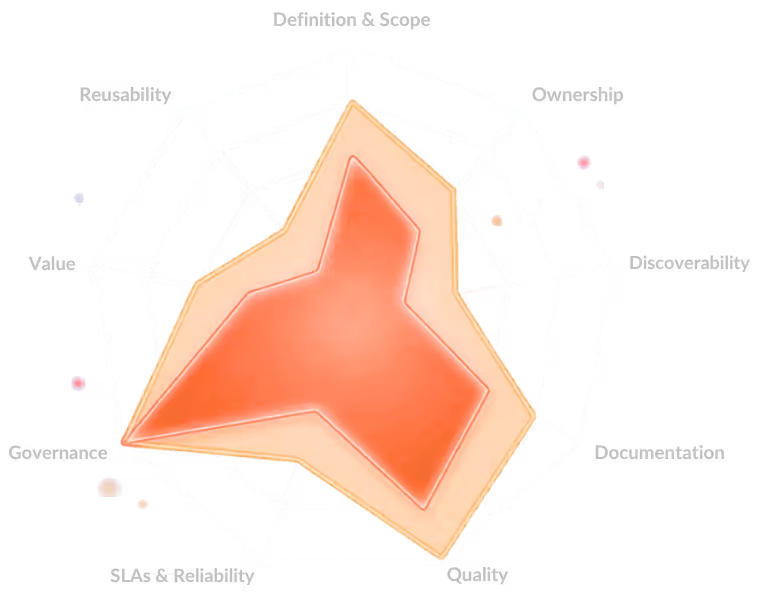
A 9-dimension self-assessment used by 100+ data teams to benchmark strategy, ownership, and platform readiness.


Ritwika Chowdhury
Ritwika Chowdhury is a data and technology professional focused on data products, AI, and modern data architecture. Her work sits at the intersection of data strategy, product thinking, and emerging AI technologies, with a focus on helping organisations turn enterprise data into trusted, usable, and scalable assets.
Read the ideas here. Build them with The Modern Data Company.
Modern Data 101 is where the data community thinks out loud. When you're ready to move from articles to architecture, data products, governed AI pipelines, or a full Data Operating System; the team behind this community can help you build it.
Continue reading