Building Enterprise-Grade Data Agents That Deliver ROI
There's a 0.8-point gap between enterprises where data agents pay for themselves and enterprises where they get shelved after the pilot, and almost nobody is measuring the right side of it.

TL;DR
Data agent business cases get built around capability: what the agent can do, how fast, and how many hours it saves. That's an easy story to sell and a cheap one to demo, but it says nothing about who answers for the agent once it's live, which is the variable that actually decides whether the ROI shows up.
McKinsey's 2026 AI Trust Maturity Survey found organisations with clear ownership for responsible AI (dedicated governance roles or internal audit and ethics teams) average a maturity score of 2.6 out of 4, versus 1.8 without a clearly accountable function (McKinsey, 2026).
Why the Business Case Usually Breaks First on Ownership
The same survey found organisations investing $25 million or more in responsible-AI capability report materially higher maturity and are far more likely to see EBIT impact above 5% (McKinsey, 2026). Spend alone doesn't buy that outcome; ownership does.
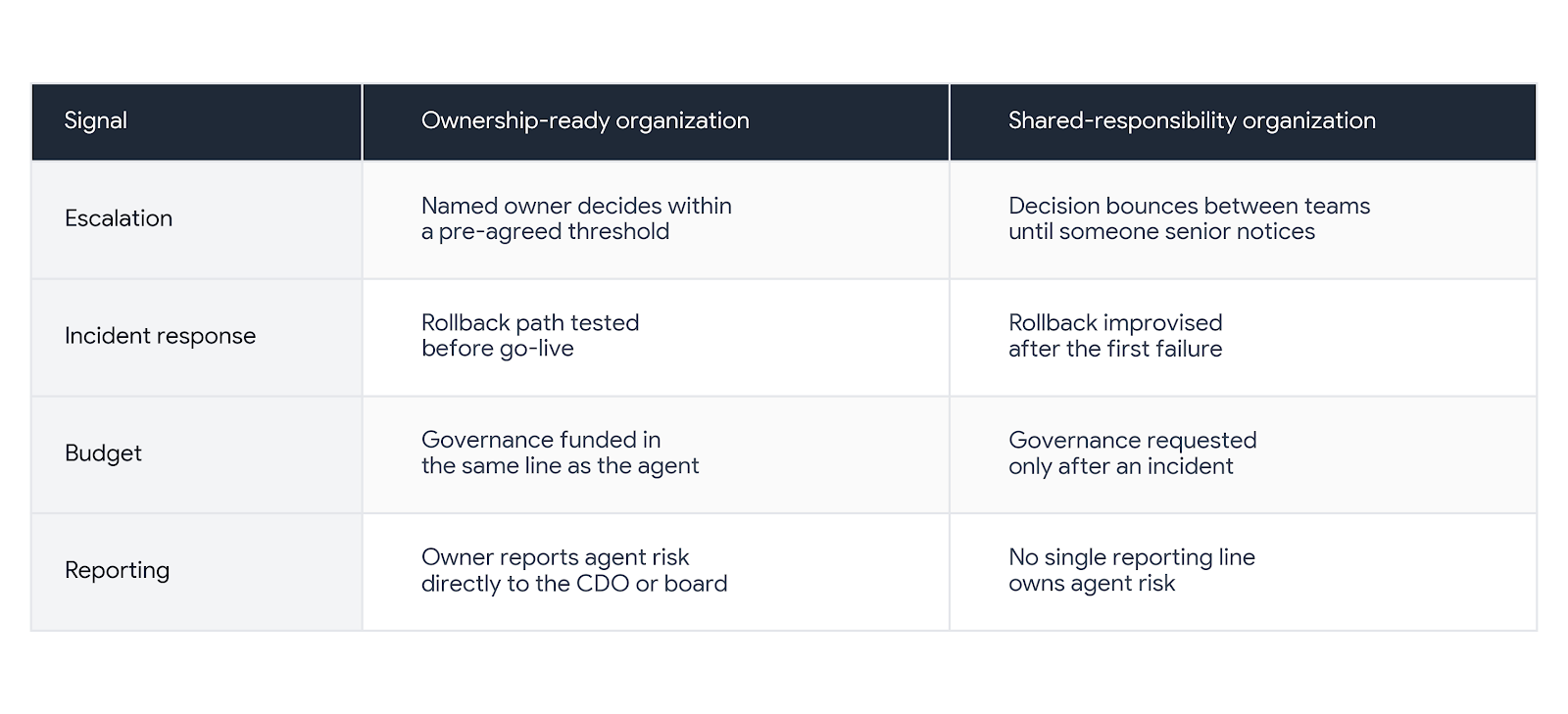
Two enterprises can license the same agent platform. One assigns a named owner with authority to pause, escalate, or roll back its actions; the other treats governance as a shared responsibility, which is how only one in five companies end up with a mature governance model for autonomous agents (Deloitte, 2026). Only the first shows up as a high performer.
What ownership actually looks like in practice:
[related-1]
The Ownership Model That Makes the Data Agent ROI Case Hold
Before scaling past pilot, the business case needs three things in place:
- A named, senior-enough owner accountable for every category of agent action, not a committee
- A pre-agreed threshold for what the agent escalates versus resolves alone, reviewed quarterly
- A documented incident path: who is paged, what gets paused, how the action reverses
The sharpest test of this model is a data recovery agent: the category with the most standing authority, since it decides what "recovered" means on your behalf. Underwrite it like an insurance policy, not a feature you switch on. Its ROI holds only if rollback scope and sign-off are settled before it runs, not discovered after a bad restore.
[related-2]
Where the ROI Case Actually Gets Built or Lost
Two layers of your existing data estate decide whether the ownership model above is even executable.
The Enterprise Data Warehouse Layer
Most enterprises point their first data agent at the enterprise data warehouse, the centralised, structured repository that legacy reporting already runs on, since the data looks ready. That's a cost trap as much as a convenience.
Warehouses built for scheduled, human-reviewed reporting rarely carry the ownership metadata an agent needs to act alone; a gap in automating context-aware data quality assessment is only just starting to close (arXiv, 2026). Retrofitting that governance later typically costs more than building it in from the start, and it's the most common reason a pilot's ROI case doesn't survive contact with production.
[related-3]
The Enterprise Data Management Layer
Enterprise data management is the operating discipline, including ownership, access policy, and documentation, that makes any agent's actions defensible to a board. It's the layer the 2.6-versus-1.8 gap above is actually measuring.
That separation, a control plane that governs policy and metadata independently of the systems doing the work, is what conventional wisdom skips when it funds this as compliance overhead after the agent ships. The organisations posting real EBIT impact fund it as the same budget line as the agent, with a named owner attached before the first pilot, not after the first incident.
Explore the foundational piece: What Are Data Agents? The Bridge Between Agentic AI and Enterprise Data
FAQs
What is a data agent?
A data agent is a system with standing authority to change something in your data estate, correcting a record or restoring a pipeline, rather than just reporting on it. That authority is what turns the purchase decision into an accountability decision.
What is an enterprise data warehouse?
An enterprise data warehouse is the centralised, structured repository most legacy reporting runs on. It's usually the first system agents get pointed at, since the data already looks modelled and clean. That familiarity is deceptive: it rarely carries the ownership metadata autonomy actually needs, and retrofitting it later costs more than building it in from day one.
What is enterprise data management?
Enterprise data management is the discipline of governing data consistently: ownership, security, documentation, and access across teams. In most enterprises, it sits with a CDO or data governance lead, not whoever owns the AI budget, which is exactly the disconnect that stalls agent ROI.
What's the single biggest predictor of data agent ROI?
Whether a specific, senior-enough person, not a committee, owns accountability for the agent's actions. That single distinction tracks with nearly a full point of governance maturity, and with measurable EBIT impact, as the data above shows.
Connect with a community data expert
A no-cost session with a practitioner who's been where you are.
About Modern Data 101
Modern Data 101 is a movement redefining how the world thinks about data. A community built by the same team behind the world’s first data operating system, Modern Data 101 sits at the intersection of data, product thinking, and AI. Spread across 150+ countries, the community brings together a global network of practitioners, architects, and leaders who are actively building the next generation of data systems.
At its core, Modern Data 101 exists to simplify the journey from raw data to tangible and observable impact. It advocates high-potential data systems and next-gen architectures to unify and activate insights and automation across analytics, applications, and operational workflows at the edge.
In a world shifting from data stacks to AI ecosystems, Modern Data 101 helps teams not just navigate the change but lead it.


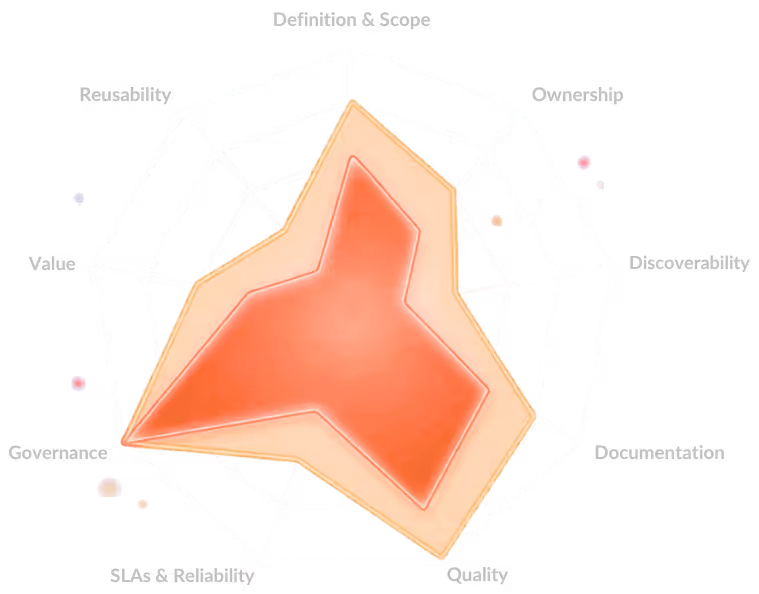
A 9-dimension self-assessment used by 100+ data teams to benchmark strategy, ownership, and platform readiness.


Muskan Purohit
Muskan Purohit is a Technical Writer contributing to community projects and tech journalism initiatives on Modern Data 101. She focuses on articulating modern data systems, platforms, and AI-driven architectures. Formerly, she worked with Amazon, training AI models and LLMs in collaboration with data developers. In addition, she has also led projects as a Content Manager @Lead with Tech, driving advocacy across data and technology domains.
Read the ideas here. Build them with The Modern Data Company.
Modern Data 101 is where the data community thinks out loud. When you're ready to move from articles to architecture, data products, governed AI pipelines, or a full Data Operating System; the team behind this community can help you build it.
Continue reading
.png)