
Generative AI Can Become An Engineering Disaster
Generative AI's soaring costs have critics calling it an engineering disaster. Here's what's actually broken and how CDOs can fix the ROI math.

TL;DR
If generative AI is so powerful, why are so many enterprise deployments failing to deliver ROI?
The answer has less to do with model capability than the systems they’re deployed into. This guide explores where generative AI ends, where agentic AI begins, and why data architecture has become the biggest determinant of AI cost, reliability, and ROI.
[state-of-data-products]
What Is Generative AI?
Generative AI is a class of machine learning systems trained to produce new content, text, code, images, and audio by predicting the most probable next element in a sequence from patterns learned across large datasets. Large language models such as GPT-4 and Claude fall into this category, alongside diffusion models for images.
Ask a generative model something, and it answers once, from static trained weights plus whatever sits in the prompt. It carries no ongoing memory of your systems, and nothing forces it to check its own answer against a source of truth.
Generative AI Platforms Compared: GPT, Claude, Gemini and Open-Weight Models
.avif)
That middle column is the tell. Every major platform converges on the same recipe: transformer architecture, trained at scale, priced by the token, which is exactly what critics point to when they argue the industry stopped experimenting and started scaling a single bet.
[related-1]
Agentic AI vs Generative AI: What’s the Real Difference?
.avif)
The table above shows what separates the two categories: trigger, output, memory. The workflow below shows how that separation actually plays out, prompt by prompt.
.avif)
The distinction shifts where cost and risk live. Two AI agents sharing the same pipeline can disagree entirely on what “approved supplier” means, because meaning was never encoded anywhere durable. Scaling that gap across an agentic workforce compounds the disaster instead of fixing it.
[report-2025]
Why Is Generative AI Called an Engineering Disaster?
The label sticks for a straightforward reason: inference costs scale in a way that doesn’t level off, and enterprises keep re-paying for context they never structured the first time. Gartner puts a number on the downstream effect:
.avif)
Reasons Generative AI Is Called an Engineering Disaster:
- Re-explaining the same context to a model on every single call burns compute for no new value.
- Treating a probabilistic text generator as a system of record produces expensive, avoidable failures.
- Training and inference costs scale in a way few comparable technologies ever have.
Reasons the Engineering Disaster Label Doesn’t Hold Up:
- No technology in history has moved from research paper to general-purpose enterprise tool this fast.
- Capability keeps compounding even as the criticism repeats, which undercuts the idea that the approach itself is broken.
What both camps skip is the systems-level view. On the generative-AI supply chain, researchers Cooper and Levy highlight how frame models like GPT-4 and Stable Diffusion are, at most, one component inside a much larger operational system; never a complete one on their own.
The real engineering failure is how many organisations skipped the layer meant to sit around that component: governed, semantically consistent data that gives a model something trustworthy to reason over. Without it, every call re-derives context from scratch, and the economics look exactly as bad as critics describe.
A Real Enterprise Example of Where Generative AI Breaks
Picture a claims team using a generative model to draft denial letters. Every letter reads fluently. None is checked against the policy that governs the claim, because the model was never given access to it.
.avif)
What typically happens next:
- An agent is layered on top to speed up the workflow, and the unchecked pattern multiplies rather than resolving.
- Nobody owns the policy data the model would need, so the gap becomes permanent rather than a one-off bug.
- Fixing it later costs more than building the data discovery and catalogue layer would have cost up front.
Generative AI is not the disaster. But it becomes one when deploying it without the infrastructure that makes its answers trustworthy, and most agentic rollouts fail at exactly that interface, not the model underneath them.
.avif)
A claims team’s AI drafted denial letters that read perfectly and were never checked against the policy governing the claim, because the model was never given access to it.
Lean AI walks through what that policy layer requires: Lean AI: Building a Scalable Data Platform for Enterprise AI ROI.
FAQs
What is generative AI in simple terms?
Generative AI creates new text, images, code, or audio by predicting patterns learned from training data. It responds once per prompt, using static trained weights, with no memory of your systems unless that context is built in separately.
What is the difference between generative AI and agentic AI?
Generative AI is reactive: it produces content only when prompted. Agentic AI is proactive: it plans, calls tools, and moves through multi-step workflows largely without supervision, typically using generative models as one component inside that loop.
Why do generative AI projects fail in production?
Most failures trace back to the same root cause: the model was deployed without governed, trustworthy data to reason over, so it produces fluent but unverified output. Gartner’s research on AI-ready data backs this up directly: most abandoned AI projects fail for data-readiness reasons, not model-capability reasons.
Will agentic AI replace generative AI?
No. Agentic AI depends on generative models to reason and produce content at each step; it orchestrates them rather than replacing them. The more relevant question is whether your data is structured well enough for either to work reliably.
Connect with a community data expert
A no-cost session with a practitioner who's been where you are.
About Modern Data 101
Modern Data 101 is a movement redefining how the world thinks about data. A community built by the same team behind the world’s first data operating system, Modern Data 101 sits at the intersection of data, product thinking, and AI. Spread across 150+ countries, the community brings together a global network of practitioners, architects, and leaders who are actively building the next generation of data systems.
At its core, Modern Data 101 exists to simplify the journey from raw data to tangible and observable impact. It advocates high-potential data systems and next-gen architectures to unify and activate insights and automation across analytics, applications, and operational workflows at the edge.
In a world shifting from data stacks to AI ecosystems, Modern Data 101 helps teams not just navigate the change but lead it.


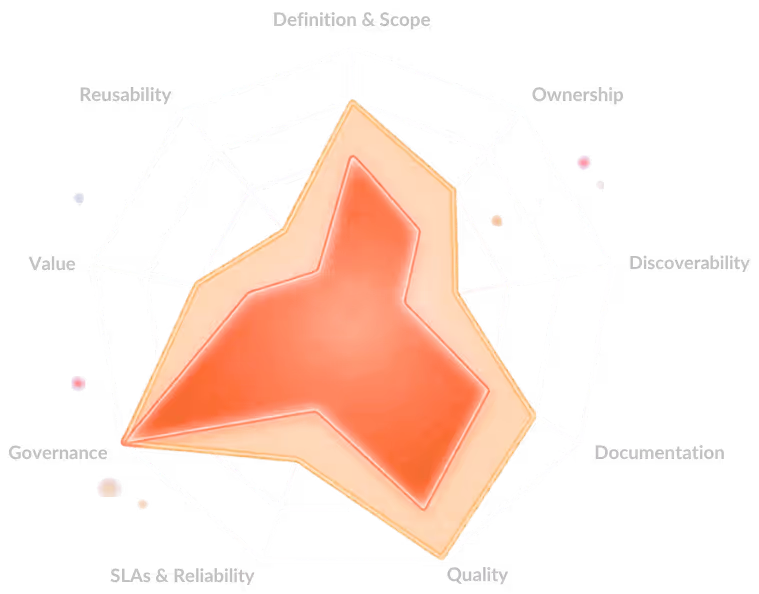
Where does your org stand on data product maturity?
A 9-dimension self-assessment used by 100+ data teams to benchmark strategy, ownership, and platform readiness.


Akshay Chame
Akshay is a GenAI/ML engineer building production-grade AI systems, including RAG pipelines, AI agents, MCP servers, and LLM fine-tuning. An IEEE-published researcher and Smart India Hackathon 2023 winner, he is focused on scalable, reliable AI systems that move intelligent solutions from experimentation to production.

Muskan Purohit
Muskan Purohit is a Technical Writer contributing to community projects and tech journalism initiatives on Modern Data 101. She focuses on articulating modern data systems, platforms, and AI-driven architectures. Formerly, she worked with Amazon, training AI models and LLMs in collaboration with data developers. In addition, she has also led projects as a Content Manager @Lead with Tech, driving advocacy across data and technology domains.
Read the ideas here. Build them with The Modern Data Company.
Modern Data 101 is where the data community thinks out loud. When you're ready to move from articles to architecture, data products, governed AI pipelines, or a full Data Operating System; the team behind this community can help you build it.
.png)

.png)

.png)
