Why Enterprises Need a Semantic Data Model to Drive Business Success
What does building semantic layers in complex enterprise environments do? This one explores that!

Every enterprise needs 'AI at scale' today. But most are still wrestling with a more fundamental gap: nobody in the organisation agrees on what the data actually means. Very often, organisations rely on tribal knowledge, brittle pipelines, and heroic analysts who “just know” where the truth lives.
Semantic data models solve this root problem by providing your business with a shared, machine-understandable language, the foundation on which every Data Product, AI system, and Agentic workflow can operate without human babysitting.
In this article, we unpack what a semantic model is, why a semantic data model is essential for enterprises, and how it unlocks actionable insights across teams.
[playbook]
What is a Semantic Data Model?
Every data system has a schema, comprising a structure that defines entities, attributes, and relationships. It tells the system what exists and how pieces of data connect. This is the foundation of any data model: a blueprint for organising information.
[related-1]
However, this defines the storage primarily. That’s where the “semantic” part comes in. In a semantic context, we care about what the data represents in business terms. This enables translating technical data into business language, so data becomes understandable and actionable across the domains.
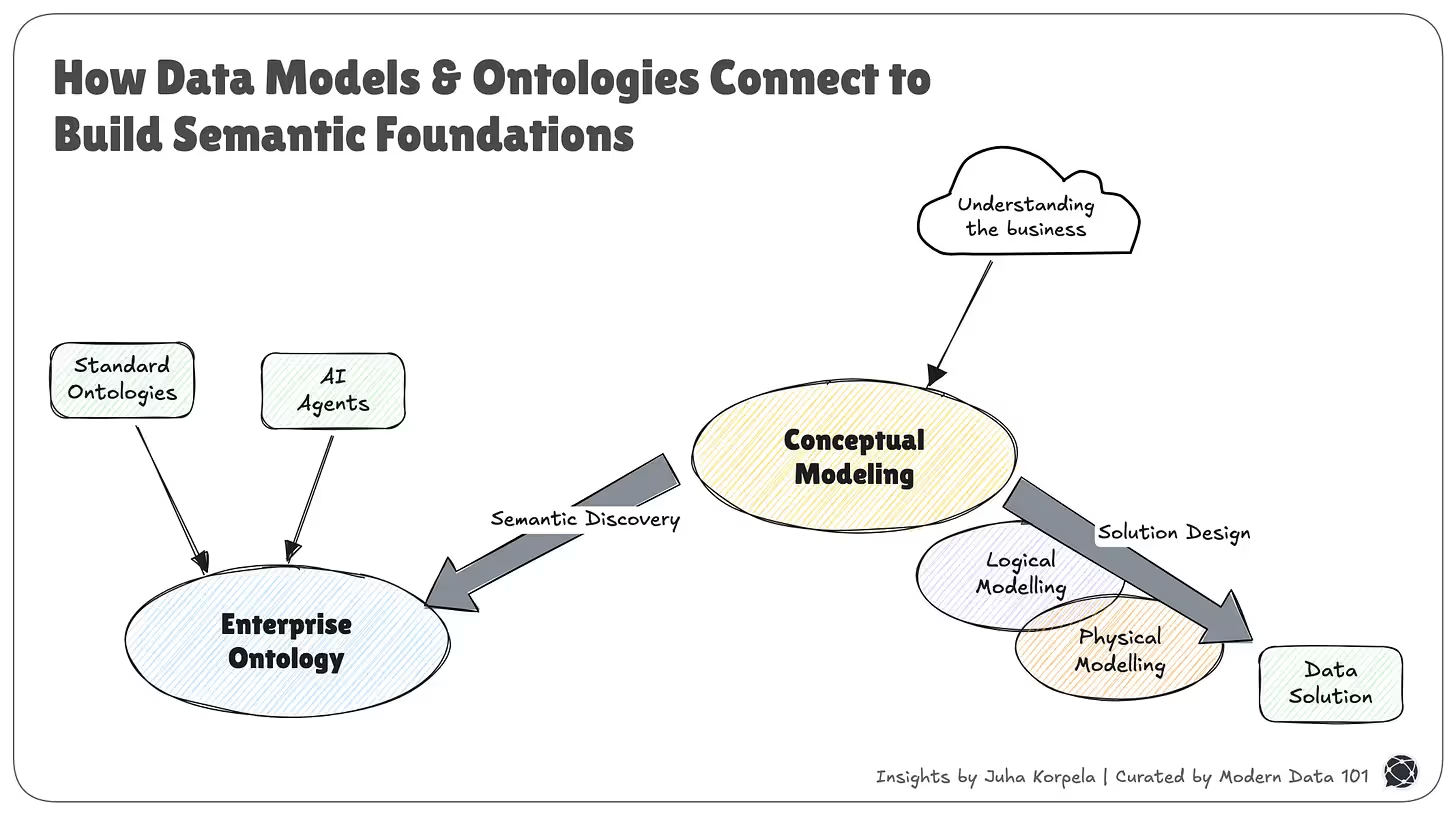
A semantic data model sits between raw data and analytics, capturing entities, relationships, and calculations in ways that reflect real-world business concepts.
[related-2]
A Semantic Data Model vs. a Relational Data Model
Unlike a traditional relational or physical database schema, which is optimised for storage, indexing, and technical efficiency, a semantic data model prioritises business context and clarity. This focuses on how people understand and use it. By translating tables, columns, and joins into business entities, metrics, and relationships, the semantic model turns raw data into a shared language that teams can act on.

What are the Benefits of Semantic Data Models for Businesses?
A semantic data model turns raw data into a trusted, usable asset.
Consistency and a single source of truth
Semantic models enable leveraging a unified definition of entities and metrics to reduce discrepancies across teams.
Self-service analytics
Self-serve analytics enable business users to access dashboards and reports in business terms, without wrestling with SQL or raw tables.
Reduced reliance on technical teams
Introducing a semantic layer in the data stack enables centralised business logic that empowers non-technical users and improves agility.
Better decision-making and trust
Semantic models mirror real-world business logic, making insights accurate and aligned.
Faster onboarding and scalability
New data sources integrate smoothly without breaking existing reports.
[report-2025]
Best Practices for Semantic Models for Enterprises: A Data Product Approach
What is the problem with semantic models? In large enterprises with many teams, data sources, and evolving requirements, semantic definitions get scattered, logic breaks when underlying data changes, and maintenance becomes difficult.
So, how does a Data Product Platform help Semantic Modelling?
Such platforms provide a unified infrastructure that abstracts away low-level plumbing (ingestion, storage, compute, deployments) and offers a consistent, “outcome-first” experience for data teams.
Treat Data as a Product
A data product platform encourages a product mindset. Data with its semantics, metadata, transformations, and governance, becomes a first-class product.
That means semantic definitions like entities, relationships, metrics, and dimensions are governed data products that are discoverable, addressable, understandable, accessible, and trustworthy.
Ensure Semantic Consistency at Scale with a Unified Architecture
Instead of stitching together dozens of “point tools” (ETL pipelines, catalogs, governance modules), each with its own semantics, a Data Product Platform offers a composable set of atomic building blocks like storage, compute, policy, metadata, transformation, and access control.
Because all data products live on the same platform, semantic definitions and metadata propagate uniformly. That avoids semantic drift or conflicting definitions when new data sources are onboarded.
[related-3]
Maintain Semantic Layers with Infrastructure-as-Code + Modular Design
Platforms like data product platforms are built with the fundamentals of a Data Developer Platform (DDP). This exposes infrastructure and transformations declaratively (via config, spec files, code), like software, allowing teams to version, test, monitor and evolve semantic definitions. So when source data changes or business logic shifts, the semantic model can evolve reliably without breaking downstream analytics or dashboards.
Reuse, Discover, and Govern
In a Data Product Platform, each semantic model, each dimension, measure, entity relationship, becomes a self-contained data product: with metadata, lineage, quality controls, access policies, and versioning.
That means different teams, analytics, finance, marketing, and product can reuse shared semantic definitions rather than building their own variants. The result: shared language, shared trust, shared metrics across the organisation.
Ensure Agility and Scalability
Because DDP abstracts infra details and offers standardised patterns, teams can spin up new data products fast (new domains, new data sources) while preserving semantic consistency. It also supports both batch and streaming, hybrid deployment models, and multi-tenant data architectures, making it suitable for large-scale, evolving enterprises.
Final Note
For enterprises that want to operate with clarity, speed, and confidence, a semantic data model is no longer optional.
Getting started doesn’t require a big-bang transformation. The following steps require defining core business entities and metrics that are of top priority and modelling these metrics leveraging tools like Power BI’s semantic layer or dbt semantic layer.
Additionally, what becomes essential is embedding governance so definitions remain consistent as the business evolves.
Enterprises investing in platforms like data developer platforms and data product platforms put themselves on a faster path to better insight, quicker action, and consistent data for sustainable growth and competitive edge.
FAQs
Q1. What makes a good semantic model?
One that clearly defines business entities, metrics, and relationships in a consistent, reusable, and tool-agnostic way. It should be easy for both technical and business teams to understand and extend.
Q2. What is an example of a semantic data model?
A retail model connecting Customers → Orders → Products → Revenue, with metrics like total sales or average order value defined once and reused across dashboards and teams.
Q3. What is a semantic database?
A database that stores data with explicit meaning, using entities, relationships, and semantics, so systems and users can query data based on concepts instead of raw tables or columns.
Connect with a community data expert
A no-cost session with a practitioner who's been where you are.
About Modern Data 101
Modern Data 101 is a movement redefining how the world thinks about data. A community built by the same team behind the world’s first data operating system, Modern Data 101 sits at the intersection of data, product thinking, and AI. Spread across 150+ countries, the community brings together a global network of practitioners, architects, and leaders who are actively building the next generation of data systems.
At its core, Modern Data 101 exists to simplify the journey from raw data to tangible and observable impact. It advocates high-potential data systems and next-gen architectures to unify and activate insights and automation across analytics, applications, and operational workflows at the edge.
In a world shifting from data stacks to AI ecosystems, Modern Data 101 helps teams not just navigate the change but lead it.


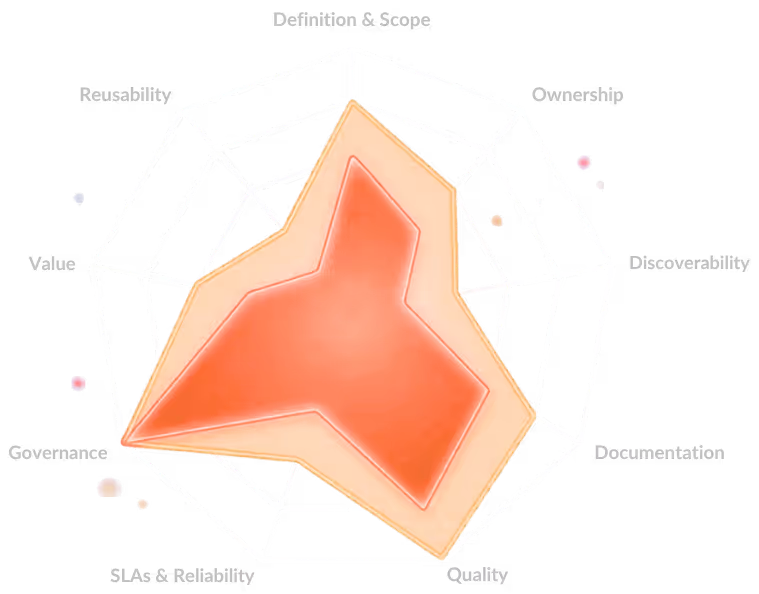
Where does your org stand on data product maturity?
A 9-dimension self-assessment used by 100+ data teams to benchmark strategy, ownership, and platform readiness.


Ritwika Chowdhury
Ritwika Chowdhury is a data and technology professional focused on data products, AI, and modern data architecture. Her work sits at the intersection of data strategy, product thinking, and emerging AI technologies, with a focus on helping organisations turn enterprise data into trusted, usable, and scalable assets.
Read the ideas here. Build them with The Modern Data Company.
Modern Data 101 is where the data community thinks out loud. When you're ready to move from articles to architecture, data products, governed AI pipelines, or a full Data Operating System; the team behind this community can help you build it.
Continue reading
.jpg)
.png)

.png)