Machine Learning Model Challenges: From Types and Drift to Enterprise Scale
A 95% test score won't protect your algorithms from real-world data decay. Discover the core types of machine learning models, their biggest production challenges, and how governed data platforms keep them reliable.

TL;DR
- The Core Crisis: A machine learning model scoring 95% accuracy in testing can quietly fail within months due to severe real-world data and pipeline challenges.
- Key Challenges Highlighted:
- Data Quality Decay: Information fidelity degrades at every join, aggregation, and mapping before reaching the model.
- Silent Drift: Concept and data drift cause live performance to quietly diverge from baseline training accuracy.
- Engineering Friction: The “Multiple-Language” orchestration problem creates massive deployment and compatibility bottlenecks.
- Scalability & Cost: Provisioning GPU-backed infrastructure for complex neural networks without MLOps leads to severe resource overconsumption.
- The Strategic Fix: Overcoming these machine learning model challenges requires shifting from raw tables to governed Data Products that guarantee data health before a model ever receives a row.
A model that scored 95% accuracy in testing can quietly degrade within months of going live, and the root cause is rarely the algorithm. It’s almost always the data feeding it.
This article breaks down what machine learning models are, the main types of machine learning models, why they struggle outside controlled environments, and how modern data platforms for AI are becoming the missing layer that keeps them reliable.
What Are Machine Learning Models and How Do They Function?
At the simplest level, machine learning models are mathematical systems trained on data to recognise patterns and make predictions without being explicitly programmed for every scenario. Instead of hand-coded rules, a model learns relationships from historical examples and applies them to new, unseen inputs.
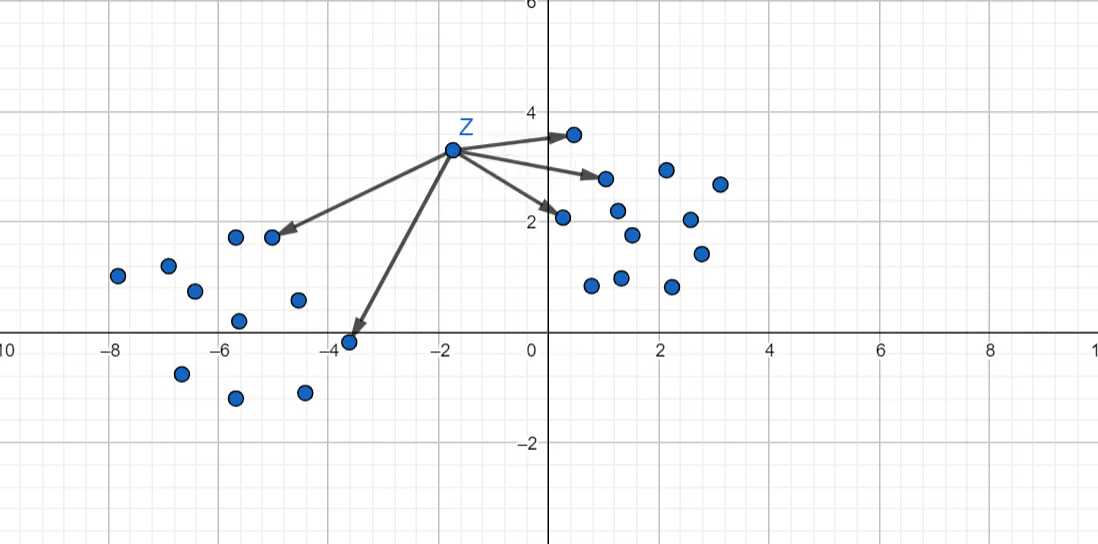
But a model is more than just its trained parameters. As researchers at Amazon Science point out, defining “the model” itself is surprisingly difficult; it includes the feature transformations, the assumptions about incoming data distributions, and often an entire pipeline of preprocessing steps that must be managed alongside the algorithm (Schelter et al., “On Challenges in Machine Learning Model Management,” IEEE Data Engineering Bulletin). This is why so many “model” problems are actually data and pipeline problems in disguise.
[playbook]
Understanding the Types of Machine Learning Models
Understanding the types of machine learning models helps clarify why different use cases demand different data strategies.
- Supervised learning models: Trained on labelled data to predict outcomes, such as demand forecasting or fraud detection.
- Unsupervised learning models: Find hidden structure in unlabeled data, useful for clustering and anomaly detection.
- Reinforcement learning models: Learn through trial and error against a reward signal, common in robotics and recommendation engines.
- Deep learning / neural network models: Layered architectures that automatically learn complex representations from raw data, are now dominant in forecasting, imputation, and language tasks.
Each type carries its own data appetite. Classical time-series models can be retrained cheaply, while deep neural forecasting models “have the ability to learn complex patterns across time series” and generalise well, but require careful long-term management once deployed.
[related-1]
Why Machine Learning Models Struggle in Production
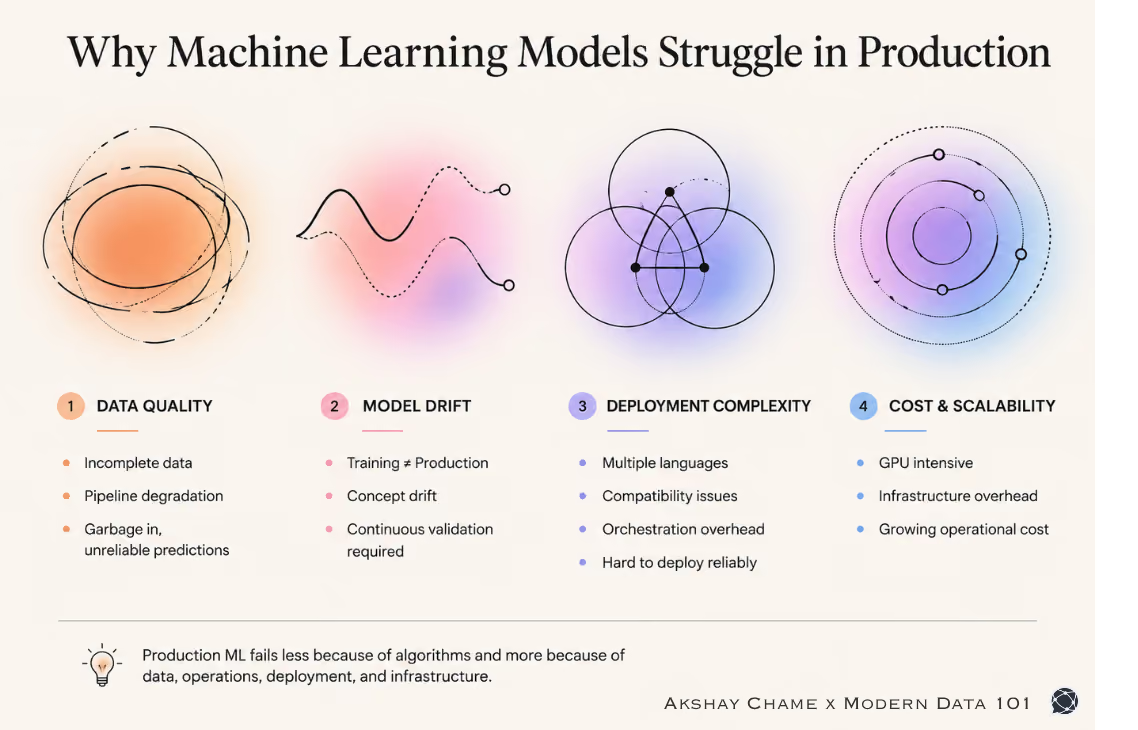
1. Data-Related Challenges
Poor data quality remains the single most cited obstacle across ML research and practice. Real-world datasets are frequently incomplete, mislabeled, or non-representative of the conditions a model will actually face, and cleaning that data often consumes more time than building the model itself.
“ML is as good as the data you feed. AI is as good as the intelligence you feed it” ~ Source.
A related piece on AI-readiness notes that data quality erodes at every pipeline stage, starting near 95% fidelity at the source and degrading with “every join, aggregation, mapping, and enrichment” before it ever reaches the model.
2. Model Validation and Drift
Validating a model once isn’t enough. Models must be back-tested continuously, since “models evolve continuously as data changes, methods improve, or software dependencies change” (Amazon Science). Left unmonitored, this shows up as concept drift, a well-documented failure mode where live performance quietly diverges from training-time accuracy.
3. Engineering and Deployment Complexity
Deploying a model into mobile apps, web platforms, or cloud systems introduces compatibility and orchestration overhead. Amazon Science’s researchers describe this as the “Multiple-Language Smell” problem: ML codebases mixing Python, JVM-based systems, and specialised hardware runtimes that are hard to keep consistent and even harder to deploy reliably.
4. Cost and Scalability
Training deep learning models at scale requires GPU-backed infrastructure that’s expensive to provision and easy to over-consume, particularly for smaller teams without dedicated MLOps support.
[related-2]
Overcoming ML Model Challenges with AI Data Platforms
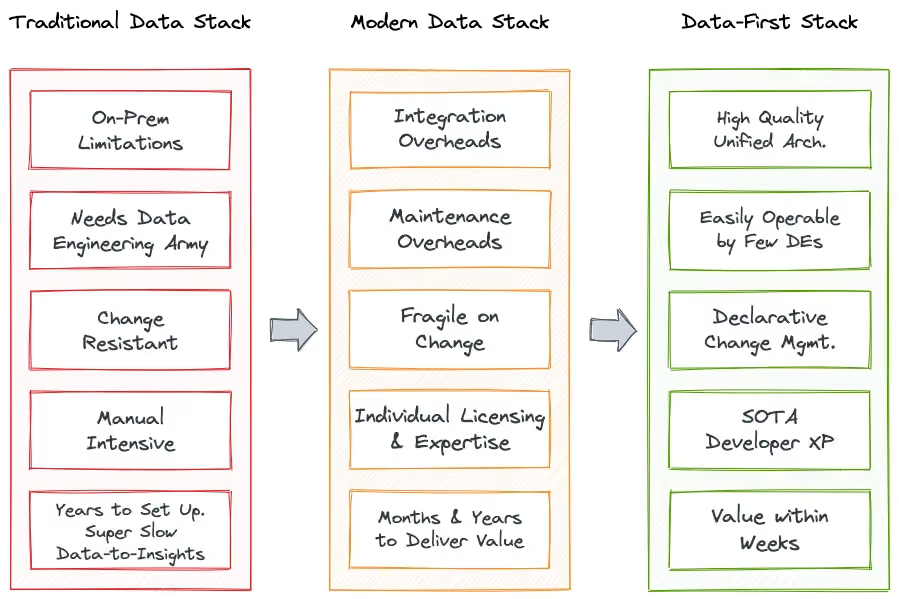
This is where data platforms for AI enter the picture. Rather than treating data quality as a one-time cleanup task, modern platforms embed governance, semantics, and lineage directly into the data itself, before it ever reaches a model.
"The missing layer for enterprise AI is the Data Product, and the right way to build Data Products is above the engine, not inside it."
Mapped to specific failure modes: drift gets caught at the contract level, not after output quality slips. Inconsistent definitions ("active customer," "churn") collapse into one queryable meaning instead of team-specific re-derivations. Reproducibility improves because lineage traces a model's inputs back to their exact source, not tribal memory. Governance travels with the data itself, so teams no longer trade access control for velocity.
This directly addresses the conceptual gap Amazon Science's researchers flagged a decade earlier: the lack of a "declarative abstraction for end-to-end ML pipelines" that can be inspected, queried, and reused. Platforms like DataOS by The Modern Data Company close that gap by making metadata, lineage, and semantics queryable infrastructure rather than scattered tribal knowledge. The Data Developer Platform offers practical patterns for standardising how models consume governed data products over raw tables.
Conclusion: Solving Machine Learning Model Challenges at the Foundation
The challenges facing machine learning models, like poor data quality, drift, deployment friction, and cost are rarely solved by better algorithms alone. They’re solved by better foundations. As enterprise AI matures, the organisations succeeding aren’t the ones with the fanciest models; they’re the ones treating data as a governed, reusable product rather than an afterthought.
If you’re evaluating your own ML stack, the first question worth asking isn’t “which model architecture?” It’s “what does our data platform for AI actually guarantee before that model ever sees a row of data?”
FAQs
Q1. What are the challenges of machine learning models in AI?
The core challenges are data quality (missing values, outliers, insufficient volume), overfitting or underfitting, poor interpretability in complex models, weak generalisation to new data, scalability and compute cost, and bias inherited from training data. In production specifically, models also face drift, silent degradation, and reproducibility gaps when lineage isn't tracked.
Q2. What are the types of machine learning models?
Machine learning models are typically grouped by learning approach: supervised (regression, classification), unsupervised (clustering, dimensionality reduction), semi-supervised, and reinforcement learning. Within these, common architectures include decision trees, ensemble methods (random forests, gradient boosting), neural networks (CNNs for vision, RNNs/transformers for sequence and language tasks), and classical statistical models like linear/logistic regression.
Q3. Why is monitoring important for ML models in production?
Once deployed, models can degrade silently since they're often treated as black boxes with no visible failure signal the way software crashes do. Without proper monitoring, issues like a broken data pipeline, an unavailable feature, or a stale model that needs retraining can go unnoticed, whereas monitoring lets teams detect these problems early and intervene. It also surfaces serving-level issues, such as unexpected traffic drops or latency high enough that predictions never actually get incorporated into the system.
Q4. What is data drift, and why does it matter?
Data drift is when the statistical properties of production input data shift away from what the model was trained on, causing prediction quality to decline even though the model itself hasn't changed. Model monitoring means continuous tracking of ML model quality in production, helping detect and debug issues and understand model behavior; drift detection is one of its central functions, since models decay over time and can make mistakes or predictions that don't make sense as real-world data shifts. Left unaddressed, drift compounds in multi-model pipelines: if one model in a chain gives wrong outputs, it can propagate downstream and degrade the quality of dependent models
Connect with a community data expert
A no-cost session with a practitioner who's been where you are.
About Modern Data 101
Modern Data 101 is a movement redefining how the world thinks about data. A community built by the same team behind the world’s first data operating system, Modern Data 101 sits at the intersection of data, product thinking, and AI. Spread across 150+ countries, the community brings together a global network of practitioners, architects, and leaders who are actively building the next generation of data systems.
At its core, Modern Data 101 exists to simplify the journey from raw data to tangible and observable impact. It advocates high-potential data systems and next-gen architectures to unify and activate insights and automation across analytics, applications, and operational workflows at the edge.
In a world shifting from data stacks to AI ecosystems, Modern Data 101 helps teams not just navigate the change but lead it.


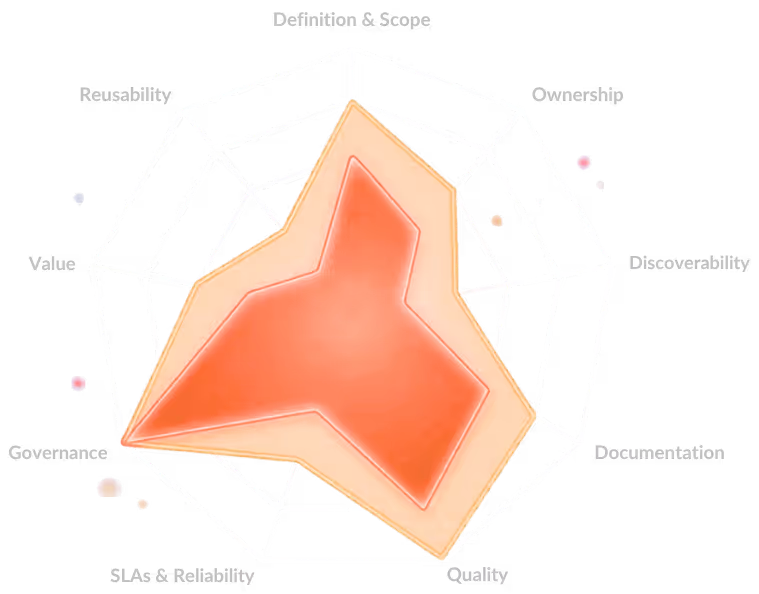
A 9-dimension self-assessment used by 100+ data teams to benchmark strategy, ownership, and platform readiness.




Akshay Chame
Akshay is a GenAI/ML engineer building production-grade AI systems, including RAG pipelines, AI agents, MCP servers, and LLM fine-tuning. An IEEE-published researcher and Smart India Hackathon 2023 winner, he is focused on scalable, reliable AI systems that move intelligent solutions from experimentation to production.
Read the ideas here. Build them with The Modern Data Company.
Modern Data 101 is where the data community thinks out loud. When you're ready to move from articles to architecture, data products, governed AI pipelines, or a full Data Operating System; the team behind this community can help you build it.
Continue reading
.png)

.png)