What are The Challenges of Data Lakes? How Data Lakehouses Address Them
The evolution of data lakehouses and modern-day lakehouse architecture that addresses the challenges of traditional lakes!

The data lake began as a bold idea; a single place to store everything. Structured or unstructured, raw or refined, it promised to scale infinitely and keep data flexible for any downstream use. It was meant to dissolve silos, power AI and ML at scale, and make data finally feel “free.”
But that freedom came at a cost. As more teams poured data in, few knew what lived inside. Governance weakened, quality drifted, and discovery turned into archaeology. The lake stopped being a system of insight and started feeling like storage with good intentions.
To understand why the Lakehouse emerged, we first need to unpack what went wrong with data lakes.
What is a Data Lake?
A data lake is a unified repository where every kind of data, structured tables, logs, images, text, is stored in their native form. It doesn’t force you to decide a schema ahead of time; instead, you bring in everything first and impose structure later (schema-on-read). Unlike a traditional data warehouse, which demands you shape data before it goes in, a lake lets you debug, experiment, and iterate over data without upfront constraint.
.avif)
Because it lives on low-cost object storage like Hadoop, AWS S3, or Azure Data Lake, the lake can absorb scale cheaply and flexibly. At the time of their inception, data lakes were meant to be open, a place where you centralise silos, let multiple engines coexist, and support everything from BI to AI. But that very openness is also the seed of chaos when you don’t guard it carefully.
[related-1]
The Challenges of Data Lakes
Data lakes were built to centralise, but without the right design principles, these ended up being a less reliable option for teams.
Following are the major challenges of data lakes faced by enterprises.
%20(1).avif)
1. Lack of Governance and Quality Controls
In most organisations, the data lake became a “write-first, think-later” environment. Anyone could drop in files, but no one felt responsible for the next course of actions.
Without clear ownership or validation rules, data pipelines broke silently, schemas drifted over time, and duplicates crept in. Ultimately, quality issues compounded until the data itself lost credibility.
For analytics and AI teams, that meant long debugging cycles and unreliable insights, not because the tools failed, but because the foundation wasn’t governed.
2. Limited Discoverability and Usability
Finding the right dataset in a data lake can often feel like searching for meaning in a hard drive dump.
In multiple scenarios, metadata exists in silos (if at all there is metadata). There’s little context around how data was created, what transformations it’s undergone, or whether it’s still relevant. Without effective lineage or documentation, analysts end up rebuilding work others have already done, which is a quiet productivity tax that grows with every terabyte.
The data lake promised democratisation, but in practice, it made discovery a specialist’s job.
3.Fragmented Tooling and Vendor Lock-In
The openness of data lakes was meant to allow diverse tools to coexist, each serving a different workload. According to Modern Data Survey 2024, users spend 1/3rd of their time jumping between tools.
But this freedom often produces friction. Tooling choices locked teams into specific ecosystems or forced custom integrations between storage, governance, and compute layers. What should have been open architecture started to behave like a fragmented patchwork.
[related-2]
4. Performance and Scalability Bottlenecks
Raw object storage is cheap and infinitely scalable, until you actually try to query it. Compute costs rise quickly when every analysis has to read massive, unoptimised files. Indexing and caching strategies vary across engines, and as data volumes explode, so do query latencies. Many teams tried to layer on performance optimizations or caching engines, but that only increased complexity. The lake could store everything, yes but it struggled to serve anything efficiently.
5.Security, Access, and Cost Management
As data volume and diversity in its form grows, enforcing consistent access policies across layers become a nightmare. Role-based access might exist at the storage level but not extend cleanly to downstream tools.
Meanwhile, uncontrolled growth in storage and redundant compute workloads inflated costs. Despite it began as a cost-efficient model, data lakes end up turning into an expensive guessing game of who’s using what, and whether it’s even needed.
A Data Lakehouse: The Concept Launched to Address Lake Challenges
The concept of a data lakehouse emerged as an answer to a simple but persistent problem: how do you keep the flexibility of a data lake without sacrificing the reliability of a data warehouse?
This idea was positioned as the unifying layer, combining low-cost object storage with transactional integrity, governance, and analytical performance.
Lakehouse, popularised by Databricks, addressed some of the deepest technical flaws of data lakes. Features like ACID transactions, structured metadata layers, and performance indexing brought order to what was once an ungoverned swamp. Query performance improved. Governance became more consistent. For the first time, enterprises could imagine one architecture serving both data engineering and analytics at scale.
Does a traditional lakehouse put up its own challenges?
These early lakehouses still thought in storage-first terms. They solved how data is written and read, not how it is discovered, owned, or reused across domains. The focus was on file formats and table reliability, not on data’s product lifecycle or its operational meaning.
Yet, as data and AI matured, even the first generation of lakehouses began to show limitations. What organisations needed next wasn’t just a faster or cheaper data system, but one that could make data usable, interoperable, and accountable by design.
Proposed Transformations in a Lakehouse Architecture
Lakehouses lean on technical unification heavily, but require a certain level of systemic coherence too. This shift becomes crucial in terms of stepping beyond managing infrastructure and focusing on designing ecosystems that make data usable, reusable, and trustworthy by default.
Features of a Second Generation Lakehouse Architecture
Product-Led Architecture
Traditional lakehouses solve problems associated with structure and reliability, like files, tables, and transactions. This limits it to being storage-first.
A new idea of Lakehouse moves the center of gravity toward data products: well-defined, discoverable, and governed assets that encapsulate both data and context. Each product carries metadata, quality signals, and ownership, helping transform “tables and pipelines” into reusable capabilities.
This shift makes the system not just technically stable, but operationally accountable. Data stops being a byproduct of pipelines and starts behaving like a composable service.
Open by Design, Not Just by Format
The first generation of lakehouses often equated openness with file formats. A second generation of Lakehouse is open across interfaces, engines, and governance layers, which allows multiple compute frameworks to interoperate without friction. Metadata, lineage, and access policies become first-class citizens, shared across domains instead of trapped in tool-specific silos. This openness ensures that organisations are not locked into a vendor or architecture, but can evolve their ecosystems as needs grow.
AI-Ready and Ecosystem-Aware
Newer transformations in Lakehouses are designed for AI-native workloads. Its data products are self-describing, enriched with metadata that allows Agentic AI systems to discover, reason about, and use them autonomously. Governance becomes event-driven and intelligent, enabling automated data management at scale. Most importantly, it connects operational, analytical, and AI pipelines into a continuous ecosystem, one where models learn from production data, and production systems learn from models.
[related-3]
[related-4]
Rethinking Data Foundations for the AI Era
Data lakes democratised storage, and they made it easy to collect everything. The new generation of lakehouses democratises use, making data trustworthy, reusable, and ready for intelligence.
The shift isn’t about adding another storage layer; it’s about building open, interoperable systems where data behaves like a governed, composable asset. In this model, reliability and discoverability aren’t features; they’re the foundation. It’s how organisations move from simply storing data to activating it for AI, safely and at scale.
FAQs
Q1: What is the difference between Data Warehouse vs. Data Lake vs. Data Lakehouse?
A data warehouse stores structured, curated data for analytics and reporting. It’s reliable and governed but rigid and expensive to scale.
A data lake stores all data types in raw form on low-cost storage. It’s flexible and scalable but often chaotic, weak on governance, quality, and usability.
A data lakehouse combines both. It keeps the openness and scale of a lake while adding the structure, reliability, and governance of a warehouse, creating one unified system for analytics, AI, and data sharing.
Q2: What are the possible challenges for data mining?
Common challenges in data mining include poor data quality, inconsistent formats, missing or biased data, and lack of integration across sources. Other barriers are high computational costs, privacy concerns, and the difficulty of interpreting complex models in business context.
Connect with a community data expert
A no-cost session with a practitioner who's been where you are.
About Modern Data 101
Modern Data 101 is a movement redefining how the world thinks about data. A community built by the same team behind the world’s first data operating system, Modern Data 101 sits at the intersection of data, product thinking, and AI. Spread across 150+ countries, the community brings together a global network of practitioners, architects, and leaders who are actively building the next generation of data systems.
At its core, Modern Data 101 exists to simplify the journey from raw data to tangible and observable impact. It advocates high-potential data systems and next-gen architectures to unify and activate insights and automation across analytics, applications, and operational workflows at the edge.
In a world shifting from data stacks to AI ecosystems, Modern Data 101 helps teams not just navigate the change but lead it.


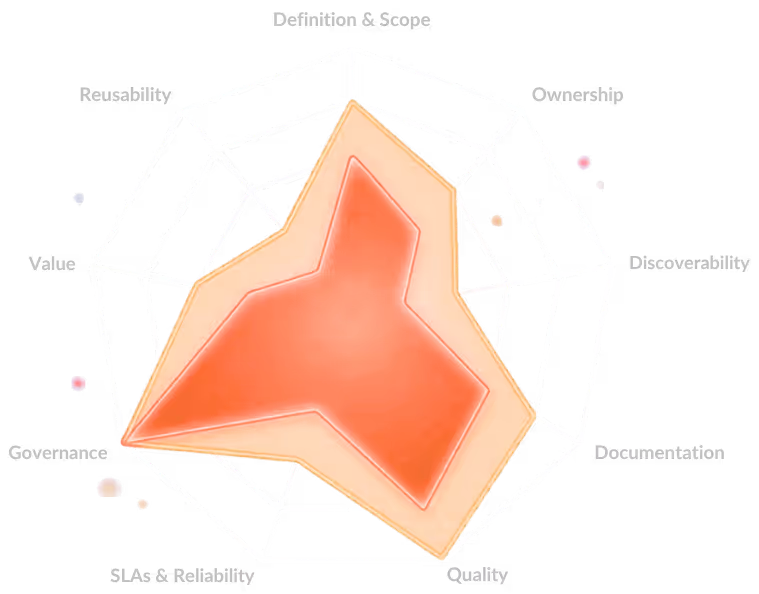
Where does your org stand on data product maturity?
A 9-dimension self-assessment used by 100+ data teams to benchmark strategy, ownership, and platform readiness.


Ritwika Chowdhury
Ritwika Chowdhury is a data and technology professional focused on data products, AI, and modern data architecture. Her work sits at the intersection of data strategy, product thinking, and emerging AI technologies, with a focus on helping organisations turn enterprise data into trusted, usable, and scalable assets.
Read the ideas here. Build them with The Modern Data Company.
Modern Data 101 is where the data community thinks out loud. When you're ready to move from articles to architecture, data products, governed AI pipelines, or a full Data Operating System; the team behind this community can help you build it.
Continue reading
.jpg)
.png)

.png)