Data Lakehouse vs Data Warehouse vs Data Mart
It's All About Building the Right Data Foundation for Your Organisation.

Choosing a data architecture isn’t about following the latest technological trend. It’s about deciding how your business will actually use its information without breaking the bank or the workflow.
Most think the Data Lakehouse vs Data Warehouse vs Data Mart debate is about selecting one “winner,” but the reality is a bit different. Be it Lakehouse, Warehouse, or Mart, all these are different ways to organise the data depending on who needs it and how fast they need it.
[state-of-data-products]
What Are Data Lakehouse, Data Warehouse, and Data Mart
Think of these data storage paradigms as your lens to the future or maybe the past, depending on what you want to do with them. These Analytical Data Stores can adjust to your business’s needs and help you zoom in or zoom out.
All three constructs (warehouse, lakehouse, mart) are attempts to solve one question: Where does data live so that decisions become predictable, repeatable, and scalable?
[data-expert]
What is a Data Warehouse
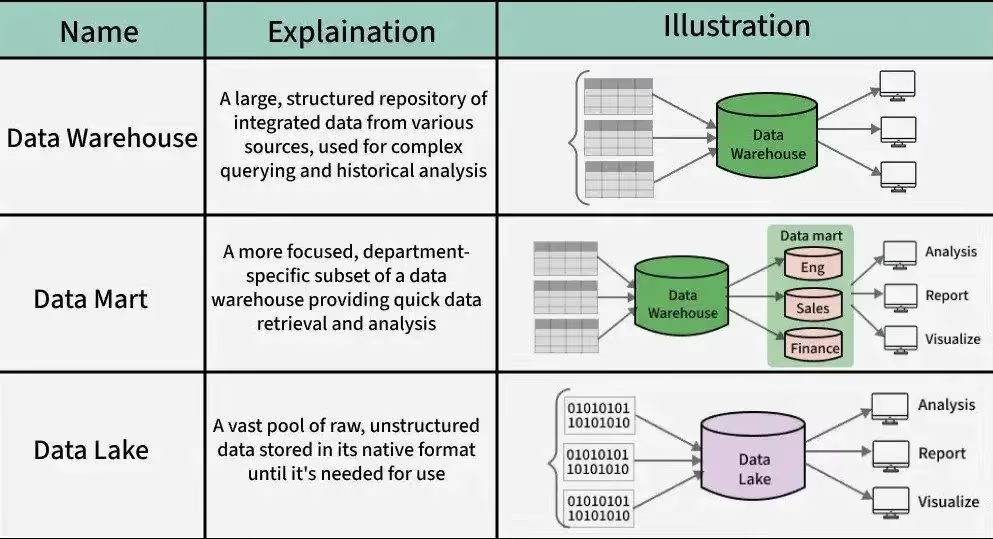
A data warehouse is a centralised, structured data repository designed to support reporting, analytics, and business intelligence.
It integrates data from multiple operational systems, applies predefined schemas and transformations, and stores historical data optimised for analytical queries rather than transactions.
Key characteristics of a data warehouse:
- Structured schema (schema-on-write)
- Cleaned and transformed data
- Historical data retention
- Optimised for analytical workloads (OLAP)
- Strong governance and consistency
A data warehouse optimises for trust, but trades flexibility for clarity by deciding how data should look before anyone touches it.
What is a Data Lakehouse
A data lakehouse is a unified data architecture that combines the low-cost, flexible storage of a data lake with the data management and performance capabilities of a data warehouse.
It enables storage of raw, semi-structured, and structured data in a single system while supporting transactional reliability, schema enforcement, and high-performance analytics.
Key characteristics of a data lakehouse:
- Open file-based storage (like a data lake)
- ACID transactions
- Schema enforcement and evolution
- Support for BI and advanced analytics (including ML)
- Separation of storage and compute
A data lakehouse allows you to store everything like a lake, but analyse it with the reliability of a warehouse.
What is a Data Mart
A data mart is a subject-oriented subset of a data warehouse designed to serve the analytical needs of a specific business function or department. It contains curated, domain-specific data structured for focused reporting and analysis.
Key characteristics of a data mart:
- Department or domain specific (e.g., finance, marketing)
- Derived from a warehouse or centralised data platform
- Optimised for specific business use cases
- Simplified schema tailored to users
A data mart is a focused analytical dataset built for a particular team or business function.
[related-1]
How Each System Organises and Serves Data
Your data organisation is directly proportional to how much friction your team feels when using it. It's like sorting your wardrobe for ease and speed. The lakehouse architecture is popular right now because it tries to stop the “silo” problem, but the warehouse and mart patterns are still the best way to handle specific, high-stakes reporting.
How a data warehouse manages data:
Data warehouses use a “Schema-on-Write” approach. This means you have to do the hard work of modelling the data before it ever hits a table. It’s slow to set up, but it makes the data incredibly reliable for the end user. You decide the structure first, and enforce types, relationships, constraints, and business logic upfront. The result is predictable performance, consistent definitions, and reports that don’t shift depending on who queries the data. Data warehouse optimises for governance and auditability.
How a data lakehouse manages data:
Meanwhile, lakehouse architecture flips this completely and allows different teams to use the same storage for different tasks. You don’t have to duplicate data just to run an ML model. Raw, semi-structured, and structured data can coexist in the same storage layer, with schema applied when needed.
It supports both “schema-on-read” and enforced schemas through table formats with transactional guarantees. This makes it adaptable. Analysts, data scientists, and engineers can work off the same underlying data without forcing everything into a rigid model on day one. Data lakehouse optimises for flexibility and scale, much needed in the age of AI.
[related-2]
How a data mart manages data:
Data marts act as a “fast lane.” Here, a specific department has the superpower to manage its own data without waiting for a centralised team to update the enterprise warehouse. It gives them the autonomy to move fast while still using the core data that everyone else is using.
Marts are curated, domain-specific views (finance, sales, marketing) designed around the metrics that matter to that team. They reduce cognitive overload. Instead of navigating enterprise-wide complexity, teams interact with a simplified, business-ready layer tailored to their decisions. They optimise for speed at the edge while preserving consistency at the core.
When to Use Each: Analytics, BI, and AI Workloads
The Data Lakehouse vs Data Warehouse vs Data Mart choice is like opting for a tool for the task. Each system is optimised for a different kind of risk.
When to use a data warehouse:
You use a data warehouse for the stuff that can’t be wrong: financial audits, regulatory reporting, and executive KPIs. If the rules of the data are carved in stone, put them in a warehouse.
When to use a data lakehouse:
Data lakehouse enters the game when the teams need raw, messy data for AI and ML use cases. A lakehouse lets you keep the raw files and the structured tables in the same place. This stops you from falling into the “safe bet fallacy”.
When to use a data mart:
Data marts are more focused and are like giving teams their own portion of data to manage without breaking the rules for everyone else. If the Marketing team is complaining that they can’t get their reports, give them a data mart.
How Modern Data Platforms Combine All Three
Modern data platforms combine lakehouse, warehouse, and mart patterns because each solves a different layer of the same organisational problem.
At the base, the lakehouse preserves raw signal and optionality, storing structured and unstructured data together so future questions remain possible.
On top of that, warehouse semantics impose discipline: core entities are modelled, definitions are standardised, and metrics are governed. This is where organisational truth stabilises.
Finally, mart-like interfaces emerge at the edge, presenting domain-specific abstractions without exposing enterprise-wide complexity.
The shift is philosophical. Centralisation no longer means controlling access, but means controlling the meaning and structure of semantics. Storage is flexible, modelling is disciplined, and consumption is domain-aligned.
This pattern is referred to as the Lakehouse 2.0 design paradigm:
Composable Data Architecture Pattern on Lakehouse 2.0
Aside from a technical upgrade, it is a shift in structure, way of working, and mindset. Built around openness, modularity, and real-time interoperability, Lakehouse 2.0 sheds the vertical stacks of the past and embraces a composable design.
A Data Architect is entrusted with designing the invisible scaffolding upon which data flows, transforms, and ultimately creates value. This isn't only about systems design, but about aligning the structure of data with how an organisation thinks, acts, and evolves.
-Animesh Kumar, creator behind the Data Operating System
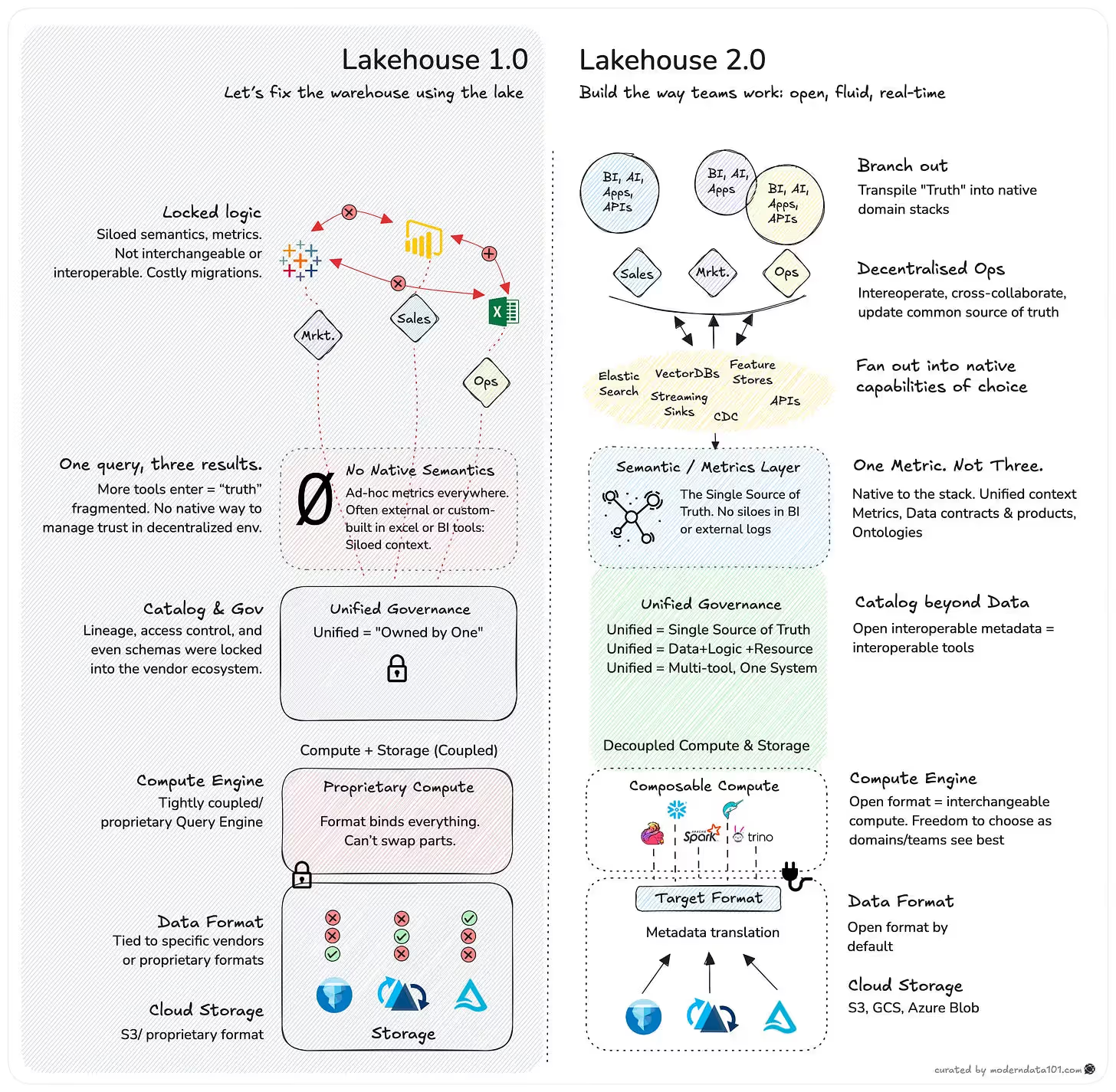
When the layers of data management and operations are cleanly separated, teams experiment without corrupting core metrics, executives trust dashboards without slowing innovation, and AI workloads operate on raw data without redefining business logic.
The future analytical platform is not a single architecture choice, but a composable stack designed to reduce friction between flexibility, consistency, and speed.
FAQs
Q1. Can a data lakehouse replace a data warehouse?
In most modern architectures, yes. But not in every scenario.
A data lakehouse can replicate the core capabilities of a data warehouse: structured tables, SQL analytics, ACID transactions, and governed schemas, often on cheaper, open storage. For many organisations, this makes running separate warehouse infrastructure unnecessary.
However, highly optimised, sub-second BI workloads, strict regulatory environments, or legacy ecosystems built around specific warehouse technologies may still justify a dedicated warehouse layer. The lakehouse reduces the need for warehouses; it does not eliminate every edge case.
Q2. Is a data mart just a small data warehouse?
A data mart and a data warehouse are technically similar but strategically different.
From a technology perspective, a data mart can look like a smaller warehouse, with structured tables designed for analytics. But strategically, a data mart is about ownership and scope.
A data mart represents a domain-specific slice of governed data, typically aligned to a department like marketing, finance, or product. Its purpose is to give teams autonomy and speed without redefining enterprise metrics. The difference is not size, but control and context.
Q3. Which is better for AI: Data Lakehouse or Data Warehouse?
The data lakehouse is generally better suited for AI workloads.
AI and machine learning require access to raw, granular, and often semi-structured data (logs, events, documents, embeddings) alongside structured tables. Traditional warehouses are optimised for curated, structured analytics, not large-scale raw file processing.
A lakehouse supports both raw file access for model training and structured layers for feature engineering and evaluation. It provides flexibility without sacrificing governance, making it a more natural foundation for AI-driven systems.
Connect with a community data expert
A no-cost session with a practitioner who's been where you are.
About Modern Data 101
Modern Data 101 is a movement redefining how the world thinks about data. A community built by the same team behind the world’s first data operating system, Modern Data 101 sits at the intersection of data, product thinking, and AI. Spread across 150+ countries, the community brings together a global network of practitioners, architects, and leaders who are actively building the next generation of data systems.
At its core, Modern Data 101 exists to simplify the journey from raw data to tangible and observable impact. It advocates high-potential data systems and next-gen architectures to unify and activate insights and automation across analytics, applications, and operational workflows at the edge.
In a world shifting from data stacks to AI ecosystems, Modern Data 101 helps teams not just navigate the change but lead it.


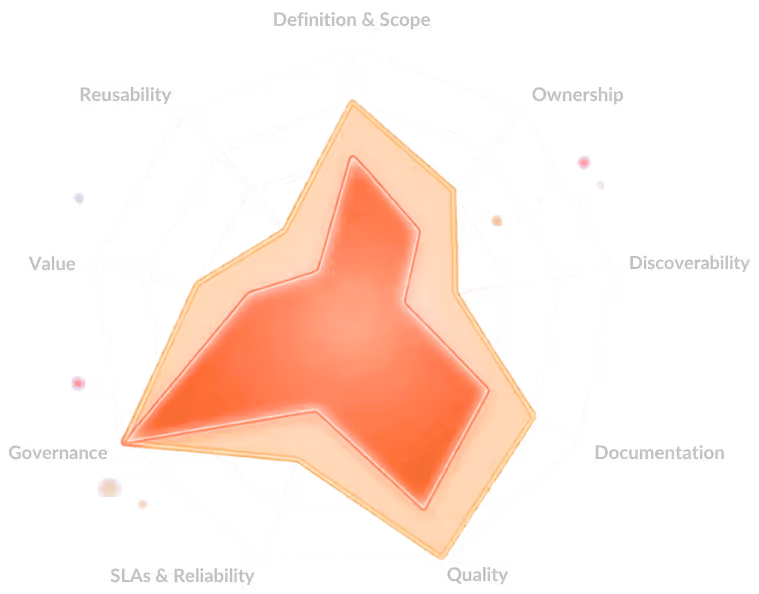
A 9-dimension self-assessment used by 100+ data teams to benchmark strategy, ownership, and platform readiness.


Akshay Jain
Akshay is a Staff Engineer in the Office of the CTO at The Modern Data Company, where he works at the intersection of research, architecture, and production. He focuses on building resilient, scalable systems and incubating next-generation capabilities for DataOS, creating production-ready foundations that enable modern data infrastructure to operate seamlessly at scale.

Swami Achari
Swami Achari is a Lead Tech Correspondent and Content Strategist who loves translating complex Data, Engineering, and AI concepts into compelling, high-impact stories. Grounded in a strong background in mainstream journalism, he seamlessly bridges traditional investigative reporting with cutting-edge technology communication. Currently exploring editorial strategy and content marketing for data-focused platforms, he works closely with industry thought leaders to build engaged tech communities and foster strategic growth through scannable, audience-first storytelling.
Read the ideas here. Build them with The Modern Data Company.
Modern Data 101 is where the data community thinks out loud. When you're ready to move from articles to architecture, data products, governed AI pipelines, or a full Data Operating System; the team behind this community can help you build it.
Continue reading