Digital Twins vs. Building Information Modeling: How Are They Different?
How the construction industry's handover gap is turning static blueprints into a liability, and what purpose-driven data products can do about it.

Last updated on 21st August, 2026
TL;DR: Executive Summary
- Design-Time vs. Run-Time: BIM is a "Design-Time" asset (the structural skeleton) defining physical geometry before occupancy. A Digital Twin is a "Run-Time" asset (the operational pulse) maintained in real time via live IoT connections.
- Overcoming the Handover Gap: Static BIM files begin to decay the moment keys are handed over. Digital twins connect live sensor telemetry to spatial models, preserving asset accuracy throughout the operational lifecycle.
- Schema-on-Design vs. Schema-on-Life: BIM relies on rigid rules set before construction; Digital Twins adapt dynamically to actual physical usage, mechanical wear, and operational changes.
- The Data Product Approach: Turning raw telemetry into governed, reusable data products establishes an AI-ready semantic layer, allowing single metrics (e.g., equipment health) to power multiple enterprise twins simultaneously.
For decades, the construction and design industries leaned heavily on 3D models for visualisations. However, in modern times, smart infrastructure and automated operations have surfaced an emerging confusion between the 3D design and 3D reality.
While both’Digital Twin’ and ‘BIM’ reflect the digital representation of a physical space, they serve entirely different masters within the data lifecycle. We are currently witnessing a massive “Design-Time” to “Run-Time” shift. In this new paradigm, digital twinning is the logical evolution of the modern data stack, transforming static architectural data into a living, operational asset.
Without much ado, let's dive into some basics:
What Is the Difference Between a Digital Twin and BIM?
Think of a digital twin as a living replica. It is a dynamic, virtual replica of a physical asset maintained in near real-time via continuous data connection.
While BIM is a blueprint. It defines the design intent, structural dependencies, and physical characteristics of a building before it is occupied. It is a collaborative process of creating and managing information for a built asset throughout its lifecycle, focusing primarily on design and construction.
Suppose BIM is a high-resolution photograph of a person capturing the form, features, and structure perfectly at a specific moment, while a digital twin is the live heart-rate monitor. One shows you the anatomy; the other shows you the pulse.
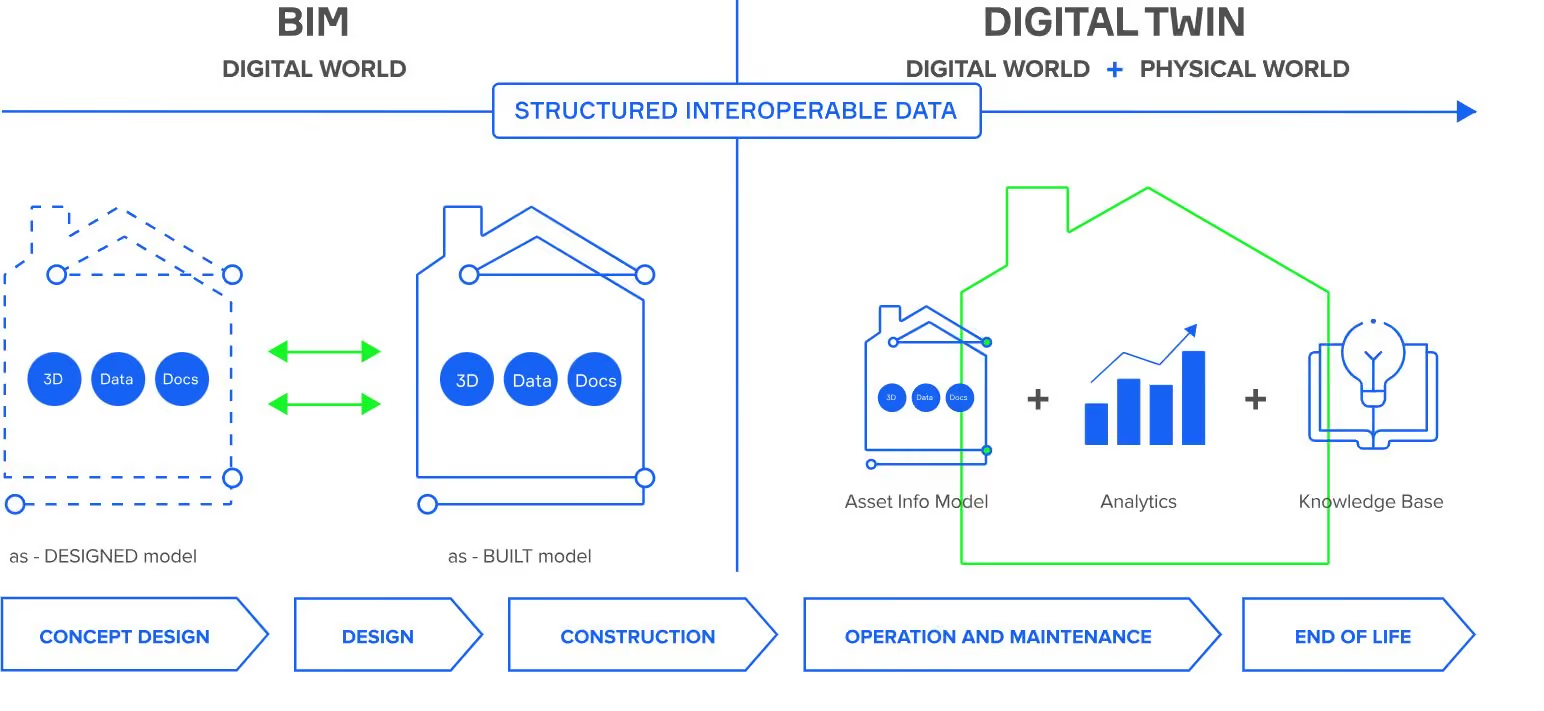
Technical Comparison: Digital Twin v/s. BIM
As we peel the architectural layers of the digital twin v/s. BIM, the differentiation becomes wider. While the digital twin serves as the nervous system, the BIM provides the spatial skeleton. Let’s understand these in a more layered manner:
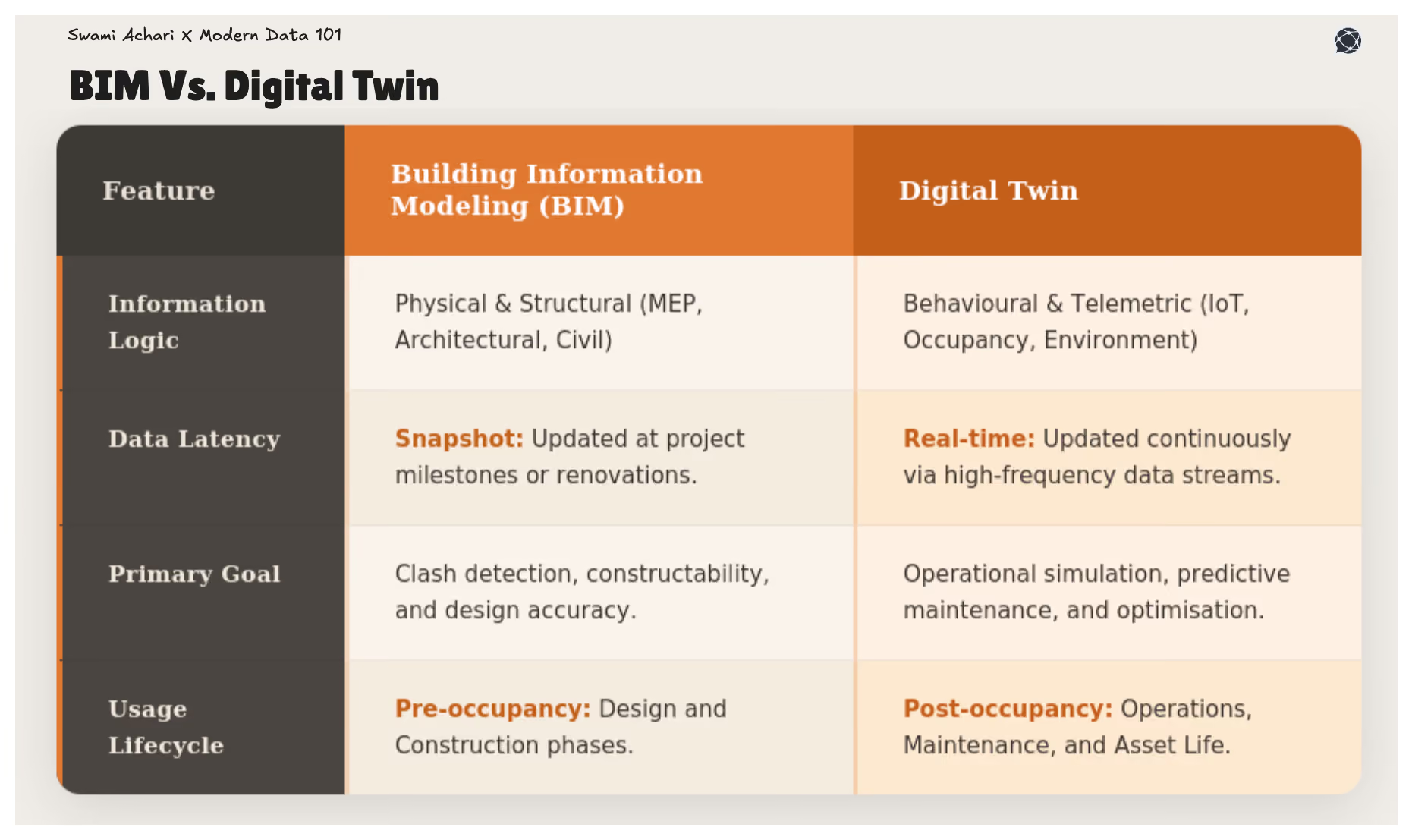
The fundamental shift here is in the Information Logic. BIM is “Schema-on-Design”, where you define the rules before the first brick is laid. Digital twin technology is “Schema-on-Life”, where the model must evolve and adapt to reflect the actual usage patterns and mechanical wear of the physical asset.
How Digital Twin Technology Bridges the “Handover Gap”
One of the most common failures in the Architecture, Engineering, and Construction aka AEC industry is the “Data Silo” created during the commissioning. In traditional workflows, a massive amount of high-fidelity BIM data is generated during construction, only to be “dumped” into a static archive once the keys are handed over. This is known as the Handover Gap.
Combatting Data Decay
In the absence of a live connection, the BIM data starts to decay the very moment a building is occupied. Renovations happen, HVAC units are replaced, and floor plans are modified, but the original BIM file rarely reflects these changes. Digital twin software acts as the bridge here, ensuring that the virtual model does not become a historical artefact, but a current reflection of the physical state.
[related-1]
From Spatial Awareness to Predictive Power
Suppose a BIM provides details on where a pipe is located in a building, whereas a digital twin gives information on when that pipe is likely to leak, based on the pressure fluctuations and vibrations. This shift from spatial awareness to predictive maintenance is exactly where the ROI of digital twinning shines. By tracking “As-Built” vs. “As-Designed” in real-time, organisations can move from reactive repairs to data-driven operational strategies.
How Data Products Boost the Capabilities of Digital Twins
Popular confectionery, pet care, and food company Mars incorporated a digital twin of its manufacturing supply chain to simulate operations, improve machine uptime, and reduce production waste through predictive insights.
It also enables reusable “use case apps” across 160+ facilities, giving end-to-end visibility and optimising supply chain decisions from production to consumption.
These crucial industry data points make digital twins a fundamental today. Industries have realised this, no doubt, but most still look ways to optimise their methods of digital twinning.
Architectural Requirements for AI-Ready Digital Twins
To be truly effective and future-proof, i.e., “AI-ready,” we must stop looking at the Digital Twin as a mere 3D file and adopt Data Product approach. In the current data space, a Digital Twin must be treated with the same rigour as any other critical business entity.
From Static Models to Managed Data Products
A Digital Twin delivers maximum business utility when it is discoverable, governed, and reliable. Replacing monolithic twins with modular DataOS data products (such as asset health, energy load, or throughput modules) gives clear ownership and strict SLAs to each component, converting conceptual demos into production-grade systems.
Reusability Across Enterprise Twin Ecosystems
A single well-designed data product (e.g., weather conditions, equipment health metrics, supply chain inventory powers multiple digital twins simultaneously, a manufacturing plant twin, a logistics twin, and an energy management twin, without rebuilding pipelines from scratch.
Embedded Semantic Layer
Raw sensor data + BIM can turn futile without context. Data products enforce an AI-ready semantic layer where, for instance, “22°C” is not just a value, but is tied to room to floor to zone to asset. This enables consistency across use cases and reusability across facilities to promote AI readiness. Without this, Digital Twins remain “visual shells,” not decision systems.
[related-2]
Scalability Through Decentralisation
In a data product platform, domain teams own and publish their data products. A factory floor team, for instance, publishes a "machine vibration" data product that multiple digital twins across the enterprise can subscribe to, enabling scale without centralised bottlenecks.
Interoperability and Open Standards
Proprietary “black box” systems slow down scaling. A robust digital twin architecture relies on Interoperability. By using open-standard data streams, vendor lock-in is ditched, and structural BIM data can communicate seamlessly with diverse IoT ecosystems.
Summary: Navigating the Architectural Continuum
The debate shouldn’t be digital twin vs BIM; it should be about how to layer these into a cohesive strategy. They share foundational similarities as digital representations of physical assets, but distinct differences make them complementary rather than identical.
BIM provides the essential structural foundation without which data has no place to live. The Digital Twin provides the intelligence which is the real-time pulse that turns a building from a concrete shell into a high-performance asset. The most successful organisations are those that stop chasing isolated models and start building a Context-First” architecture.
By evolving your static designs into living data products, you aren’t just managing a building; you are future-proofing your entire operational lifecycle.
[related-3]
Frequently Asked Questions (FAQ)
Q1. What is the fundamental difference between a digital twin v/s. BIM?
The core difference is live synchronicity. BIM is a static representation of design and construction (the “what”), while a digital twin is a real-time, data-connected replica of operations (the “how it’s performing”).
Q2. Can a digital twin exist without a BIM foundation?
Technically, yes. You can build a twin using reality capture (point clouds) or simple 2D schematics. However, without the deep structural metadata provided by BIM, the twin loses the “context” required for complex simulations and AI-driven insights.
Q3. What are the top benefits of a digital twin for asset owners?
Primary benefits of digital twin include: operational costs are reduced through predictive maintenance, energy efficiency is enhanced, and a unified “Source of Truth” for facility management, preventing data decay.
Connect with a community data expert
A no-cost session with a practitioner who's been where you are.
About Modern Data 101
Modern Data 101 is a movement redefining how the world thinks about data. A community built by the same team behind the world’s first data operating system, Modern Data 101 sits at the intersection of data, product thinking, and AI. Spread across 150+ countries, the community brings together a global network of practitioners, architects, and leaders who are actively building the next generation of data systems.
At its core, Modern Data 101 exists to simplify the journey from raw data to tangible and observable impact. It advocates high-potential data systems and next-gen architectures to unify and activate insights and automation across analytics, applications, and operational workflows at the edge.
In a world shifting from data stacks to AI ecosystems, Modern Data 101 helps teams not just navigate the change but lead it.


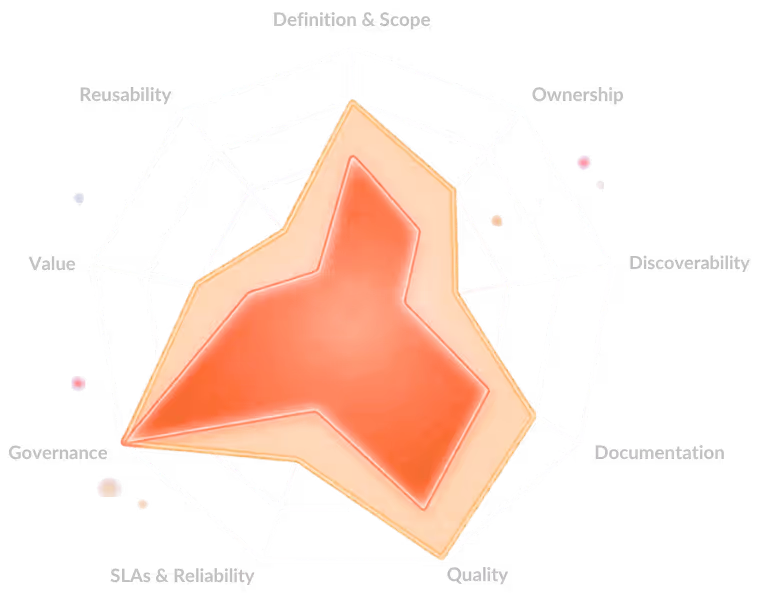
Where does your org stand on data product maturity?
A 9-dimension self-assessment used by 100+ data teams to benchmark strategy, ownership, and platform readiness.


Swami Achari
Swami Achari is a Lead Tech Correspondent and Content Strategist who loves translating complex Data, Engineering, and AI concepts into compelling, high-impact stories. Grounded in a strong background in mainstream journalism, he seamlessly bridges traditional investigative reporting with cutting-edge technology communication. Currently exploring editorial strategy and content marketing for data-focused platforms, he works closely with industry thought leaders to build engaged tech communities and foster strategic growth through scannable, audience-first storytelling.
Read the ideas here. Build them with The Modern Data Company.
Modern Data 101 is where the data community thinks out loud. When you're ready to move from articles to architecture, data products, governed AI pipelines, or a full Data Operating System; the team behind this community can help you build it.
Continue reading