
AI in Defence: Governance, Ontology, and Human-Machine Decision Architecture
A strategic framework for AI integration in defence institutions, covering task classification, governance architecture, explainability requirements, and the permanent limits of automation.

AI’s battleground is an algorithmic. The EU's European Defence Fund is committing hundreds of millions of euros to AI-driven projects spanning cyber defence, autonomous systems, and battlefield awareness.
The key question is how framing AI in terms of future human-level performance, which creates a misleading lens for defence policymakers. This is where the real challenge is around operational risk management.
Learn about risk intelligence here.
Across defence institutions, AI projects are already shifting from pilots to deployment. This marks a structural transition: the core engineering problem is how to integrate it safely into mission-critical environments without introducing new categories of operational risk.
The cost of error is extreme. A logistics calculation error from a probabilistic model can create operational failure at scale. A command decision delegated to an algorithm represents a loss of legal and moral accountability.
This is why AI in defence cannot be evaluated purely on capability. It must be governed through task-specific risk classification, where every AI system is aligned to the level of judgment, responsibility, and consequence it affects.
[state-of-data-products]
The Real Transformation: AI Decision Architecture for Defence
Across defence establishments globally, AI is already reshaping how decisions are made, intelligence is synthesised, and resources are allocated.
European defence investment priorities now reflect this shift, with funded programmes targeting trustworthy AI for processing complex data, such as imagery, video, signals, and improving human-machine interaction. AI-enabled cyber defence platforms are now deployed within EU member states’ armed forces, applied to explosive device detection, network threat identification, and enhanced language technologies in command and control systems. AI is moving from pilot to embedded operational capability at speed.
The direction of travel is clear. What remains unresolved, and what is now the critical policy question, is the architecture governing how AI integrates into the cognitive stack of defence institutions.
[report-2025]
Why AI in Defence Is Different from Commercial AI Adoption
Defence AI operates under constraints that no commercial deployment faces.
- Defence AI operates in adversarial environments
Unlike enterprise AI, defence systems function under deception, cyber interference, and incomplete or falsified inputs. Failure impacts lives, legal accountability, and national security. - AI safety depends on the task
The same AI system may be useful for logistics scheduling, risky for tactical planning, and unacceptable for command decisions. In defence, safety depends on the task-system pairing. - Governance becomes mission-critical
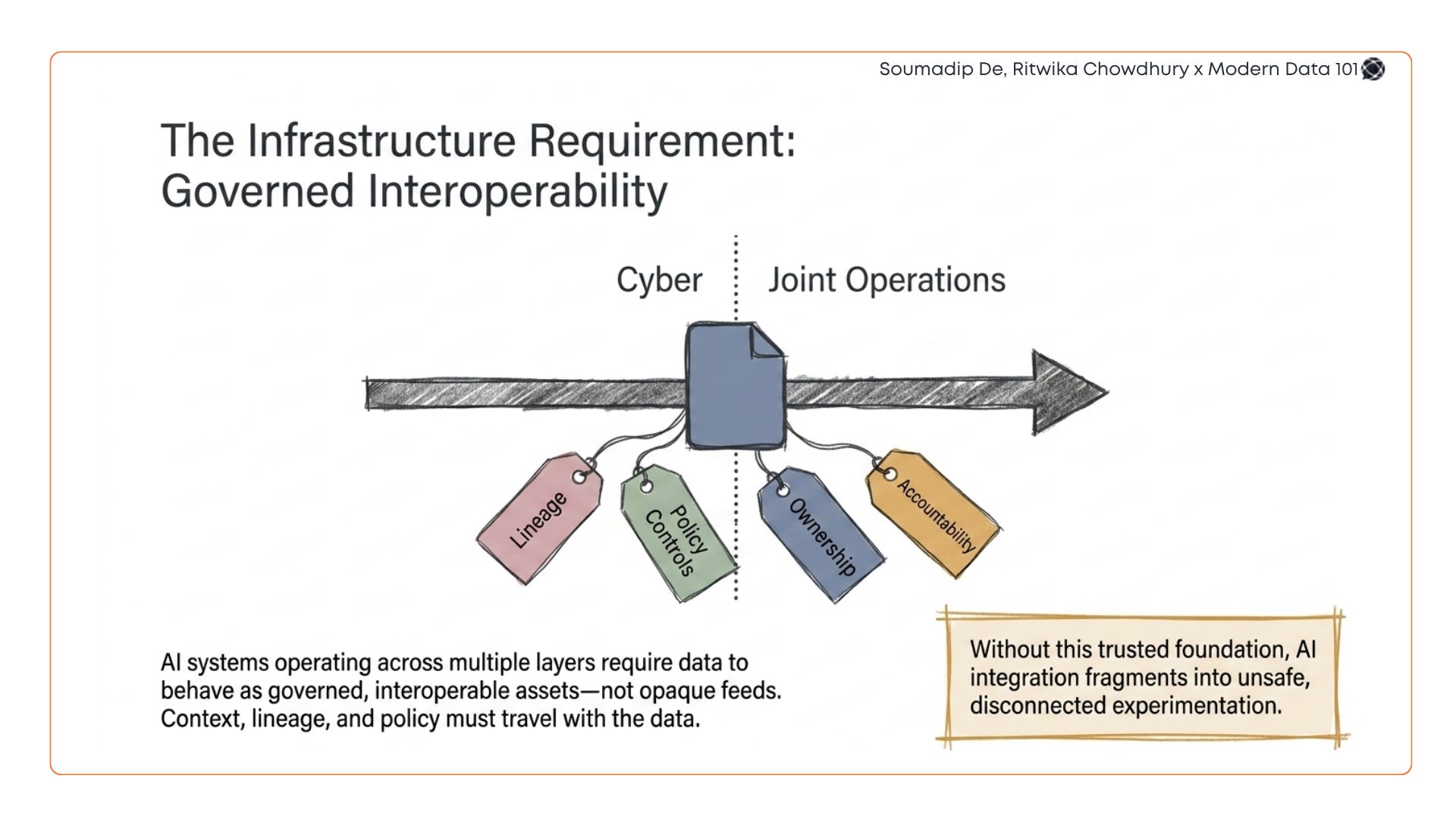
AI systems can be opaque and difficult to audit. In military contexts, explainability, traceability, and human oversight are operational requirements, not optional safeguards. - Defence requires a governed intelligence infrastructure
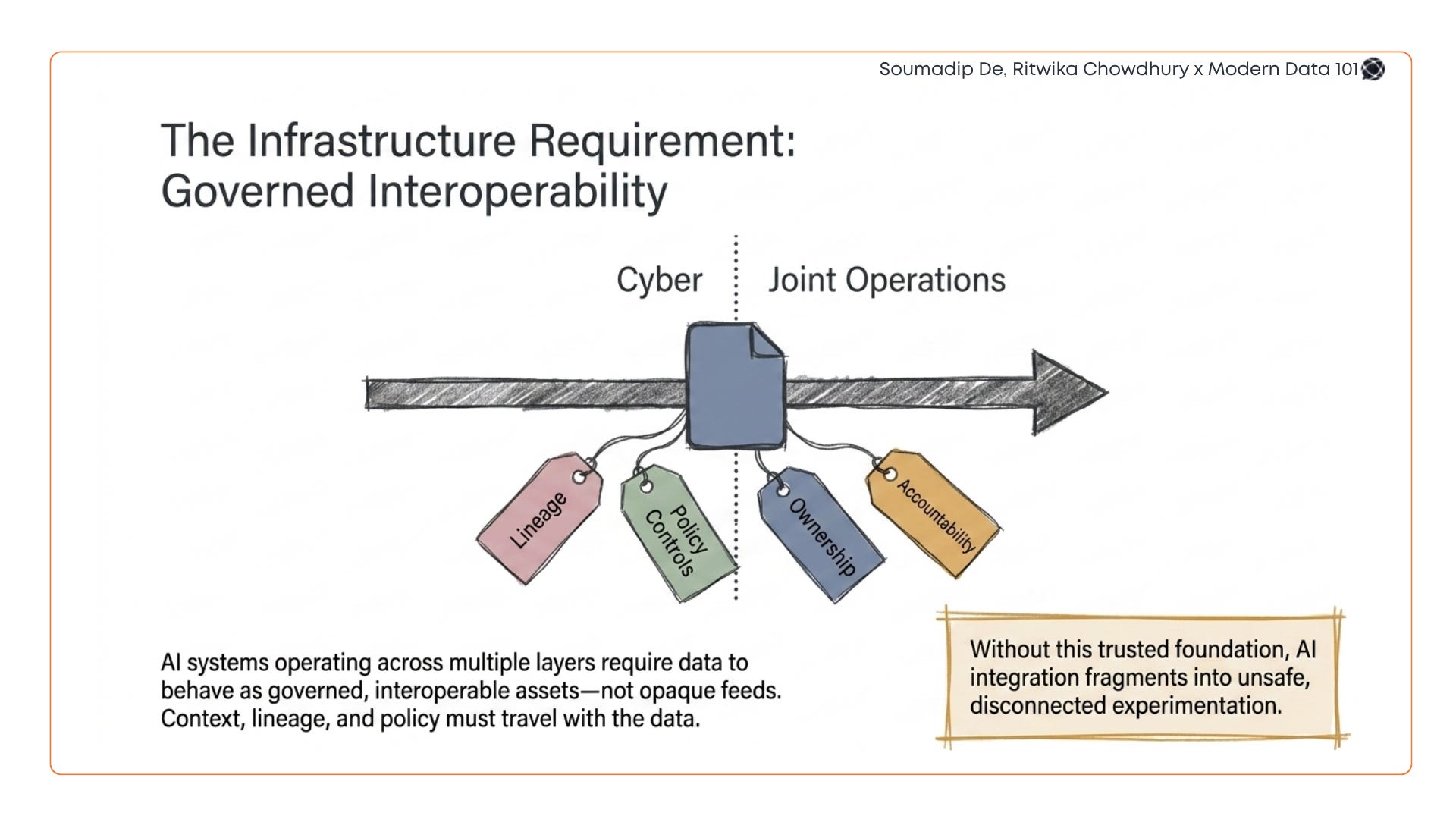
AI integration depends on interoperable systems where context, lineage, policy, and accountability travel with the data. Without this, AI deployment becomes fragmented and unsafe.
Related reading: How AI Is Reshaping Enterprise Data Governance
Modern Data 101’s expert desk explores how AI governance must balance automation with human oversight, a challenge equally central to defence AI architecture.
The Classification Problem: Four Categories of Cognitive Work
The dominant discourse around AI in defence still asks the wrong question: which roles will AI replace?
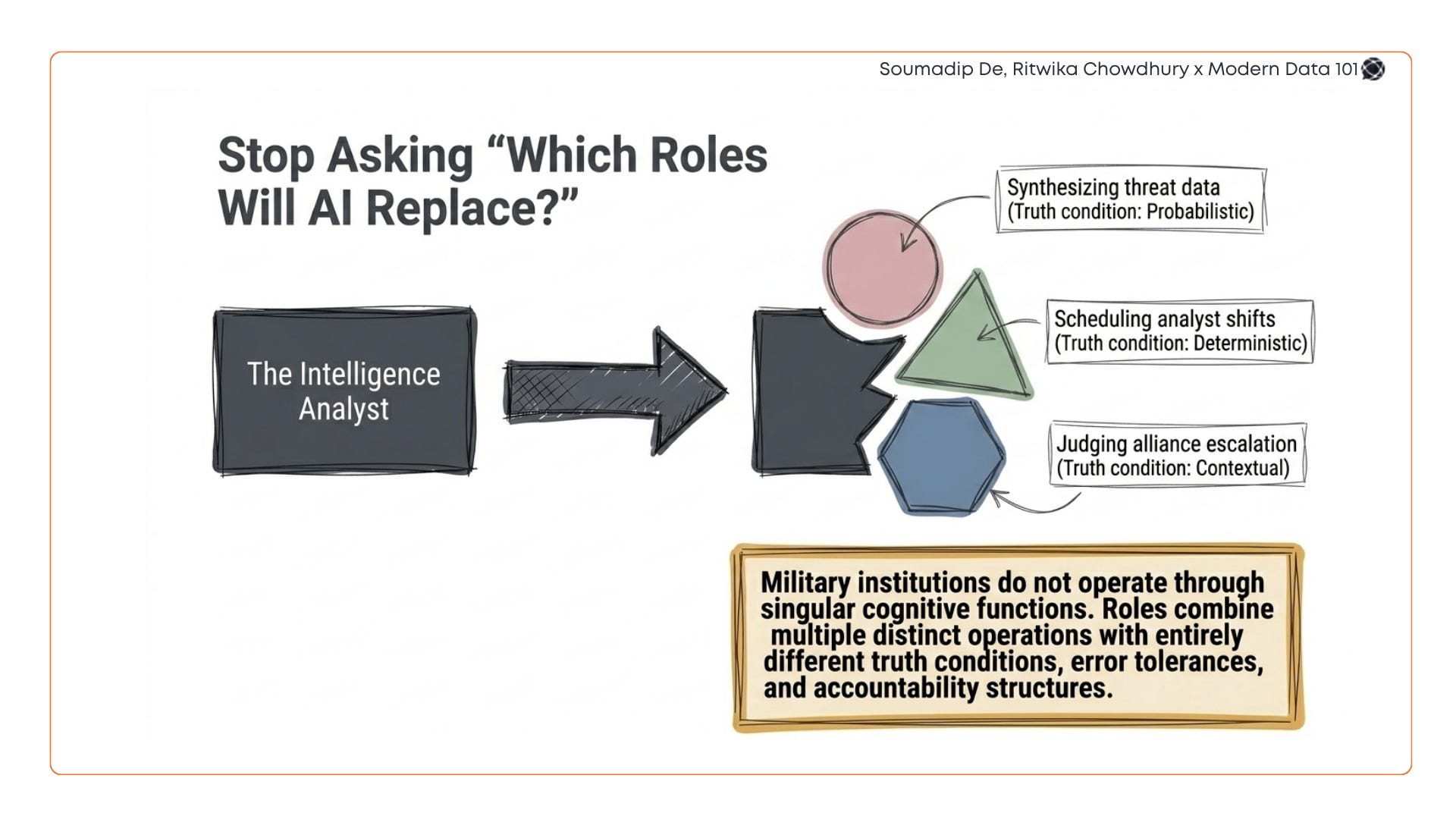
Military institutions do not operate through singular cognitive functions. Roles such as intelligence analyst, logistics coordinator, or commanding officer combine multiple distinct operations with different truth conditions, error tolerances, and accountability structures.
The more useful framework is therefore not job replacement, but cognitive classification: what kind of thinking is taking place, and what role should AI play within it?
This produces four broad operational categories.
[data-expert]
Class I: Deterministic Operations
These are operations where a correct answer objectively exists.
Inventory calculations, maintenance scheduling, supply chain optimisation, budget variance analysis, and personnel allocation fall into this category. AI systems operating here behave primarily as high-speed calculators and automation engines.
The governance challenge is comparatively limited because outputs can be verified against deterministic rules and operational thresholds.
This is where defence AI currently generates some of its safest and highest-return efficiencies: reducing administrative overhead while reallocating experienced personnel toward higher-order operational work.
These deterministic layers closely align with how governed infrastructure enables AI readiness across organisations.
Class II: Probabilistic Operations
These generate calibrated assessments across uncertain futures. Instances could be threat estimation, intelligence synthesis, predictive maintenance forecasting, and operational scenario generation.
The critical risk in this category is epistemological confusion: treating probabilistic outputs as verified truth.
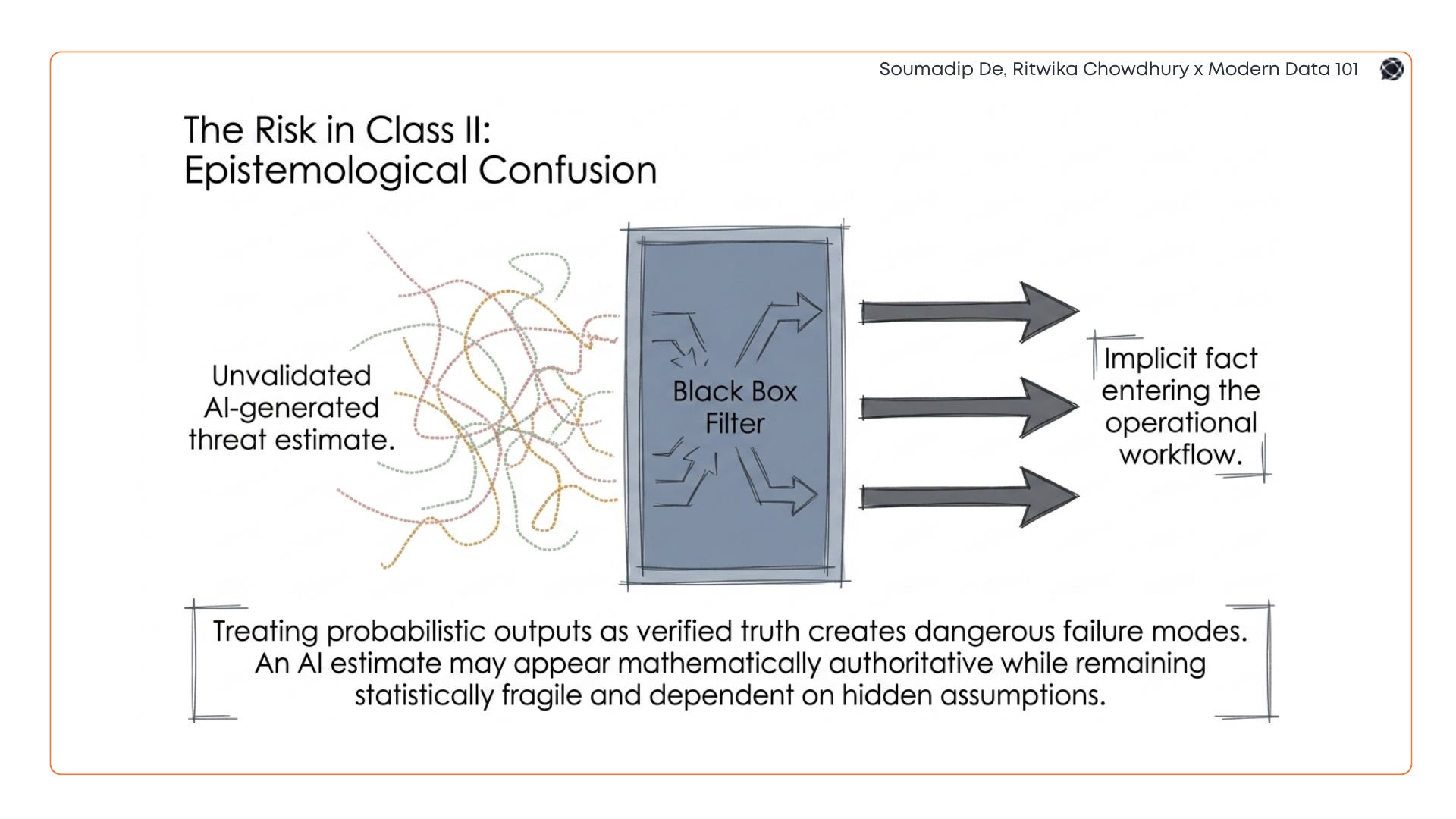
An AI-generated threat estimate may appear authoritative while remaining statistically fragile, contextually incomplete, or dependent on hidden assumptions. In defence environments, this creates dangerous failure modes if probabilistic outputs bypass human scrutiny and enter operational workflows as implicit fact.
This is why governance mechanisms such as validation gates, traceability requirements, and human review structures are becoming increasingly central to defence AI deployment.
Class III: Contextual Operations
These are decisions shaped by variables that no dataset fully captures.
Strategic resource allocation, battlefield adaptation, alliance management, escalation judgment, crisis communication, and tactical leadership all depend on contextual intelligence accumulated through experience, institutional understanding, and situational interpretation.
AI can support these operations by surfacing patterns, generating alternatives, and stress-testing assumptions. But it cannot independently carry the synthesis authority required to make consequential military judgments.
The emerging model across defence establishments is therefore not AI substitution, but human-machine complementarity: AI as analytical sparring partner, human officers as accountable decision-makers.
Class IV: Principal Authority
Some operations cannot be delegated to AI systems in principle.
Command authority, rules of engagement interpretation, legal accountability, and ethical authorisation derive their legitimacy from personhood and institutional responsibility, instead of computational capability.
When a military commander authorises force, accountability attaches to a human being operating within legal and moral frameworks recognised by national and international law. No AI system can inherit or substitute for this responsibility.
The central governance challenge for advanced military AI is therefore not simply building more capable systems, but preserving institutional mechanisms that prevent operational convenience from gradually eroding human accountability.
Why Ontology Is the Missing Layer in Defence AI Governance
What gives the above framework practical traction is ontology: explicit, governed definitions of concepts, their relationships, and their lineage.
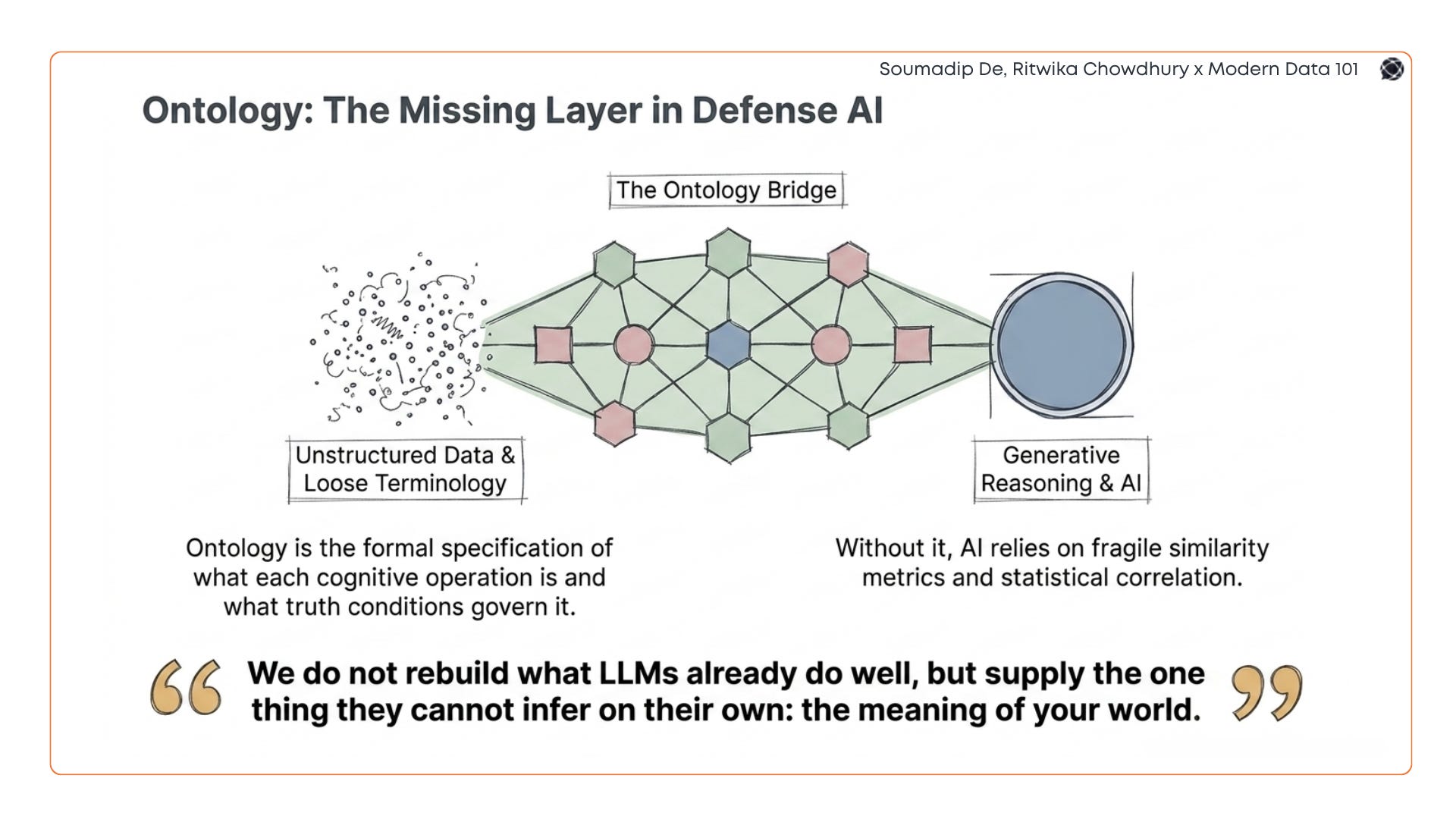
Without this layer, AI integration in defence defaults to role-level analysis, “which jobs will AI replace?” that cuts across cognitively distinct operations and produces unsafe architectures.
In safety-critical defence engineering, ontology-driven AI has already demonstrated concrete value. Knowledge graphs handle domain semantics and relational structure in ways large language models cannot infer independently: “We do not rebuild what LLMs already do well, but supply the one thing they cannot infer on their own: the meaning of your world.”
This insight is foundational to explainable AI in defence contexts.
Let’s place a simple instance.
A commander briefed by an intelligence team must understand why conclusions were reached. Black-box AI systems struggle to provide this reasoning chain. The Defence Intelligence Agency recognised this directly through the DIA Knowledge Model, a space-time ontology designed to unify signals, imagery, telemetry, and open-source intelligence into coherent operational reasoning structures interpretable by both humans and machines.
Explainability is a command requirement.
Intelligence conclusions with no traceable reasoning chain are not governance solutions; they are institutional liabilities.
The current state of ontology in defence
- A broader architectural transition is now emerging across advanced AI ecosystems.
Organisations are increasingly discovering that explainable AI depends less on model sophistication alone and more on whether intelligence inputs behave as governed, interoperable, and traceable operational assets rather than disconnected datasets or opaque model feeds.
- Ontology becomes critical precisely because it mediates between structured data and generative reasoning.
It transforms loosely aligned terminology into explicitly defined operational relationships. Without this layer, AI systems fall back on raw similarity. Similarity is a fine signal for proposing matches that a human then approves; what's fragile is treating similarity as the final reasoning substrate, with no governed concept layer above it.
- Conceptual and spatial-temporal alignment, for joint operations specifically, across service branches, becomes essential.
When the reasoning behind AI-assisted assessments cannot be examined, challenged, or verified by the humans responsible for acting on them, the operational risk expands dramatically.
Principles for Defence AI Governance
For defence policymakers, program managers, and senior officials, the framework produces five actionable governance principles, applicable regardless of national context or institutional structure.
1. Classify before you deploy.
Every AI integration decision must begin with cognitive task classification. The question is not “what can this AI system do?” but “what class of cognitive operation are we asking it to perform, and does the governance architecture match that classification?” Existing responsible AI frameworks provide the ethical principles; cognitive task classification provides the operational architecture to implement them.
2. Mandate validation gates for all probabilistic outputs.
No AI-generated threat assessment, planning option, or intelligence synthesis should inform operational decisions without documented human validation. This must be designed into the workflow at the unit level, not left to individual discretion, because time pressure and institutional convenience will consistently erode ad hoc validation discipline.
3. Enforce the Class IV boundary institutionally.
Without this layer, AI systems fall back on raw similarity. Similarity is a fine signal for proposing matches that a human then approves; what's fragile is treating similarity as the final reasoning substrate, with no governed concept layer above it.
Command authority, rules of engagement, and moral accountability cannot be delegated to AI systems under any circumstances. This boundary is often rooted in the structure of military law and international humanitarian law, not in current AI capability limitations. Governance architecture must make it structurally impossible, not merely discouraged, for AI recommendations to become orders without human decision authority.
4. Build traceability into every AI deployment.
Traceability is the ability to track and document all data and decisions of an AI tool, including training data and processing logic, which must be an architectural requirement, instead of a post-hoc audit feature. AI systems that cannot explain their outputs to a human decision-maker in operational timeframes are not deployable in high-stakes defence contexts, making it a design mandate.
5. Align workforce development with AI integration speed.
The pace at which defence establishments are deploying AI is outrunning the pace at which personnel are being trained to govern it. Closing this gap is the most urgent human capital challenge in military AI modernisation globally. AI literacy, epistemological discipline, and governance authority must be treated as core warfighter competencies, not specialist skills held by technical staff alone.
Building a Defence AI Architecture
A principled defence AI architecture, therefore, requires governance to be embedded into the infrastructure itself rather than treated as a downstream compliance exercise.
Deterministic operations require formally verified automation layers. Probabilistic systems require mandatory human validation gates before operational deployment. Contextual operations require human synthesis authority supported, not replaced, by machine analysis. Principal authority functions must remain institutionally and legally human.
This also changes how defence institutions must think about data infrastructure itself.
AI systems operating across multiple operational layers require governed interoperability between intelligence, logistics, readiness, cyber, and operational systems, where trusted data assets carry embedded lineage, policy controls, ownership, and accountability across organisational boundaries.
Without this foundation, AI integration becomes fragmented experimentation rather than a sustainable military capability.
The future of defence AI will therefore be determined not simply by the sophistication of models, but by the quality of institutional architecture surrounding them: governance systems, ontology layers, traceability frameworks, interoperable intelligence structures, and the preservation of meaningful human authority within increasingly machine-assisted environments.
FAQs
Q1. How AI and ontology are transforming defence?
AI is transforming defence by accelerating intelligence analysis, logistics, cyber defence, and battlefield decision support. Ontology complements this by structuring relationships between data, systems, and operational concepts, making AI outputs explainable, traceable, and interoperable. Together, they enable faster decisions while preserving human oversight, accountability, and operational trust in high-risk military environments.
Q2. Why is explainable AI critical in military operations?
In military contexts, AI-generated outputs inform decisions with life-or-death and legal consequences. A commander must be able to trace how an intelligence assessment was reached, not just receive the conclusion. Responsible military AI frameworks globally require explainability for high-risk decisions and traceability as a core characteristic of valid defense AI. AI systems that cannot provide traceable reasoning chains create accountability gaps that violate both military law and responsible AI governance principles.
Q3. How should defense institutions govern AI decision-making?
Governance should be organised around four principles: cognitive task classification before deployment; mandatory human validation of all probabilistic outputs before they inform operations; institutional enforcement of the command authority boundary as a permanent constraint; and traceability built into every AI deployment as an architectural requirement. Governance is not a compliance exercise, it is the architecture that determines whether AI amplifies operational judgment or undermines it.
Connect with a community data expert
A no-cost session with a practitioner who's been where you are.
About Modern Data 101
Modern Data 101 is a movement redefining how the world thinks about data. A community built by the same team behind the world’s first data operating system, Modern Data 101 sits at the intersection of data, product thinking, and AI. Spread across 150+ countries, the community brings together a global network of practitioners, architects, and leaders who are actively building the next generation of data systems.
At its core, Modern Data 101 exists to simplify the journey from raw data to tangible and observable impact. It advocates high-potential data systems and next-gen architectures to unify and activate insights and automation across analytics, applications, and operational workflows at the edge.
In a world shifting from data stacks to AI ecosystems, Modern Data 101 helps teams not just navigate the change but lead it.


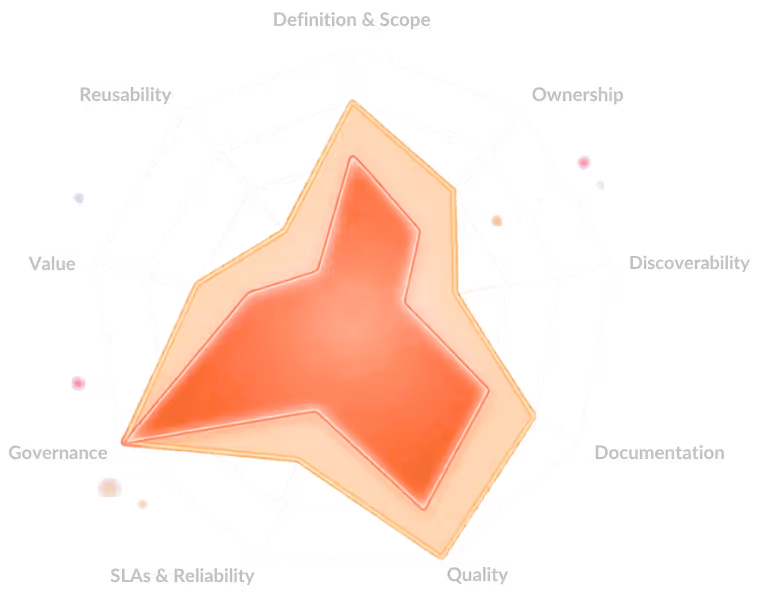
Where does your org stand on data product maturity?
A 9-dimension self-assessment used by 100+ data teams to benchmark strategy, ownership, and platform readiness.




Soumadip De
Soumadip De is an AI Product Manager at The Modern Data Company, working on ontology, context management, and knowledge systems for enterprise AI agents. His work spans data-productisation, context mining, and agentic workflow enablement that help teams move from raw enterprise data to reliable answers and governed action.

Ritwika Chowdhury
Ritwika is part of Product Advocacy team at Modern, driving awareness around product thinking for data and consequently vocalising design paradigms such as data products, data mesh, and data developer platforms.
Read the ideas here. Build them with The Modern Data Company.
Modern Data 101 is where the data community thinks out loud. When you're ready to move from articles to architecture, data products, governed AI pipelines, or a full Data Operating System; the team behind this community can help you build it.
Continue reading
.png)

.png)

%20(1).png)

