
What is a Data Governance Framework? How Does a Data Platform Improve the Outcomes?
Data governance framework aided by a Data Developer Platform is a great plan.

The enterprise environment has become very data-intensive today, which is why setting up a robust data governance framework becomes a strategic imperative in itself. Data governance ensures that all information assets of an organisation are secure, accurate, accessible, and optimised to deliver value. When executed well, enterprise data governance enables a business to trust its data, maintain compliance, boost insights, and also fuel innovation.
However, it’s important to note that even the best frameworks can have a tough time if governance stays disconnected from the use and delivery of data. Unified data architectures offer a product-oriented infrastructure that embeds self-service, feedback loops, ownership, and observability to unlock the full business value of data while also reinforcing governance.
🎢 Numbers to Know: Data governance is the second-biggest challenge for 91% of CIOs and technology leaders for the next three to five years, according to PwC.
In this post, we will explore what a data governance framework is, why it’s important, and how a Data Developer Platform can help in enhancing outcomes for organisations.
Let’s begin with data governance first.
[playbook]
What is Data Governance
Data governance is a set of processes, standards, roles, and metrics to ensure responsible and effective data usage within an enterprise.
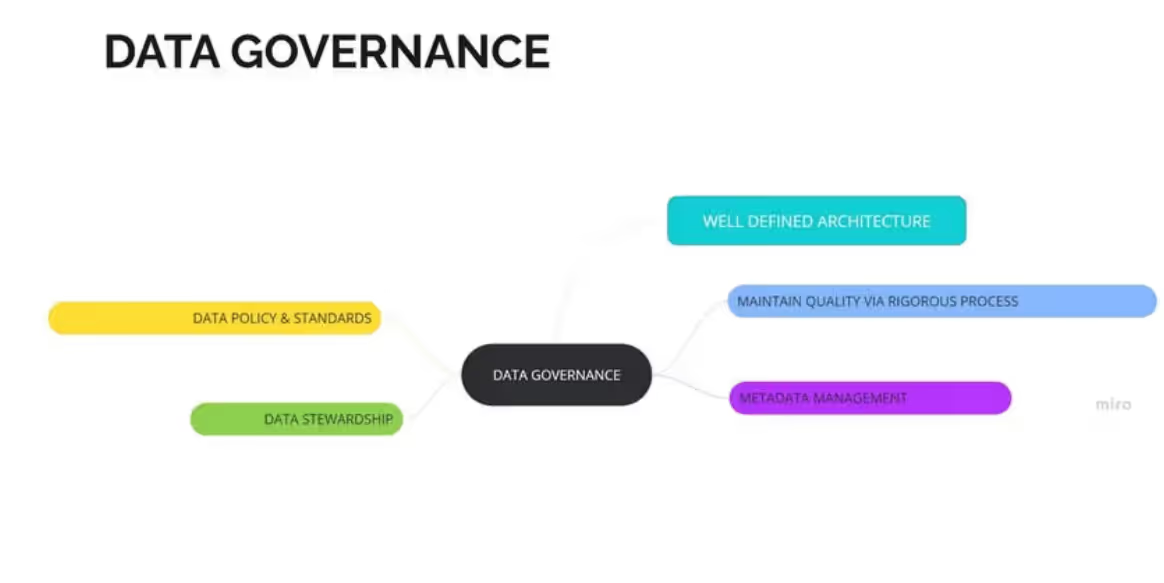
From an organisation’s POV, governance needs to be differentiated from management.
- The focus of data management is the operational handling of data, which includes the processes of ingestion, storage, processing, and delivery.
- On the other hand, data governance provides different decision rights, policies, and accountability to ensure that all management practices are nicely aligned with the varying objectives of business and regulatory requirements.
When effectively scaled across the organisation, governance sets a shared framework for high-quality and trustworthy data to drive operational efficiency, analytics, and AI-readiness.
💡Related Reads:
Learn more about how data governance improves AI success here.
What is a Data Governance Framework
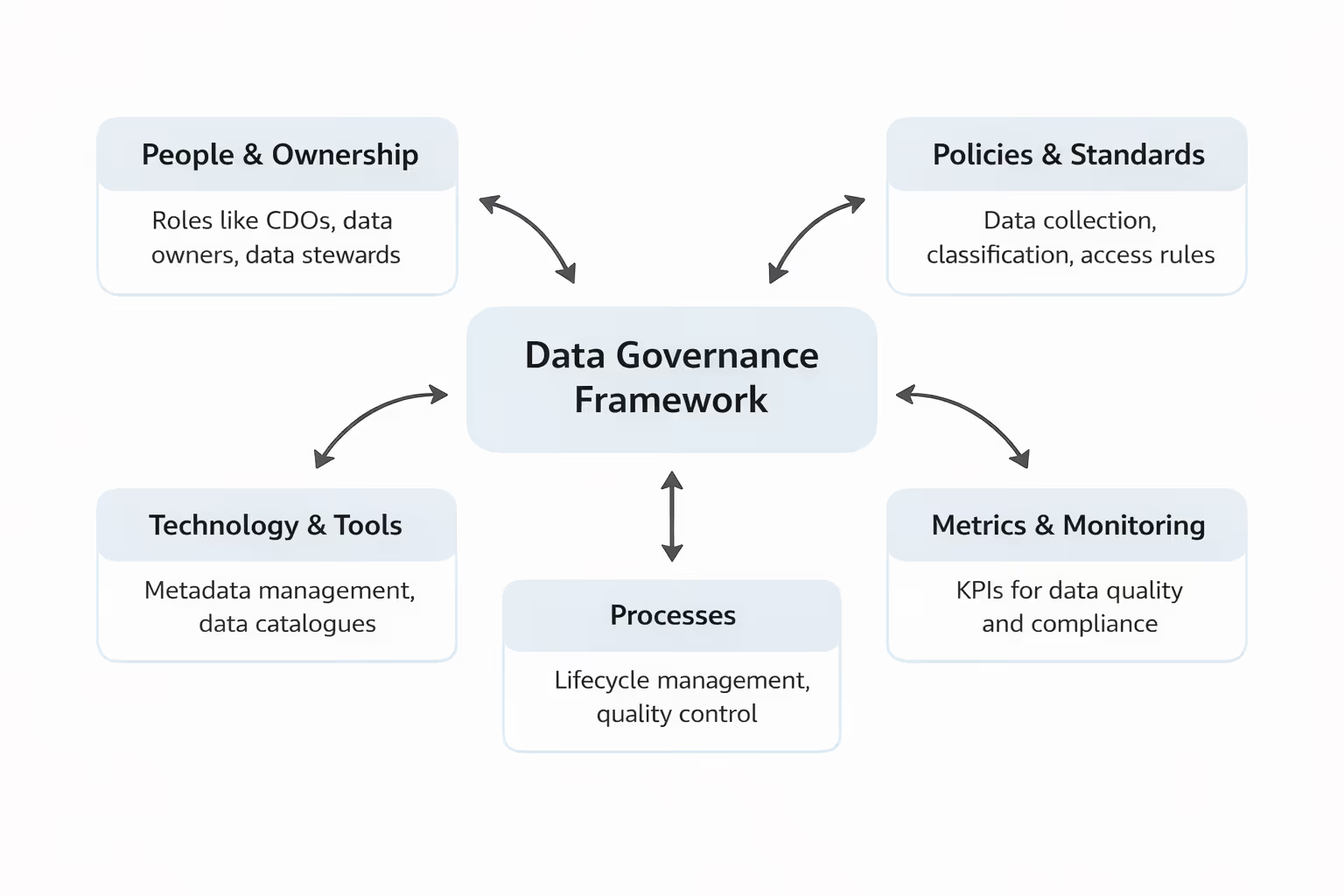
A data governance framework is a blueprint of processes, people, and technologies that transforms governance from theory into practice, giving each dataset a defined owner, measurable standards, and consistent policies across the organisation.
It underlines the processes, people, and technologies needed to manage data assets securely and consistently across the organisation.
When integrated correctly, a governance framework ensures that each dataset has a dedicated owner, a measurable impact, and a mutually agreed-upon standards.
In multi-domain and dynamic environments, however, data resides across edge, cloud, and AI pipelines, which combine to form a recipe for struggling static frameworks. This is why the real challenge does not lie in designing governance, but in operationalising it.
[data-expert]
Personas Responsible for Data Governance Framework
A successful implementation of a data governance framework relies heavily on clearly defined roles.
Three critical personas are involved: the Chief Data Officer (CDO), Data Owners, and Data Stewards.
- Chief Data Officer
This persona includes the executive sponsor, owning the data governance strategy and ensuring that the data estate is secure, accessible, and usable. They secure funding, set the organisational tone, and monitor overall health.
- Data Owners
Data owners are primarily accountable for specific data domains or assets. They decide who gets access, define usage, and are responsible if standards are not met. Many organisations place senior business or IT leaders in this role.
- Data Stewards
Decision makers, like data stewards, implement the policies and processes defined by owners and the CDO. They handle day-to-day governance activities like monitoring compliance, managing metadata, ensuring quality, and escalating issues when they occur.
These personas together enable governance operating models, aligning to enable effective enterprise-scale data governance.
What are the Pillars of the Data Governance Framework
A robust data governance framework transforms governance into a repeatable and structured practice from just theory. It is built on a few core pillars that define how data is owned, controlled, and measured across organisations.
People and Ownership
Governance begins with accountability. Defined roles such as data owners, data stewards, and governance councils ensure that each dataset gets a responsible custodian. Data owners make key decisions about usage and access, while stewards take care of data quality and compliance on a regular basis. Governance councils align these efforts with enterprise strategy.
Policies and Standards
They form the rulebook, highlighting how data is collected, classified, accessed, and shared. Well-created standards ensure compliance with appropriate privacy regulations such as GDPR and HIPAA, and other internal mandates, while also promoting consistency across domains.
Processes
Governance is operationalised through repeatable processes such as data lifecycle management, validation workflows, and escalation paths in case of quality or compliance issues.
Technology and Tools
Data governance relies on platforms for metadata management, data cataloging, lineage tracking, and observability, enabling automation and transparency.
Metrics and Monitoring
Finally, success or impact has to be measurable. Organisations decide and set up KPIs for data quality, policy adherence, and consumption to evaluate governance effectiveness with efficiency.
When executed correctly, these pillars of the data governance framework ensure that each dataset has a defined owner, clear standards, and measurable business value to turn governance into a consistently evolving system.
[related-1]
Business Value of a Governance Framework
A mature data governance framework provides quantifiable advantages, going beyond the usual compliance mechanisms and frameworks:
- Trusted, High-Quality Data
Consistent standards enable improved data accuracy, reliability, and completeness, which are essential for analytics and AI models.
- Regulatory Compliance and Risk Mitigation
Clearly-defined data policies and lineage ensure easier audits as well as reduced legal exposure.
- Cost Control and Operational Efficiency
By eliminating confusion and redundancy, teams spend less time searching for data and more time generating actionable insights.
- Cross-Functional Collaboration
Shared definitions and ownership break silos to ensure a single version of truth.
- AI-Readiness
Governance ensures that data used for Machine Learning model training is traceable, unbiased, and ethically sourced.
Governance frameworks create the foundation of trust, without which data-driven transformation and responsible AI are impossible.
Common Pitfalls and Why Governance Alone Doesn’t Deliver
Governance programmes fail not because of a flawed strategy, but because the operating model isn’t built for modern organisations and how they use their data. Governance can succeed only when it goes beyond documents, committees, and tools and becomes embedded in everyday delivery. Here are some of the pitfalls faced by most teams:
- Siloed Implementation
Governance is often positioned as a major IT or compliance function. This isolates decisions from business teams, leading to policies nobody wishes to adopt and standards no one wishes to operationalise. Governance should be a shared enterprise capability, and never too reliant on one team.
- Static, Policy-First Design
Many frameworks tend to over-index documentation with policies, glossaries, and other such classification matrices, without embedding guardrails into pipelines and workflows. In quick-paced environments, these static documents quickly get outdated, leading to a gap between expectations and actual practice.
- Lack of Clarity in Ownership
Without well-defined data owners, stewards, and domain-specific responsibilities, issues continue to float between teams, making accountability pretty unclear. This results in quality gaps, inconsistent access rules, and stalled remediation cycles.
- Technology-Specific Focus
Organisations often tend to invest in a governance tool, thinking it will take care of governance. But tools without proper processes and roles don’t really deliver any outcome. Governance technologies should complement, and not replace, a coherent operating model.
- Lack of Agility
Traditional frameworks assume systems to be stable and linear. However, there are multiple feature stores, domains, cloud architectures, and AI pipelines in the scenario, entailing the need for governance that evolves rapidly with changing dynamics. Too rigid a governance slows down innovation, increasing shadow data and policy exceptions.
To solve and get through these pitfalls, enterprises are now embedding governance directly into how data products are built, deployed, and managed with a Data Developer Platform.
How a Data Developer Platform Enhances Governance Framework Implementation and Outcomes
Pairing a governance framework with a Data Developer Platform transforms governance from control to enablement. Here’s how it achieves this:
1. Operationalising the Framework
A governance framework defines what needs to be controlled, and the DDP enforces how it happens. Access controls, quality checks, and metadata capture happen automatically as a part of the data pipeline, and not as a separate step.
2. Embedded Guardrails
Governance policies become code. Rules for classification, retention, and lineage get directly encoded into the platform, ensuring its consistency as well as auditability by design.
3. Clear Roles and Ownership
Every data product deployed through the DDP carries explicit ownership metadata, linking it to the data owner and data steward defined in the framework. This reduces the gap between accountability and policy.
4. Continuous Observability and Feedback
The DDP’s observability layer collects lineage, quality metrics, and usage automatically. Governance teams can also monitor compliance in real time and adjust policies based on empirical evidence.
5. Self-Service with Compliance
Through self-service APIs and catalogs, business teams can discover and consume governed data products safely, accelerating insight while also maintaining control.
6. AI and Agentic Readiness
Governed, productised data contained within the DDP ensures that AI models and agentic systems get trained on reliable, traceable data, reducing bias and compliance risk while also accelerating innovation.
Best Practices for Data Governance with a Data Developer Platform
Effective governance begins with business alignment, so anchoring every decision to measurable outcomes like faster time-to-insight or improved AI model reliability is important. Instead of rolling out governance everywhere at once, begin with one domain to validate how your framework and platform work together. As an enterprise scales, the focus needs to shift to defining the right metrics on both sides: governance KPIs, such as policy adherence and data quality, and data product KPIs, like usage and time-to-value, so teams can see how governance influences delivery rather than slows it down.
Achieving the right governance practices requires building a culture where governance is treated as an embedded part of products (let the platform do the heavy lifting: use telemetry, automated checks, and usage signals to refine your governance model continuously).
Over time, this creates a self-improving system where better data, better products, and better outcomes reinforce each other.
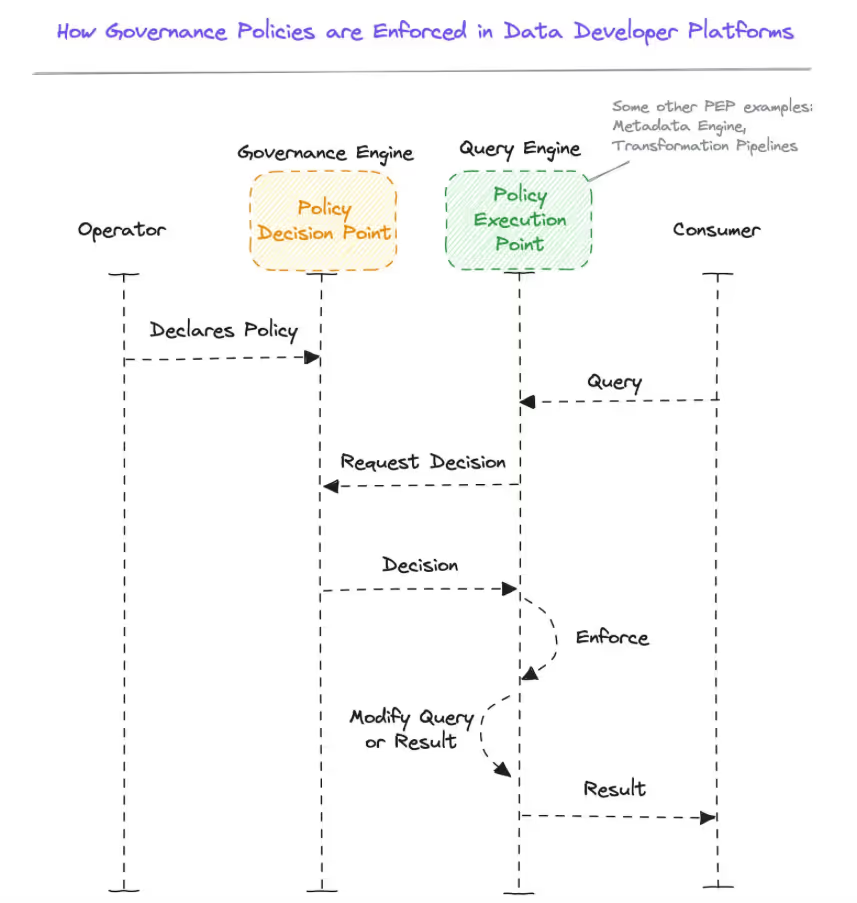
Together, the governance framework and DDP enable governance-by-design that is built-in, scalable, and measurable. Enterprises today no longer make a choice between agility and control; they achieve both.
Conclusion
In the modern enterprise, data governance is not a checkbox but a competitive differentiator. However, frameworks can’t deliver agility, and platforms without risking chaos on their own.
By uniting a structured data governance framework and a scalable Data Developer Platform, organisations can transform governance from policy to practice.
FAQs
Q1. Who is responsible for implementing a data governance framework?
The key personas responsible for ensuring proper implementation of a governance framework include the Chief Data Officer for driving strategy, data owners to ensure policy adherence, and data stewards to manage everyday metadata, compliance, and data quality for enterprise-scale governance.
Q2. How does a governance framework tie with the data product mindset?
A governance framework complements the data product mindset through embedding governance directly into product lifecycles. Each data product has its own quality standards, ownership, and lineage that transform governance from just an oversight to a built-in capability.
A data governance framework is a blueprint that transforms governance into practice. It underlines the processes, people, and technologies needed to manage data assets securely and consistently across the organisation.
Q3. Why organisations seem to have a tough time in scaling governance even after investing in a Data Developer Platform?
Platforms alone are not the stakeholders to fill in the accountability gaps. Governance cannot progress when teams think of DDP as infrastructure, and not as a complete ecosystem. If clear ownership and cultural adoption are not present, automation only increases inconsistency rather than solving it.
Connect with a community data expert
A no-cost session with a practitioner who's been where you are.
About Modern Data 101
Modern Data 101 is a movement redefining how the world thinks about data. A community built by the same team behind the world’s first data operating system, Modern Data 101 sits at the intersection of data, product thinking, and AI. Spread across 150+ countries, the community brings together a global network of practitioners, architects, and leaders who are actively building the next generation of data systems.
At its core, Modern Data 101 exists to simplify the journey from raw data to tangible and observable impact. It advocates high-potential data systems and next-gen architectures to unify and activate insights and automation across analytics, applications, and operational workflows at the edge.
In a world shifting from data stacks to AI ecosystems, Modern Data 101 helps teams not just navigate the change but lead it.


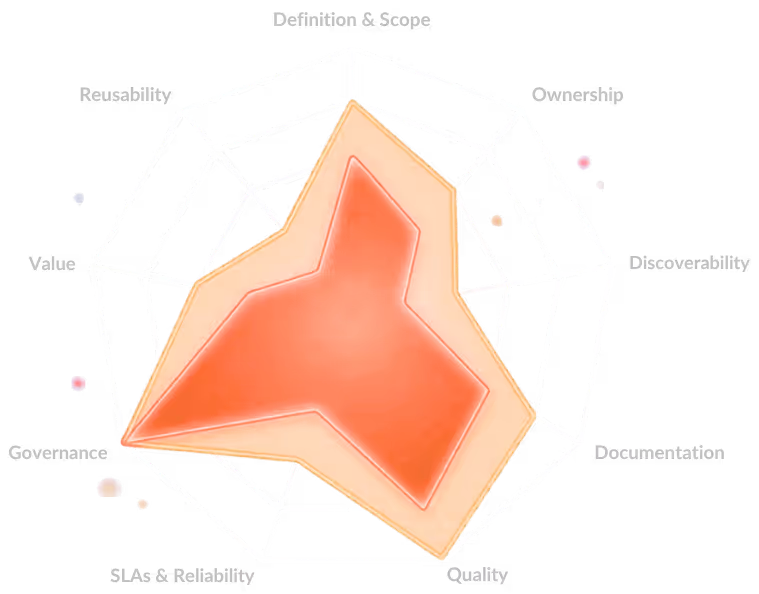
Where does your org stand on data product maturity?
A 9-dimension self-assessment used by 100+ data teams to benchmark strategy, ownership, and platform readiness.


Aishwarya Sharma
Aishwarya is a Senior Analytics Engineer at The Modern Data Company, focused on building end-to-end data solutions that bridge engineering and analytics. He works across data pipelines, modelling, and visualisation to deliver reliable, business-ready insights, combining strong technical expertise with a practical, problem-solving approach to modern data systems.
Read the ideas here. Build them with The Modern Data Company.
Modern Data 101 is where the data community thinks out loud. When you're ready to move from articles to architecture, data products, governed AI pipelines, or a full Data Operating System; the team behind this community can help you build it.
Continue reading


.jpg)
