Boosting Data Adoption with Data Product Marketplace | Masterclass by Priyanshi Durbha
Data Marketplace vs. Data Product Marketplace, Fundamentals of the Marketplace, and Using it as a Lever to Boost Adoption of Data Products Across Domains

This piece is an overview of a Modern Data Masterclass:
Boosting Data Adoption with Data Product Marketplaces by Priyanshi Durbha.
About Host: Priyanshi Durbha | Principal, Advanced Analytics
Priyanshi is a Principal of Advanced Analytics at The Modern Data Company, where she partners with enterprises to help them unlock the full potential of their data through DataOS. With over a decade of experience spanning analytics, data science, and business strategy, she has built a career at the intersection of insight and impact. Before joining Modern, Priyanshi led the Analytics Practice at AKIRA Insights, scaling it into a core business function by fostering high-performing teams and delivering transformative client solutions. Her earlier stints at AB InBev, Deloitte, and Mu Sigma shaped her expertise in advanced analytics, stakeholder alignment, and data-driven storytelling.
A trained economist from Presidency University, Priyanshi is passionate about turning complex data into narratives that drive confident decision-making and sustainable business growth.
Below is a detailed overview of Priyanshi’s masterclass, which should give you a taste of the concepts she touches on, her views on how the fundamentals of data product marketplaces build the foundation for democratisation and innovation, and how it could be used to further data products and their adoption at scale!
Let’s Dive In
Every analytics journey begins with clear goals, and then stalls at the same predictable choke point: accessing the data itself. Months dissolve between problem definition and the first usable dataset because of structural inertia: architectures fragmented by design, teams siloed by function, ownership diffused across invisible boundaries.
Each new project becomes a task of rediscovery. Analysts and data scientists start from zero, chasing the same sources, revalidating the same checks, reengineering the same transformations, as if institutional memory resets with every use case.
The consequence is that momentum dies where it should compound.
The answer begins by reversing the direction: shifting from process-/pipeline-first to use-case-first thinking.
Instead of moving left to right, through the labyrinth of ingestion and curation, we begin from the right: from the exact outcomes we expect. A data product marketplace embodies this inversion: it reframes adoption as a data accessibility experience instead of a data availability problem.
Rethinking from the Right: What a Data Product Marketplace Really Is
For years, organisations have been conditioned to build from the left: ingest everything, refine it layer by layer, and hope it becomes useful at the end. The result: vast data lakes filled with potential, but few products anyone can actually use.
The marketplace mindset flips this approach and begins with consumption instead of storage.
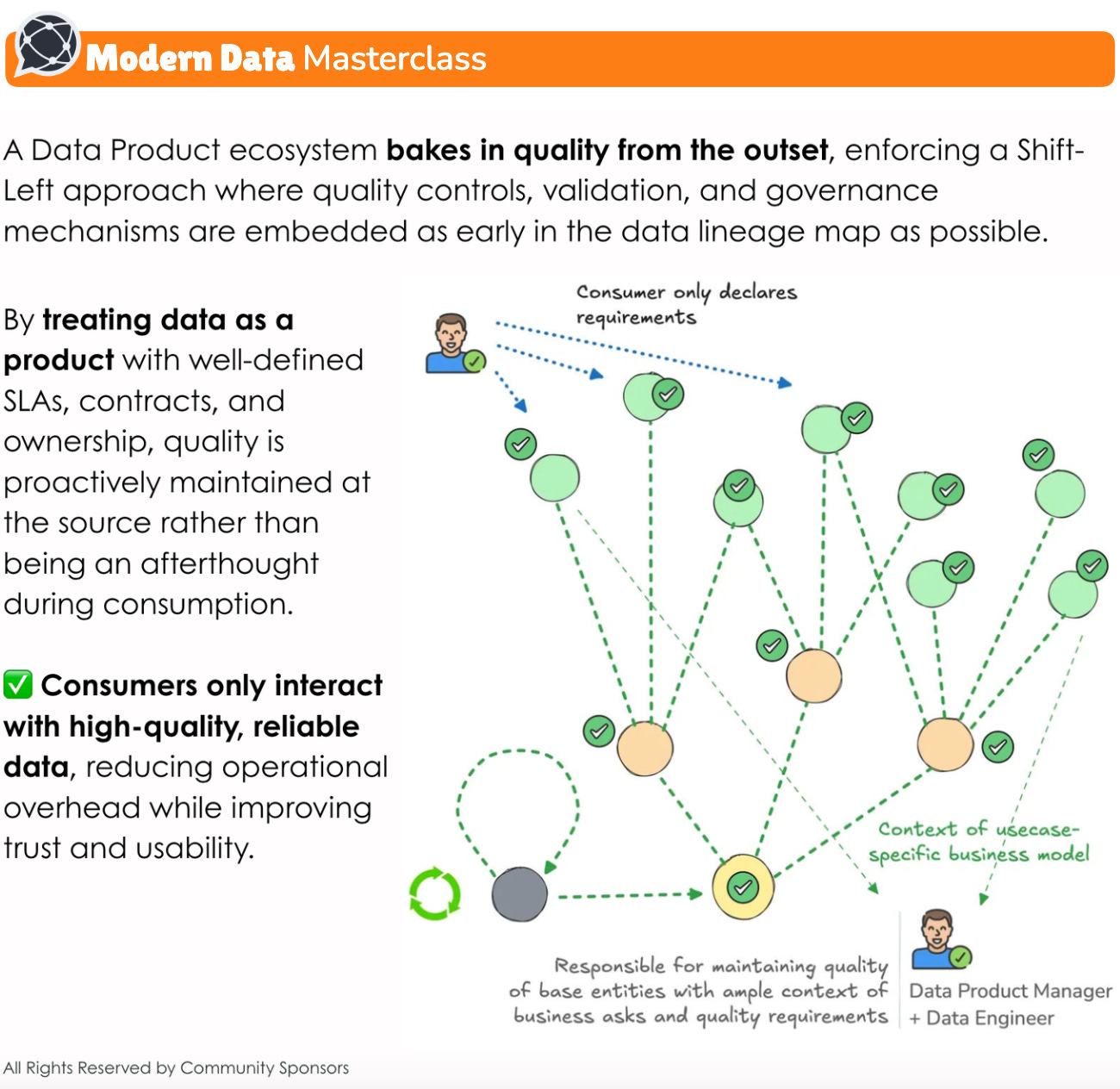
Start from the right: from the dashboard that needs updating, the ML model that needs training, or the LLM that needs grounding, and work backwards. Ask: What data truly matters here? What shape should it take? What quality must it uphold?
This is the backward design principle at the heart of a data product marketplace.
You define the destination first, then assemble only what’s essential to reach it. Each data product is packaged once with quality checks, governance rules, PII protections, and rich descriptions already embedded, and reused endlessly across use cases.
The payoff is exponential instead of incremental. Time-to-insight accelerates nearly threefold, while trust compounds with every reuse. In this model, data stops being a raw material and becomes a unit of the business: standardised, governed, and ready for action.
Making Data Discoverable, Relatable, and Trustworthy
A data product, no matter how sophisticated, is only as valuable as its ability to be found, understood, and used with confidence. The data product marketplace makes this possible by turning discovery into design, and trust into an inherent feature, not an afterthought.
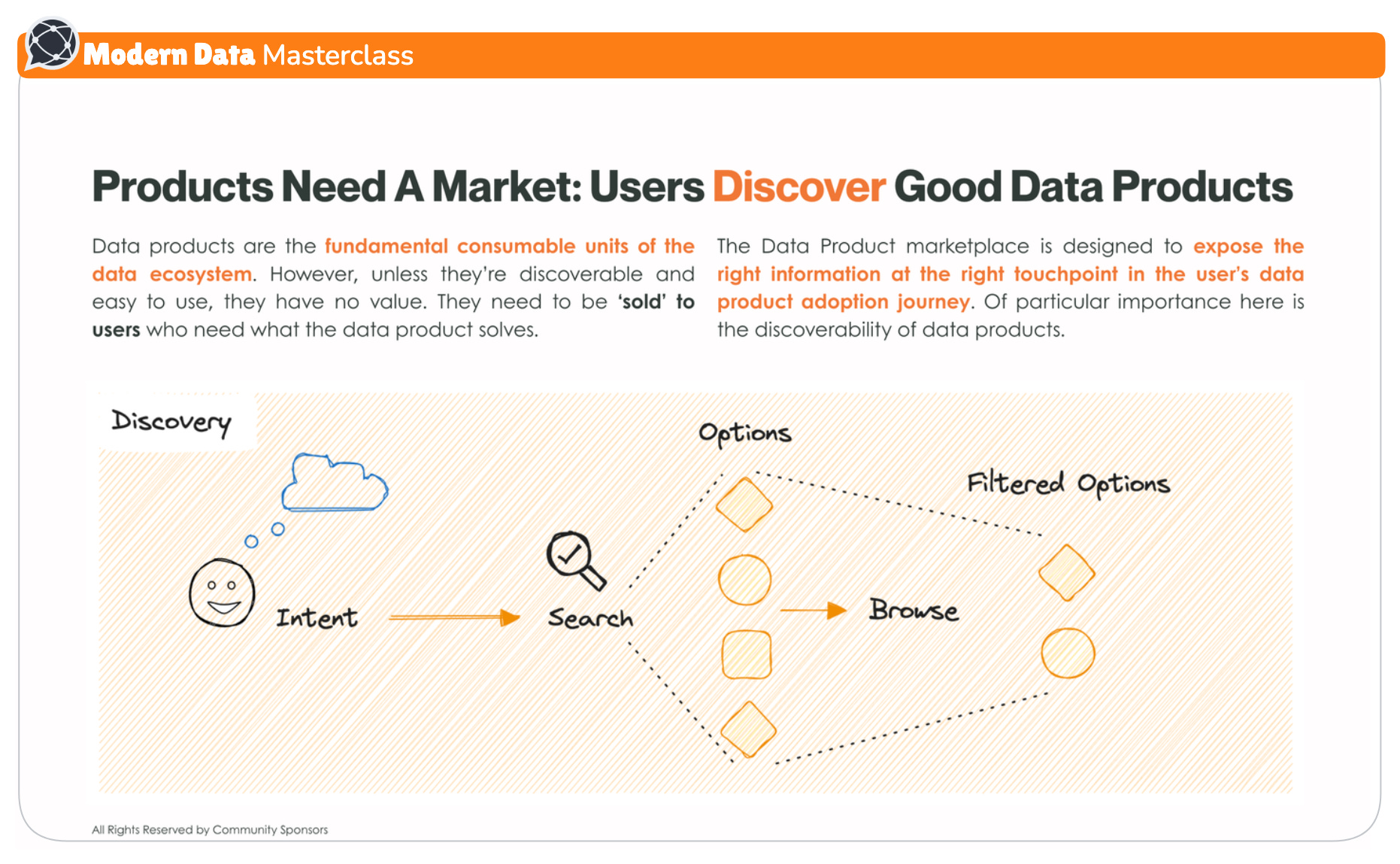
Discoverability
Think of it as the App Store for data. Every product is searchable, annotated, and contextualised, tagged by domain, tier, and use case, so users can reach relevance in seconds. Ownership details, documentation, and purpose-driven metadata ensure that discovery becomes a guided navigation.
Relatability
Finding data is one thing; trusting it is another. Lineage becomes the new language of confidence, showing where data flows from, how it transforms, and how often it’s been used. Quality scores, governance checks, and usage metrics give every product a history and a heartbeat, bridging the gap between technical producers and analytical consumers.
Availability Beyond the Platform
Adoption thrives when data travels well. A true data product doesn’t live in confinement, it integrates seamlessly with Power BI, Tableau, Excel, Jupyter, or Cursor. APIs and output ports make it portable, embedded governance keeps it compliant.
The data you trust here, you can trust everywhere.
Building Continuous Feedback Loops
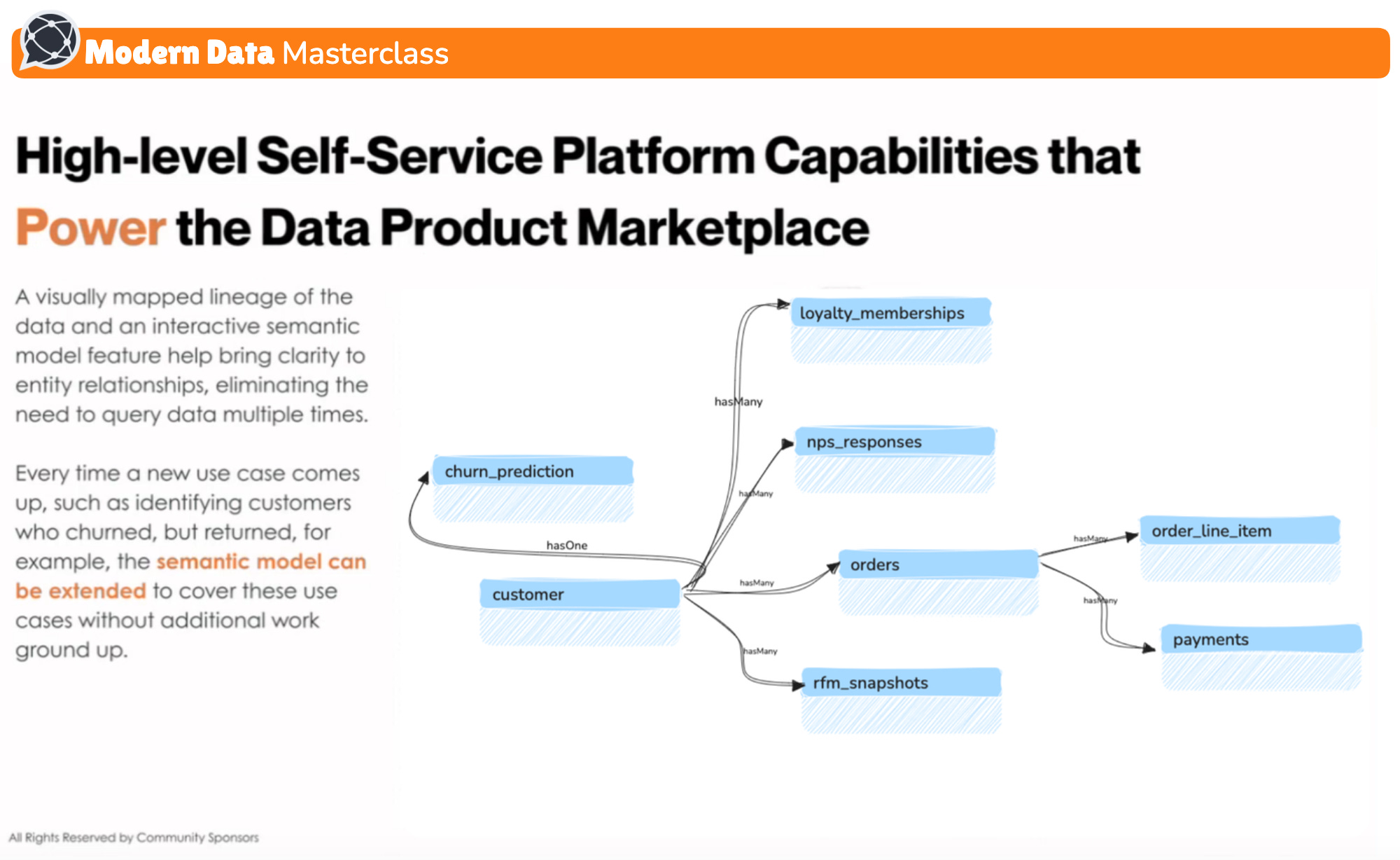
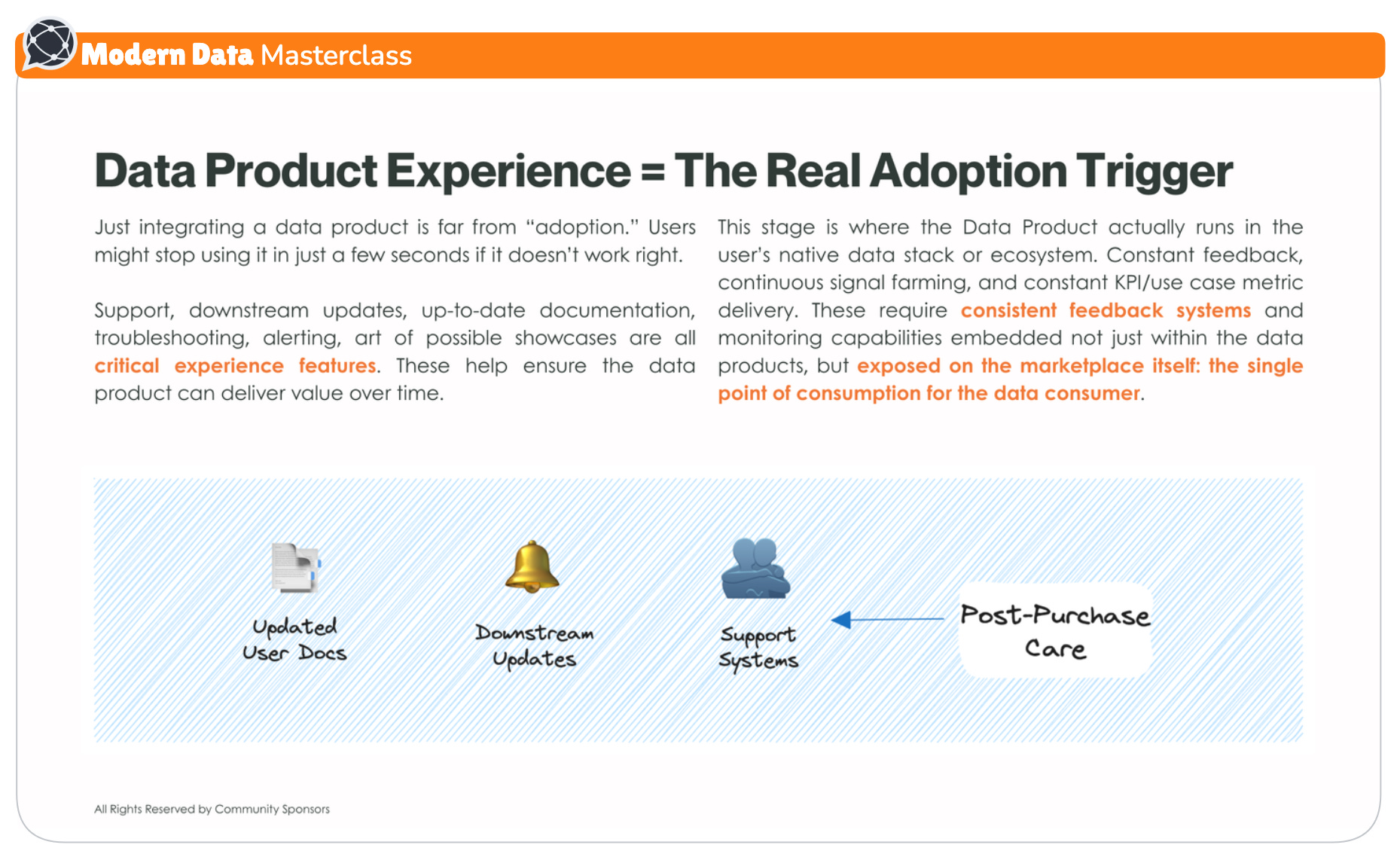
Take a churn prediction model: its value doesn’t end at prediction. Each output, whether a score or a segment, generates new actions, and each action produces new data. Marketing campaigns, NPS responses, and behavioural shifts, all flow back into the same product, closing the loop between insight and outcome.
This is where feedback becomes architecture. The system starts to self-correct and self-enrich, turning usage into training data and adoption into improvement. Semantic models act as the nervous system of this loop: mapping entities, lineage, and transformations so the product can evolve without human intervention. Every interaction should make the data product smarter than it was before.
Rationalising Data, Democratising Insight
The true advantage of a data product marketplace is less redundancy. When every product is designed once, with purpose and governance, the system naturally prunes duplication. Computational costs drop, pipelines simplify, and data creation aligns with actual demand. This is not a cleanup exercise, but a cultural shift from hoarding to intention.
And with that comes democratisation. Business users no longer wait for engineering cycles to access insights; they explore governed, contextualised products built for reuse. The marketplace turns discovery into intuition, surfacing what matters when it matters. In the end, adoption grows not by forcing data literacy, but by making data itself literate, clear, contextual, and continuously valuable.
There’s More…
The craft of data modelling has come full circle: returning to structure, but this time infused with agility and product thinking. What once revolved around schemas and storage now centres on value chains: understanding how data moves through the organisation to create measurable outcomes.
The modern modeller begins with why, collaborates across domains to embed context, evolves designs as the business learns, and governs not by control but by coherence. The Masterclass session dives into the nuances of this lifecycle and extends the viewer’s understanding from theoretical ideas to practical forms of implementations with foundational techniques like data modelling.
Access the Full Masterclass Session for Free

Who is this course for, ideally
01. Data Product Managers | 02. Data Scientists | 03. Business Analysts or Business Stakeholders
What you’ll learn
💡 What is a data product marketplace and why is it important?
💡 How does a data product marketplace improve data adoption and efficiency?
💡 What features make data products more usable and trustworthy?
MD101 Support ☎️
If you have any queries about the piece, feel free to connect with the author(s). Or feel free to connect with the MD101 team directly at community@moderndata101.com 🧡
Connect with a community data expert
A no-cost session with a practitioner who's been where you are.
About Modern Data 101
Modern Data 101 is a movement redefining how the world thinks about data. A community built by the same team behind the world’s first data operating system, Modern Data 101 sits at the intersection of data, product thinking, and AI. Spread across 150+ countries, the community brings together a global network of practitioners, architects, and leaders who are actively building the next generation of data systems.
At its core, Modern Data 101 exists to simplify the journey from raw data to tangible and observable impact. It advocates high-potential data systems and next-gen architectures to unify and activate insights and automation across analytics, applications, and operational workflows at the edge.
In a world shifting from data stacks to AI ecosystems, Modern Data 101 helps teams not just navigate the change but lead it.


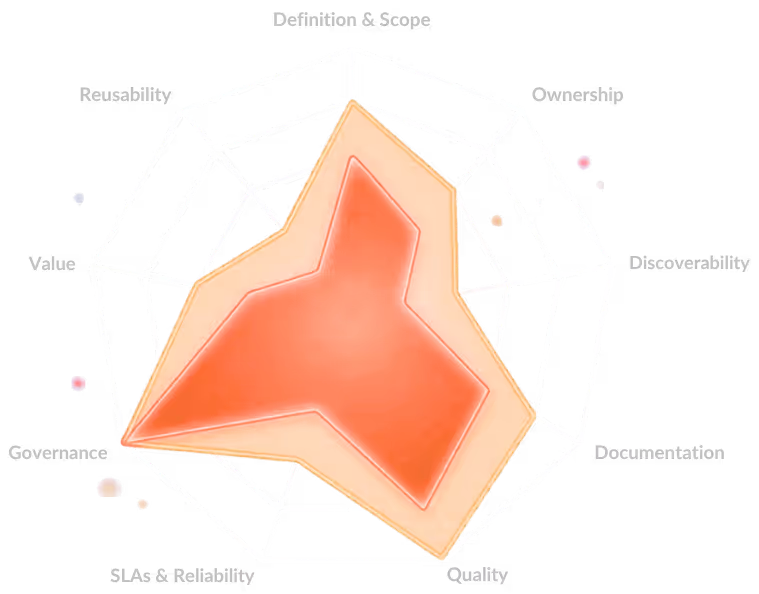
Where does your org stand on data product maturity?
A 9-dimension self-assessment used by 100+ data teams to benchmark strategy, ownership, and platform readiness.

.avif)
Priyanshi Durbha
Priyanshi Durbha is a Data Product Evangelist and Principal of Advanced Analytics. With over a decade of experience spanning analytics leadership, solution engineering, and data science, she specialises in turning complex data challenges into actionable insights that drive business impact.
Read the ideas here. Build them with The Modern Data Company.
Modern Data 101 is where the data community thinks out loud. When you're ready to move from articles to architecture, data products, governed AI pipelines, or a full Data Operating System; the team behind this community can help you build it.
Continue reading
.jpg)

.png)

.png)