How Ontology Addresses the Challenges of Vector Embeddings (Part 1)
Here is how enterprise AI can finally move from plausible answers to auditable reasoning by breaking free from vector search.

Limitations of Vector Embeddings
Vector representations became the default foundation for enterprise AI between 2022 and 2024: fast to deploy, easy to scale, and effective for straightforward Q&A. But when applied to reasoning-heavy tasks like compliance analysis or cross-domain relationship mapping, outputs appeared plausible without being logically correct. The problem is representational: vector embeddings compress meaning into numeric space where similarity is statistical, not structural.
.avif)
High cosine similarity does not guarantee contextual relevance. A query like “Java” in a technical corpus may surface both the programming language and the island because both occupy adjacent regions in embedding space, despite representing entirely different concepts.
[report-2025]
These are structural edge-case limitations.
- Semantic ambiguity collapse: different meanings of the same term are mapped into nearby regions of vector space without explicit disambiguation rules.
- Loss of relational structure: embeddings encode similarity, meaning they cannot distinguish between loosely related concepts and hierarchically or causally linked entities.
- Lack of compositional structure: embeddings represent concepts independently, without encoding how multiple entities interact across contexts.
- Multi-hop reasoning failure: any task requiring traversal across connected entities cannot be represented as a structured path within the embedding space.
.avif)
What is an Ontology, and why do we need it
An ontology is a structured representation of a domain that defines entities, their types, and the relationships between them. Instead of representing meaning as proximity in vector space, it encodes meaning as explicit, typed connections between concepts. For example, a drug is linked to a target protein, which connects to a disease through defined biological pathways.
Why Ontology-Grounded Retrieval Outperforms Vector Embeddings in RAG
Unlike embedding space, ontology-grounded retrieval follows typed entity relationships step by step, making it structurally suited to queries that imply a chain:
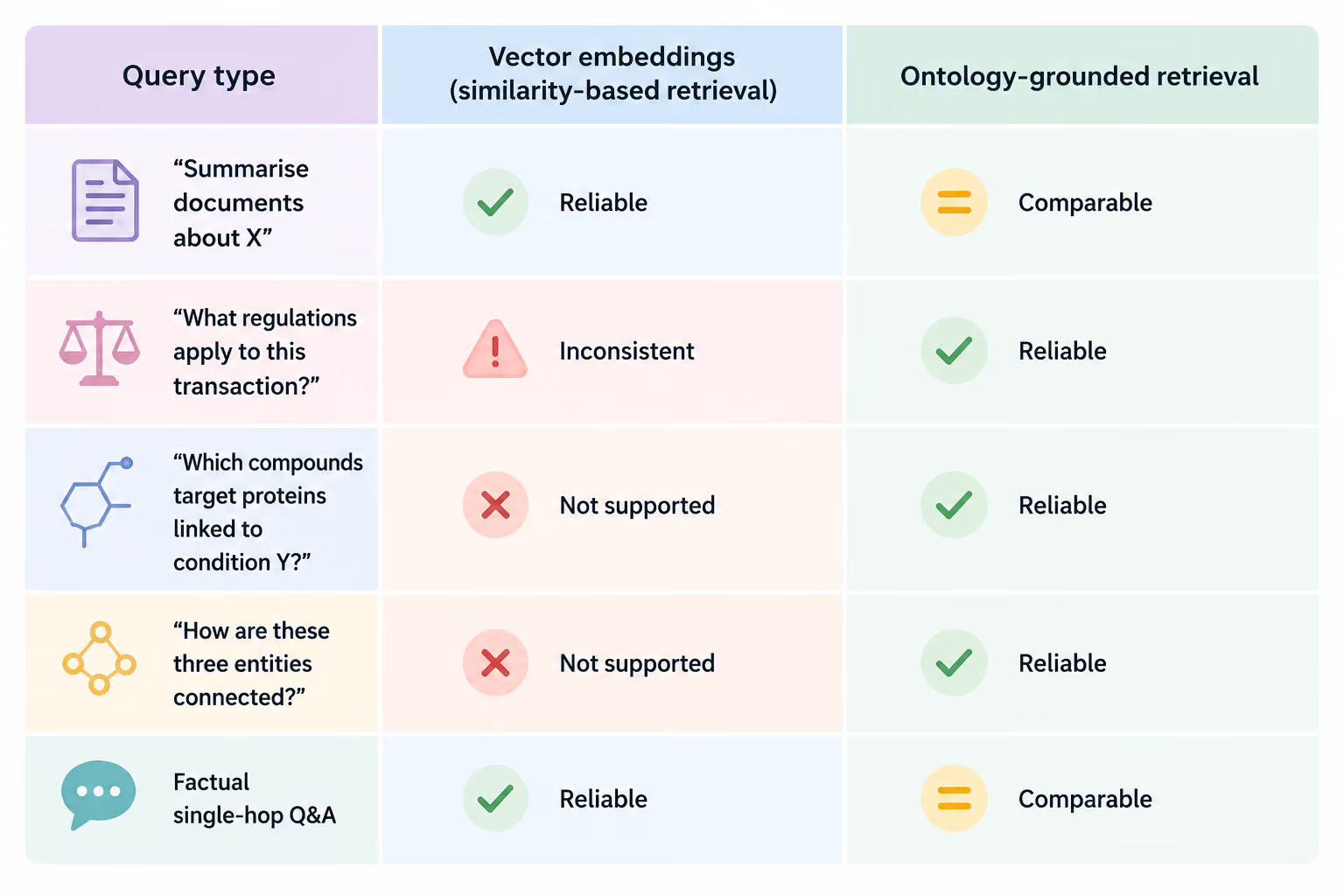
- Regulatory compliance: "Which transactions violate Rule 15c3-5?" requires connecting transaction records, rule definitions, threshold values, and entity identities across structured sources.
- Pharmaceutical R&D: Drug discovery follows explicit chains: a compound acts on a target protein, which affects a biological pathway and links to a disease. Vector space proximity cannot represent this structure.
- Supply chain risk: Mapping multi-tier supplier dependencies means following chains of relationships across entities, something proximity-based search cannot do reliably.
[related -1]
Why do Enterprise Queries Break
Multi-hop queries, those requiring information connected across multiple entities, are where vector retrieval breaks down in production.
A concrete case: A pharmaceutical team evaluating whether a compound can be repurposed must integrate information across multiple layers. The answer spans multiple datasets and entities, each connected through a defined dependency chain.
A 2025 PMC study (Han X et al.) showed that large-scale drug knowledge graphs can efficiently surface multi-step repurposing pathways at scale.
Vector retrieval fails here for a structural reason: Each chunk is independent of the others, with no structural awareness of how the underlying entities relate. The model is then asked to reason across implicit connections that the retrieval layer has made no attempt to surface.
What ontology-grounded systems do differently:
The ontology defines the domain's entity types, named relationships, and constraints on valid reasoning paths. A query follows typed edges in a structured graph. Each hop is constrained by the schema, which means:
- The reasoning path is explicit and auditable.
- The retrieved context is already organised around the domain's actual logic.
Because the retrieval context is already structured around domain logic, the model fills fewer gaps: OG-RAG's 40% improvement in answer correctness reflects the same model performing better on better-grounded input.
.avif)
The benchmark evidence
OG-RAG was evaluated across four LLMs on domain-specific reasoning tasks, compared against conventional RAG and graph-based baselines on identical datasets.
.avif)
Benchmarks confirm the gap: a Lettria/AWS implementation (December 2024) reported 86% accuracy versus 32% for standard RAG on an enterprise corpus, and selectively combining RAG with GraphRAG improved QA accuracy by up to 6.4 percentage points on the MultiHop-RAG benchmark (Han H. et al., Llama 3.1-70B).
OG-RAG figures were measured on structured domain-specific tasks. Validate against your own query distribution before architectural decisions.
[state-of-data-products]
GraphRAG vs Vector RAG: Comparison
.avif)
[related-2]
When to Move Beyond Vector Embeddings
.avif)
- Hybrid architectures are the likely outcome: Route by query type: vector retrieval for broad approximate search, graph traversal for relationship-heavy reasoning. Pure replacement is rarely the right call, and GraphRAG v1.0 (December 2024) has made adoption easier, reducing storage requirements by 43% and simplifying indexing workflows.
- Treat schema curation as engineering infrastructure: Ontologies require ongoing maintenance as domains evolve. This is a first-class function requiring dedicated ownership, not a one-time setup task.
[related-3]
Why Ontology-Based Systems Change Retrieval Into Reasoning
Vector embeddings will remain part of most serious AI stacks: as a component of hybrid systems but not the primary reasoning layer. Retrieval architecture is increasingly becoming a balancing act between structure and approximation. The real challenge is deciding where relationship-aware reasoning is necessary and where semantic similarity alone is still practical, and recent benchmarks are finally making those boundaries much clearer.
FAQs
Q: Do I need a pre-existing Knowledge Graph for GraphRAG?
A: You do not need a pre-built knowledge graph to use GraphRAG. Current pipelines can automatically generate knowledge graphs from your existing unstructured data using AI models. This enables rapid deployment without manual graph engineering.
Q: What tools are used to build these ontologies?
A: Specialised tools like BootOX, Karma, LogMap, and D2RQ help convert raw data into formal ontology formats such as RDF or OWL. These tools streamline mapping and integration across different data sources. They support efficient ontology creation and maintenance.
Q: Why does Vector RAG fail on complex queries?
A: Vector search typically loses the logical structure and relationships between entities. This means it can miss connections needed to answer multi-step or reasoning-based queries. Graph-based retrieval preserves these links for more accurate results.
Connect with a community data expert
A no-cost session with a practitioner who's been where you are.
About Modern Data 101
Modern Data 101 is a movement redefining how the world thinks about data. A community built by the same team behind the world’s first data operating system, Modern Data 101 sits at the intersection of data, product thinking, and AI. Spread across 150+ countries, the community brings together a global network of practitioners, architects, and leaders who are actively building the next generation of data systems.
At its core, Modern Data 101 exists to simplify the journey from raw data to tangible and observable impact. It advocates high-potential data systems and next-gen architectures to unify and activate insights and automation across analytics, applications, and operational workflows at the edge.
In a world shifting from data stacks to AI ecosystems, Modern Data 101 helps teams not just navigate the change but lead it.


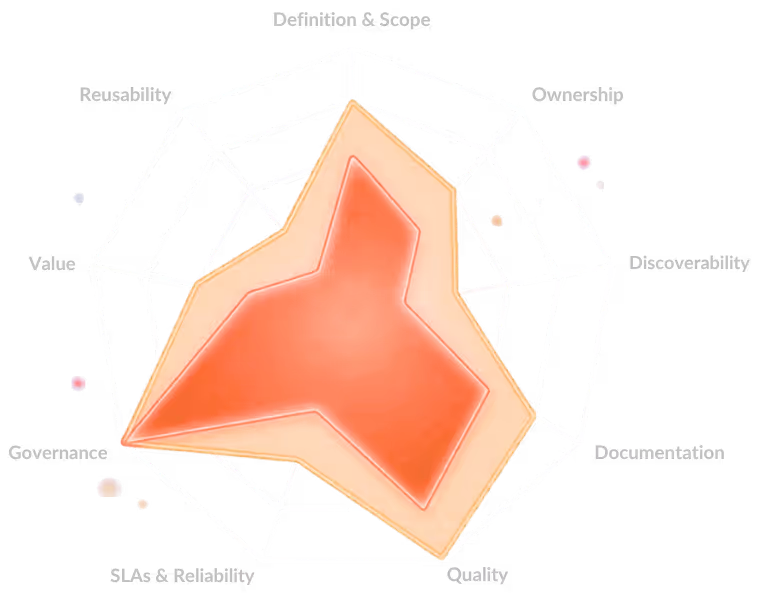
A 9-dimension self-assessment used by 100+ data teams to benchmark strategy, ownership, and platform readiness.


Soumadip De
Soumadip De is an AI Product Manager at The Modern Data Company, working on ontology, context management, and knowledge systems for enterprise AI agents. His work spans data-productisation, context mining, and agentic workflow enablement that help teams move from raw enterprise data to reliable answers and governed action.
Read the ideas here. Build them with The Modern Data Company.
Modern Data 101 is where the data community thinks out loud. When you're ready to move from articles to architecture, data products, governed AI pipelines, or a full Data Operating System; the team behind this community can help you build it.
Continue reading