How to Optimise Your Supply Chain with Data Analytics
Optimised supply chain, driven by analytics, for exceptional enterprise results

Supply Chain with Data and AI
The global landscape has become increasingly volatile, and this is where supply chains have become an enabler as well as a point of vulnerability for enterprises. From geopolitical situations to climatic conditions, a lot of factors come into play, including fluctuations in customer demand. All of these point to a single factor:
Traditional planning approaches are no longer enough.
Modern supply chain analytics provides a promising way forward by combining AI-driven forecasting, real-time data, and connected decision-making to build agility and resilience. In this post, we will explore:
- What is supply chain analytics?
- Why supply chain analytics matters?
- How Data Developer Platforms and Data Products help in end-to-end modernisation of supply chains
What is Supply Chain Analytics?
Supply chain analytics involves the use of statistical models and data to improve forecasting, planning, and overall operational performance across the supply chain. It transforms raw information into actionable data, empowering organisations to reduce costs, anticipate any delays well in advance, and also enhance the pace of decision-making.
Fortune Business Insights pegs the supply chain analytics market size at USD 11.08 billion in 2025, and expected to reach USD 32.71 billion by 2032, at a CAGR of 16.7%.
Supply chain analytics focuses on four core capabilities:
- Diagnostic analytics to identify bottlenecks and uncover root causes
- Descriptive analytics to understand current performance and historical patterns
- Predictive analytics to forecast lead times, demand, and other potential risks
- Prescriptive analytics to automate decisions and suggest optimal actions

When these capabilities are smartly integrated into everyday operations, enterprises build a more proactive, data-driven supply chain.
[data-expert]
Essential Use Cases of Supply Chain Analytics
Supply chain analytics takes care of a wide range of operational and strategic use cases. A few of the most important ones include:
Demand Forecasting and Planning
Causal forecasting, advanced time-series models, and market analysis help organisations with accurate demand forecasting, leading to reduced stockouts, lost revenue, and overstocking.
Supplier and Procurement Management
Supplier performance analytics, risk scoring, and optimisation of contracts help bolster supplier relationships and manage vulnerabilities across multi-tier networks.
[related-1]
Inventory Optimisation
Analytics allows real-time visibility into replenishment cycles, stock levels, and performance across individual SKUs. It leads to improved service levels with lower costs.
Resilience and Risk Management
Predictive analytics helps enterprises detect anomalies and disruptions early and then create alternative scenarios, for instance, relocating inventory, rerouting shipments, or even adjusting production schedules.
Network and Logistics Optimisation
Once insights are data-driven, they help with warehouse positioning, optimised routing, shipment consolidation, and carrier selection. Robust AI models can adjust plans dynamically based on delays, capacity, or weather changes.
Best Practices for Supply Chain Optimisation
Supply chain optimisation demands a coherent operating model built around a few foundational disciplines.
- Establish a single source of truth for supply chain data. Decisions across procurement, logistics, and fulfilment must draw from consistent, governed inputs. When planning teams and operational systems work from different versions of the same data, even well-designed models produce conflicting outputs.
- Treat analytical outputs as reusable assets. Demand forecasts, supplier risk profiles, and inventory health metrics should be built once, owned clearly, and consumed across multiple systems and teams, rather than rebuilt repeatedly inside individual dashboards or pipelines.
- Embed analytics directly into operational workflows. Insights delivered after the fact have limited impact. Real-time signals, such as on lead times, stockouts, or logistics performance, need to be integrated into the systems where planners and operators actually make decisions.
- Automate high-frequency decision cycles. Replenishment triggers, routing adjustments, and supplier alerts operate at a cadence that manual review cannot match. Automation should be applied where decision logic is well-understood, and latency has a direct operational cost.
- Govern data at the point of production, not after the fact. Quality checks, lineage tracking, and access controls are most effective when embedded into how data is created and published, instead of applying retroactively during audits or incident reviews.
[state-of-data-products]
How Data Products and Data Developer Platforms Optimise Supply Chain Analytics
Supply chains generate data across ERP systems, POS platforms, supplier networks, and IoT devices, but that data rarely arrives in a form that analytics and AI systems can act on reliably. Let’s see how Data Developer Platforms and the data products they help build, address these gaps.
A unified, high-quality data layer
DDPs standardise ingestion across disparate source systems, creating a single real-time foundation that operational and planning tools can trust. This eliminates the inconsistencies that arise when each team maintains its own pipelines from the same upstream sources.

Interoperability across the wider ecosystem
Data products can be shared via secure APIs to external planning systems, logistics partners, and supplier platforms, enabling multi-enterprise collaboration without custom point-to-point integrations.
[related-2]
Reusable data products
Teams shift to create modular data products rather than creating dashboards and pipelines again and again. These products include lead-time predictors, supplier-risk profiles, logistics-performance views, demand-signal products, and inventory-health metrics, acting as the foundation for decision engines, AI models, and operational flows.
AI-ready infrastructure
A model-first design approach within a DDP means forecasting models, optimisation engines, and anomaly detection systems can be deployed faster, with standardised tooling and automated retraining pipelines built in from the start.
Conclusion
Modern supply chains cannot function and create the desired impact with siloed, reactive, and outdated processes and practices. A data-driven supply chain is the need of the hour, where AI-driven insights and a strong data foundation drive advanced analytics. With DDPs and data products in the fray, supply chains become more intelligent, adaptive, and capable of supreme optimisation.
FAQs
Q1. What does it mean to build a data-driven supply chain?
A data-driven supply chain relies on analytics, real-time data, and AI to drive decisions across procurement, forecasting, inventory, and logistics. It replaces assumptions with actionable insights, improves end-to-end visibility, and creates an operating model that’s scalable, predictable, and resilient.
Q2. How does supply chain optimisation help in improved organisational performance?
Supply chain optimisation elevates operational efficiency by using analytics, data, and automation to streamline logistics, planning, and inventory. It cuts down costs, reduces delays, and drives quicker decisions so that businesses respond to market dynamics quickly.
Q3. Are AI investments alone enough to build AI-driven supply chains?
A lot of data practitioners are of the opinion that AI tools rarely deliver the right business impact when invested into, alone. AI models deliver inconsistent results without a scalable infrastructure and clean, integrated data. Operational integration with a solid data foundation are crucial to ensure sustained optimisation.
Connect with a community data expert
A no-cost session with a practitioner who's been where you are.
About Modern Data 101
Modern Data 101 is a movement redefining how the world thinks about data. A community built by the same team behind the world’s first data operating system, Modern Data 101 sits at the intersection of data, product thinking, and AI. Spread across 150+ countries, the community brings together a global network of practitioners, architects, and leaders who are actively building the next generation of data systems.
At its core, Modern Data 101 exists to simplify the journey from raw data to tangible and observable impact. It advocates high-potential data systems and next-gen architectures to unify and activate insights and automation across analytics, applications, and operational workflows at the edge.
In a world shifting from data stacks to AI ecosystems, Modern Data 101 helps teams not just navigate the change but lead it.


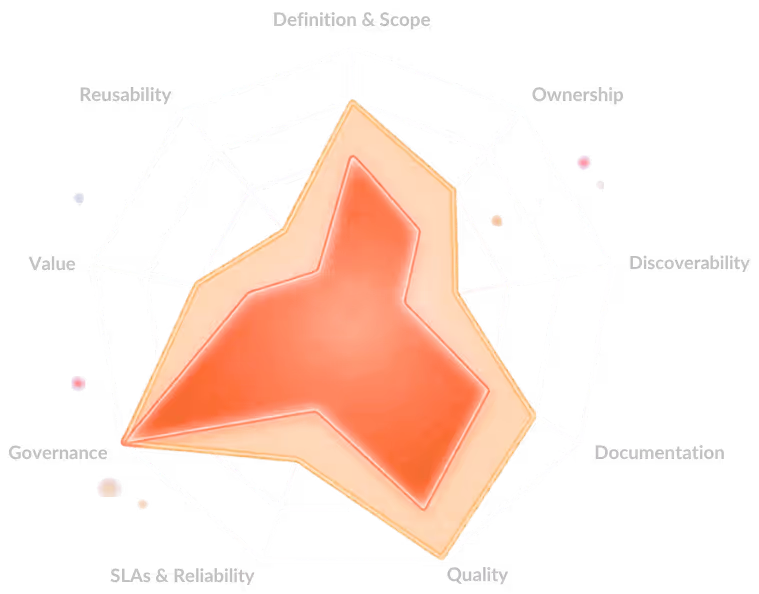
Where does your org stand on data product maturity?
A 9-dimension self-assessment used by 100+ data teams to benchmark strategy, ownership, and platform readiness.


Aishwarya Sharma
Aishwarya is a Senior Analytics Engineer at The Modern Data Company, focused on building end-to-end data solutions that bridge engineering and analytics. He works across data pipelines, modelling, and visualisation to deliver reliable, business-ready insights, combining strong technical expertise with a practical, problem-solving approach to modern data systems.
Read the ideas here. Build them with The Modern Data Company.
Modern Data 101 is where the data community thinks out loud. When you're ready to move from articles to architecture, data products, governed AI pipelines, or a full Data Operating System; the team behind this community can help you build it.
.png)
.png)

.png)