How to Build a Data Governance Strategy for ROI Growth
CDOs treating governance as a growth lever aren’t just dodging fines; they’re shipping AI initiatives 3x faster than those still stuck in policy review. Every quarter you wait to make this shift is a quarter a competitor closes the gap on you.

TL;DR
A data governance strategy earns its budget through measurable outcomes, not policy documents. This guide gives CDOs and VPs of Data four decision checkpoints that turn governance from a compliance line item into a growth lever with visible payback:
- Baseline what ungoverned data already costs you
- Pick one high-value domain, not the whole estate
- Define data governance roles and responsibilities around decision rights
- Instrument it and report the number monthly
[playbook]
Most governance programmes get this wrong from the start; they open with a policy binder instead of a business case:
- Poor data quality costs an average organisation $12.9 million a year in wasted analyst time, failed campaigns, and rework
- Most data leaders can’t say what their programme returned last quarter
- That gap is why programmes stall after year one: built to survive an audit, not move a number the board cares about.
Why a data governance strategy for ROI Can't Wait
Three pressures are forcing this onto the 2026 agenda. AI initiatives are surfacing governance debt that used to stay hidden: a model trained on ungoverned data inherits every inconsistency in it, and Gartner reports that over 50% of generative AI projects are abandoned after proof of concept, with poor data quality chief among the reasons.
Boards are also asking for payback periods instead of maturity scores on every data investment. And regulatory scope keeps widening faster than manual controls can track it. A governance strategy that can’t show return within a year rarely survives its second budget cycle.
[related-1]
Why data governance strategies lose their ROI
The pattern repeats across industries. Governance loses its ROI when:
- It’s framed as an IT control function instead of a business enabler, so it never gets a P&L line to defend
- Leaders build governance for the whole estate at once instead of the handful of datasets that drive decisions
- Nobody measures a “before” state, so there’s no baseline to prove the “after” against
Each mistake is fixable, but only if it’s caught before the programme launches, not a year into it.
[related-2]
Step 1: Baseline the Cost of Ungoverned Data
Before proposing a solution, quantify the problem in numbers finance will recognise: hours spent reconciling reports, audit preparation labour, rework from bad campaign or pricing data, and any recent compliance near-misses.
Organisations lose an average of 30% of enterprise time to non-value-add work caused by poor data quality and availability. That figure becomes your baseline. Without it, any ROI claim you make later is unverifiable.
Step 2: Scope Your Data Governance Strategy to One High-Value Domain
A data governance strategy imposed everywhere at once dies under its own weight. Choose a single domain, customer, pricing, or the dataset feeding your highest-priority AI use case, where a clean, well-owned version of the truth would change a decision this quarter.
Treating that dataset as a product with a named owner, a quality bar, and a defined consumer does more for early ROI than any enterprise-wide policy rollout. This highlights how authority without a named owner rarely survives contact with a real decision.
Step 3: Define Data Governance Roles and Responsibilities
How do you define data governance roles and responsibilities?
Roles are defined by decision rights, not titles: data owners set the quality bar for their domain, stewards get real authority to resolve conflicts and enforce standards, and a data developer platform enforces policy automatically instead of relying on manual review.
A governance framework has six parts working together:
- Architecture, roles, documented processes, a communication cadence, metrics and tooling.
- The roles matter most. Give stewards real authority to resolve conflicts and enforce standards, not just a title. A data developer platform that enforces policy and lineage at the point of access removes the need to police every dataset by hand, which is where most governance headcount otherwise goes.
Step 4: Track Data Governance ROI With the Right Metrics
Governance that isn’t measured decays. Track incident reduction, time-to-data-access, and audit preparation hours against your Step 1 baseline, the core of measuring data governance ROI in practice and report them to the same executive audience every month.
Consistent reporting is what turns governance from a cost centre defending its existence into a function the board expects a number from.
[the modern data survey report 2026]
Data Governance Roles and Responsibilities in an ROI-Driven Strategy
Decision rights are what make data governance roles and responsibilities actually pay back, not titles on an org chart. Three roles carry the weight:
- Data owner: accountable for the quality bar and business definition of a single high-value domain, not the whole estate.
- Data steward: holds real authority to resolve conflicts and enforce standards day to day, rather than a title with no teeth.
- Platform enforcement: a data developer platform that applies policy and lineage automatically at the point of access, so roles aren't spent policing datasets by hand.
Without this structure, governance headcount grows faster than the ROI it produces.
[related-3]
Data Governance Best Practices Before You Scale
What are the best practices for data governance?
The best practices are treating governance as a product decision rather than overhead, assigning a named owner and quality bar to every high-value dataset, and proving ROI against a measured baseline before scaling the programme enterprise-wide.
Most data governance strategies fail for the same reason most cost-cutting initiatives fail: they’re framed as overhead instead of as the infrastructure a growth number depends on. The CDOs who get funding renewed treat governance as a product decision because a dataset with a clear owner, a quality bar, and a defined consumer behaves like an asset instead of a liability. That reframe, more than any tool purchase, is what determines whether year two gets budget at all.
Everything above works because the underlying data behaves like a product, instead of a swamp. This shift plays out uniquely in practice, and you can witness it here: What Are Data Products? The Complete Guide
FAQs
Q1. What is data governance?
Data governance is the set of rules, roles, and decision rights that determine who can access, change, and rely on an organisation’s data. It’s ongoing infrastructure, not a one-time cleanup project.
Q2. How do you measure the ROI of data governance?
Calculate it as (gains minus investment) divided by investment, where gains include cost avoidance, productivity hours recovered, and faster or more reliable decisions, benchmarked against a baseline captured before the programme started.
Q3. What does data governance mean for AI projects specifically?
It means the difference between AI-ready data and data that merely exists. Ungoverned inputs are a leading reason AI pilots stall before production, since no model can outperform the data quality it was trained on.
Q4. How long before a data governance strategy shows ROI?
Programmes that start with one high-value domain and a clear baseline typically show measurable gains, fewer incidents, and faster access within two to three quarters, well before an enterprise-wide rollout would.
Connect with a community data expert
A no-cost session with a practitioner who's been where you are.
About Modern Data 101
Modern Data 101 is a movement redefining how the world thinks about data. A community built by the same team behind the world’s first data operating system, Modern Data 101 sits at the intersection of data, product thinking, and AI. Spread across 150+ countries, the community brings together a global network of practitioners, architects, and leaders who are actively building the next generation of data systems.
At its core, Modern Data 101 exists to simplify the journey from raw data to tangible and observable impact. It advocates high-potential data systems and next-gen architectures to unify and activate insights and automation across analytics, applications, and operational workflows at the edge.
In a world shifting from data stacks to AI ecosystems, Modern Data 101 helps teams not just navigate the change but lead it.


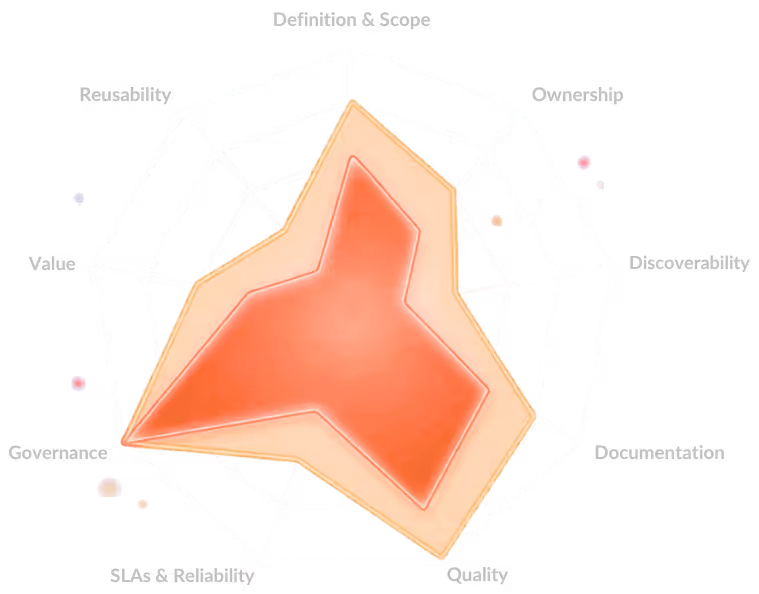
A 9-dimension self-assessment used by 100+ data teams to benchmark strategy, ownership, and platform readiness.


Aishwarya Sharma
Aishwarya is a Senior Analytics Engineer at The Modern Data Company, focused on building end-to-end data solutions that bridge engineering and analytics. He works across data pipelines, modelling, and visualisation to deliver reliable, business-ready insights, combining strong technical expertise with a practical, problem-solving approach to modern data systems.

Muskan Purohit
Muskan Purohit is a Technical Writer contributing to community projects and tech journalism initiatives on Modern Data 101. She focuses on articulating modern data systems, platforms, and AI-driven architectures. Formerly, she worked with Amazon, training AI models and LLMs in collaboration with data developers. In addition, she has also led projects as a Content Manager @Lead with Tech, driving advocacy across data and technology domains.
Read the ideas here. Build them with The Modern Data Company.
Modern Data 101 is where the data community thinks out loud. When you're ready to move from articles to architecture, data products, governed AI pipelines, or a full Data Operating System; the team behind this community can help you build it.
Continue reading