What Is Data Security? Definition & Best Practices for 2026
A third of employees already leak sensitive data into unapproved AI tools. Here's what data security means now and the practices built to catch it.

TL;DR
Data security programs may still guard a perimeter, but 33% of employees already bypass it without meaning to, feeding sensitive data into AI tools nobody signed off on (Gartner, 2026).
Here are the five practices built for data that refuses to stay put.
[related-1]
Old Definition of Data Security
Because definitions of data security still describe a fence: a firewall at the edge, a login at the door, a backup in a vault. That picture made sense when data lived in one database and stayed there.
It doesn't hold up once the same customer record gets copied into a warehouse, reshaped into a data product, and queried by three different teams before lunch, or pasted into a chatbot nobody in IT has heard of.
What is data security?
Data security is the practice of protecting digital information from unauthorised access, corruption, or theft throughout its entire lifecycle, from the moment it's created to the moment it's deleted. This includes technical controls like encryption and access management, as well as processes that decide who can access the data and under what conditions.
It's distinct from data privacy, which governs how organisations are allowed to use data they already have legitimate access to. Security decides whether the door can be opened at all, but it is the aspect of privacy that decides who's allowed to ask.
Why is Data Security Important?
A security gap doesn't stay contained to one system. It surfaces as:
- Regulatory exposure: fines under frameworks like GDPR or HIPAA when sensitive data isn't adequately protected,
- Operational downtime: incident response and containment pull teams off their actual work,
- Competitive loss: stolen intellectual property or exposed strategy documents hand an advantage to someone else,
- Shadow AI risk: over 57% of employees already use personal GenAI accounts for work, and a third have fed sensitive information into tools their security team never approved; a gap that grows every quarter it stays unaddressed.
Building Blocks of a Data Security Program That Works
Classification and access control show up in almost every checklist. What most miss is what happens once data leaves its original system and starts moving through a pipeline, a chatbot, or a data product nobody flagged as sensitive.
1. Start With Knowing Where the Data Sits
You can't protect what you can't find. Data spreads across SaaS tools, cloud storage, and AI workflows faster than any spreadsheet can track, which is why discovery works best as a continuous process rather than an annual audit.
2. Access Should Expire with the Real Business Need
Permissions accumulate quietly, and most of it happens in the same three ways:
- A contractor's project ends, but their login doesn't expire
- A role changes internally, but old access stays attached to the person
- An AI agent gets provisioned for one task and quietly keeps standing access after
Gartner's 2026 cybersecurity trends flag this as a growing risk specifically because AI agents now request and hold access too, and most identity systems still aren't built to govern machine actors the same way they govern people.
[related-2]
3. Data Needs Encryption in Motion and at Rest
Encrypting a database solves half the problem. Data is constantly moving between applications, APIs, and analytics platforms, and each of those transfers needs the same level of protection as the data sitting still. A payment record encrypted in the warehouse is still exposed if the API pulling it into a dashboard sends it as plain text.
4. When Access Itself Becomes the Risk
Stolen credentials matter less today than someone with legitimate access doing something risky with it, for instance:
- Sharing a file more broadly than the task requires
- Exporting a volume of data that doesn't match normal behaviour
- Pasting a client record into a chatbot to save time on a task
That third-of-employees statistic isn't a hypothetical. It's the exact behaviour audit trails miss unless someone is actively watching for it.
[related-3]
5. Protection Must Follow the Data
Most checklists stop at the system boundary. But once data is packaged into a data product and shared across teams, vendors, or partners, the controls that protected it originally don't automatically travel with it.
What this looks like in practice:
An insurer classified claims data as restricted. When a separate team built a fraud-detection data product on top of it, that classification never carried over, and a wider group had query access than the original policy intended for several weeks. No breach ever happened. But the access sat wider than intended for weeks, simply because the original restriction never made the trip.
Platforms built for governed data infrastructure close that exact gap: access rules enforced at the point of consumption along with the point of storage.
[related-4]
Building Security Around the Data Itself
The organisations getting this right treat data security as a property of the data itself, one that holds regardless of who queries it, where, or through what tool. These five practices matter because they keep protection attached to data that has no intention of staying still.
Access failures don't start with just a stolen password but also with control that never made it past the system it was written for. If that sounds like a gap in your own stack, it's worth walking through with someone who's dealt with it before.
Access decays quietly long before anyone notices. Governed data products keep permissions consistent from source to consumption, wherever the data ends up: The Complete Guide to Data Products
Frequently Asked Questions
Q1. What are the 5 components of data security?
Most programmes break it into five working parts: discovery and classification (knowing what you actually have), access control (who can reach it), encryption (protecting it at rest and in transit), monitoring (catching misuse as it happens), and portability (making sure those controls travel once data moves into a pipeline or a data product).
Q2. What is the biggest vulnerability when it comes to information security?
People, not technology, are consistently the weakest point. Stolen or misused credentials, accidental oversharing, and data pasted into unapproved tools account for more exposure than sophisticated attacks do.
Q3. What are the three main types of data security?
Most frameworks split it into three categories: administrative controls (policies, training, approval processes), technical controls (encryption, access management, monitoring systems), and physical controls (protecting the servers, devices, and facilities data actually lives on). A gap in any one weakens the other two, so they're rarely treated as separate problems.
Connect with a community data expert
A no-cost session with a practitioner who's been where you are.
About Modern Data 101
Modern Data 101 is a movement redefining how the world thinks about data. A community built by the same team behind the world’s first data operating system, Modern Data 101 sits at the intersection of data, product thinking, and AI. Spread across 150+ countries, the community brings together a global network of practitioners, architects, and leaders who are actively building the next generation of data systems.
At its core, Modern Data 101 exists to simplify the journey from raw data to tangible and observable impact. It advocates high-potential data systems and next-gen architectures to unify and activate insights and automation across analytics, applications, and operational workflows at the edge.
In a world shifting from data stacks to AI ecosystems, Modern Data 101 helps teams not just navigate the change but lead it.


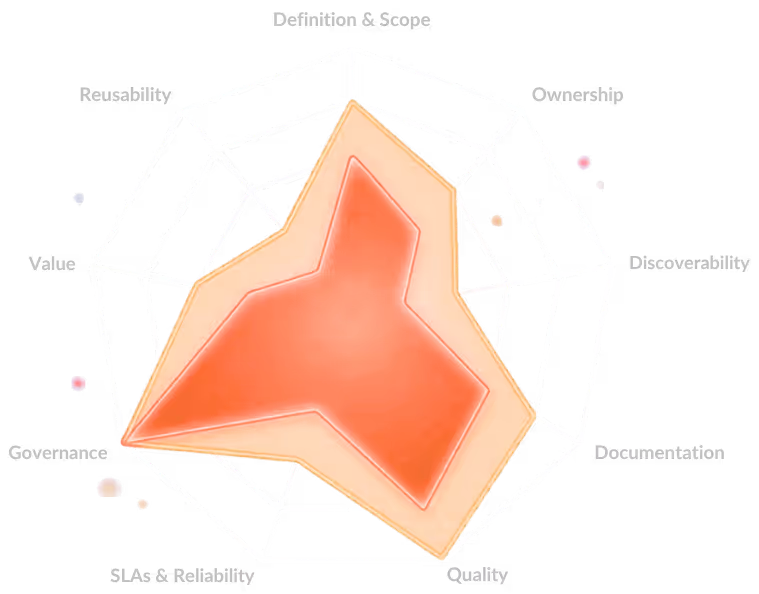
A 9-dimension self-assessment used by 100+ data teams to benchmark strategy, ownership, and platform readiness.


Soumadip De
Soumadip De is an AI Product Manager at The Modern Data Company, working on ontology, context management, and knowledge systems for enterprise AI agents. His work spans data-productisation, context mining, and agentic workflow enablement that help teams move from raw enterprise data to reliable answers and governed action.
Read the ideas here. Build them with The Modern Data Company.
Modern Data 101 is where the data community thinks out loud. When you're ready to move from articles to architecture, data products, governed AI pipelines, or a full Data Operating System; the team behind this community can help you build it.
Continue reading