How Does a Data Product Platform Improve Data Lineage for Organisations?
The fast-moving GenAI landscape marked with its persistent gaps in data trust makes end-to-end lineage a strategic necessity.

A few weeks into 2026, and the demands of aligning with the GenAI era have taken giant strides. It’s nobody’s fault. Innovation rarely waits, but the pace feels a bit like scrambling for oxygen in an atmosphere that keeps changing. And the data reality behind this shift is sobering: a global survey from Precisely and Drexel University’s LeBow College of Business found that while 76% of organisations call data-driven decision-making a top priority, 67% still don’t fully trust the data they rely on.
And in this fast-shifting world, one truth becomes unavoidable: you can’t step into your AI initiatives and earn royalties from the GenAI without knowing exactly where your data comes from and where it’s going.
As organisations shift from traditional data platforms to more business-case-aligned and user-facing data products, the approach to data lineage is fundamentally evolving. This article explores data lineage from a data product perspective and demonstrates how a data product platform can transform lineage from a technical necessity into a strategic business enabler.
What is Data Lineage
Data lineage refers to a visual map that tracks the entire lifecycle of your data. It shows where your data comes from (the origin), where it travels (the destinations), and all the changes or transformations that happen along the way.
Think of FedEx. Data lineage is your FedEx tracking for data.
You know when the package was shipped, who handled it, which warehouses it passed through, what changed in transit, and exactly when it arrived.If something looks wrong, you can rewind the entire journey.

More formally, data lineage documents the relationship between enterprise data in various business and IT applications, providing a clear understanding of where data originated, how it has changed, and its ultimate destination within the data pipeline.
[related-1]
Why Do We Need Data Lineage?
Today, organisations move and transform vast amounts of data constantly, from raw operational data to reports, dashboards, and machine learning models. This complexity creates critical challenges that data lineage helps address.
Trust and Verification
Teams often struggle to confirm whether the numbers in a report are accurate and sourced correctly. Questions like “Did this come from the right system?” or “Can I rely on this for a decision?” show up every day.
Data lineage gives users the ability to see where data started and how it moved. That transparency makes it possible to validate authenticity and trust what they’re looking at.
[data-expert]
Data Quality and Accuracy
Lineage plays a major role in maintaining data integrity. Showing every change that happens during migrations, system updates, and transformations, it helps teams confirm that data remains accurate and consistent as it moves.
When something looks off, lineage lets engineers trace the issue back to its origin, pinpointing exactly where the corruption or error occurred.
[related-2]
Impact Analysis and Change Management
Before making any change to a data system, teams need a clear view of the downstream dependencies. Lineage makes that possible by showing the impact at every level, from individual fields to entire platforms, so teams understand the full effect before taking action.
So whether it’s a system upgrade, database migration, or schema update, lineage surfaces every report, dashboard, and application that will be affected. That insight lowers risk and helps teams manage changes with minimal disruption.

Operational Efficiency
Data lineage eliminates the burden of manual documentation and Excel-based tracking. Automated lineage extraction eliminates time-consuming, error-prone manual processes with continuously updated, accurate representations of data flows. These capabilities save time and additionally enable faster troubleshooting when issues arise, as teams can quickly visualise the complete journey of problematic data.
AI Alignment
AI & ML adoption has increased in giant leaps. This requires large volumes of training data for the models to generate their expected outcomes. Understanding where the training data comes from becomes non-negotiable. Column-level lineage verifies that model features originate from reliable, audited sources rather than temporary or unverified data.
This level of visibility is key for building explainable, trustworthy models and meeting both ethical and regulatory expectations.
Challenges of Data Lineage
Let’s be real: data lineage is no walk in the park. It gets tricky fast, especially when companies approach it as an afterthought instead of building it into their systems from the start. As data stacks grow and sprawl across different platforms, the headaches just multiply.
The following are the key challenges of data lineage:
- Lineage is fragmented across clouds, on-prem systems, ETL tools, BI platforms, and custom pipelines, leaving no unified end-to-end view of data flow.
- Manual lineage, which is tracked in spreadsheets, wikis, or diagrams, becomes outdated immediately, remains inconsistent, and never scales with evolving pipelines.
- Table-level lineage lacks the column-level detail needed to understand data quality, ML feature provenance, and precise downstream impact.
- Batch-updated lineage often lags hours or days behind reality, slowing incident response and making it impossible to support real-time data products.
- Technical lineage lacks business context, making it difficult for analysts and business users to interpret without heavy engineering support.
- Lineage is disconnected from data governance, so access policies, quality rules, and sensitivity labels don’t flow through lineage graphs or reflect how data is actually used.
How Data Product Platforms Solve Data Lineage Challenges
Built on data developer platform principles, data product platforms make lineage a core, automated, always-current capability.
I. Lineage Capture Through Declarative Specifications
Data product platforms enable developers to define data assets through declarative specifications rather than imperative code. Instead of manually writing ETL scripts and then separately documenting lineage, developers declare what data sources they need, what transformations to apply, and what outputs to produce, all in structured configuration files.
.avif)
The platform uses these specifications to extract full lineage information. When a developer indicates that a "Customer 360" asset relies on "CRM Contacts," "Transaction History," and "Support Tickets," the platform records these dependencies. Once the transformation logic is defined, whether in SQL queries, code in Python or a drag-and-drop visual workflow, the platform analyses that transformation logic to understand how the data will flow from input to output.
[related-3]
This declarative approach eliminates manual lineage documentation, as lineage is automatically extracted from the same specifications used to build the data asset. It stays accurate because it's derived from executable code, and always current because it updates whenever specifications change.
SQL queries are analysed to extract column-level dependencies, showing precisely which source columns contribute to each output. Python transformation code is scanned for data inputs and outputs. API calls are instrumented to capture runtime data access. The platform also integrates with external tools through standards like OpenLineage, importing lineage events across systems to provide end-to-end visibility across the entire data ecosystem.
💡For instance, a data engineer builds a "Monthly Revenue Summary" asset. They declare dependencies on the "Transactions" and "Exchange Rates" tables in a YAML specification file. The transformation logic, a SQL query joining these tables, converting currencies, and aggregating by month, is included in the same specification.
On deployment, the platform automatically:
- Captures that the asset depends on two upstream sources
- Analyses the SQL to determine that the output "revenue_usd" column derives from "transactions.amount" and "exchange_rates.rate"
- Records the aggregation and join transformations
- Makes this lineage immediately queryable through APIs and visualisations
- Updates lineage automatically whenever the specification changes
II. Business-Friendly Lineage with Rich Context
A Semantic Approach, yes, that’s what a data product platform will enable!
Data products are designed with business users in mind, providing clear descriptions, business glossary linkages, and domain context that make lineage comprehensible to non-technical stakeholders.
The platform presents lineage at multiple levels:
- Data product level: Shows dependencies between named, business-meaningful data products like “Customer 360,” “Sales Pipeline,” and “Marketing Campaign Performance.”
- Attribute level: Provides column-level lineage with business-friendly field names and descriptions.
- Transformation level: Describes transformations in business terms (“aggregated by region”) alongside technical details (SQL code) for different audiences.
Data products bridge technical and business lineage, linking high-level product dependencies and business context with the underlying column-level flows and transformation logic. Users can move seamlessly between both views, drilling down from business understanding to technical detail whenever needed.
.avif)
For instance, an executive exploring lineage for the "Executive KPI Dashboard" sees that it depends on the "Revenue Recognition" and "Customer Lifetime Value" data products, concepts they understand.
A data engineer investigating an issue in the dashboard can drill down to see that the "quarterly_revenue" column ultimately derives from specific columns in multiple source databases, with complete transformation logic visible.
[state-of-data-products]
III. Federated Architecture with Cross-Domain Lineage
Data product platforms use federated architectures that organise lineage around domain boundaries while maintaining cross-domain visibility.
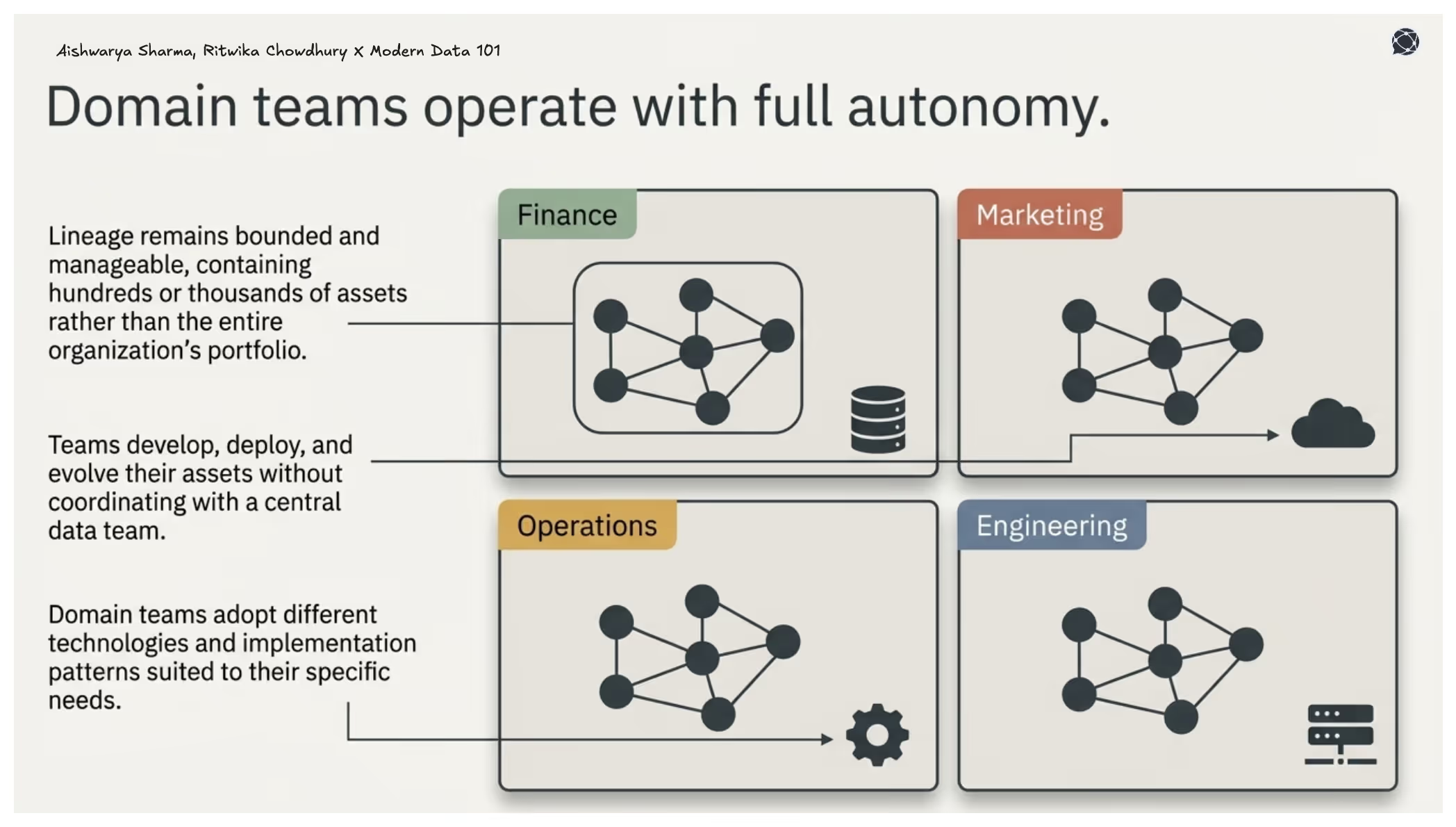
Each domain, including marketing, finance, operations, and engineering, manages its own data assets and their associated lineage. Domain teams have full autonomy to develop, deploy, and evolve their assets without coordinating with a central data team. The domain’s lineage remains bounded and manageable, typically containing hundreds or thousands of assets rather than the entire organisation’s portfolio.
Cross-domain lineage is maintained through explicit dependency declarations. When a financial asset depends on a marketing asset, this dependency is declared in the financial asset’s specification. The platform maintains these cross-domain links in a global lineage graph while keeping detailed, within-domain lineage federated to each domain’s scope.

Each domain, including marketing, finance, operations, and engineering, manages its own data assets and their associated lineage. Domain teams have full autonomy to develop, deploy, and evolve their assets without coordinating with a central data team. The domain’s lineage remains bounded and manageable, typically containing hundreds or thousands of assets rather than the entire organisation’s portfolio.
Cross-domain lineage is maintained through explicit dependency declarations. When a financial asset depends on a marketing asset, this dependency is declared in the financial asset’s specification. The platform maintains these cross-domain links in a global lineage graph while keeping detailed, within-domain lineage federated to each domain’s scope.
This architecture provides scalability benefits that monolithic systems cannot match. Lineage queries within a domain are fast because they operate on smaller graphs. Updates to one domain’s lineage don’t need rebuilding the entire organisation’s lineage graph.
Further, domain teams are able to adopt different technologies and implementation patterns, while the platform maintains consistent cross-domain lineage through standardised interfaces.
When organisation-wide lineage queries are needed,” trace this executive report back to its ultimate sources,” the platform traverses cross-domain dependencies to construct end-to-end lineage. It identifies the domains involved, retrieves lineage from each domain’s graph, and stitches these together using declared dependencies. The result is a complete view spanning multiple domains without requiring a monolithic, centralised lineage repository
Unifying Lineage and Governance in a Single Interface
A data product platform unifies them, treating governance as part of lineage itself. Each data asset carries access policies, quality SLOs, classifications, retention rules, and ownership, all embedded directly into the lineage graph.
When users explore lineage, they see both the technical flow of data and the governance context applied at every step, whether a source is Gold-certified, which transformations maintain quality standards, or which consumers have approved access. Questions like “Which reports use PII?” or “Which ML models depend on low-quality data?” become straightforward lookups.
A unified view connects business and technical perspectives. Business users browse lineage across meaningful products like Customer Lifetime Value or Revenue Forecasts, while technical teams drill into column-level flows and code, both using the same consistent lineage foundation.
Conclusion
Traditional approaches to lineage, fragmented, manual, and disconnected from governance, struggle to meet the demands of modern data ecosystems. Data product platforms built on data developer platform principles fundamentally reimagine lineage as a first-class product attribute.
Organisations adopting data product platforms gain a competitive advantage through superior data trust and agility, where lineage becomes a strategic enabler of data-driven innovation.
The shift to data products represents a fundamental evolution in how organisations think about and manage data. Lineage, as a core attribute of well-designed data products, ensures that this evolution delivers on its promise of trusted, governed, and valuable data for all.
FAQ
Q1: What is the main purpose of the lineage chart tool?
The lineage chart tool usually shows where data comes from, how it moves, and what it impacts. This enables users to trace data end-to-end to help verify trust, understand dependencies, and assess the impact of changes.
Q2: What are the use cases for data lineage?
Data lineage is leveraged for impact analysis, troubleshooting data quality issues, supporting regulatory compliance, validating AI/ML feature provenance, improving business trust in metrics, and enforcing governance policies across data flows.
Q3. What is a data lineage diagram?
A data lineage diagram refers to a visual map that shows how data flows from its sources through transformations to its final destinations. It helps users see where data came from, how it changed, and what depends on it.
Connect with a community data expert
A no-cost session with a practitioner who's been where you are.
About Modern Data 101
Modern Data 101 is a movement redefining how the world thinks about data. A community built by the same team behind the world’s first data operating system, Modern Data 101 sits at the intersection of data, product thinking, and AI. Spread across 150+ countries, the community brings together a global network of practitioners, architects, and leaders who are actively building the next generation of data systems.
At its core, Modern Data 101 exists to simplify the journey from raw data to tangible and observable impact. It advocates high-potential data systems and next-gen architectures to unify and activate insights and automation across analytics, applications, and operational workflows at the edge.
In a world shifting from data stacks to AI ecosystems, Modern Data 101 helps teams not just navigate the change but lead it.


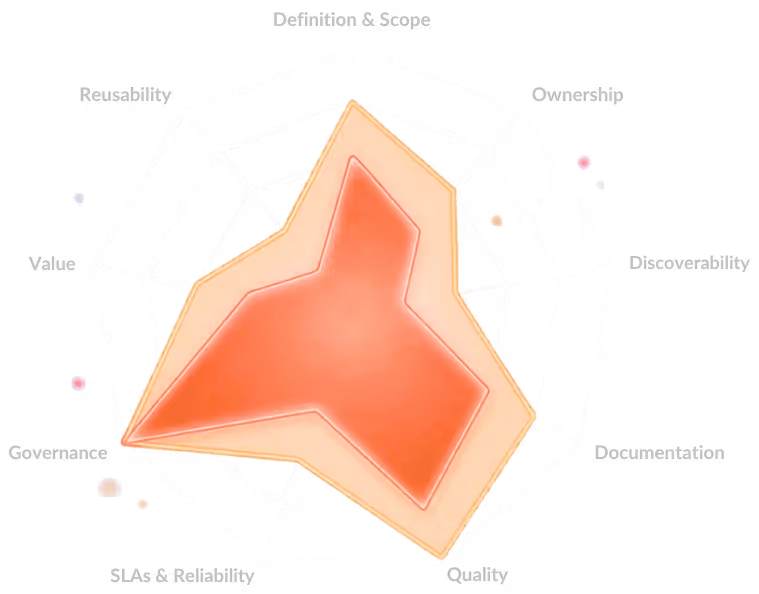
Where does your org stand on data product maturity?
A 9-dimension self-assessment used by 100+ data teams to benchmark strategy, ownership, and platform readiness.


Aishwarya Sharma
Aishwarya is a Senior Analytics Engineer at The Modern Data Company, focused on building end-to-end data solutions that bridge engineering and analytics. He works across data pipelines, modelling, and visualisation to deliver reliable, business-ready insights, combining strong technical expertise with a practical, problem-solving approach to modern data systems.

Ritwika Chowdhury
Ritwika Chowdhury is a data and technology professional focused on data products, AI, and modern data architecture. Her work sits at the intersection of data strategy, product thinking, and emerging AI technologies, with a focus on helping organisations turn enterprise data into trusted, usable, and scalable assets.
Read the ideas here. Build them with The Modern Data Company.
Modern Data 101 is where the data community thinks out loud. When you're ready to move from articles to architecture, data products, governed AI pipelines, or a full Data Operating System; the team behind this community can help you build it.
Continue reading
.jpg)
.png)
.png)