First Strategy Piece of Enterprise AI: The Change Management Framework
Emphasis on the role of Change Managers, the Change Management and Communications Architecture, and the Human Aspect of the AI Activation Layer

TOC
- The Case for Change
- Stakeholder Mapping and Influence Analysis
- The Impact-Influence Matrix
- Stakeholder Mapping Framework
- Change Impact Analysis (CIA)
- As-Is and To-Be States
- User Group Impact Assessment
- Change Readiness and Maturity Assessment
- Change Readiness Analysis (CRA)
- Change Maturity Assessment
- Communication Architecture
- Training & Enablement
- Reward & Recognition Mechanisms
- The Social Flywheel of Change
- Behaviour Reinforcement Loops
- Go-Live & Post-Go-Live Management
- Managing Change Resistance
- Models & Frameworks on Change Management for Enterprise AI
- Final Note
The Case for Change
The most profound constraint to AI transformation today is not technical. It’s ironically the human at the centre of the equation.
Enterprises have spent the last decade industrialising their data infrastructure, yet their human infrastructure remains analogue. AI fails in large enterprise setups because organisations cannot change how they think.
Beneath the surface of every failed initiative is the same pattern: change fatigue, tool overload, and fragmented accountability. Systems evolve faster than the people operating them. The outcome: a widening adoption gap where the brilliance of technology is dulled by the inertia of behaviour.
The Generative Turn (GT) has amplified this tension. AI has moved from the back office to the front line: from automating processes to augmenting decisions. This transition demands trust, which is ten steps ahead of merely demanding integration. To deploy AI effectively, enterprises must engineer deliberate pathways that help users perceive, understand, and internalise AI’s role in their workflow.
From first principles, every AI transformation is a story of human transformation.
Data managers may prepare the ground, but change managers grow the roots. AI success is 20% model performance and 80% organisational adoption.
Stakeholder Mapping and Influence Analysis
Every AI transformation begins with a paradox: the people who decide the change are rarely the ones who live it. Between the boardroom and the workflow is an invisible dense layer of managers, teams, and operators who determine whether the transformation fails or meaningfully endures. Mapping this landscape is an act of empathy and systems thinking.
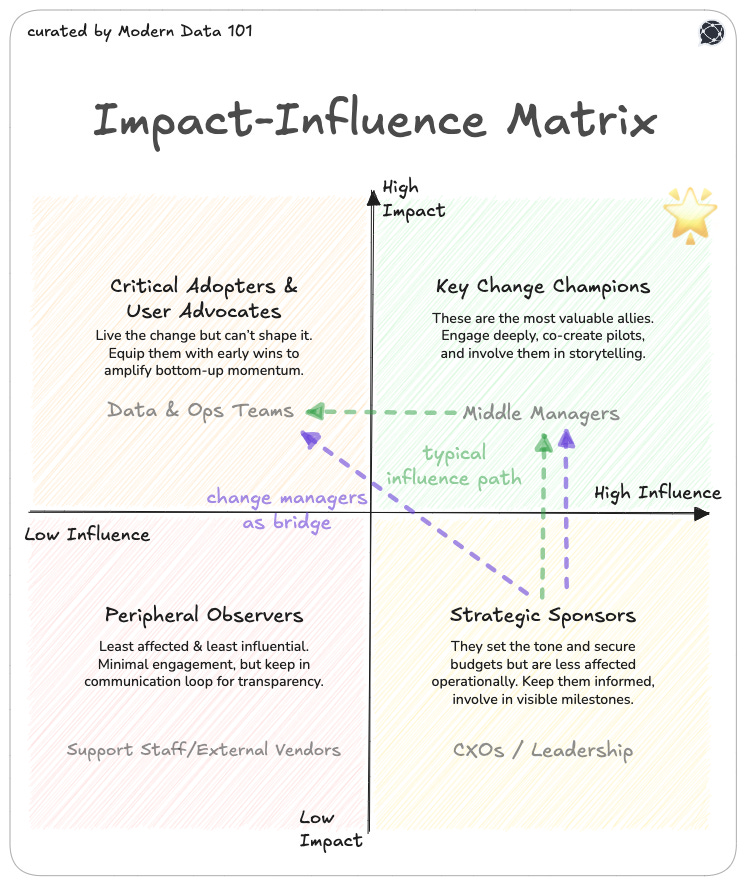
- At the highest layer sit the CXOs: architects of vision with the power to legitimise change but limited proximity to its daily friction.
- In the middle, managers hold the most complex role: they must execute new systems while preserving stability. They carry both the most influence and the most scepticism.
- At the foundation are frontline users: the true adopters whose behaviours determine whether the system activates or stalls. They possess the lowest formal authority but the highest operational impact.
The Impact-Influence Matrix
An Impact-Influence Matrix makes these dynamics visible. It distinguishes those who shape the transformation narrative from those who live it. Real momentum rarely cascades top-down. It radiates from change champions embedded within high-impact zones. Identifying and empowering these individuals creates a distributed architecture of trust that accelerates adoption far more effectively than mandates.
Stakeholder Mapping Framework
A robust Stakeholder Mapping Framework must go beyond titles and hierarchies. It requires empathy maps: structured reflections of what each group fears, values, and hopes to gain from AI. Through focus groups, pulse surveys, and shadowing exercises, change managers uncover the “invisible resistance” that rarely appears in project plans but always surfaces in execution.
Change Impact Analysis (CIA)
Every transformation introduces friction because progress alters the familiar grammar of work. Change Impact Analysis is the discipline of translating that disruption into clarity. It answers a fundamental question: What exactly will change, for whom, and how much will it matter?
As-Is and To-Be States
The starting point is mapping the As-Is and To-Be states: narratives of how decisions are made, actions are taken, and value is created.
- In the As-Is, systems reflect legacy patterns of trust and control;
- In the To-Be, AI reconfigures those patterns by introducing autonomy, prediction, and algorithmic feedback.
Each process and sub-process must be examined for both its technical shift (how tasks are executed) and its behavioural shift (how people experience that execution). The true “change drivers” are rarely just tools. They are altered roles, redefined accountability, and new feedback loops between humans and machines.
User Group Impact Assessment
Every user role experiences change differently: a data analyst may see acceleration, a manager may see loss of control, an operator may see uncertainty. Mapping how each role’s decision flow evolves after AI integration exposes where resistance will surface and where confidence can be built. Each group is then classified by impact intensity (low, medium, or high) to calibrate communication depth, training frequency, and leadership involvement.
CIA, done right, is not documentation. It allows organisations to rehearse the future state before living it, ensuring that every change feels intentional, supported.
Change Readiness and Maturity Assessment
Before scaling AI initiatives, we must understand that readiness is measurable. Often enterprises confuse enthusiasm for readiness. But AI collides with the changing dynamics of human capacity, attention, and trust instead of integrating into static systems. The purpose of readiness assessment is to reveal that invisible layer and understand not what the organisation wants to change, but what it’s ready to absorb.
Change Readiness Analysis (CRA)
A Change Readiness Analysis (CRA) acts as an early radar. Conducted every one to two months, it measures adoption sentiment, leadership alignment, and operational load. The goal is not to produce a score but to identify change saturation points, those zones where teams are juggling too many parallel transformations to engage with another meaningfully. Recognising these fault lines early prevents initiative fatigue and allows for pacing change rather than forcing it.
Change Maturity Assessment
The Change Maturity Assessment adds a longitudinal view. It tracks how the organisation evolves in its ability to sustain transformation. It evaluates whether leadership sponsorship is visible and credible, whether communication channels actually reach their intended audiences, and whether employees perceive AI as augmentation or imposition. Maturity, in this sense, is cultural, and it reflects how deeply the logic of adaptation has been internalised.
Together, CRA and maturity assessment distinguish between being AI-ready and merely AI-curious. The former signals an organisation capable of metabolising change; the latter, one that is excited about it but doesn’t have a plan.
Communication Architecture
Every transformation lives or dies by the quality of its communication.
Technology introduces capability, but communication introduces meaning. It tells people why the change matters, where they belong in it, and what future they are helping to create. A well-designed communication architecture engineers the rate at which conviction spreads through an organisation.
The journey follows a clear psychological arc:
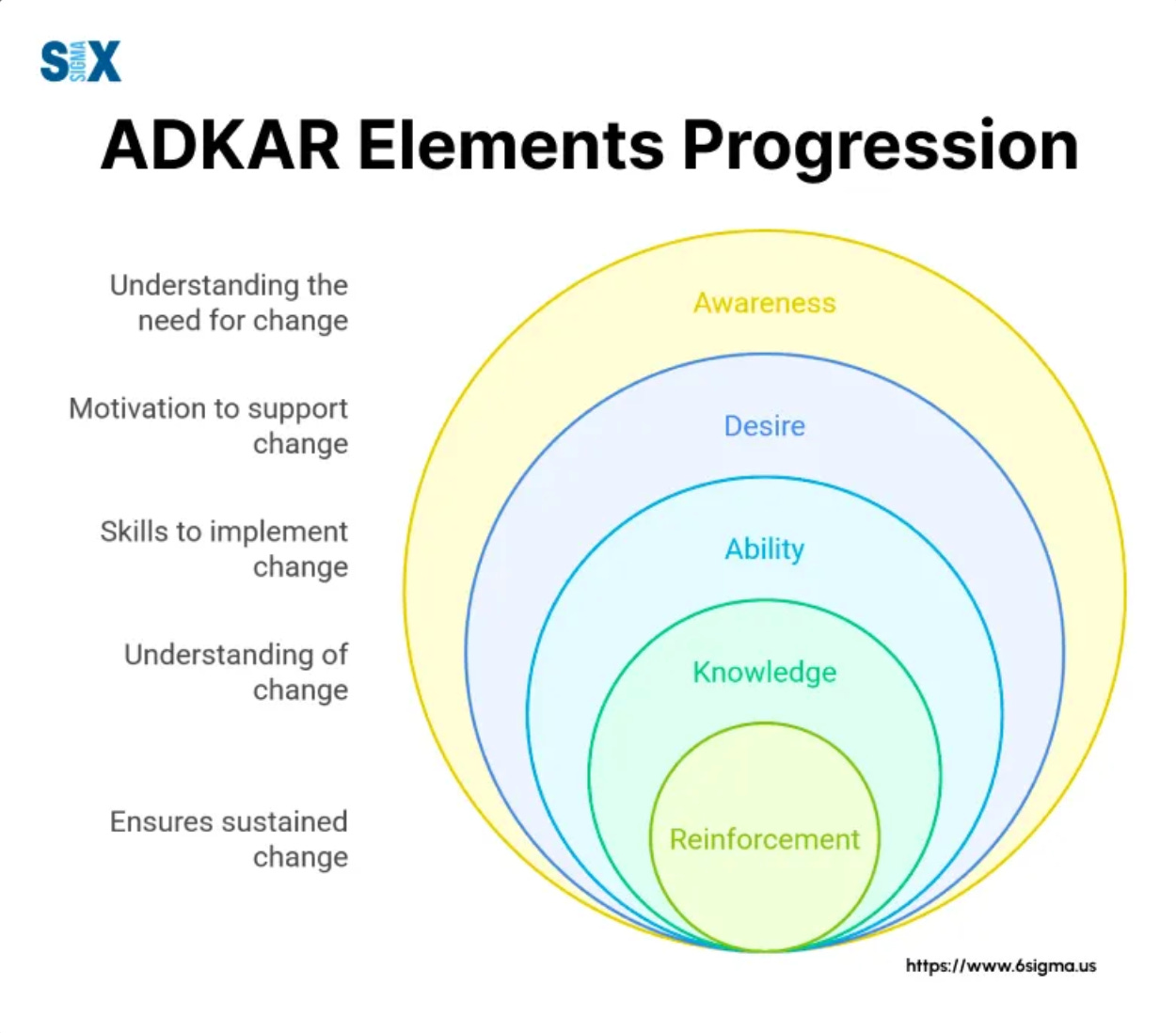
Awareness → Understanding → Commitment.
- At first, communication builds awareness: the what and why of the AI initiative.
- It then deepens into understanding: the how and for whom.
- Finally, it matures into commitment: the ownership of new behaviours.
This progression must be designed deliberately through a communication calendar anchored in the ADKAR model. Each phase uses a blend of creative storytelling (videos, decks, internal case studies) and tactical updates (milestones, metrics, next steps) to balance inspiration with clarity.
Change champions sit at the centre of this network. They are the internal influencers whose credibility makes change relatable. Recruiting these champions early enables them to be active participants in the transformation journey, in fact, as the primary agent of the transformation. In parallel, leadership alignment ensures that every executive speaks from the same script: a unified narrative that avoids the confusion of mixed messaging.
The communication system should be passing through multiple channels and artefacts: townhalls to inspire, newsletters to inform, dashboards to measure, and rituals like “AI Fridays” to normalise ongoing dialogue. Repetition is reinforcement.The aim is to surround employees with meaning until the story of change feels less like a corporate campaign and more like the organisation’s new language.
Training & Enablement
Training is the activation mechanism that turns potential into practice. Data systems can be deployed overnight, but human systems require rhythm, reinforcement, and repetition. Effective enablement is less about transferring knowledge and more about building confidence loops and cycles where users feel competent, supported, and progressively capable of self-navigation in an AI-driven environment.
The Curriculum of Adoption
Adoption has a higher success rate when learning is structured like a product instead of a mundane corporate program. It needs to be personalised, cyclic, and user-centric.
- Segmentation of users: create learning paths based on roles, responsibilities, and technical depth, instead of a one-size-fits-all.
- Role-specific curriculum design: align skills with real-world workflows and processes that are already in-practice to ensure relevance.
- Learning calendar: structure training in digestible phases that accommodate bandwidth and attention cycles. Always consider that this is the last item on everyone’s plate.
- Microlearning modules: deliver short, contextual lessons that reinforce key behaviours.
- Simulations and sandbox play: allow experimentation in risk-free environments.
- Peer pods: create collaborative groups for discussions and problem-solving. For example, experimental projects tied to enabling existing processes.
- Gamified progression: make advancement visible, measurable, and motivating with incentives that actually make a difference.
- Practical certifications: validate competence through assessments that aren’t just theoretical but assessed based on implementation in existing workflows.
- Feedback sessions: use surveys and focus groups to understand the degree of clarity and confidence in the “new”.
- Post-training follow-up: reinforce lessons through refreshers and advanced modules.
Training, when designed this way, converts AI from an external imposition into an internal capability, something the organisation doesn’t just use, but feels familiarity in.
Reward & Recognition Mechanisms
Change thrives on social proof. Every adoption story, every early success, becomes a ripple that nudges the organisation toward new norms. Recognition transforms effort into inspiration, signalling not just what is expected, but what is celebrated. In this way, reward becomes a lever, turning individual wins into organisational momentum.
The Social Flywheel of Change
- Spotlight success stories and early adopters to create visible role models whose behaviours others can emulate.
- Reward super users, those who not only adopt AI but actively enable peers, transforming them into informal evangelists.
- Incentivise continuity through both symbolic and tangible recognition: badges, bonuses, visibility in leadership forums, or featured internal communications.
Behaviour Reinforcement Loops
- Align KPIs and performance appraisals to sustained AI usage, embedding adoption into the fabric of accountability.
- Build feedback loops where adoption feeds adoption: each success reinforces the next, generating momentum.
- Treat recognition not as a one-time reward, but as a continuous mechanism that amplifies confidence, reinforces learning, and normalises the new way of working.
In this way, reward and recognition become structural elements of the AI activation layer: the human circuitry that ensures transformation doesn’t just happen, it sticks.
Go-Live & Post-Go-Live Management
The moment of go-live is often mistaken for the finish line, but it is in fact the beginning of the adoption cycle. The first 3 to 6 months is the hypercare period: an intensive phase of continuous handholding where users are supported through every friction point. Live helpdesks, dedicated support channels, on-demand training refreshers, FAQs, and user guides become the structure that prevents early frustration from turning into abandonment.
Equally important is the gradual transition to organisational self-reliance. Hypercare is not meant to create dependency; it is designed to build capability. Over time, ownership of the change process shifts from the change management team back to the organisation itself. By the end of this period, the goal is clear: the enterprise should be able to sustain AI adoption independently, with confidence in its people, processes, and systems.
Managing Change Resistance
Resistance is the most common aspect of digital transformation projects.
Middle management, in particular, carries the heaviest load of resistance: they must deliver results while navigating the disruption that AI introduces, balancing pressure from above with scepticism from below.
A human-centric strategy is essential to navigate these dynamics. Change managers engage directly through one-on-one conversations, focus groups, and transparent surveys to surface hidden concerns and understand the true sources of hesitation. Resistance is then categorised into three buckets:
- Legal/Ops Required changes that are non-negotiable,
- Productivity Gains that are high priority,
- and Good-to-Have changes that can be deferred.
In this ecosystem, change managers act as translators and the bridge between strategy and daily work. They protect employees from overload while maintaining speed, translating abstract goals into actionable steps. Without change managers at the centre of such transformations, AI adoption becomes yet another technical rollout with high chances of abandonment. With change managers, we ensure a human-centred transformation.
Models & Frameworks on Change Management for Enterprise AI
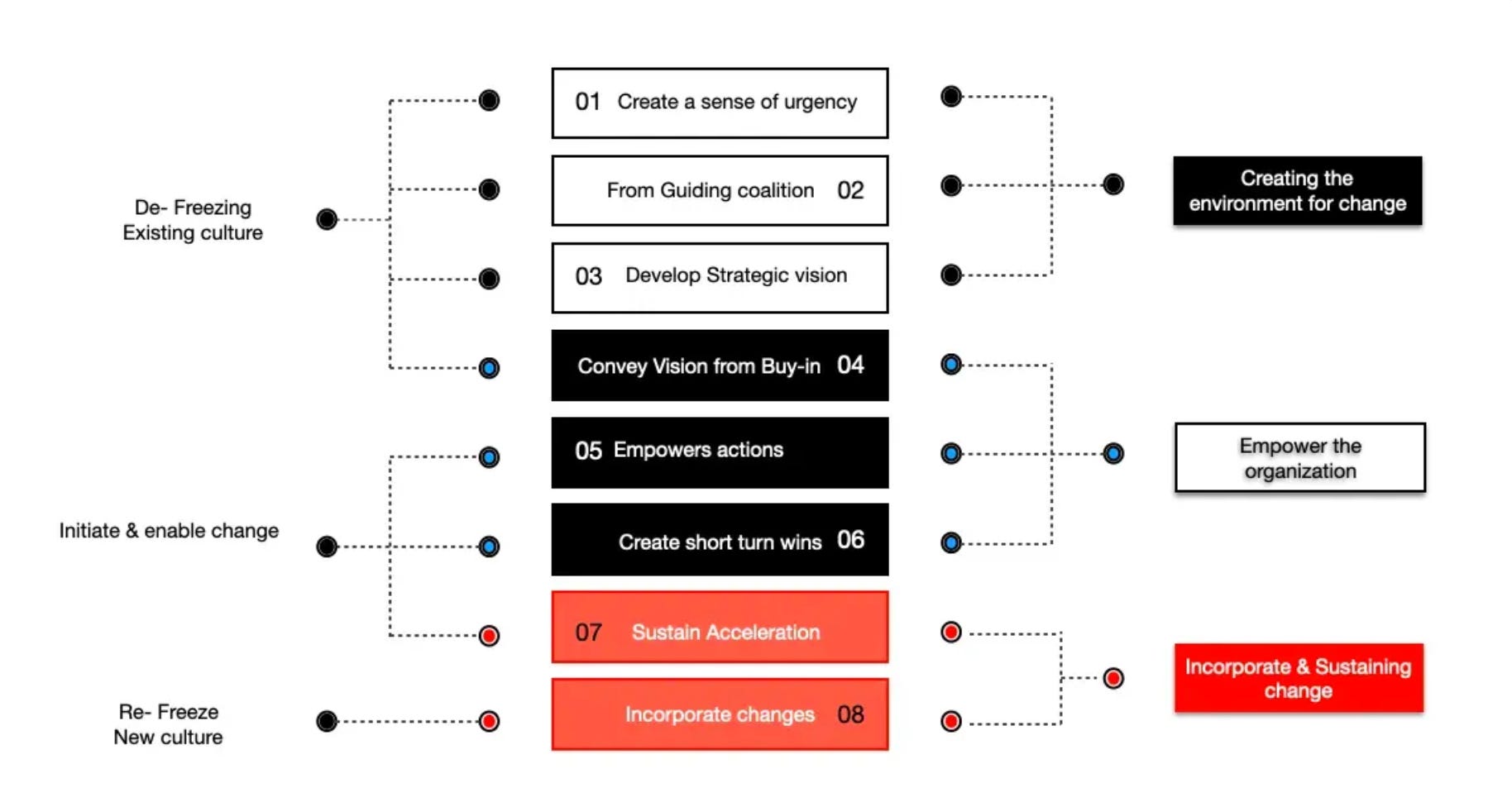
Kotter’s 8-Step Model emphasises urgency, coalition building, and the pursuit of quick wins, ensuring that change momentum is visible and actionable.
ADKAR focuses on individual transitions, moving employees through the stages of Awareness, Desire, Knowledge, Ability, and Reinforcement. A lens that captures the human heartbeat of transformation.
Prosci’s methodology institutionalises these practices, embedding structured change processes into organisational DNA so that adoption is repeatable, measurable, and sustainable.
Especially for enterprise AI transformations, the true power of these frameworks emerges when they are integrated with the AI Activation Layer.
This layer is an organisational operating layer and the connective tissue between systems of intelligence and systems of behaviour. It ensures that AI is not just deployed, but activated within the enterprise.
Final Note: Enable Change Managers and Bring Them to the Forefront
The coming decade of enterprise AI will not be defined by bigger models, faster pipelines, or more sophisticated algorithms. It will be defined by adoption success. Adoption and transformation are not byproducts of technology, but require real psychological, social, and cultural incentives.
AI in legacy enterprises or systems does not fail because it lacks this exact adoption at scale. And scalable adoption requires orchestrators who can navigate resistance, cultivate trust, and embed new behaviours into daily work. The change manager, long undervalued in the hierarchy of technical priorities, emerges as the true architect of enterprise AI.
Thanks for reading Modern Data 101! Subscribe for free to receive new posts and support my work.
MD101 Support ☎️
If you have any queries about the piece, feel free to connect with the author(s). Or feel free to connect with the MD101 team directly at community@moderndata101.com 🧡
Author Connect
Find me on LinkedIn 🙌🏻
Find me on LinkedIn 🤝🏻
From MD101 team 🧡
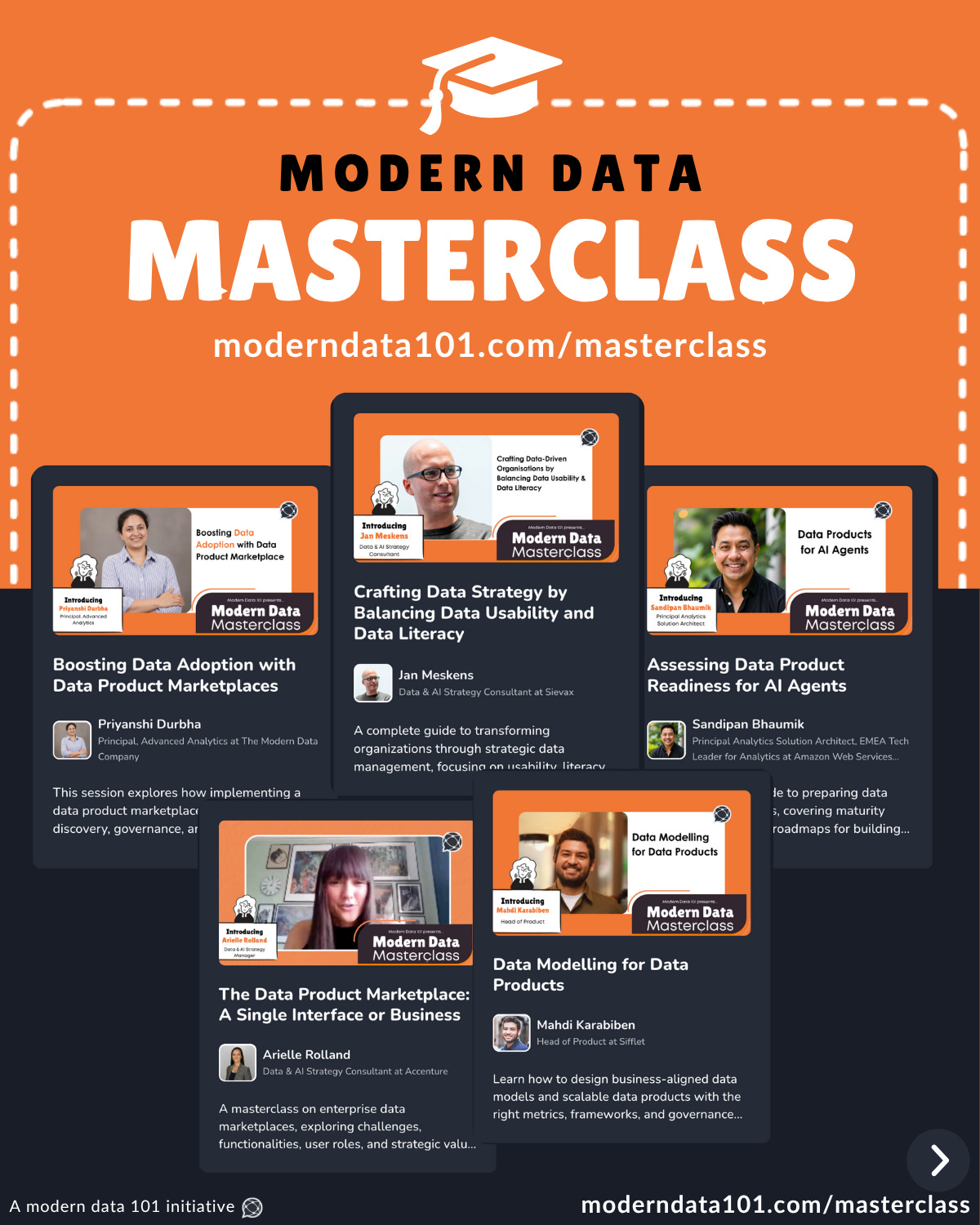
The Modern Data Masterclass: Learn from 5 Masters in Data Products, Agentic Ecosystems, and Data Adoption!
With our latest 10,000 subscribers milestone, we opened up The Modern Data Masterclass for all to tune in and find countless insights from top data experts in the field. We are extremely appreciative of the time and effort they’ve dedicatedly shared with us to make this happen for the data community.
Connect with a community data expert
A no-cost session with a practitioner who's been where you are.
About Modern Data 101
Modern Data 101 is a movement redefining how the world thinks about data. A community built by the same team behind the world’s first data operating system, Modern Data 101 sits at the intersection of data, product thinking, and AI. Spread across 150+ countries, the community brings together a global network of practitioners, architects, and leaders who are actively building the next generation of data systems.
At its core, Modern Data 101 exists to simplify the journey from raw data to tangible and observable impact. It advocates high-potential data systems and next-gen architectures to unify and activate insights and automation across analytics, applications, and operational workflows at the edge.
In a world shifting from data stacks to AI ecosystems, Modern Data 101 helps teams not just navigate the change but lead it.


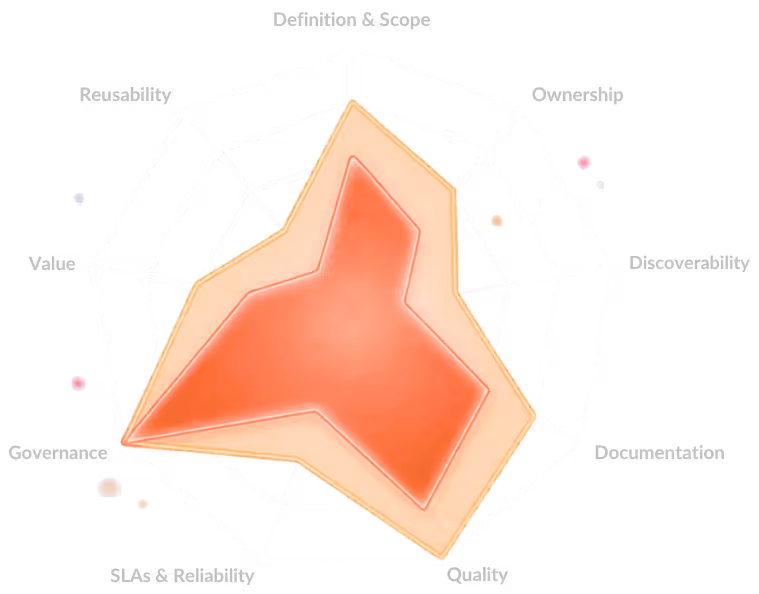
Where does your org stand on data product maturity?
A 9-dimension self-assessment used by 100+ data teams to benchmark strategy, ownership, and platform readiness.


Travis Thompson
Travis is the Chief Architect of DataOS, building full-stack Data Product solutions, and a founding contributor to the Data Developer Platform Standard that enables flexible implementation of disparate data design architectures such as data products, meshes, or fabrics. Over 30 years in all things data engineering, Travis has designed state-of-the-art architectures and solutions for top organisations, including GAP, Iterative, MuleSoft, HP, and many more. He is also an active advocate for polymorphic data architectures and contributes extensively to community archives.

Animesh Kumar
Animesh Kumar is the Co-Founder and Chief Technology Officer at The Modern Data Company, where he leads the design and development of DataOS, the company’s flagship data operating system. With over two decades in data engineering and platform development, he is also the founding curator of Modern Data 101, an independent community for data leaders and practitioners, and a contributor to the Data Developer Platform (DDP) specification, shaping how the industry approaches data products and platforms.
Read the ideas here. Build them with The Modern Data Company.
Modern Data 101 is where the data community thinks out loud. When you're ready to move from articles to architecture, data products, governed AI pipelines, or a full Data Operating System; the team behind this community can help you build it.
Continue reading