Why Organisations Should Leverage Data Products for Business Process Reengineering
Why 70% of radical process redesigns collapse during rollout, and how productising your underlying data layer fixes broken workflows, scales operational efficiency, and powers enterprise AI.

Last updated on 24th August 2026
TL;DR
- Initial studies show that nearly 70% of Business Process Reengineering (BPR) projects fail during execution, largely because organisations redesign workflows while leaving fragmented, unowned legacy data intact.
- Redesigning a process inherently alters how data flows, where it lives, and who owns it. When legacy schemas, hidden API connections, or metric definitions break, the reengineered process falls apart.
- A data product approach packages raw operational inputs into governed, reusable, and contractually backed assets. This guarantees that every step of a redesigned workflow receives reliable, metrics-ready data.
- Deploying AI or machine learning on top of reengineered processes requires unambiguous semantic clarity and complete lineage tracking. Data products ensure LLMs and AI agents draw from trusted operational definitions.
Organisations today are under relentless pressure from rising costs, broken workflows, outdated systems, and customers who expect more than ever. Incremental fixes no longer cut it. Business Process Reengineering (BPR) offers something bolder: a fundamental rethink of how work gets done. But in a world drowning in data, redesigning processes without a clear data strategy is building on sand. Infact, intial studies on BPR mentioned around 70% of these initiatives fail during implementation, largely due to poor planning and unrealistic expectations.
This article explores BPR, its principles, its modern relevance, and why data products are quietly becoming the difference between transformation that sticks and transformation that fades.
[playbook]
What is Business Process Reengineering?
Business Process Reengineering is the fundamental rethinking and radical redesign of core business processes to achieve dramatic improvements in performance, cost, quality, speed, and customer experience. Unlike continuous improvement methods that refine what already exists, BPR asks a more disruptive question: if we were building this process from scratch today, would we build it this way? The answer, almost always, is no.
The concept was designed for organisations willing to challenge their own assumptions, to discard legacy thinking and redesign the way value actually flows through the business.
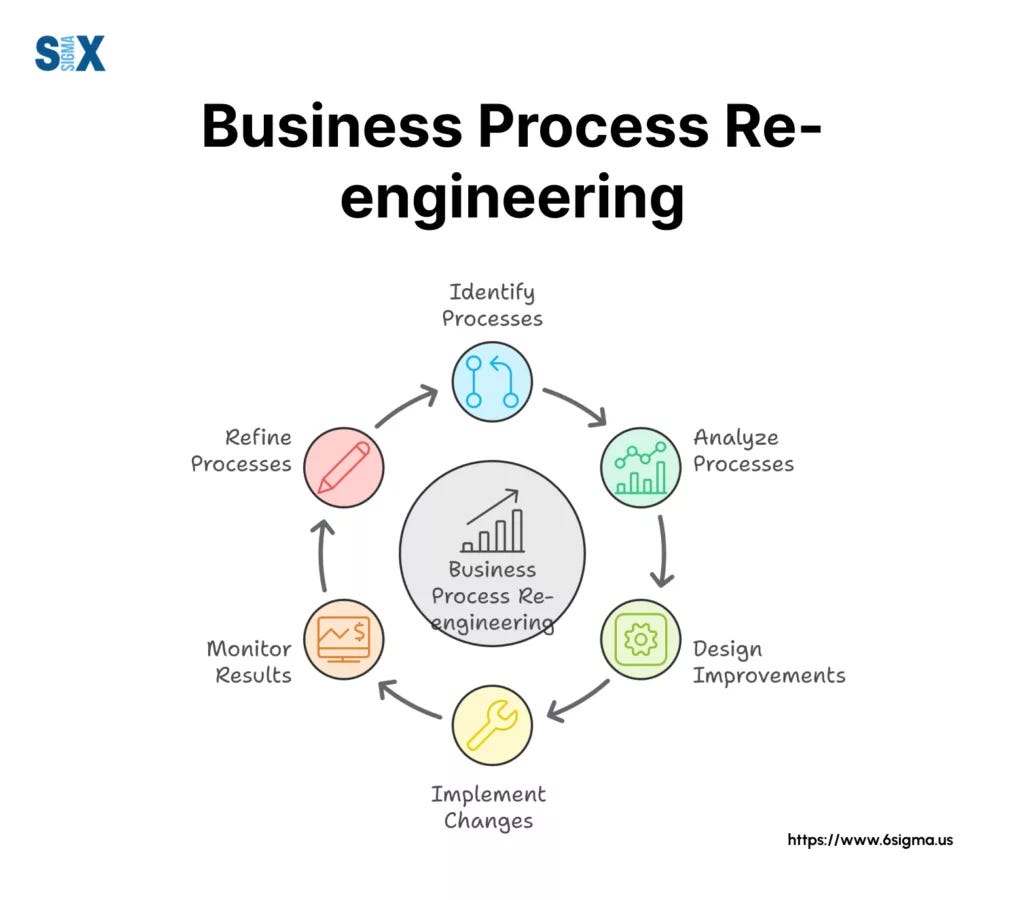
But here's what often gets missed. A process is only as intelligent as the information feeding it. When you redesign how work gets done, you are, whether you realise it or not, also redesigning how data moves, where it lives, who owns it, and what decisions it enables. The most successful reengineering efforts treat each core process as something that should produce reliable, reusable outputs that other teams, systems, and decisions can depend on without having to question their quality or origin.
That shift in thinking changes everything: processes stop being isolated pipelines and start becoming interconnected systems that generate real organisational intelligence.
The Challenges of Business Process Reengineering in a Data-Driven Organisation
We might not have looked at BPR from the data POV, but today this cannot be ignored! This is largely because most organisations are now data-enabled or data-driven, and behind every minor and major process modification and change management step, data has started playing the central character.
Processes are ultimately powered by how data is created, shared, and used across systems and teams. When organisations redesign processes without addressing the data behind them, several issues arise.
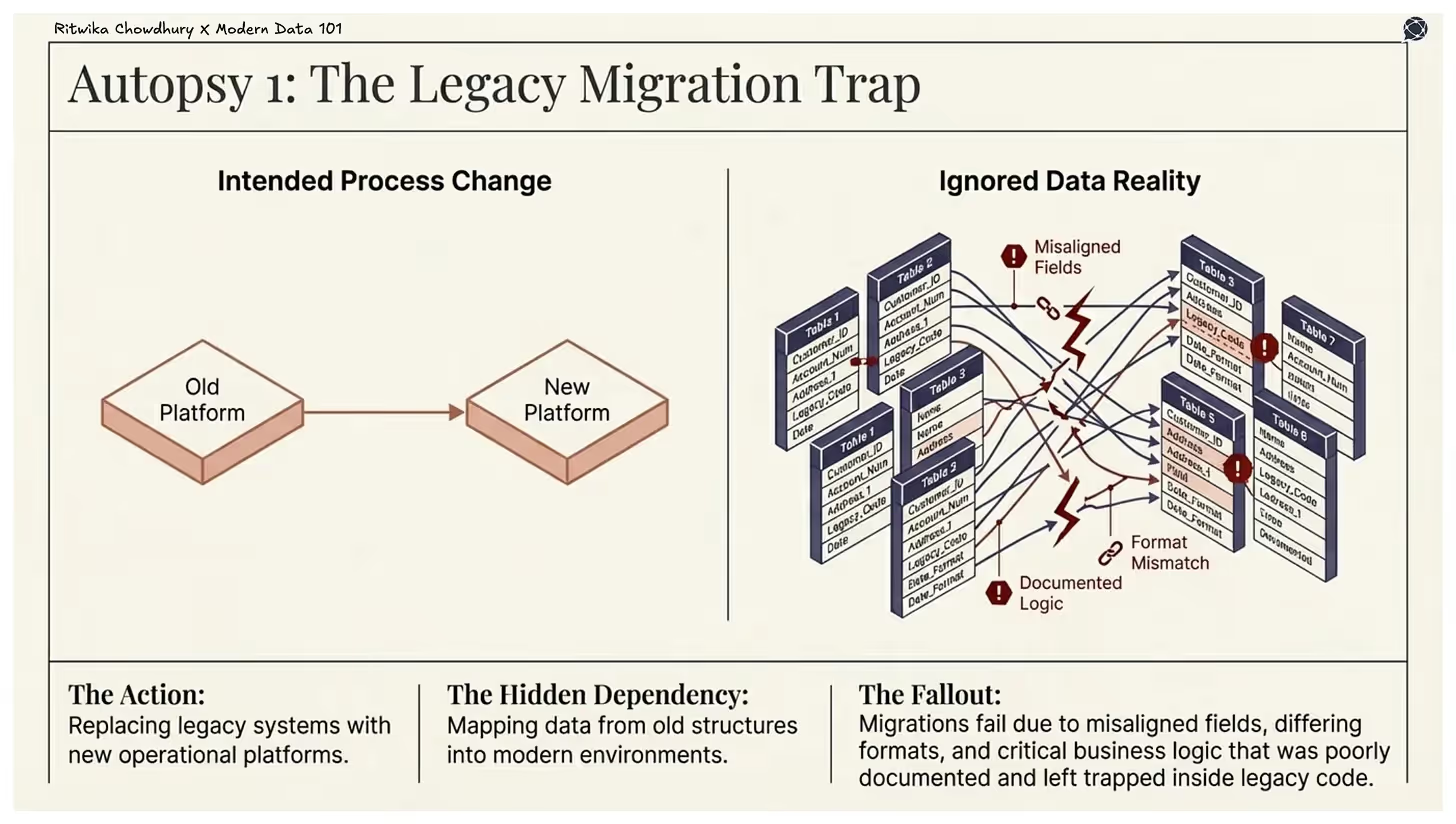
- For instance, BPR often involves replacing legacy systems with new platforms. Mapping data from old structures to new ones is complex, as fields may not align, formats differ, and business logic embedded in old systems may be poorly documented.
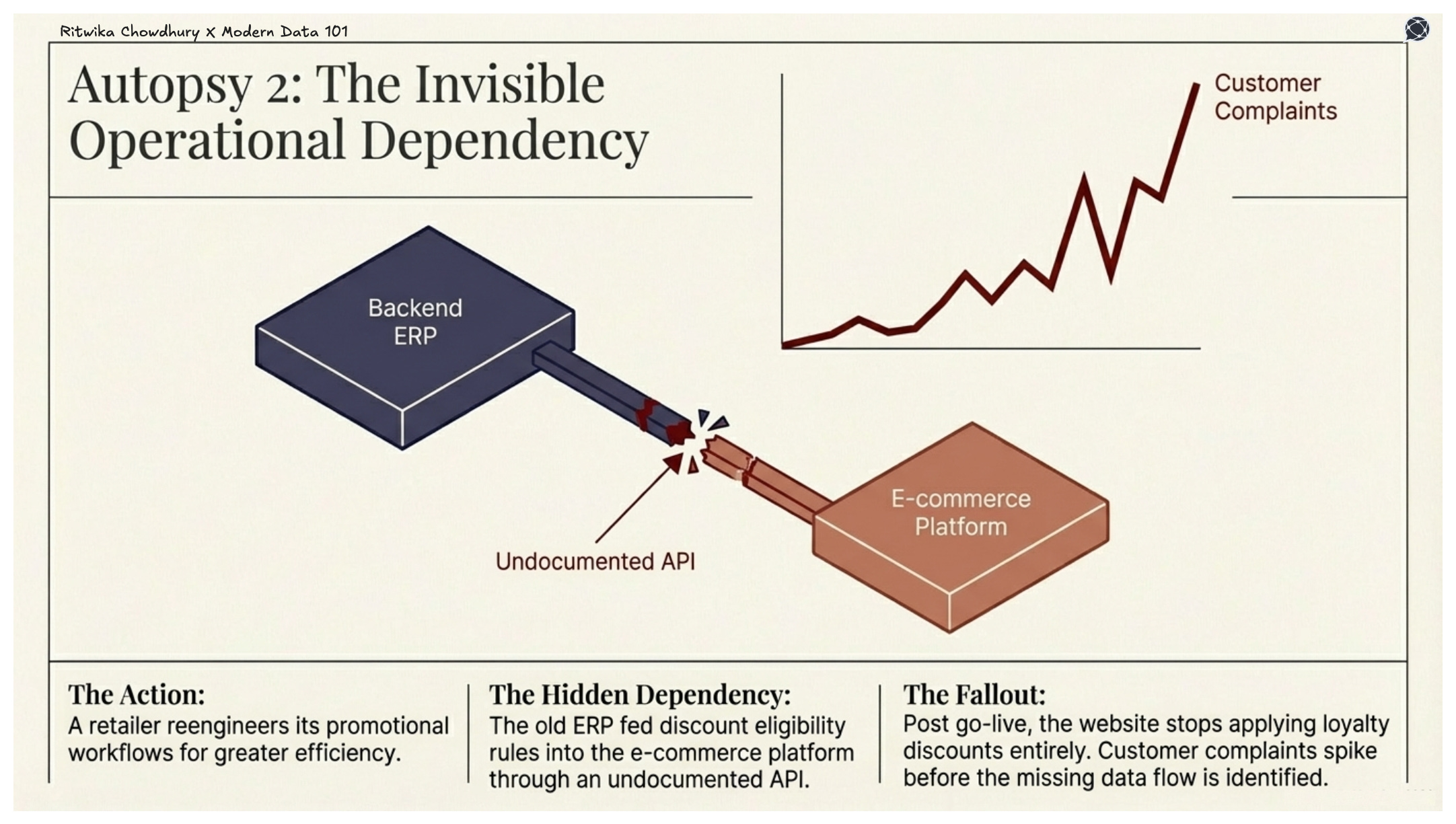
- In another instance, think of a retailer that reengineers its promotions process but doesn't realise its old ERP fed discount eligibility rules into the e-commerce platform through an undocumented API. After go-live, the website stops applying loyalty discounts entirely, and customer complaints spike before anyone connects the issue to the missing data flow.
- There could be an analytics complication, too. A company reengineers its sales funnel and changes how pipeline stages are defined. "Proposal Sent" becomes two separate stages in the new process. Historical win-rate reports are now broken, such that you can no longer compare this year's conversion rates to last year's, making it impossible to tell if the reengineering actually improved performance.
How Data Products Solve BPR Challenges
A large section of the challenges of implementing BRP, as discussed, are often data problems, exposed by process redesigning. And this is precisely where most BPR initiatives hit a ceiling because the information layer underneath it was never designed at all.
This is the gap that data products fill. So why should you consider using data products when dealing with data problems of BPR.
Purpose-driven by design
Every data product is built to cater to a specific business problem or purpose, involving outcome-first modelling where the business goal is set as a north star and the rest of the pieces are assembled around it. In BPR terms, this means every piece of information entering a reengineered process has a clear reason to exist, eliminating the noise that makes process diagnosis unreliable.
Consumer-aligned
A data product approach means identifying the consumer and their problems before kickstarting any effort, mapping all data work to specific business goals, metrics, and challenges. BPR fails when redesigned processes serve internal technical logic rather than actual users. Data products force the opposite discipline from the start.
Metrics-first and continuously evolving
The objective is to build a product that can tend to novel queries at the speed of the business, consistently understanding the pulse of metrics and tracing back to deep-seated opportunities and risks. This is precisely what BPR’s continuous iteration phase needs.
Reliable by contract
One of the primary pillars of data products is data quality, enforced through data contracts at multiple endpoints. In BPR, KPIs and process metrics are only credible when the information feeding them is contractually guaranteed to meet quality standards instead of being hoped to be correct.
Clean ownership of data
The legacy migration problem becomes manageable when the data is owned. Every field, every transformation rule, every business logic embedded in an old system has a named steward responsible for it. Migration stops being an archaeological dig through undocumented pipelines and becomes a structured handover between accountable owners. Think of a retailer is this scenario. His missing loyalty discount flow would have been a defined output of a governed data product, with known consumers, tested interfaces, and a clear audit trail.
[state-of-data-products]
Transforming Marketing Operations with Data Products
How Data Products Optimise Campaigns With Better Business Process Reengineering
The marketing domain of a company could give out one of the clearest instances where Business Process Reengineering either succeeds dramatically or quietly fails. The reason is simple: modern marketing is often a measurement problem.
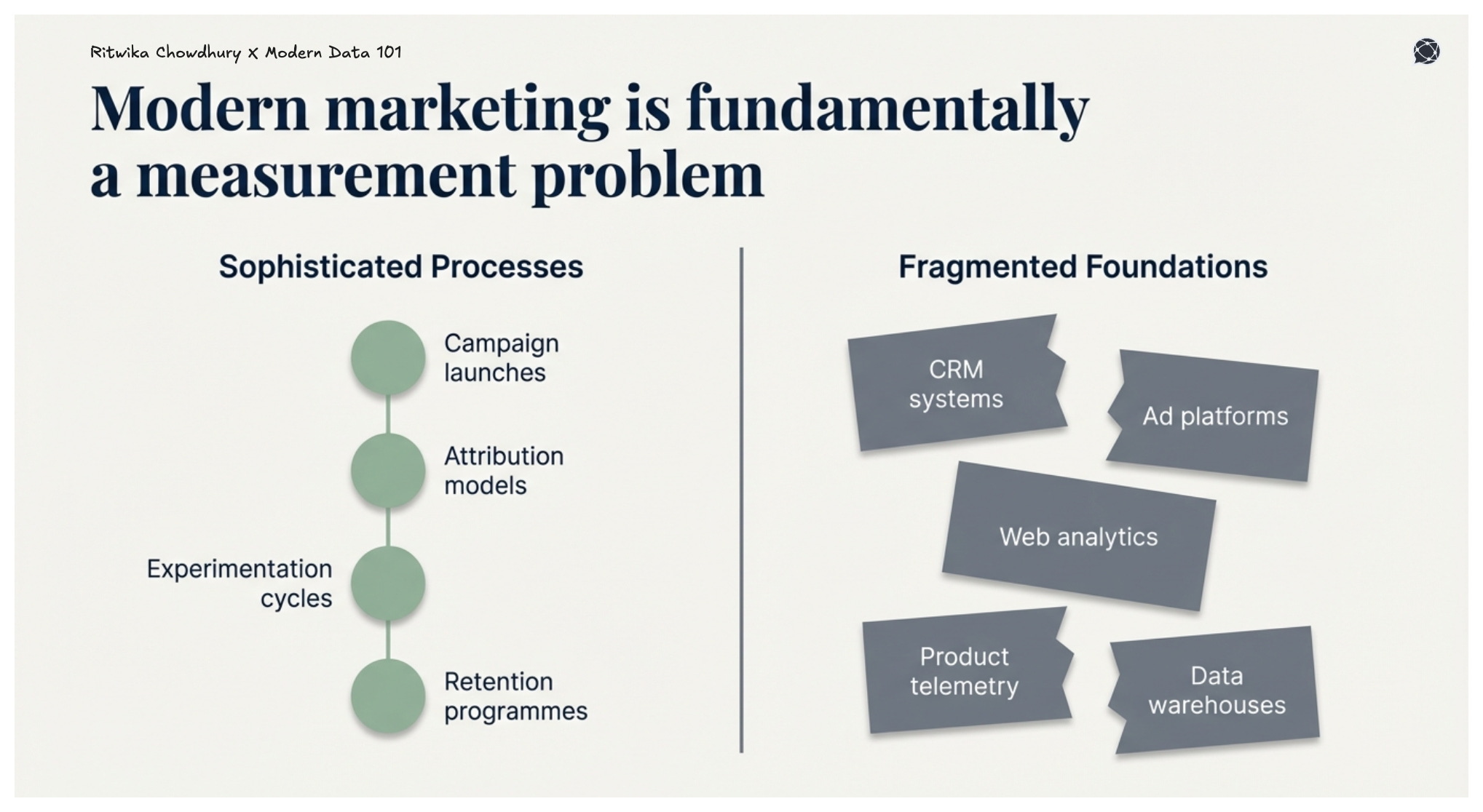
Most marketing teams already run sophisticated processes like campaign launches, attribution models, experimentation cycles, and retention programs. But the information layer beneath these processes is usually fragmented across CRM systems, ad platforms, web analytics, product telemetry, and data warehouses.
[related-1]
When organisations attempt to redesign marketing processes, such as moving to experimentation-led growth, lifecycle marketing, or product-led acquisition, they quickly discover that data is a bigger constraint in the process.
This is where data products fundamentally change the equation.
- A metrics-centric growth data product
Imagine a Growth Intelligence Data Product designed specifically to support the reengineered marketing process.
Instead of raw tables from ad platforms, CRM exports, and product analytics tools, the data product exposes governed, metrics-ready interfaces such as:
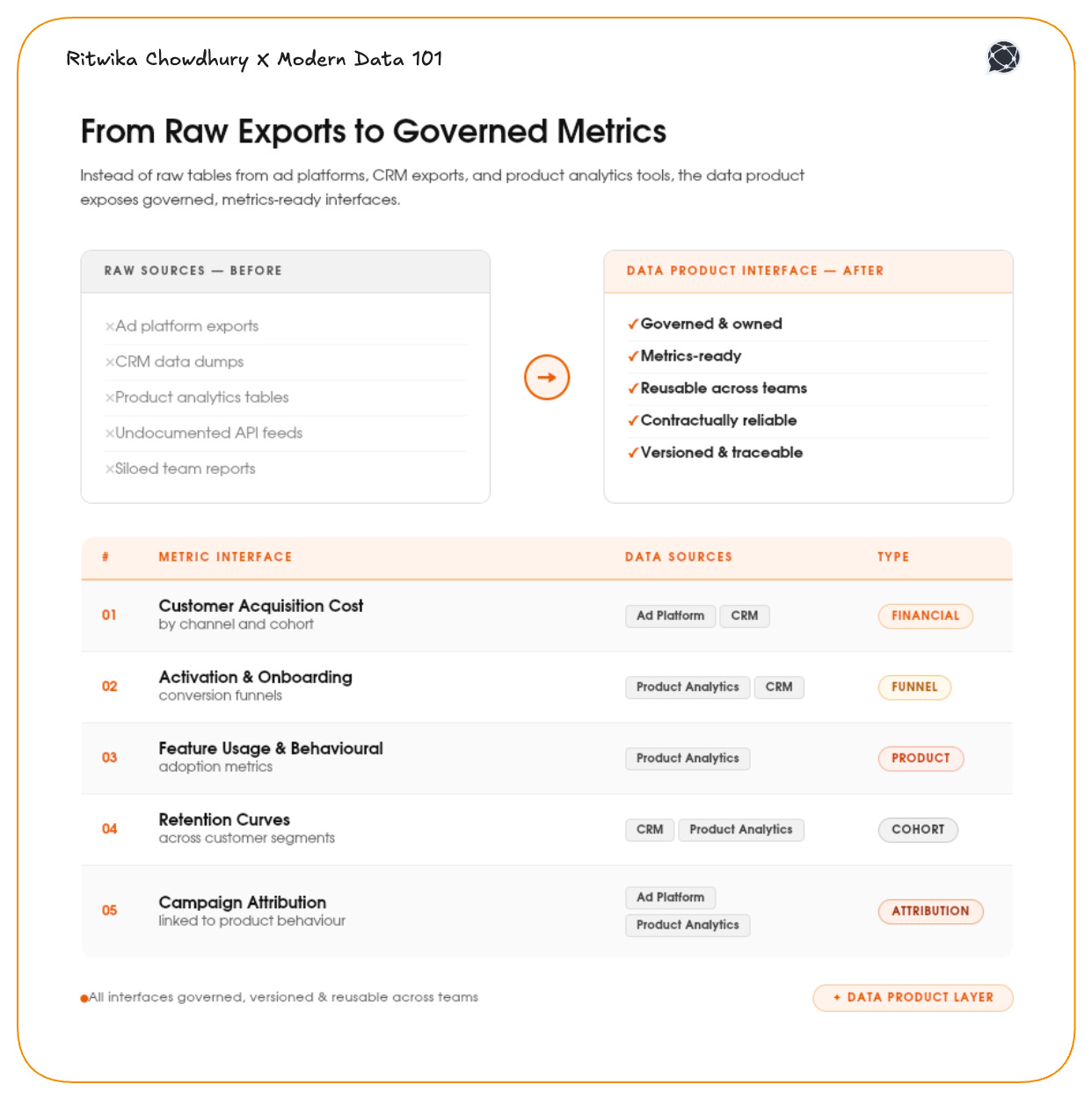
These are structured, governed outputs of a product designed to power marketing decisions.
- Outcome-driven modelling
The data product is modelled around growth questions instead of data sources.
‘Which acquisition channels drive long-term product usage?’ ‘Which onboarding paths lead to higher retention?’ ‘Which campaigns generate customers who actually adopt core features?’
This outcome-first modelling aligns perfectly with a reengineered marketing process where experimentation and iteration are central.
- Usage analytics as operational feedback
Today's marketing increasingly depends on usage analytics, understanding how customers interact with the product after acquisition.
A marketing data product integrates behavioural signals directly into growth metrics. Feature adoption signals feed lifecycle campaigns. Product usage drives segmentation for retention strategies. Engagement metrics trigger automated experimentation loops
In other words, the marketing process extends into the product itself.
[related-2]
- Continuous process optimisation
Because the data product exposes metrics as governed interfaces, marketing teams can run rapid experimentation cycles, launch campaigns, observe acquisition cohorts, track behavioural adoption signals and adjust targeting, messaging, or onboarding
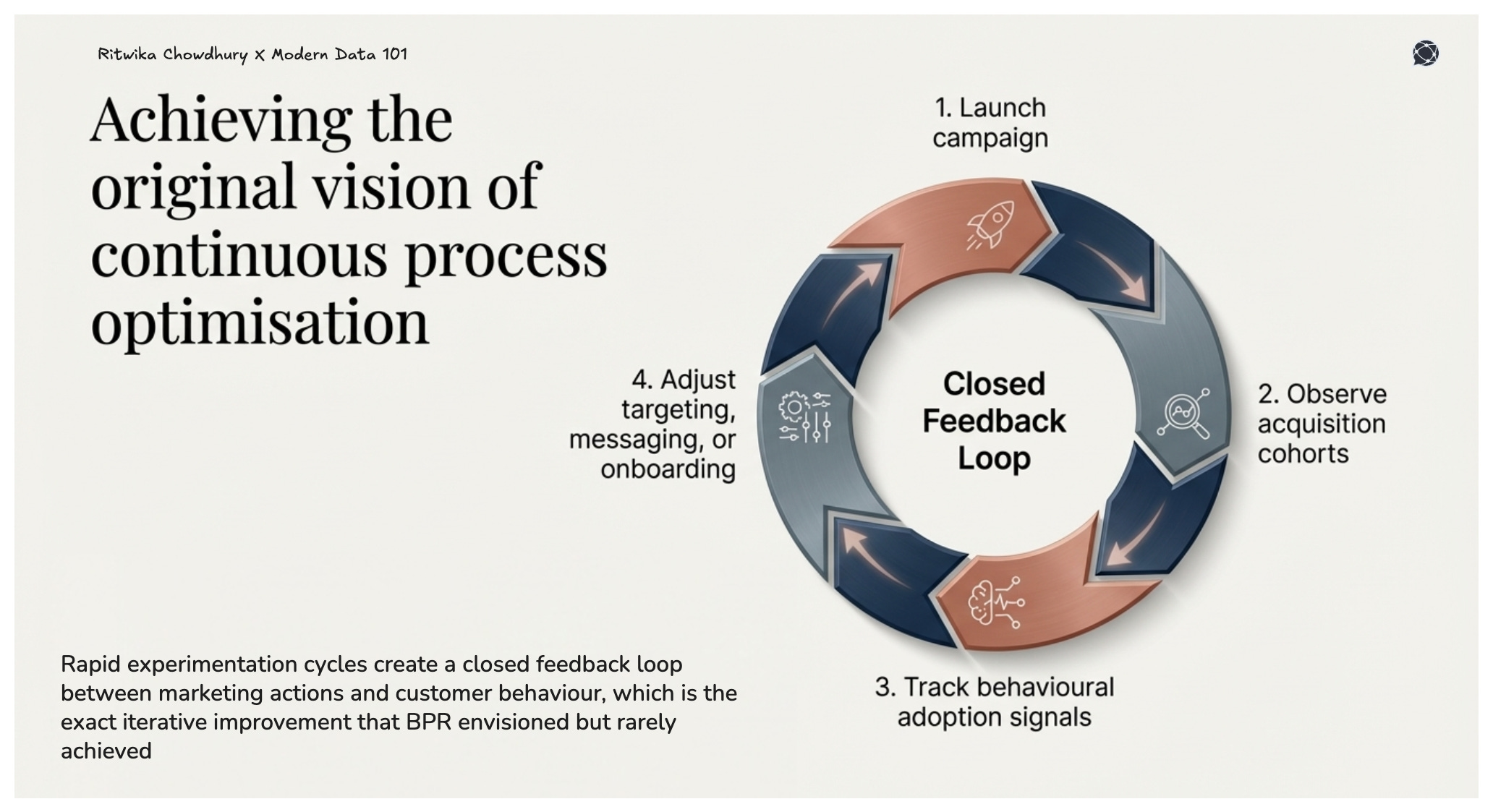
This creates a closed feedback loop between marketing actions and customer behaviour, exactly the type of iterative improvement that BPR originally envisioned but rarely achieved.
- Reliability enables speed
Most marketing analytics efforts collapse under inconsistent definitions. CAC is calculated differently across teams, conflicting attribution models, and inconsistent definitions of “active user.”
A data product resolves this by publishing metrics as contractual outputs. CAC, activation, retention, and feature adoption become trusted interfaces rather than disputed calculations. When marketing leaders can rely on the numbers, decision cycles accelerate.
The Boons of Using Data Products for Business Process Reengineering
From the instance, we deduce how a marketing data product creates infrastructure that is future-proof.
Campaign teams, lifecycle managers, growth engineers, and product teams all interact with the same governed metrics layer. Experiments can be launched faster, insights travel instantly across teams, and process redesign becomes sustainable because the underlying information layer finally supports it.
Hence, the reengineered marketing process stops being a fragile set of workflows and becomes a continuously learning growth engine powered by data products.
Why are data products important for BPR in the Era of Enterprise AI
None of the orgs want AI to become a liability for them, which is perfectly why data products make one of the best solutions to BPR challenges along with amny others.
When an organisation reengineers a process and then deploys AI on top of it, any ambiguity in the data layer becomes an AI decision risk. Regulators, auditors, and customers increasingly want to know why an AI made a specific decision. If the data feeding that decision is undocumented, unowned, and ungoverned, there is no defensible answer. Data products make AI explainability structurally possible rather than a retrospective scramble.
Not to miss on the fact that LLMs and AI agents need semantic clarity.
This is the part most organisations are underestimating right now. It is not enough for data to be technically present and formatted correctly. For AI to reason over it, the data needs to carry meaning, what does "activated user" mean in this organisation? What counts as a "closed deal"? Data products enforce that semantic layer. They are where business definitions live, get versioned, and get inherited by every system consuming themm including AI systems.
FAQs
Q1. What is process reengineering?
Process reengineering is the fundamental redesign of business processes to improve performance, efficiency, and outcomes. It involves rethinking workflows, roles, and technologies from the ground up rather than making incremental improvements to existing processes.
Q2. What are the stages of business process reengineering?
Business Process Reengineering typically follows five stages: identify processes for redesign, analyse existing workflows, redesign the process for desired outcomes, implement the new process with supporting systems, and continuously monitor and optimize performance using defined metrics.
Q3. What are the 7 stages of Business Process Reengineering (BPR)?
- Identify processes – Select high-impact processes with the biggest performance gaps.
- Analyze the current process – Map workflows, bottlenecks, and baseline metrics.
- Redesign the process – Rethink assumptions and design a new value-driven workflow.
- Acquire resources – Secure technology, skills, and organisational support.
- Implement the new process – Roll out the redesigned workflow and manage change.
- Monitor performance – Track KPIs and evaluate outcomes.
- Continuously improve – Refine the process through ongoing feedback and optimisation.
Connect with a community data expert
A no-cost session with a practitioner who's been where you are.
About Modern Data 101
Modern Data 101 is a movement redefining how the world thinks about data. A community built by the same team behind the world’s first data operating system, Modern Data 101 sits at the intersection of data, product thinking, and AI. Spread across 150+ countries, the community brings together a global network of practitioners, architects, and leaders who are actively building the next generation of data systems.
At its core, Modern Data 101 exists to simplify the journey from raw data to tangible and observable impact. It advocates high-potential data systems and next-gen architectures to unify and activate insights and automation across analytics, applications, and operational workflows at the edge.
In a world shifting from data stacks to AI ecosystems, Modern Data 101 helps teams not just navigate the change but lead it.


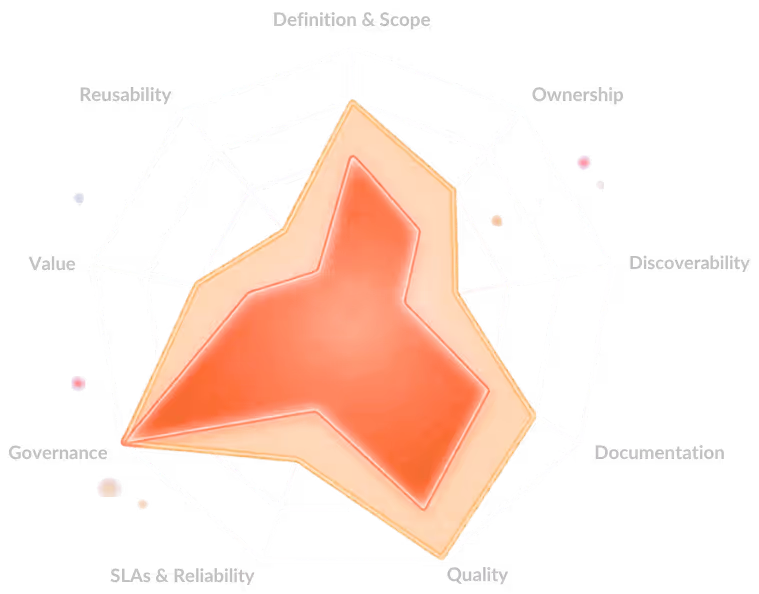
Where does your org stand on data product maturity?
A 9-dimension self-assessment used by 100+ data teams to benchmark strategy, ownership, and platform readiness.



Ritwika Chowdhury
Ritwika Chowdhury is a data and technology professional focused on data products, AI, and modern data architecture. Her work sits at the intersection of data strategy, product thinking, and emerging AI technologies, with a focus on helping organisations turn enterprise data into trusted, usable, and scalable assets.
Read the ideas here. Build them with The Modern Data Company.
Modern Data 101 is where the data community thinks out loud. When you're ready to move from articles to architecture, data products, governed AI pipelines, or a full Data Operating System; the team behind this community can help you build it.
.png)

.png)

.png)