
AI Governance Benchmark 2026: Why Only 4% of Enterprises Are AI-Ready
60% of companies scale AI, yet only 4% possess governance mature enough to manage the risk. Discover how industry leaders bridge the 56-point gap to capture 3.6x higher returns.


of practitioners say they cannot fully trust their own data for business decisions
of enterprises are already scaling AI across multiple departments
of companies qualify as genuinely AI-driven
of companies show almost no measurable return on their AI spend at all

- While 60% of enterprises are scaling AI across multiple departments, only 4% possess mature AI governance equipped to monitor real-time system failure or behavioural drift.
- Governance drives direct financial outperformance. AI-driven leaders with strong governance frameworks outgrow competitors by 1.7x in revenue, 3.6x in 3-year shareholder return, and 1.6x in EBIT margin. Conversely, 60% of un-governed organisations report near-zero ROI on AI spend.
- Most enterprises satisfy NIST’s Govern pillar via static policy documents, but skip execution: only 34% maintain a model inventory, 21% test for bias, and 17% conduct AI red teaming.
- Organisations combining dedicated leadership (e.g., Chief AI Officer) with technical governance report 81% measurable ROI on AI investments, compared to just 15% for those with neither.
- Agentic AI eliminates pre-approval human checkpoints. Managing agentic workflows requires shifting from static sign-offs to real-time exception monitoring to mitigate compounding “agent debt.”
As 2027 is around the corner, enterprises are expected to focus greatly on treating AI governance maturity as measurable proof of how an organisation performs under stress. It measures whether anyone would actually notice and act the moment an AI system started behaving badly. Almost every company can produce intention. Very few can produce that kind of proof.
That gap shows up at ground level too. 46% of practitioners say they cannot fully trust their own data for business decisions, and 93% regularly encounter conflicting versions of the same metric, the same intention-versus-proof problem this benchmark finds in boardrooms, playing out on an ordinary Tuesday in a data team.
In an era dominated by generative AI and autonomous agents, true governance measures whether your team can detect, trace, and remediate an operational failure the exact moment an AI model misbehaves.
That distinction is the real finding behind a new AI governance benchmark from Modern Data 101, built on survey data from BCG, PwC, Deloitte, McKinsey, IBM, Credo AI, and Optro. A survey of 371 senior leaders found 60% of enterprises are already scaling AI across multiple departments, yet only 4% have governance mature enough to keep pace. That 56-point gap between deployment and control is the central problem every other finding in this piece traces back to.
[report-card]
The High Cost of Poor Governance: Why 60% of AI Investments Fail to Deliver ROI
Governance loses almost every budget fight it enters against a feature launch, until an incident makes the cost of not governing suddenly visible.
That incentive gap now shows up as a hard performance split. Roughly 5% of companies qualify as genuinely AI-driven, another 35% are still catching up, and 60% show almost no measurable return on their AI spend at all. The top group outgrows the rest by 1.7 times on revenue, 3.6 times on three-year shareholder return, and 1.6 times on EBIT margin.
PwC’s 2026 AI Performance Study found three-quarters of AI’s economic gains are being captured by just 20% of companies. Three different firms, three different numbers, one population.
The NIST RMF Framework: Moving from Paper Policy to Continuous Monitoring
Most corporate governance playbooks were written for systems that behave the same way twice. An AI model drifts as data changes. Governing it with a one-time audit checklist is like inspecting a bridge once and assuming the traffic load never changes.
NIST’s AI Risk Management Framework breaks the real work into four jobs: Govern (accountability and culture), Map (documenting each system’s risk), Measure (testing against defined criteria), and Manage (turning measurements into actual treatment and response). Govern is the only one that can be satisfied with a document instead of a system, which is why it is the one almost every enterprise already has.
Roughly half of organisations have usage policies and training in place, but only 34% maintain a model inventory, 21% run bias and fairness testing, and 17% conduct AI red teaming ~ Source
That ordering runs from cheapest to build down to most expensive.
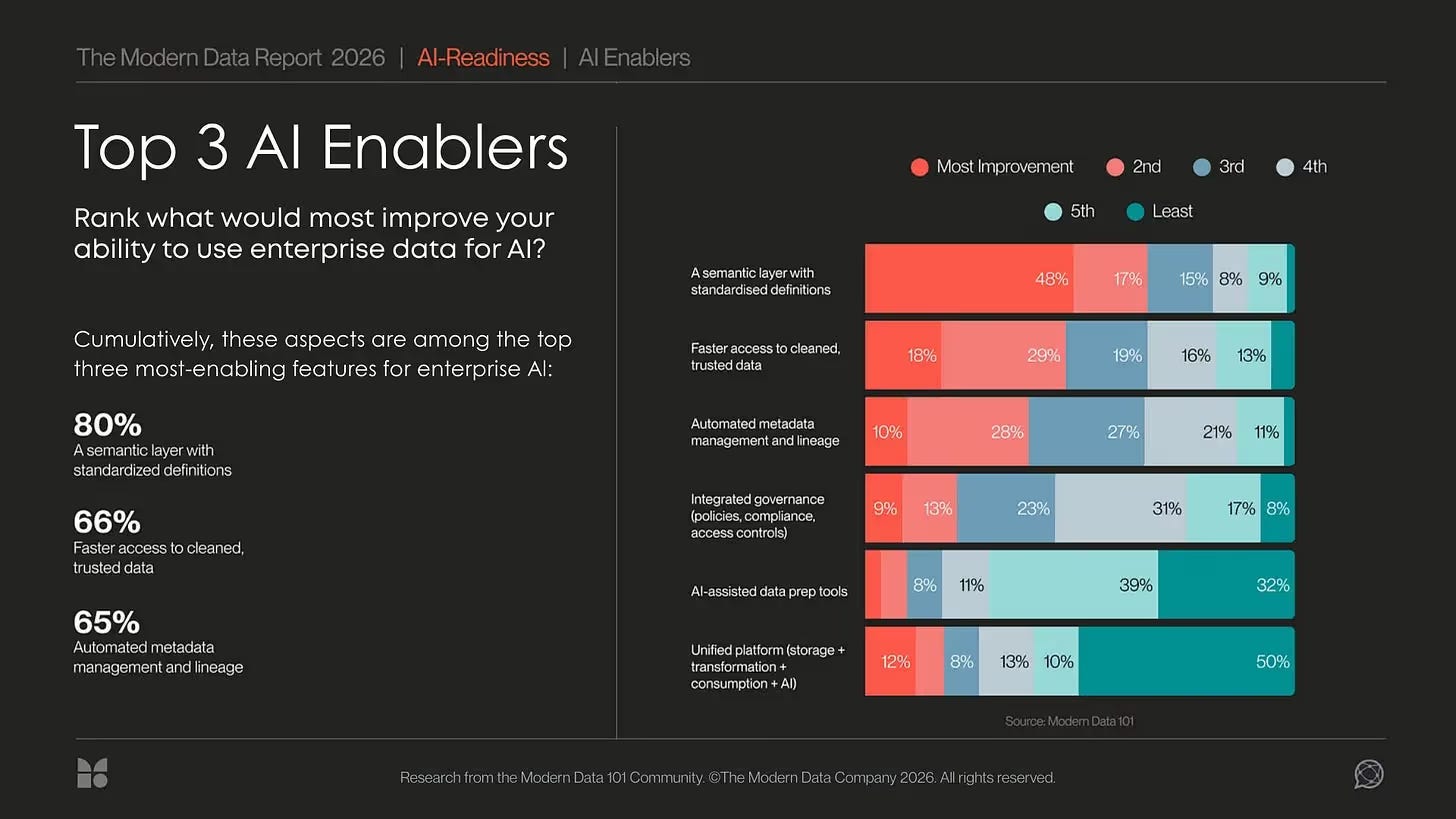
That pattern holds at the practitioner level too. In a survey of 540+ data professionals, 81% ranked strong, consistent governance among their top three platform requirements, and 80% ranked a semantic layer with standardised definitions as the single most important AI enabler, ahead of the AI tooling itself. People doing the work want Measure and Manage. Budgets keep buying them Govern.
[report-card]
Why AI Governance and Capability Drive 81% Measurable ROI
The single behaviour that predicts almost everything else is whether a company named one person to own AI risk before it named a single use case. 76% of organisations now have a Chief AI Officer, up from just 26% a year earlier, and 60% of Fortune 100 companies are expected to name a dedicated head of AI governance in 2026, a role Sony, Bank of America, and UBS have already filled.
Capability follows ownership, and not the other way around. 67% of leaders have pushed foundational AI use cases to scale across the organisation, against just 16% of laggards.
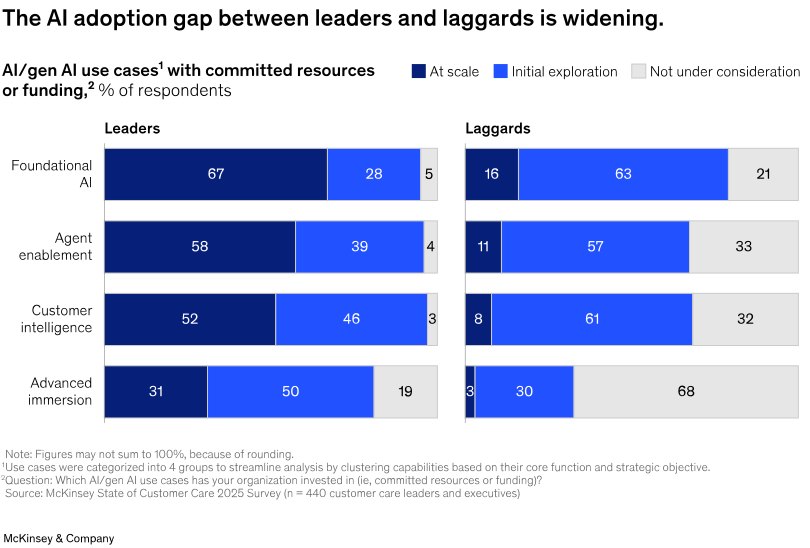
Enterprises considered laggards mostly lack in handing over control to aspects they cannot verify, since 37% say they are not at all comfortable letting AI handle a customer interaction end-to-end, against just 4% of leaders. A study of 755 mid-market leaders found companies combining strong governance with real capability building reported an 81% measurable ROI on AI, against roughly 40% for either lever alone, and just 15% with neither. Governance and capability multiply each other. They do not add.
The Agentic AI Shift: Replacing Pre-Approval Checkpoints with Real-Time Oversight
Every governance model built so far assumes a checkpoint exists before an AI system’s output reaches the world. An agent that can call an API or trigger a workflow has already acted by the time anyone could have reviewed it. Governance has to shift from pre-approval to real-time exception handling, the model fraud detection systems use rather than the one compliance sign-off uses.
Close to three-quarters of organisations plan to deploy agentic AI within two years, while only 21% currently report a mature governance model for it, the widest spread in this entire benchmark. Modern Data 101’s prior research named this shortfall agent debt: the distance between how many autonomous decisions a system is authorised to make and how many anyone can trace, own, or reverse.
The Bottom Line
Every credible survey behind this benchmark draws the line in the same place: somewhere between 4% and 21% of enterprises have governance that can actually prove itself under pressure, and not just describe itself on paper. That band will jump the way agentic AI adoption itself is jumping, once a visible failure makes the cost of not having real oversight impossible to ignore. Every company still has a choice about which side of that jump it lands on. The choice gets more expensive to make once it is made for you.
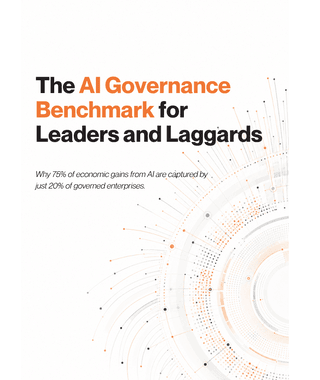
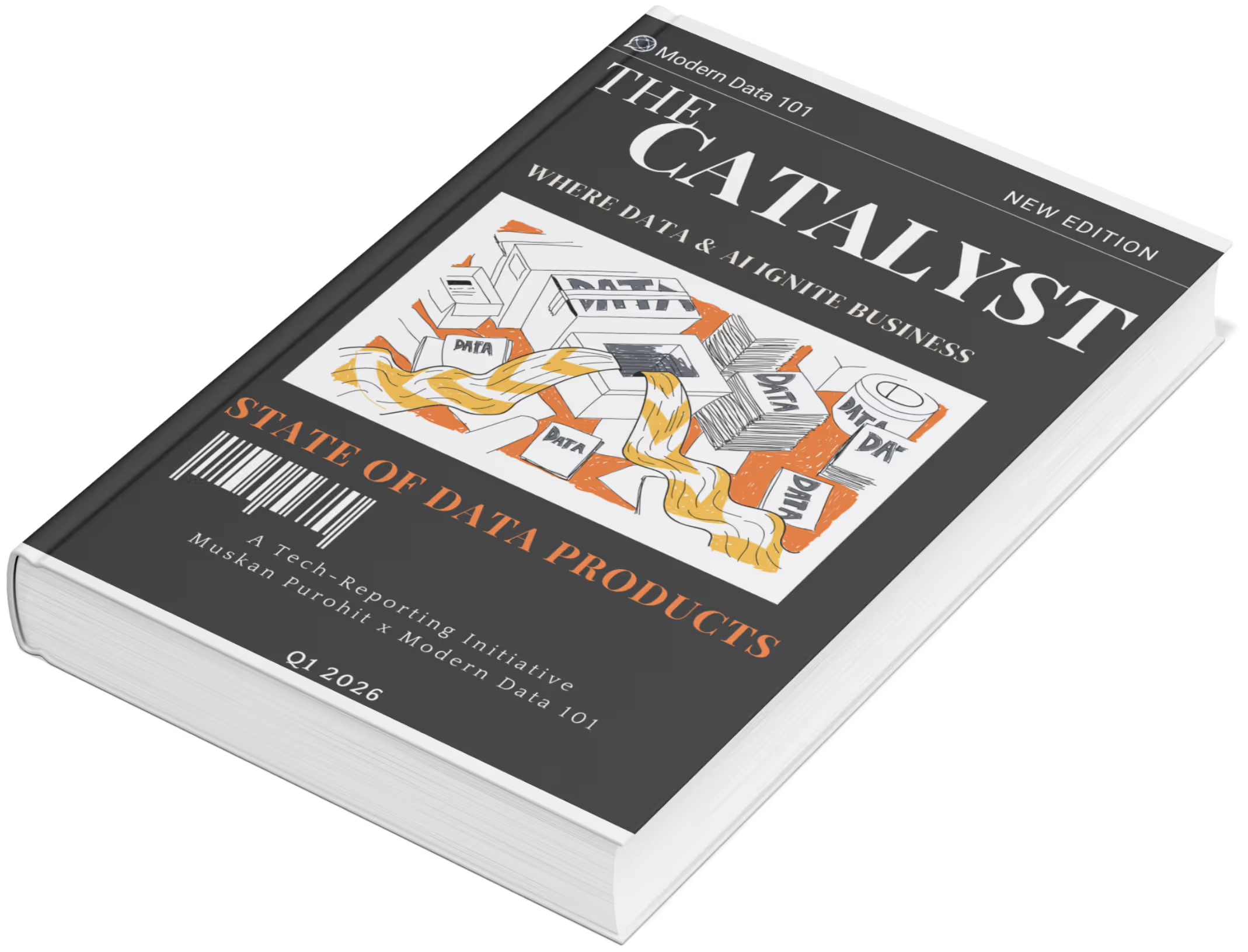
This article summarises findings from Modern Data 101’s full research brief, The AI Governance Benchmark For Leaders and Laggards.
[report-card]
Get the full report
- 19-pager downloadable report
- Insights on the gap between AI leaders and laggards
- Strategies to shift from laggards to leaders
Get the full report
- 19-pager downloadable report
- Insights on the gap between AI leaders and laggards
- Strategies to shift from laggards to leaders


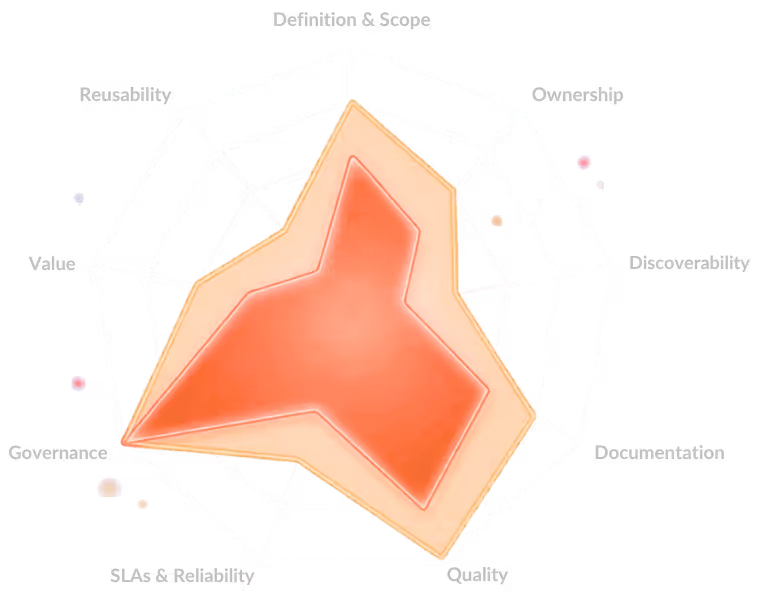
Where does your org stand on data product maturity?
A 9-dimension self-assessment used by 100+ data teams to benchmark strategy, ownership, and platform readiness.

You're all set
Your report is opening in a new tab
Tab didn't open? Open it manually
Animesh Kumar
Animesh Kumar is the Co-Founder and Chief Technology Officer at The Modern Data Company, where he leads the design and development of DataOS, the company’s flagship data operating system. With over two decades in data engineering and platform development, he is also the founding curator of Modern Data 101, an independent community for data leaders and practitioners, and a contributor to the Data Developer Platform (DDP) specification, shaping how the industry approaches data products and platforms.
Ritwika Chowdhury
Ritwika Chowdhury is a data and technology professional focused on data products, AI, and modern data architecture. Her work sits at the intersection of data strategy, product thinking, and emerging AI technologies, with a focus on helping organisations turn enterprise data into trusted, usable, and scalable assets.
AI Governance Benchmark
- 19-pager downloadable report
- Insights on the gap between AI leaders and laggards
- Strategies to shift from laggards to leaders
You're all set
Your report is opening in a new tab
Tab didn't open? Open it manually
You're subscribed
You'll get every new Modern Data Report in your inbox — check your email to confirm.
Done

.jpg)
