Why Vector Embeddings Alone Fail Under Complex Enterprise Queries

The Shifting Landscape of Retrieval Architecture and Agentic AI
The retrieval case has been made: vector embeddings collapse under multi-hop queries, ontology-grounded systems return auditable reasoning paths, and the benchmark evidence across OG-RAG, GraphRAG, and hybrid implementations supports the structural argument. But improved retrieval accuracy is only part of the shift. The deeper question and the one most architecture conversations skip is what happens after retrieval.
What changes when your AI system doesn't just fetch closer answers but reasons over a domain it actually understands?
[report-2025]
Retrieval vs Reasoning: Are You Solving the Right Problem?
Even at OG-RAG's reported 40% correction uplift, retrieval is still just the input layer. An LLM receiving better-grounded context still bears full responsibility for what it infers. In unstructured pipelines, there's no mechanism to constrain the model's reasoning paths.
Ontologies change this structurally. When a query traverses typed edges in a knowledge graph, tracing a compound to its target protein, through a biological pathway, and out to a disease, each hop is schema-governed. The model isn't inferring relationships from proximity; it's walking a path the domain itself has validated. That constraint shifts AI behaviour from plausible generation to bounded, auditable reasoning.
This distinction matters most for AI agents operating across cross-domain enterprise decisions. Agents act on answers. A hallucinated inference in a compliance or risk context carries consequences that a conversational chatbot error simply doesn't.
[playbook]
Ontology Engineering: The Semantic Operating System
A persistent misconception is treating ontology as a modelling project: something you commission, complete, and ship. The minimal ontology principle reframes this: an enterprise ontology should define only the delta between what a model already knows and what your organisation's domain actually means.
.avif)
Built this way, an ontology is closer to infrastructure than documentation. It requires versioned updates as domain concepts evolve, deprecation handling when entities are renamed, and quality signals that propagate downstream. This is precisely where Data Developer Platform is a good fit; the same engineering discipline used for software delivery infrastructure applies equally to semantic infrastructure.
The failure mode most organisations hit: schema curation treated as a one-time task. When the business changes, the ontology drifts. Queries that once returned precise results now return contextually incorrect ones, and because the system still appears to function, the degradation is invisible until something downstream breaks badly.
[related-1]
How Do Knowledge Graphs Work for AI Agents?
What makes knowledge graphs AI-ready isn't query performance; it's their role as the semantic boundary between what an LLM can infer and what your organisation's data actually means. LLMs handle language and reasoning on natural-language inputs. Knowledge graphs handle domain semantics, organisational ontology, and relational structure. These are complementary layers, not competing ones.
.avif)
In multi-agent architectures where specialist agents handle retrieval, reasoning, and execution in sequence, a shared ontology becomes the contract between them. Agents that don't share a domain vocabulary will contradict each other in ways that are difficult to detect and even harder to trace through downstream lineage. The semantic layer isn't just improving outputs; it's the governance mechanism that makes those outputs verifiable.
Why Hybrid AI Architectures Struggle in Enterprise Production
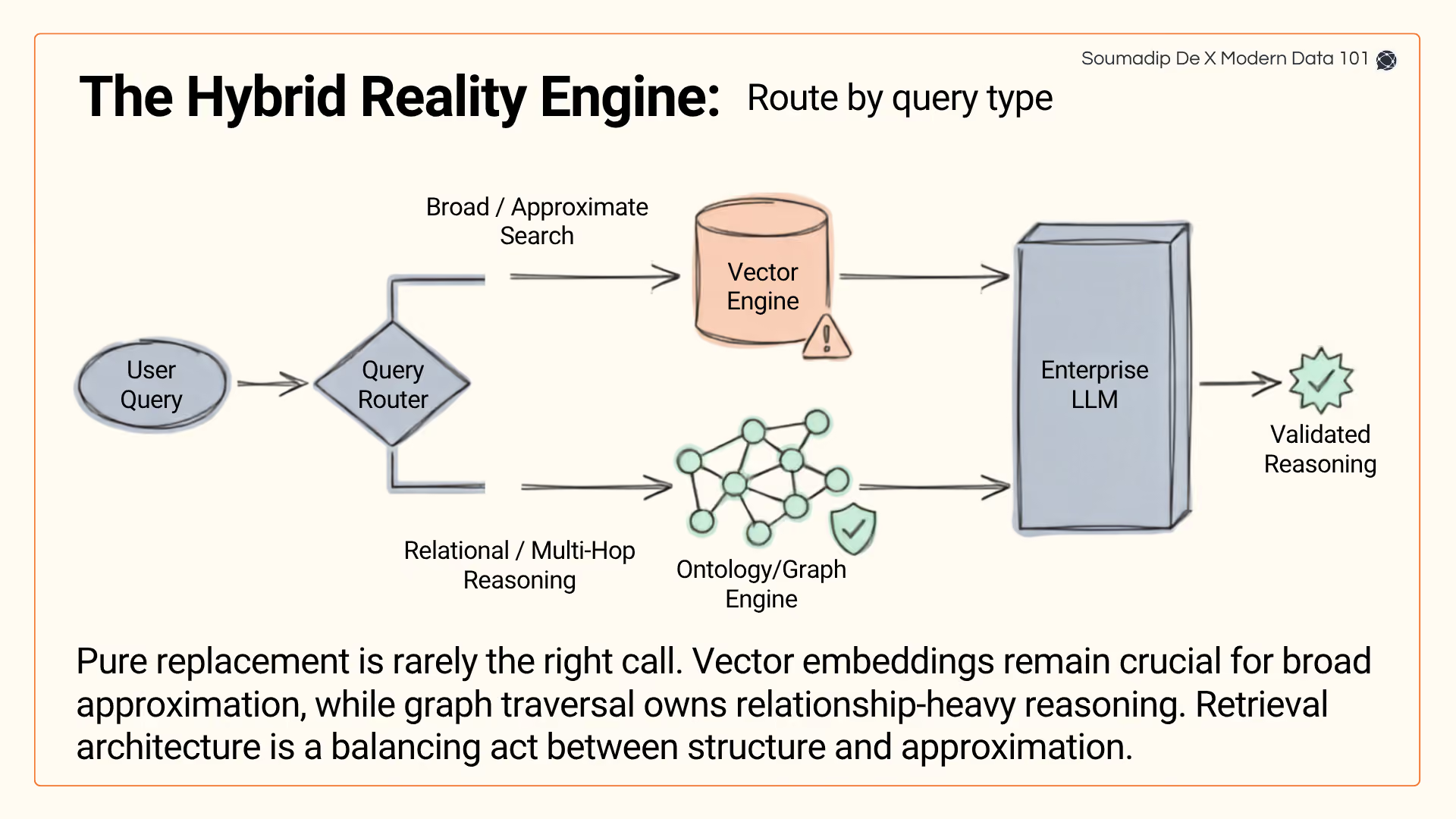
The standard hybrid guidance, vector retrieval for broad search, graph traversal for relationship-heavy queries, route between them is sound directionally. But the routing layer is where real implementations struggle.
Enterprise queries arrive in natural language, don't announce their complexity, and routinely require both broad context and precise relational traversal. Systems that rely on keyword heuristics to route traffic between engines will misclassify under load. The Lettria/AWS benchmark (December 2024) reported answer correctness improving from roughly 50% with traditional RAG to over 80% with a hybrid GraphRAG approach tested across finance, healthcare, industry, and legal corpora. That result is specific to those document types and that query distribution; it doesn't transfer wholesale to other enterprise contexts.
Learn more about the concepts here:
The Semantic Medallion: Building a Knowledge Graph-Powered Data Catalog
What Breaks in Production: Tooling and Organisational Gaps
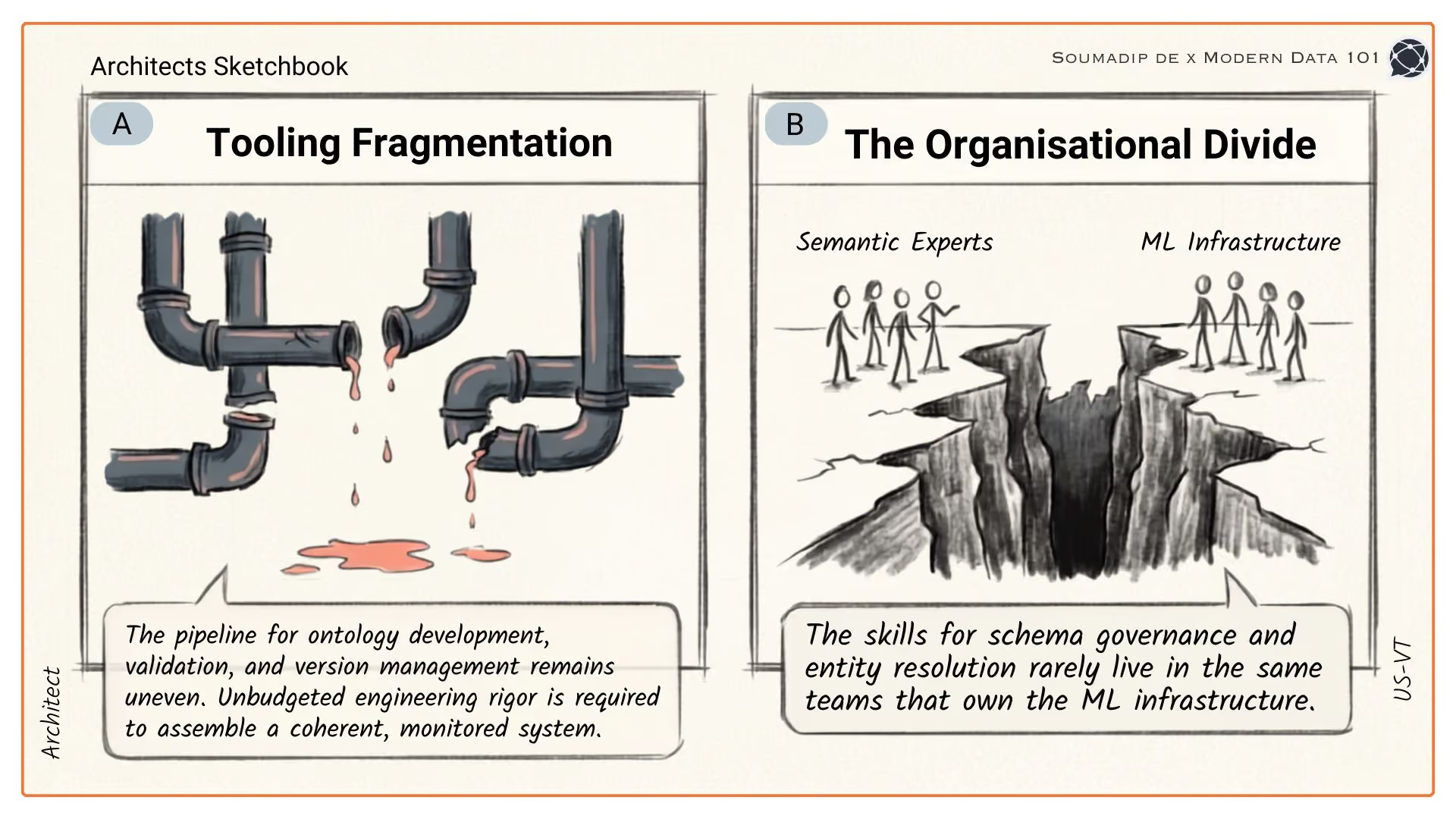
Two patterns appear consistently in enterprise teams currently adopting these architectures.
The first is tooling fragmentation. GraphRAG v1.0 improved indexing cost and storage efficiency, but the pipeline for ontology development, validation, and version management remains uneven. Assembling it into a coherent, monitored production system requires engineering rigour that initial implementations rarely budget for.
The second is organisational. The skills required for ontology design, entity resolution, and schema governance rarely live in the same teams that own ML infrastructure. The knowledge graph initiatives that fail most reliably do so because of four gaps: no semantic expertise, leadership treating ontologies as a side project, proprietary format lock-in, and confusing accuracy with provable trust.
[related-2]
Closing the Gap Between Output and Accountability
The value of ontology-grounded systems isn't only that retrieval improves at query time. Semantic infrastructure is maintained with engineering discipline and designed for provenance changes, so that AI systems can be held accountable. The distance between "AI gave us an answer" and "AI gave us a verifiable answer" largely depends on whether the semantic layer was built to support verification.
Schema governance doesn't limit what enterprise AI can do. In production, it's what makes doing it reliably possible at all.
FAQs
Q1: What is the difference between an ontology and a vector embedding in AI?
An ontology structures explicit relationships and rules within a domain, enabling logical reasoning and explainability. Vector embeddings, on the other hand, map concepts into numeric space for semantic similarity, supporting flexible search and pattern recognition in unstructured data.
Q2: How does semantic search benefit enterprise applications compared to keyword search?
Semantic search leverages vector embeddings to interpret user intent and context, retrieving more relevant and meaningful results than traditional keyword searches. This boosts productivity and decision-making in enterprise environments by surfacing hidden insights.
Q3: What are the main barriers to successful enterprise AI adoption?
Common barriers include poor data quality, fragmented legacy systems, lack of AI expertise, and challenges in scaling pilots to production. Addressing these with robust data governance, integrated platforms, and a clear AI strategy is key for enterprise success.
Q4: What are the limitations of knowledge graphs?
Knowledge graphs require significant manual effort to build and maintain, struggle with rapidly changing or unstructured data, and can be expensive to scale for large enterprise environments. Their rigid structure sometimes limits agility for fast-evolving business needs.
Connect with a community data expert
A no-cost session with a practitioner who's been where you are.
About Modern Data 101
Modern Data 101 is a movement redefining how the world thinks about data. A community built by the same team behind the world’s first data operating system, Modern Data 101 sits at the intersection of data, product thinking, and AI. Spread across 150+ countries, the community brings together a global network of practitioners, architects, and leaders who are actively building the next generation of data systems.
At its core, Modern Data 101 exists to simplify the journey from raw data to tangible and observable impact. It advocates high-potential data systems and next-gen architectures to unify and activate insights and automation across analytics, applications, and operational workflows at the edge.
In a world shifting from data stacks to AI ecosystems, Modern Data 101 helps teams not just navigate the change but lead it.


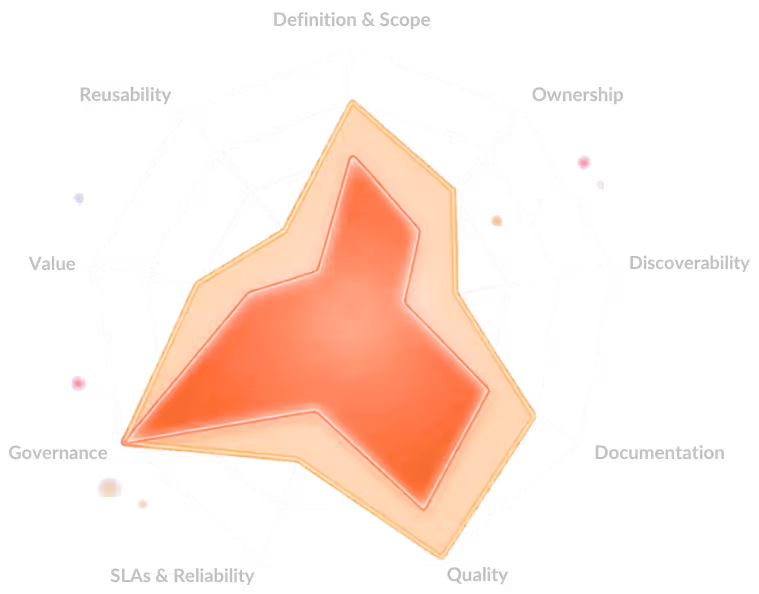
Where does your org stand on data product maturity?
A 9-dimension self-assessment used by 100+ data teams to benchmark strategy, ownership, and platform readiness.


Soumadip De
Soumadip De is an AI Product Manager at The Modern Data Company, working on ontology, context management, and knowledge systems for enterprise AI agents. His work spans data-productisation, context mining, and agentic workflow enablement that help teams move from raw enterprise data to reliable answers and governed action.
Read the ideas here. Build them with The Modern Data Company.
Modern Data 101 is where the data community thinks out loud. When you're ready to move from articles to architecture, data products, governed AI pipelines, or a full Data Operating System; the team behind this community can help you build it.
Continue reading
.png)

.png)

.png)