AI Adoption vs. AI Maturity in 2026: Navigating the Enterprise Capability Gap
AI adoption hit 88%, yet only 29% report substantial GenAI ROI. Discover why enterprise adoption and true maturity are moving on two separate curves.



of companies have used or explored AI
of organisations, only, report substantial ROI from generative AI
of executives admit their company’s AI strategy is “more for show” than actual internal guidance
of organisations have access to the tools

- Enterprise AI adoption (88%) and AI maturity have split into two separate curves; while access is widespread, only 29% of organizations report substantial ROI from Generative AI and 23% from AI agents.
- Adoption vs. Maturity Defined: Adoption measures isolated testing and tool access; maturity requires scalable, repeatable, measurable, and governed integration into core operational workflows.
- Frameworks from Carnegie Mellon, Cognizant, and INSEAD demonstrate that skipping foundational stages, such as data architecture, individual fluency, and process efficiency, inevitably pushes project failure downstream.
- Though organization-level adoption sits at 50–70%, only 15–25% of users produce real value. A rare 1–3% of power users generate 10–50x more value than beginners using identical tools.
- 97% of executives report deploying AI agents, but only 21% maintain a mature governance model, leading analysts to project that 40% of agentic AI projects will be canceled by 2027 due to cost and ROI issues.
Every enterprise AI conversation in 2026 starts with the same flex: adoption numbers. And the numbers are genuinely striking, organisational AI adoption reached 88% in 2025, and 77% of companies have used or explored AI in their operations. But AI adoption was never the hard part. AI maturity is. And new research shows the two have almost nothing to do with each other.
Only 29% of organisations report substantial ROI from generative AI, and just 23% from AI agents, proof that enterprise AI adoption and enterprise AI maturity are now separate curves. This new research traces that gap across three independent maturity frameworks. Here’s what it found.
AI Adoption Has Gone Mainstream: AI Maturity Hasn’t Caught Up
AI adoption is no longer a differentiator; it’s a baseline. Generative AI reached 53% global adoption in three years, faster than PCs or the internet reached the same milestone, and ChatGPT alone counts roughly 700 million weekly active users. Inside the enterprise, 83% of companies now name AI a top business priority.
Yet 75% of executives admit their company’s AI strategy is “more for show” than actual internal guidance, and 48% now call AI adoption a “massive disappointment,” up from 34% a year earlier. That’s the AI adoption-maturity gap in a single statistic: enterprise AI usage is nearly universal, but enterprise AI capability is not.
Why Enterprise AI Strategies Are “More for Show”
The distinction has a name. Carnegie Mellon’s Software Engineering Institute, working with Accenture on a field-tested AI Adoption Maturity Model, defines AI maturity precisely: capability that is scalable, repeatable, measurable, and governed, however widespread that experimentation becomes.
Enterprise AI adoption also isn’t evenly distributed. 52% of large firms use AI versus just 17.4% of small firms. That divide looks like a resources gap, but it’s really a data-architecture gap wearing a company-size costume: large enterprises built governed data platforms over the last decade for other reasons, compliance, BI, ERP consolidation that AI adoption now rides on top of. Smaller firms never built that foundation, so for them, AI adoption and AI maturity have to happen at once.
Three AI Maturity Models, One Convergent Pattern
The clearest evidence that this gap is real comes from three research groups working independently. Cognizant’s cross-industry research tracks five sequential stages of AI maturity, awareness, skilling, adoption, productivity, and ROI, and finds industries scoring well on adoption often rank lowest on productivity and ROI. In life sciences, 77% of employees believe AI can help their work, yet only 35% have access to the tools, and just 33% of executives report measurable productivity gains.
INSEAD’s AI maturity pyramid describes four levels: individual productivity, group productivity, business process efficiency, and business model transformation, and argues the top level “cannot be mandated into existence; it emerges from mastery of the levels below.” Energy firm Yinson built broad AI fluency first before automating processes; only then did transformation-level bets become viable, the same sequence that took DBS from a bank into a consumer marketplace.
Skipping a stage doesn’t compress the AI maturity timeline, it moves the failure downstream. An enterprise AI program that jumps to process automation without foundational fluency is the organisational mirror of what Cognizant finds in life sciences: strong AI adoption sitting on top of weak productivity and ROI.
AI Maturity at the Individual Level: The Proficiency Curve
The same pattern repeats one level down. Organisations typically report 50–70% AI adoption, but proficiency analysis reveals only 15–25% of users generating real business value from it. Power users, meanwhile, generate 10–50x more value than beginners from identical tools, yet make up only 1–3% of users without deliberate development.
Read alongside INSEAD’s pyramid and Cognizant’s five stages, this individual proficiency curve is the AI maturity pattern restated as a distribution of daily habits rather than organisational capability. Enterprise AI adoption creates access; enterprise AI maturity is what determines whether that access turns into value.
Governance: The Dimension Enterprise AI Programs Skip
Nowhere is the AI adoption-maturity gap wider than in agentic AI. 97% of executives say their company deployed AI agents in the past year, but only 21% report having a mature governance model for them. Analysts project 40% of agentic AI projects will be cancelled by 2027 on cost and ROI grounds, the same productivity stall showing up one technology cycle later.
Closing the AI Adoption-Maturity Gap
The enterprise AI programs that pull ahead won’t be the ones with the highest AI adoption numbers to report. They’ll be the ones that measure AI maturity, proficiency, productivity, governance, instead of just access, and that treat maturity as sequential infrastructure rather than a switch to flip.
This article summarises findings from Modern Data 101’s comprehensive research ‘Why AI Adoption and AI Maturity Are Two Different Curves,’ which also extends report on best data architecture in 2026 for AI workflows.
Get the full report
- Complete 11-page PDF
- Covers explores cross-industry research from Cognizant, INSEAD, and CMU defines real AI capability
- 5 strategic imperatives for achieving AI maturity
.png)
Get the full report
- Complete 11-page PDF
- Covers explores cross-industry research from Cognizant, INSEAD, and CMU defines real AI capability
- 5 strategic imperatives for achieving AI maturity


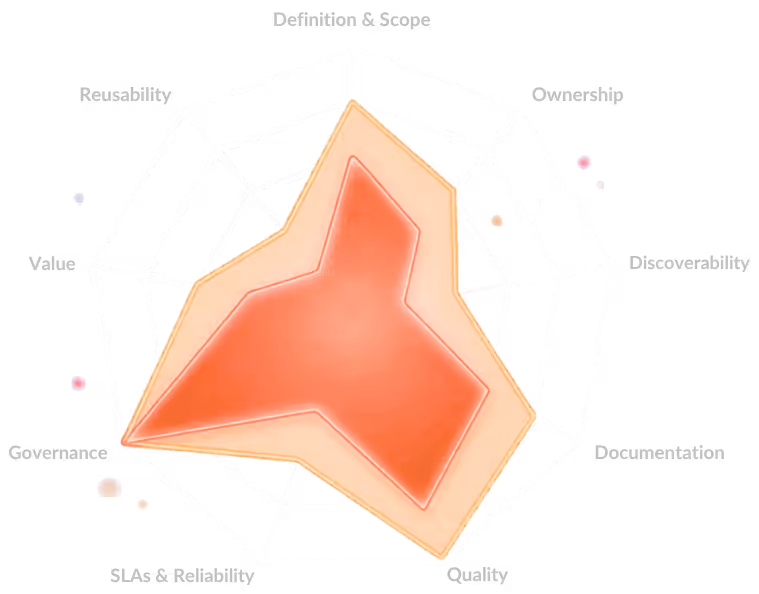
Where does your org stand on data product maturity?
A 9-dimension self-assessment used by 100+ data teams to benchmark strategy, ownership, and platform readiness.

You're all set
Your report is opening in a new tab
Tab didn't open? Open it manually
Travis Thompson
Travis is the Chief Architect of DataOS, building full-stack Data Product solutions, and a founding contributor to the Data Developer Platform Standard that enables flexible implementation of disparate data design architectures such as data products, meshes, or fabrics. Over 30 years in all things data engineering, Travis has designed state-of-the-art architectures and solutions for top organisations, including GAP, Iterative, MuleSoft, HP, and many more. He is also an active advocate for polymorphic data architectures and contributes extensively to community archives.
Animesh Kumar
Animesh Kumar is the Co-Founder and Chief Technology Officer at The Modern Data Company, where he leads the design and development of DataOS, the company’s flagship data operating system. With over two decades in data engineering and platform development, he is also the founding curator of Modern Data 101, an independent community for data leaders and practitioners, and a contributor to the Data Developer Platform (DDP) specification, shaping how the industry approaches data products and platforms.
Ritwika Chowdhury
Ritwika Chowdhury is a data and technology professional focused on data products, AI, and modern data architecture. Her work sits at the intersection of data strategy, product thinking, and emerging AI technologies, with a focus on helping organisations turn enterprise data into trusted, usable, and scalable assets.
Why AI Adoption and AI Maturity Are Two Different Curves
- Complete 11-page PDF
- Covers explores cross-industry research from Cognizant, INSEAD, and CMU defines real AI capability
- 5 strategic imperatives for achieving AI maturity
You're all set
Your report is opening in a new tab
Tab didn't open? Open it manually
You're subscribed
You'll get every new Modern Data Report in your inbox — check your email to confirm.
Done.png)

.png)

.png)